

Micron (MU) stock has been on a downward trajectory since the June 24 earnings report. I previously reported that the selloff won’t last long, though the stock has since declined further. This decline in price has started receiving attention on Wall Street as well, with UBS analyst Timothy Arcuri forecasting that the company could generate as much as $400 billion in free cash flow through the end of calendar year 2028. The amount of money, especially for a business like Micron that has had its fair share of downturns in the past, is staggering. The analyst believes the company could retire as much as 40% of its outstanding shares using this money. While MU stock is rebounding as a result of this development, let me dive deeper into why the UBS comment requires a little more scrutiny.
To begin with, Micron is restricted from buying back its own shares other than minor buybacks that offset dilution from employee stock options. This means its cash will sit on the books for some time, providing a massive spring-loaded catalyst for 2027. That is as bullish as it can get for the company, because it will have increased its cash pile by the time the buyback restriction is lifted. It is true that the same cash is competing for debt reduction and expansion. But the company is aggressively buying back debt as the Chips Act doesn’t impose any restrictions on that. Its expansion projects are controlled owing to the boom- and-bust nature of memory cycles, and the company said in its latest earnings report that it does not foresee spending more than $50 billion per year on expansion.
More Top Stocks Daily: Go behind Wall Street’s hottest headlines with Barchart’s Active Investor newsletter.
The only thing left to consider now is whether the $400 billion in free cash flow actually materializes, as future cash flows are never easy to predict. It assumes that high-bandwidth memory (HBM) demand continues and the company can serve it while keeping its pricing power intact. However, if all goes well for the company, buyback supporters will also need to consider the fact that the stock price may not be at current levels anymore, as the company would be sitting on huge cash with a business going strong. In short, the buyback is theoretically possible, but a strong business bringing in massive amounts of free cash flow will itself be a catalyst for re-rating, which would make a buyback at such a scale extremely difficult to execute.
About Micron Technology Stock
Micron Technology is a semiconductor company that designs and manufactures memory and storage products for consumer, enterprise, and industrial applications. Its product portfolio includes DRAM, NAND flash memory, high-bandwidth memory, and solid-state drives. Founded in 1978, the company is headquartered in Boise, Idaho, and is led by CEO Sanjay Mehrotra.
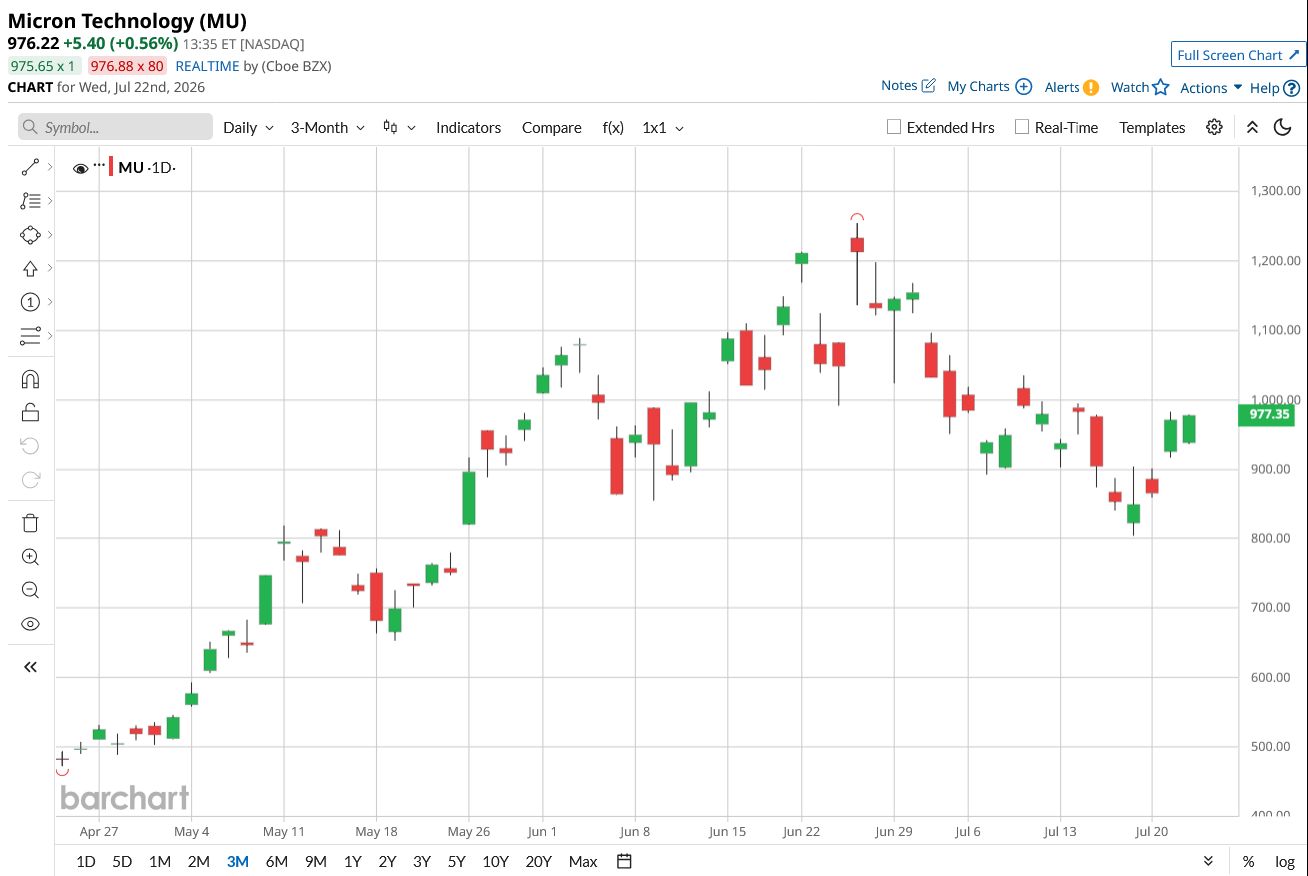
Year-to-date (YTD), Micron’s stock has increased 242%, far outperforming the iShares Semiconductor ETF’s (SOXX) 86% gain during the same period. The surge was driven by strong demand for HBM and rising memory prices. MU stock has been fairly volatile, climbing from roughly $321 in late March to $1,214 by June 25 and then down to $853 by mid-July. The decline reflects profit-taking after an extraordinary run rather than a change in the demand story.
 www.barchart.com
 Micron’s valuation isn’t straightforward to assess. The forward GAAP P/E of 12.44x doesn’t have a meaningful 5-year average to compare with, but it looks remarkably cheap for a stock that has skyrocketed this year. The forward price-to-sales ratio of 7.88x tells a different story, sitting almost 100% above its 5-year average of 3.95x. HBM selling at high prices means that Micron earns far more profit for each dollar of sales than it used to. This is why the P/E has been pulled down while the P/S stays high.
Similar to the stock price, the EPS outlook is also volatile rather than consistent. An accelerated growth of 785% is expected in 2026, followed by another 105% in 2027. The EPS is expected to then dramatically slow down to 9% in 2028 and turn to negative 26% in 2029. The balance sheet is a genuine strength. Micron holds $26.02 billion in cash against just $6.38 billion in debt. This gives the firm a healthy financial cushion to push through any decline expected in the future.
Micron Reports Record Earnings
Micron reported third-quarter fiscal 2026 earnings on June 24. The memory chipmaker achieved record results across every key metric. The company reported revenue of $41.46 billion, which comfortably beat the analyst consensus of $35.69 billion. The earnings per share came in at $25.11, exceeding the estimates by 22.55%. The key driver for Micron’s record revenue was the data center segment, which accounted for $25 billion in the quarter. The company’s SSD revenue represented 20% of data center revenue. Moreover, the firm reported a record operating cash flow of $25.4 billion.
For Q4, the company guided revenue of approximately $50 billion. Gross margin is also expected to be a healthy 86%, signaling strong pricing power. The company expects earnings per share to reach a record $31. As the company expands its R&D to support an unprecedented set of opportunities in memory and storage, it projects operating expenses to increase by approximately $1 billion in fiscal 2027.
What Do Analysts Expect for MU Stock?
On July 16, Bank of America Securities analyst Vivek Arya reiterated a “Buy” rating on MU stock. The analyst also assigned a price target of $1550. The firm’s price target reflects an additional 60% upside from the current share price. Overall, the AI tailwind has driven a bullish view among analysts, with others also assigning positive ratings. In addition to BofA, KeyBanc analyst John Vinh also reaffirmed a “Buy” rating on the stock with a target price of $1750.
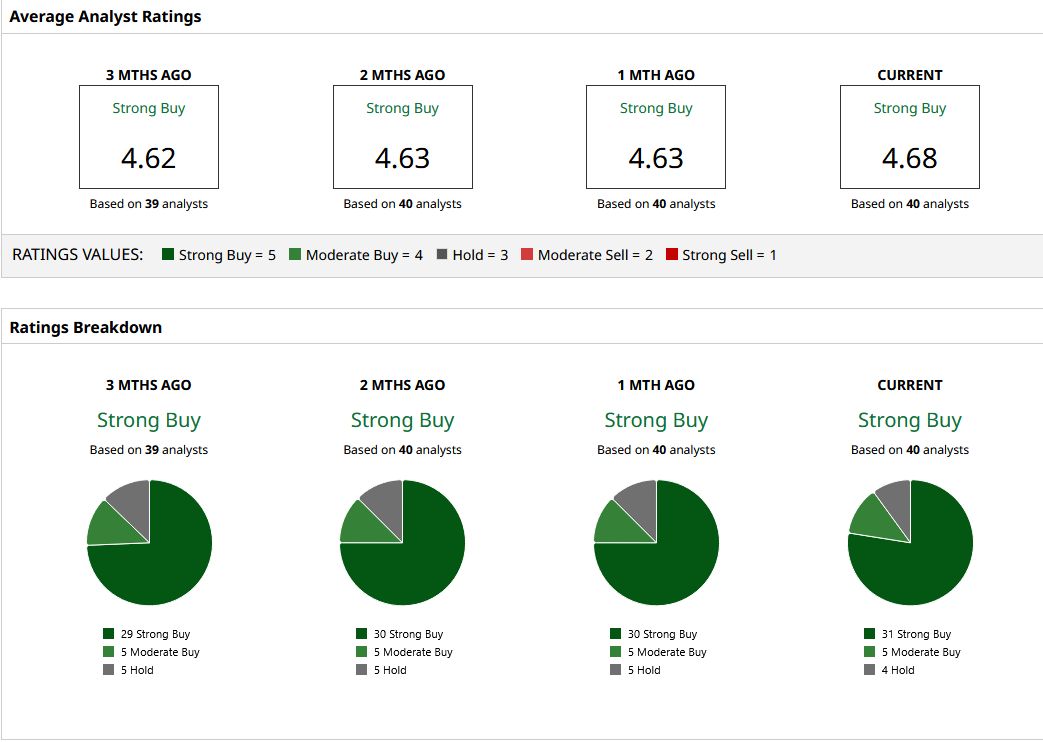
Based on 40 Wall Street analysts covering the stock, MU stock holds a consensus “Strong Buy” rating. Out of those analysts, 31 have a “Strong Buy” rating, five have a “Moderate Buy” rating, and four have a “Hold” rating. The stock has a mean price target of $1495, which implies a further 53% upside from current levels. This upside reflects strong confidence in Micron’s long-term growth prospects.
 www.barchart.com
 On the date of publication, Jabran Kundi did not have (either directly or indirectly) positions in any of the securities mentioned in this article. All information and data in this article is solely for informational purposes. For more information please view the Barchart Disclosure Policy here.
More news from Barchart
Record Orders, Soft Revenue: What Super Micro Isn’t Saying About Its $60 Billion Quarter General Motors’ CFO Says GM Stock Is a Bargain. Here's Why He's Right. Microsoft Is Deepening Ties with AI Giant Mistral. What That Actually Means for MSFT Stock Investors. TSMC Stock: A $64 Billion Bet Even as AI Bubble Fears Grow