

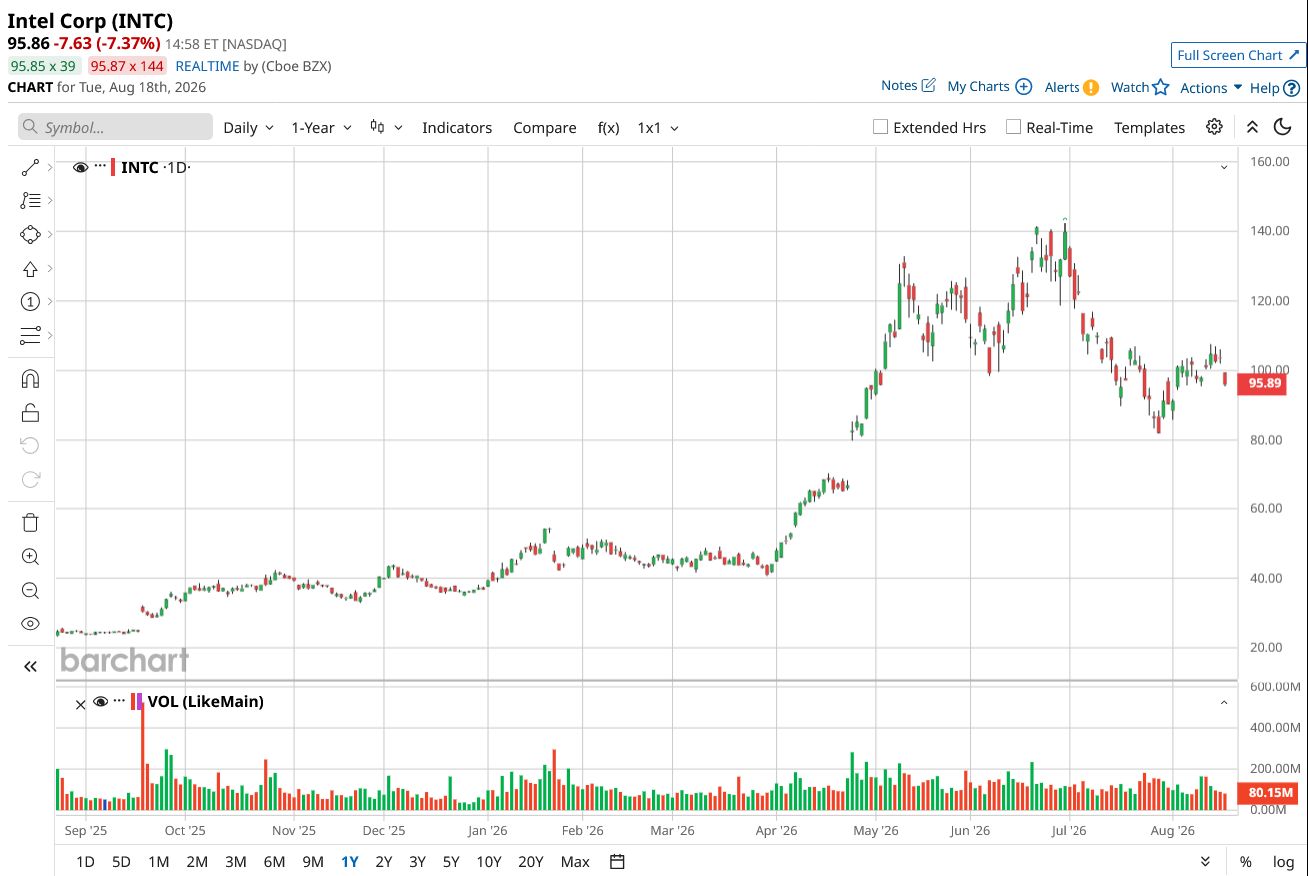
Intel (INTC) stock has fallen more than 32% from its 52-week high, giving back much of its earlier gains. The decline reflects profit-taking after a significant rally as well as investor concerns about dilution following the company’s decision to raise additional capital.
Intel initially planned to raise $15 billion, increased the target to $20 billion, and ultimately raised $23 billion.
More Top Stocks Daily: Go behind Wall Street’s hottest headlines with Barchart’s Active Investor newsletter.
Intel’s Capital Raise Could Further Fund Its Turnaround
Although the move will dilute earnings as Intel’s share count increases, the capital raise could support the company’s broader turnaround. Intel intends to use the proceeds for capital expenditures and working capital. That funding could prove strategically important as the company expects capital spending to exceed $20 billion in 2026.
Management is accelerating capacity expansion, acquiring semiconductor manufacturing equipment, and securing memory supplies to meet customer demand. The scale of spending suggests Intel sees substantial opportunities ahead across both its products business and its foundry operations.
 www.barchart.com
 AI and Data Center Demand Are Driving Intel’s Growth
Intel’s latest financial results show its operational recovery is gaining traction. Intel generated $16.1 billion in second-quarter revenue, while AI-related businesses grew more than 70% year-over-year (YoY). Data Center and AI (DCAI) was a major contributor, producing $6.3 billion in revenue, up 59% YoY and 24% sequentially. Demand from cloud and enterprise customers has strengthened as AI infrastructure increasingly requires high-performance CPUs alongside accelerators.
Intel’s Xeon 6 platform has also emerged as an important growth driver. Server demand posted its strongest YoY growth in Q2, while Xeon 6 became one of the fastest-ramping products in Intel’s history. Additional strategic customer wins and long-term agreements point to improving execution. However, the company still faces the challenge of increasing factory output quickly enough to satisfy demand while improving its competitive product roadmap.
Intel is also expanding its position in purpose-built AI silicon. Revenue from these products rose about 20% sequentially and nearly tripled from a year earlier. New customer commitments and multiyear partnerships could provide additional growth opportunities as AI workloads evolve.
Looking ahead, higher production volumes, a more favorable product mix, pricing gains, and tighter cost controls should support margins and earnings.
However, for investors, the capital raise creates a clear trade-off. The larger share count will dilute earnings in the near term, but the funding gives Intel greater capacity to respond to strong demand and invest in manufacturing scale. If management can translate that investment into higher foundry utilization, stronger customer commitments, and improved operational efficiency, the long-term benefits could exceed the impact of a larger share count.
INTC’s Valuation Remains a Major Risk
Besides dilution, valuation remains a significant risk for investors. Intel shares have still gained more than 305% over the past year despite the recent pullback, meaning the positives are already priced in.
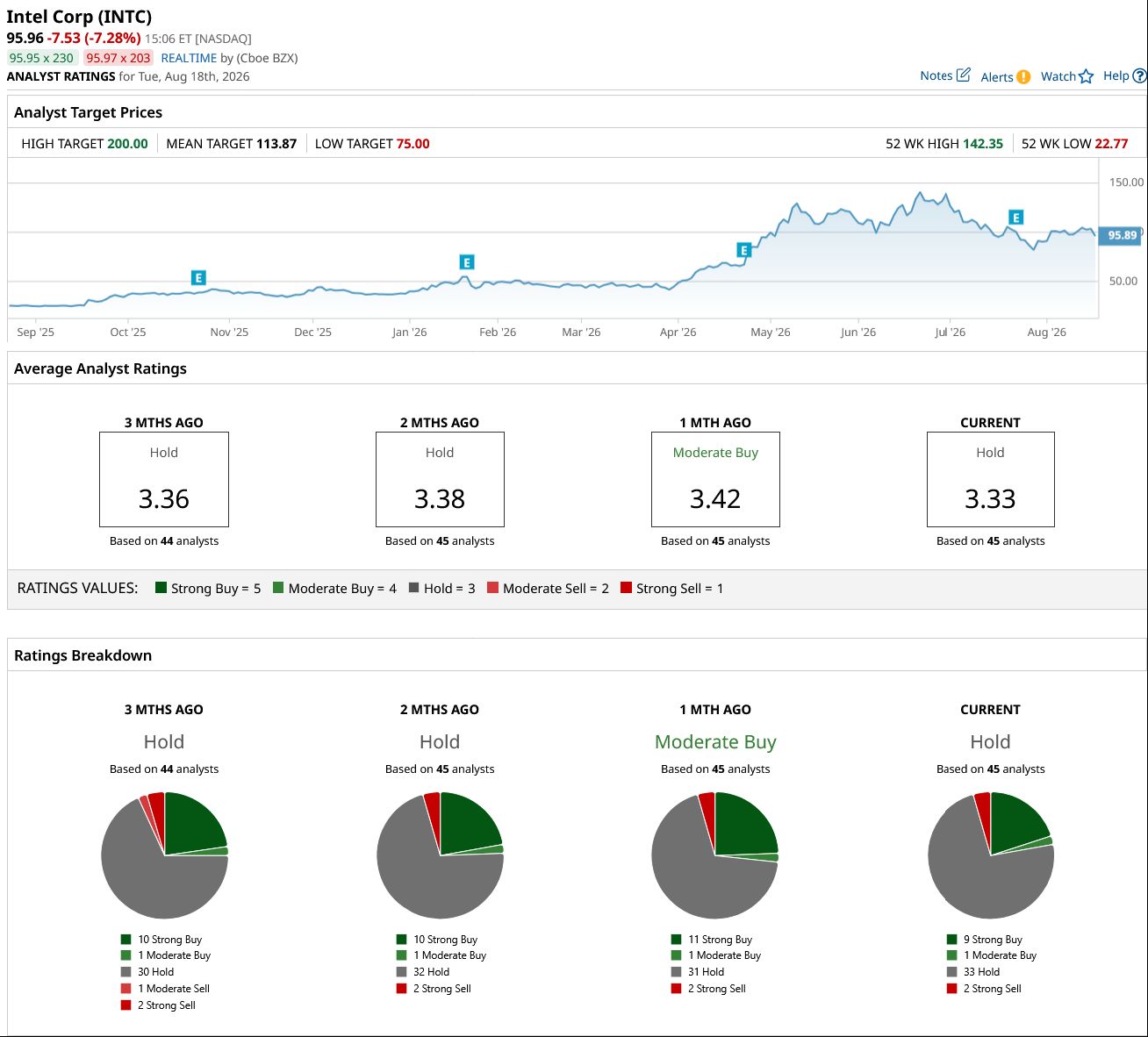
Moreover, most analysts remain sidelined. Of 45 analysts covering INTC stock, 33 maintain a “Hold” rating, reflecting concerns around valuation and competition.
Intel’s forward price-to-earnings (P/E) multiple of 102 is significantly higher than AMD (AMD) and Nvidia (NVDA). AMD trades at a forward P/E ratio of 80, while Nvidia is far cheaper, trading at a forward earnings multiple of 25.6. Intel’s high valuation means it must deliver sustained growth and meaningful profitability improvements to justify its premium.
 www.barchart.com
 The Final Takeaway
For investors, Intel’s capital raise is only one element of a broader turnaround story. The company’s improving position in AI, solid demand for data center products, and expanding foundry ambitions provide credible sources of future growth. Together, these factors suggest that Intel’s strategic repositioning is gaining traction and that the turnaround is becoming more tangible.
However, the investment case has significant constraints. Intel continues to face intense competition, and its ability to execute its technology roadmap, improve manufacturing efficiency, and translate strategic investments into sustainable earnings remains critical. These risks matter more when the stock trades at an elevated valuation, leaving less room for operational setbacks or weaker-than-expected results.
Overall, Intel’s turnaround appears increasingly credible, yet at current valuation levels, the positives are already reflected to a substantial degree in its share price.
On the date of publication, Amit Singh did not have (either directly or indirectly) positions in any of the securities mentioned in this article. All information and data in this article is solely for informational purposes. For more information please view the Barchart Disclosure Policy here.
More news from Barchart
1 Hidden Options Level That Can Change How a Stock Trades Anthropic Just Gave This Bitcoin Miner a Contract Bigger Than the Whole Company What to Know as Guggenheim Ups Its Price Target on MongoDB Stock CEO Lip-Bu Tan Just Bought Another 105,000 Shares of Intel Stock