

Tesla (TSLA) has lost another senior architect of silicon. Shishuang Sun, who served as Senior Director of AI Hardware Design, left for DensityAI in July, the AI-hardware startup built largely by former members of Tesla’s own Dojo team.
Sun’s expertise in AI hardware design was relevant to Tesla’s effort to build Dojo3, its third-generation AI supercomputer project. The news surfaced publicly on Aug. 24 and coincided with Tesla shares down 3.83% on the day.
More Top Stocks Daily: Go behind Wall Street’s hottest headlines with Barchart’s Active Investor newsletter.
The departure carries an obvious irony. It comes roughly a year after Tesla itself shut down its Dojo project in August 2025 and redirected resources toward its next-generation inference chips, AI5 and AI6.
On its own, the exit of a single executive is unlikely to reshape Tesla’s near-term financial performance. Yet the move comes as Tesla competes with deep-pocketed technology companies and fast-growing startups for specialized semiconductor and AI talent.
That context makes the latest senior chip-engineering departure worth examining. Is it a meaningful setback for TSLA, or simply another sign of intense competition for top technical talent? Let’s dive in.
Tesla’s Tough Financial Picture
Tesla, headquartered in Austin, Texas, makes electric vehicles, battery-storage products, solar systems, and related software. It is also investing in self-driving technology, custom AI chips, robotaxis, and Optimus humanoid robots.
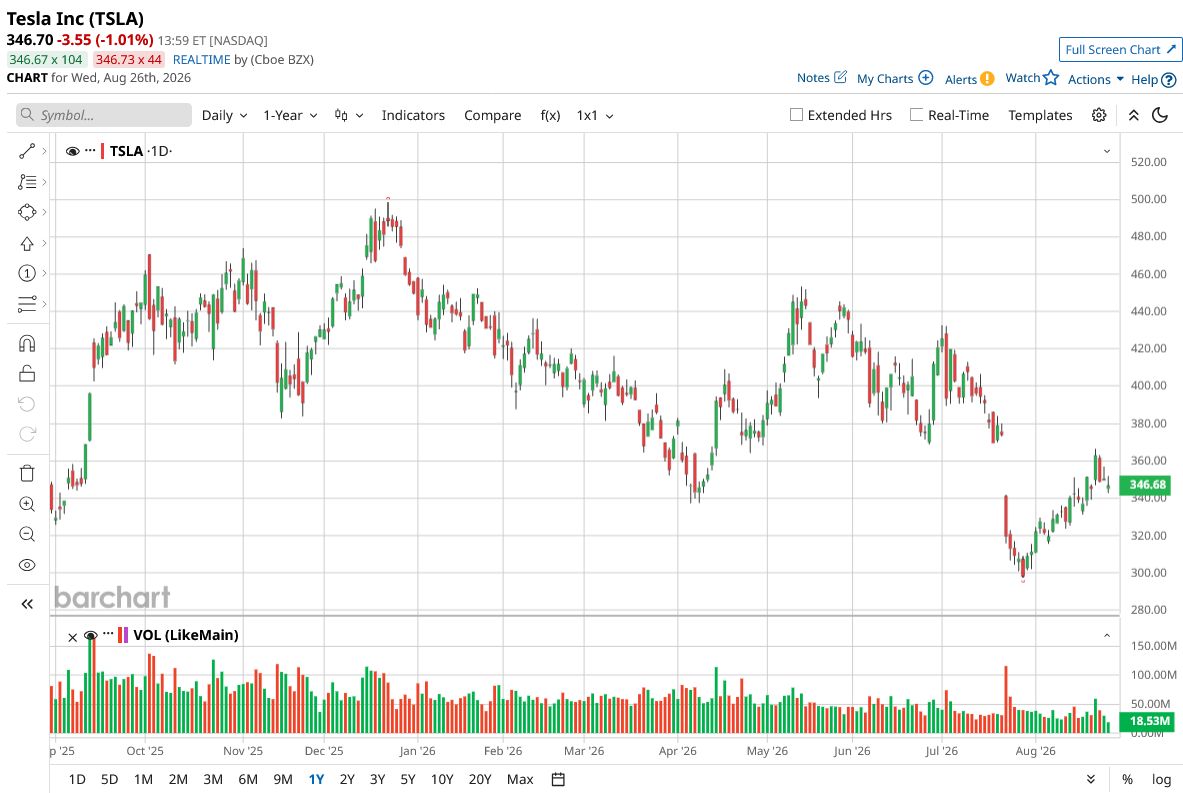
Tesla shares closed at $350.20 yesterday, Aug. 25, bringing their year-to-date (YTD) gain to about 23% and their 52-week advance to 1.5%.
 www.barchart.com
 Its $1.43 trillion market capitalization comes with a steep valuation, as its 383.48x trailing P/E and 393.68x forward P/E far exceed sector medians of 19.65x and 17.35x, respectively.
Tesla released its Q2 2026 results on July 22, reporting $28.24 billion in revenue. This figure topped analysts’ $26.71 billion expectation by 5.7%, as total deliveries reached 480,126 vehicles.
Their Model 3 and Model Y deliveries totaled 467,762 units, while other models contributed 12,364 deliveries. Tesla produced 451,758 vehicles during the period, creating a drawdown in inventory as deliveries exceeded production.
TSLA reported non-GAAP EPS of $0.33, missing the $0.54 consensus estimate by 39.1%. The gross margin held at 16.8%, matching the prior-year quarter.
Operating margin, however, contracted sharply to 1.4% from 4.1% a year earlier, reflecting the cost of Tesla’s expanding AI, robotics, and vehicle programs. Tesla generated $1.11 billion in net income, up 133.54% from the comparable period.
Its operating cash flow jumped 119.30% to $8.63 billion. This investment phase also drove net cash flow to negative $1.19 billion, a $3.15 billion deterioration from the prior-year period. The company’s capital expenditures reached $5.79 billion, up 142%, as it scaled AI compute infrastructure and other growth projects.
Silicon Roadmap Raises the Stakes
Tesla’s decision to build more of its AI infrastructure internally puts extra focus on the loss of a senior chip leader. Musk said on April 15 that the AI5 chip had reached tape-out. That means its design was finalized and submitted to a manufacturing partner.
Taiwan Semiconductor (TSM) is handling AI5, while Samsung’s 2-nanometer process is expected to support the later AI6 design. Tesla has already experienced AI6-related delays, but Musk expects AI5 could enter volume production in 2027.
Tesla is also planning a broader move into semiconductor production. Musk introduced Terafab in March as a proposed U.S. facility combining logic chips, memory, packaging, and manufacturing. Terafab could help Tesla avoid an expected chip shortage within three to four years and reduce the company’s dependence on supply routes vulnerable to geopolitical disruption.
Building that capacity would come at a significant cost. Tesla estimates a cost of $20 billion to $25 billion and targets eventual annual output of 200B AI and memory chips. Musk has also discussed more than 1 terawatt of annual AI computing capacity and 2-nanometer chip production.
Tesla sees demand emerging from autonomous vehicles, humanoid robots, and possible data centers in space. SpaceX’s S-1 likewise identified chip availability as a key constraint on AI expansion. Tesla’s proposed $2 billion acquisition of an unnamed AI-hardware business would add to its chip, robotics, and autonomy strategy.
None of this makes one departure decisive. Still, it raises the importance of retaining the technical depth required to move Tesla’s ambitious hardware plans from the drawing board into mass production.
Wall Street’s View on TSLA Stock
Tesla’s next earnings release is scheduled for Oct. 28. For the September quarter, analysts expect an average EPS of $0.26. That estimate is below the $0.37 Tesla earned in the prior-year period and implies a 29.73% year-over-year decline.
Cathie Wood has maintained a more constructive view of the company. She recently purchased 27,864 Tesla shares, valued at roughly $8.7M. Tesla now represents 7.4% of ARK Invest’s combined ETF portfolio.
Wood’s investment case treats Tesla as an AI, autonomous-driving, and robotics business. That view places less weight on near-term EV profitability but depends on Tesla successfully scaling Full Self-Driving, robotaxis, custom AI hardware, and Optimus.
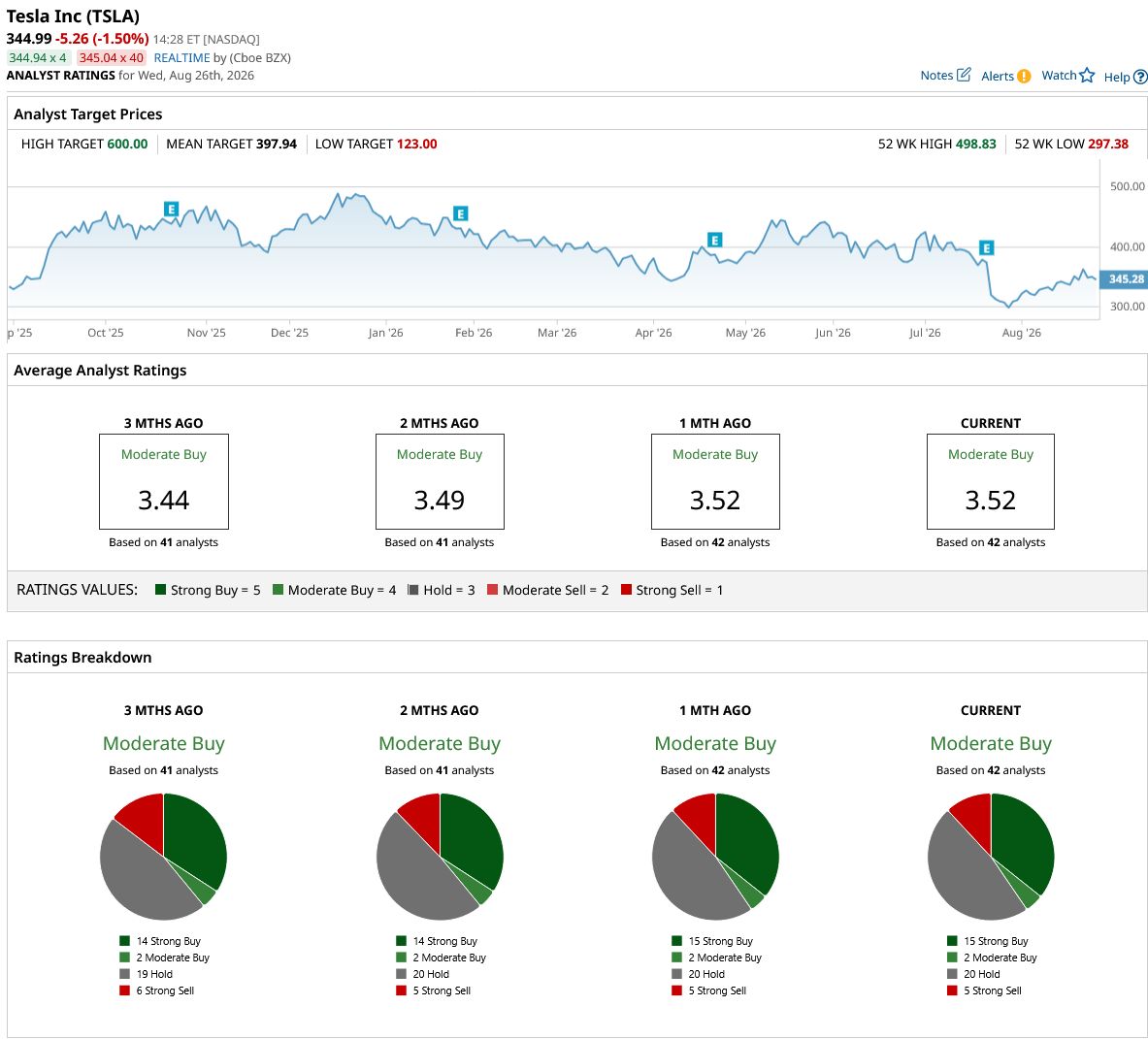
The broader analyst consensus is also moderately positive. Based on 42 surveyed analysts, TSLA carries a “Moderate Buy” consensus rating. Their average price target of $397.94 implies 14% upside from the Aug. 25 share price.
 www.barchart.com
 Conclusion
Tesla losing a top chip engineer is a manageable setback, not a reason alone to abandon TSLA. Its deep AI investments, TSMC partnership, and broader engineering base limit the immediate operational impact. Still, the exit adds risk as Tesla races to scale AI5, robotaxis, and Optimus while margins remain thin. Shares are likely to stay sensitive to execution updates and earnings results, with near-term direction depending on whether Tesla can turn its costly AI ambitions into measurable commercial progress.
On the date of publication, Ebube Jones did not have (either directly or indirectly) positions in any of the securities mentioned in this article. All information and data in this article is solely for informational purposes. For more information please view the Barchart Disclosure Policy here.
More news from Barchart
Cathie Wood Is a Historic Fund Manager with Viral Fame. That Doesn’t Make Her ARK ETFs Good Buys Now. Tesla Just Lost Its Top Chip Engineer to Another Firm. Consider It a Manageable Setback for TSLA Stock. Why Michael Burry Is Doubling Down on JD.com Stock Dick’s Sporting Goods Hits New 52-Week Low: Why Aggressive Investors Should Buy the DKS Stock Dip Here