


Amid the artificial intelligence boom, Corning (GLW) has played an important, albeit somewhat underappreciated role. A multinational technology company, Corning provides the critical high-density optical fiber, cable and connectivity hardware required to link thousands of graphics processing units (GPUs) within and between backend AI data centers, per Google Finance’s summary sheet. It’s no surprise, then, that over the past year, GLW stock has gained over 74%.
Contributing to this strong performance are robust second-quarter results, which included core sales increasing approximately 17% year-over-year to $4.74 billion and core earnings per share growing 30% to 78 cents, beating consensus estimates. Against a broader view, AI demand — particularly from major publicly traded hyperscalers — has accelerated, leading to multiyear agreements for Corning.
Can’t Get Enough Options?: Join the list for Barchart’s daily unusual options report, delivered free.
Still, there are negatives to consider and per Google Finance, one of the biggest centers on the perceived stretched valuation multiples. Historically, GLW stock appears well overvalued — and this comparison applies to industry peers as well. Further, there’s the concern of heavy insider selling, which has amounted to an $111 million liquidation over the past 12 months.
It’s also worth pointing out that Corning stock has recorded zero insider purchases during this period, which doesn’t exactly speak to great confidence for the ticker. Factor in the 24% Weak Sell rating from the Barchart Technical Opinion indicator and you have a ready-made excuse to avoid this name.
However, extended underperformance for Corning stock is rare — and GLW tends to respond positively under such circumstances. In other words, while the current snapshot of GLW is bearish, it’s the forward response that should be the focus.
Arguing Against the Random Walk Pricing of GLW Stock
In the trailing 10 weeks, Corning stock managed to print only three positive weekly candlesticks, leading to a downward slope across the period. As such, it’s natural to view GLW as an attempt to catch a falling knife. For conservative traders, it may be wise to wait for a bottom. Of course, a bottom really isn’t perceivable until the target ticker rises convincingly, thus leading to a lost opportunity.
The whole idea, then, is to anticipate when this bullish recovery wave might materialize. I’m interested in the aforementioned 3-7-D quantitative sequence (3 up, 7 down, downward slope) because under this setup, GLW stock generally tends to pop higher. Specifically, over the next seven-and-a-half weeks, the data suggests an inductive case for GLW to reach $165.
If so, that may place a spotlight on the 160/165 bull call spread expiring Oct. 16. For a net debit (cash outlay) of $235, speculators will be hoping that GLW stock rises through the $165 strike at expiration. If so, the maximum profit would be $265, a payout of almost 113%. There’s just one problem here: Wall Street’s option pricing mechanism implies a low probability of success.
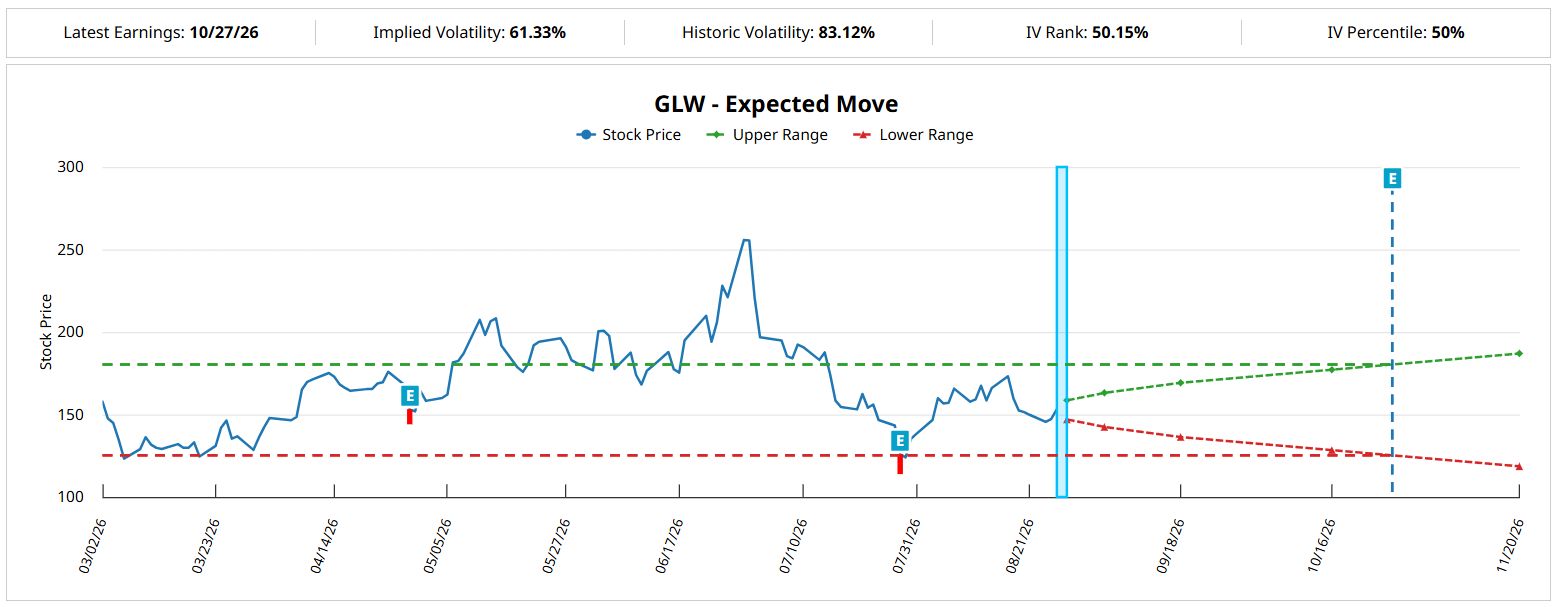
Specifically, the chance that Corning stock will trigger the $162.35 breakeven price at the Oct. 16 expiration date is only 39.7%. For GLW to reach $165 at expiration, a reverse-engineering of Barchart’s Expected Move calculator reveals that the probability is only 38.05%.
Under expected value (EV) calculations, trading the 160/165 bull spread would likely be a money-losing endeavor over the theoretical long run. That’s because the max payout of nearly 113% is not enough to overcome the lowly success ratio of 38%.
Ordinarily, you would probably want to walk away. However, these ratios are built off an assumption that GLW stock will undergo a random walk between now and the expiration date. That assumption might work for a stable (read boring) blue chip. But because Corning stock is tied to the exciting (though volatile) AI boom, I would propose that the journey is more likely to be nonrandom.
Getting Ready for the Nonrandom Walk
It must be acknowledged that my argument for a nonrandom walk of GLW stock is presuppositional. Because I don’t know the future, I have to make certain assumptions — that the 3-7-D signal above will influence a nonrandom response by the market — to move the argument forward.
In all fairness, though, any forward-looking statistic issued by Wall Street is also presuppositional. Options pricing protocols assume random behavior for all the securities that are optionable. Personally, I don’t find that argument convincing, which is why I’m proposing nonrandomness.
Looking at historical data since January 2019, we know as an empirical fact that the 3-7-D signal has flashed (on a rolling basis) 37 times. Of this tally, Corning stock has exceeded the equivalent of the $165 strike at roughly the Oct. 16 expiration date a total of 17 to 20 times. That puts the conditioned probability of full profitability in a range between 45.9% and 54.1%.
Granted, these aren’t stellar odds, which means that the Oct. 16 160/165 bull spread still carries significant risk. However, in the middle of the range, the spread should theoretically enjoy a positive EV. That makes a seemingly irrational trade relatively more rational — and thus may entice speculators anticipating a comeback in GLW stock.
On the date of publication, Josh Enomoto did not have (either directly or indirectly) positions in any of the securities mentioned in this article. All information and data in this article is solely for informational purposes. For more information please view the Barchart Disclosure Policy here.
More news from Barchart
Why Corning Stock Can Make a Comeback Here High-Probability Meta Platforms Iron Condor with 48% Return Potential Nvidia Reports $7.8 Billion in Q2 Gains on Equity Portfolio That Includes SpaceX, Intel, CoreWeave, and More HP, Inc. Results Today - Huge, Unusual Options Activity in Long-Dated HPQ Puts