


Grain traders at midday Friday got the latest crop assessments from the U.S. Department of Agriculture in its monthly World Agricultural Supply and Demand Estimates (WASDE) report. The report contained a few price-friendly elements and a few negative elements for the grains. Importantly, however, the USDA data did not provide the fresh, positive fundamental spark that the seemingly tired grain market bulls wanted. A breakdown of the USDA’s latest data and other key fundamental news for the three major grain markets follows.
USDA Cuts U.S. Corn Production Estimate, But Not as Much as Traders Expected
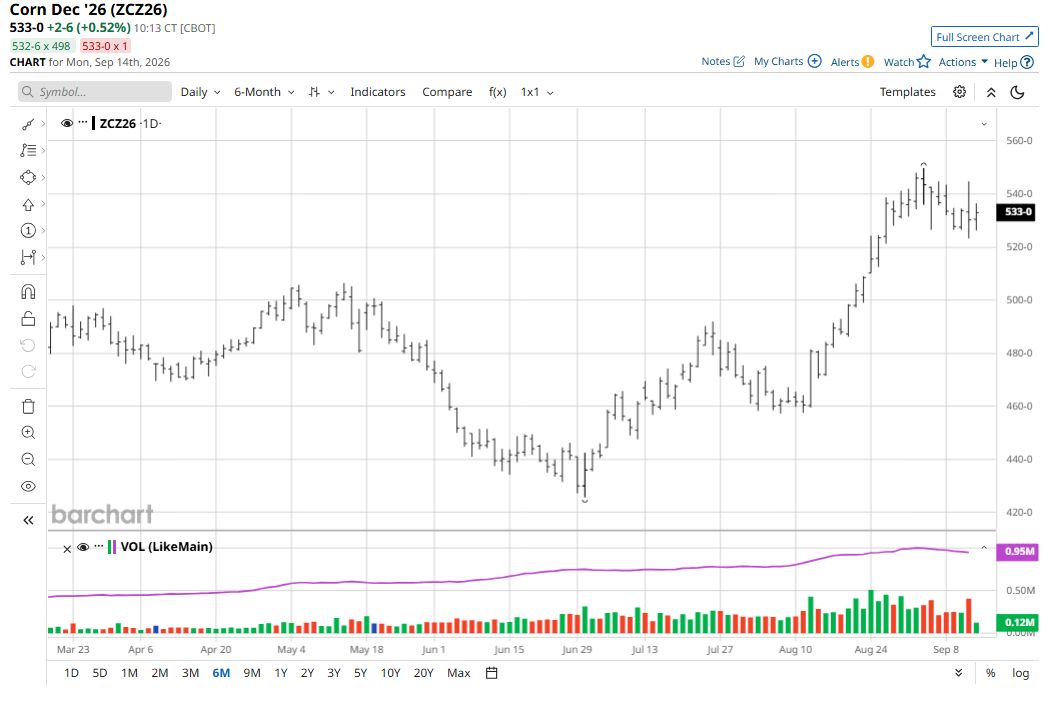
December corn (ZCZ26) futures on Friday fell 3 1/2 cents to $5.30 1/4 and for the week were down 6 1/2 cents. Corn futures prices gyrated on both sides of unchanged immediately after the release of the WASDE report. The agency cut its U.S. corn production estimate 213 million bushels from last month. It decreased yield 2.2 bushels to 178.5 bushels per acre. U.S. harvested acres were cut to 88.506 million acres, down 86,000 acres from the August report despite a 47,000-acre increase to planted acres (to 96.777 million). The USDA decreased U.S. old-crop corn carryover by 23 million bushels from last month and put the national average on-farm cash corn price for the 2025-26 marketing year at $4.15, unchanged from last month. On new-crop corn, the USDA cut estimated carryover 86 million bushels from last month, but that is 39 million bushels above the average pre-report trade estimate. The USDA put the national average on-farm cash corn price for the 2026-27 marketing year at $4.80, up 30 cents from a month ago.
Don’t Miss a Day: From crude oil to coffee, sign up free for Barchart’s best-in-class commodity analysis.
 www.barchart.com
 Grain traders will keep watching the weekly USDA crop progress reports on Monday afternoons.
Harvesting and commercial hedge pressure could add to selling interest in corn and soybean futures this fall. Ongoing uncertainties regarding the Black Sea and Sea of Azov grain shipments will remain market-sensitive for all the grains at least until the end of this year. Those export risks are compounded by already reduced supplies in the European Union after a severe drought in western Europe this growing season. Reports this week said more U.S. corn could be shipped into Europe in the coming months, due to their shorter supplies. There is also concern that a strengthening El Niño could trim output in key Southern Hemisphere grain regions later this year.
USDA Slightly Raises its U.S. Soybean Production Forecast
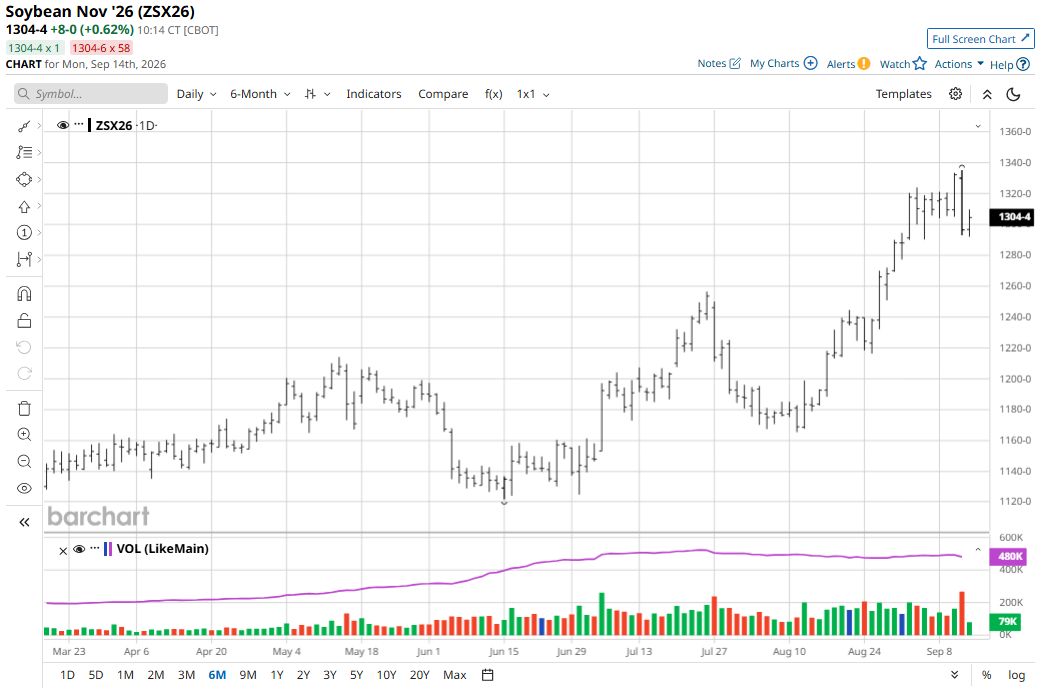
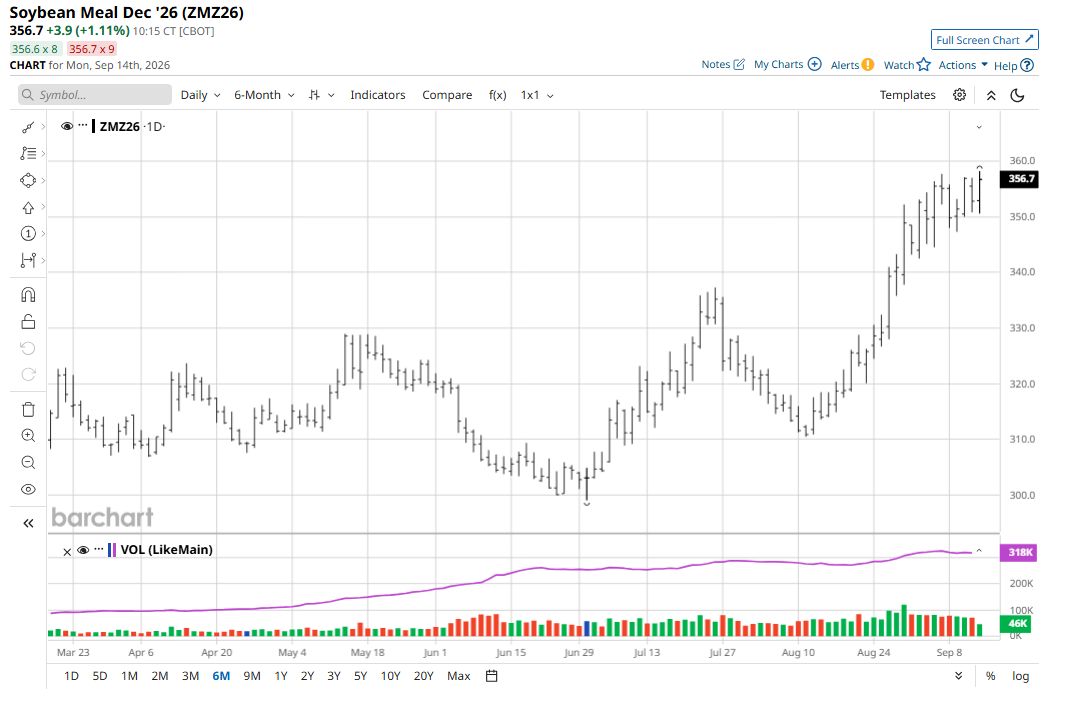
November soybeans (ZSX26) on Friday fell 35 3/4 cents to $12.96 1/2 after hitting a contract high earlier in the session. For the week, November beans were down 13 1/4 cents. The soybean complex futures markets on Friday saw heavy profit-taking pressure and weak long liquidation after the midday WASDE report favored the bearish camp. Friday’s technically bearish “key reversal” down on the daily bar chart and weekly low close for November soybeans will give the chart-based speculators confidence early this week.
The WASDE report saw USDA increased its U.S. soybean production estimate 16.0 million bushels from last month. The USDA increased yield 0.1 bushel to 52.8 bushels per acre. USDA increased harvested acres 0.100 million acres to 85.881 million acres amid a 0.100 million acre increase to planted acres (to 86.865 million acres). The USDA held old-crop soybean carryover unchanged from last month and left total supplies unchanged alongside the demand side of the balance sheet. The USDA put the national average on-farm cash soybean price for 2025-26 at $10.50, up a dime from last month. On new-crop beans, USDA cut carryover 10 million bushels from last month but that was still 12 million bushels above the average pre-report trade estimate. USDA put the national average on-farm cash bean price for 2026-27 at $12.00, up 60 cents from last month.
 www.barchart.com
  www.barchart.com
  www.barchart.com
 The expected Sept. 24 summit meeting between President Donald Trump and Chinese leader Xi Jinping will be a major focal point for the soybean market. Tensions between the world’s two largest economies have risen in the past few weeks.
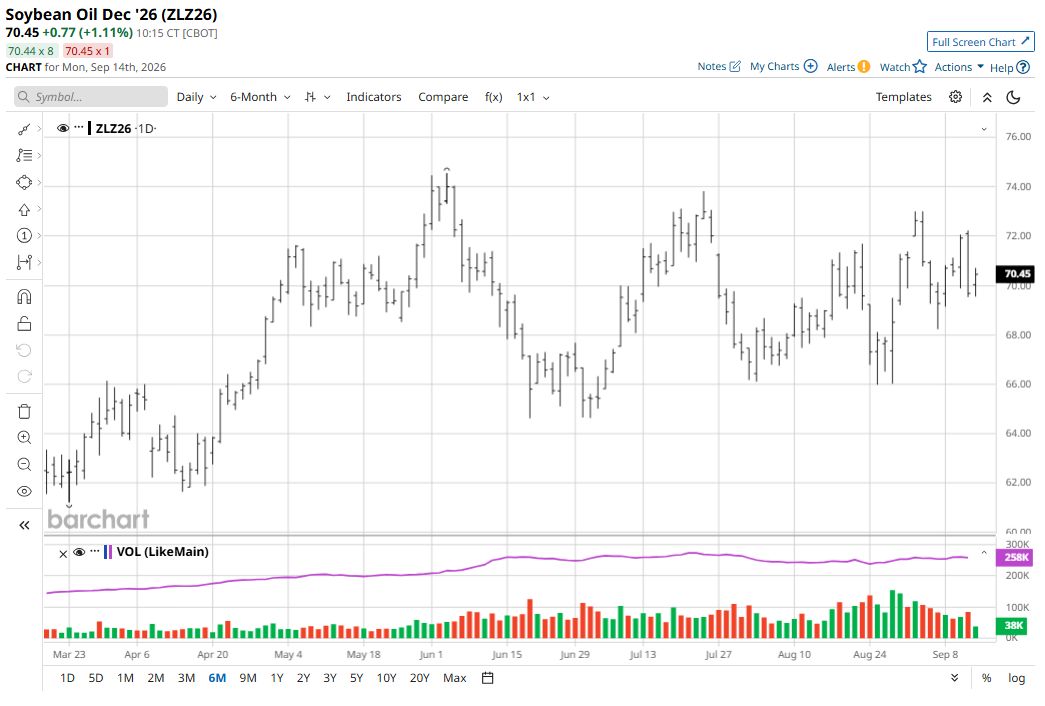
Malaysian palm oil production will be monitored as well as any impacts of the El Nino weather phenomenon on oilseed production in the Southern Hemisphere. Farmers in the Brazilian state of Mato Grosso will likely soon begin planting, as Pro Farmer consultant Dr. Cordonnier noted that the mandatory soybean-free period ended on Sept. 6. Early planting will likely be limited to irrigated fields.
Winter Wheat Sees Profit-Taking Weak Long Liquidation
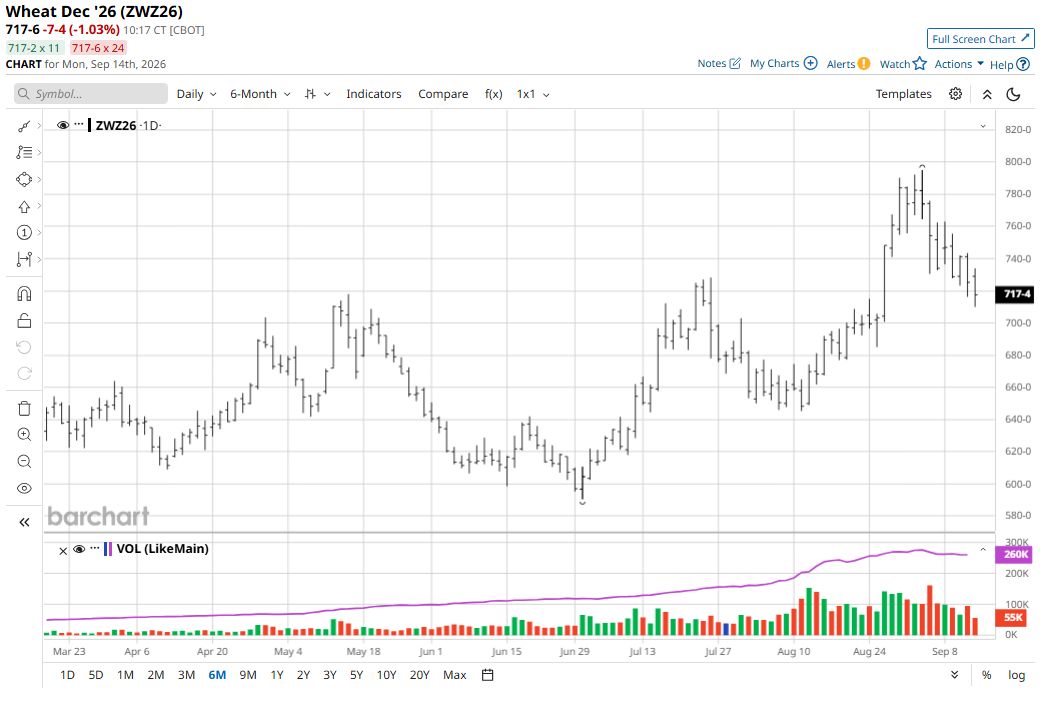
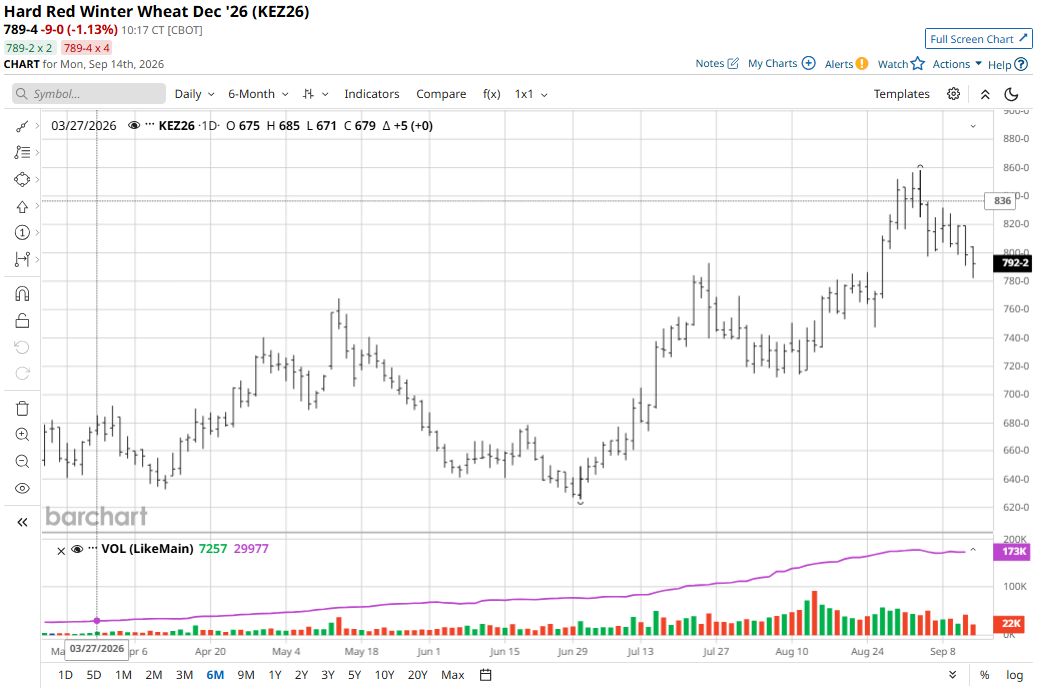
December soft red winter (SRW) wheat (ZWZ26) futures on Friday fell 16 cents to $7.25 1/4, hit a nearly three-week low, and for the week were down 8 3/4 cents. December hard red winter (HRW) wheat (KEZ26) lost 20 1/4 cents to $7.98 1/2, hit a nearly three-week low, and for the week were down 3 3/4 cents.
The winter wheat futures markets Friday saw more profit-taking pressure, as well as weak long liquidation. Friday’s technically bearish weekly low closes set the table for some follow-through technical selling early this week.
USDA’s WASDE report on Friday left the estimated U.S. wheat 2026-27 carryover unchanged at 717 million bushels. USDA made no changes on the supply or demand side of the 2026-27 balance sheet. The USDA did raise the forecast average farm price by 20 cents a bushel from last month to $6.40 per bushel. An unchanged wheat balance sheet in the September WASDE is not unusual, as the USDA will release the annual Small Grains Summary at the end of this month with more firm data to estimate from.
Some early season planting of wheat and other crops will occur in areas that receive significant rain. Much of the planting will occur in October when temperatures will be less oppressively hot.
 www.barchart.com
  www.barchart.com
 Global wheat supplies, weather concerns, and the so-called Super El Nino, as well as ongoing grain-shipping constraints out of the Black Sea region, will remain on the front burner of the wheat markets in the coming months. However, traders presently appear cautious to push wheat prices higher while talks of interest in a peace deal from Russian President Vladimir Putin are swirling.
Let me know what you think. I enjoy hearing from my valued Barchart readers all around the globe. Email me at jim@jimwyckoff.com.
On the date of publication, Jim Wyckoff did not have (either directly or indirectly) positions in any of the securities mentioned in this article. All information and data in this article is solely for informational purposes. For more information please view the Barchart Disclosure Policy here.
More news from Barchart
Corn, Soybean Prices Get a Mixed Bag from the USDA’s Monthly WASDE Report Can Soybeans Remain in the Teens? Will Corn’s Bullish Trend Continue Grain Traders Are Closely Eyeballing Black Sea Region Grain Shipping as Wheat, Corn Prices Fall