


Europe’s robotaxi market is starting to move beyond tightly controlled pilot programs and toward larger commercial ambitions. Uber (UBER), Verne, and Pony.ai (PONY) launched robotaxi rides in Zagreb, Croatia, in August, while Alphabet’s (GOOG) (GOOGL) Waymo has begun testing autonomous vehicles in Munich ahead of a planned German launch in late 2027.
That accelerating race for the European autonomous-mobility scale is why Lucid Group’s (LCID) latest announcement has caught investors’ attention.
More Top Stocks Daily: Go behind Wall Street’s hottest headlines with Barchart’s Active Investor newsletter.
Lucid Motors has partnered with European shared-mobility platform Bolt to develop an autonomous-vehicle-ready platform and deploy up to 25,000 self-driving Lucid EVs across major European cities. The announcement sent shares almost 6% higher during Thursday's trading, offering a brief lift for a stock that is still down more than 60% since the start of the year.
For a company with $405 million in Q2 revenue and a $3.30 per-share loss, Bolt offers Lucid a route toward autonomous fleet supply. But what does Lucid’s 25,000-vehicle robotaxi ambition with Bolt really mean for LCID stock? Let’s take a closer look.
Lucid’s Financial Reset
Lucid Group, based in Newark, California, designs and manufactures luxury electric vehicles, including the Air sedan and Gravity SUV. The $1.59 billion company is now pursuing autonomous mobility opportunities through its forthcoming midsize platform.
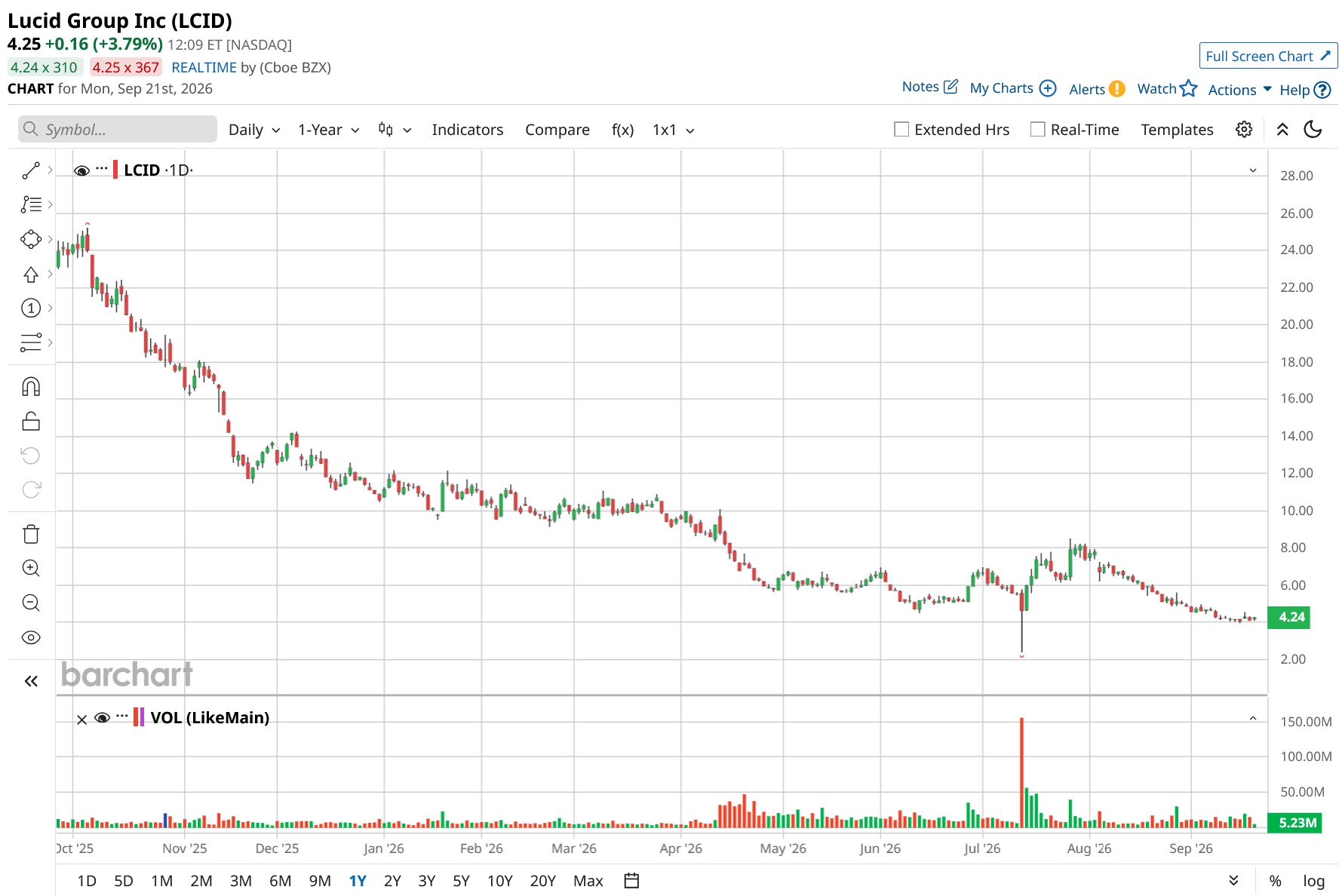
As of Sept. 21, LCID shares are trading around at $4.25, reflecting a year-to-date (YTD) decline of 60% and a 80% drop over the trailing 52 weeks.
 www.barchart.com
Its 1.20x price-to-sales multiple stands above the sector median of 0.84x, leaving limited room for further operational missteps.
Lucid Group released its second-quarter 2026 results on Aug. 4, reporting $405.3 million in revenue, up 56.2% year-over-year (YoY). This result exceeded analyst expectations of $389.3 million by 4.1%, supported by deliveries and an improved vehicle mix.
It produced 4,774 vehicles, up 24% from a year earlier, though output was intentionally curtailed to reduce inventory and conserve cash. Their deliveries rose 19% YoY to 3,953 vehicles.
LCID, however, remains far from profitability. Its adjusted loss of $2.78 per share missed the consensus forecast for a $2.32 loss by 20%. The company also posted an adjusted EBITDA loss of $901.1 million, equal to a negative 222% margin, despite that loss narrowing 42.6% YoY.
Lucid’s new chief executive, Silvio Napoli, openly acknowledged the company’s execution problems during his first quarter leading the business.
The company’s operational reset targets cash, costs, customer experience, quality, and accountability, with workforce cuts and a second-shift elimination generating $115 million in annualized savings. Lucid’s management is targeting $1.4 billion in 2026 cash-flow improvements across operating costs, capital spending, and working capital.
That effort is backed by $3 billion in total liquidity, which Lucid says should fund operations well into 2027.
Why the Bolt Deal Matters
Lucid’s partnership with Bolt could give its upcoming Midsize platform a major European fleet opportunity. Bolt aims to deploy at least 25,000 autonomous Lucid vehicles across major European cities and countries.
The companies will jointly develop an autonomous-driving-system-ready vehicle from the product-development stage. The vehicle will be designed to support SAE Level 4 autonomy and incorporate Nvidia Hyperion hardware, including high-performance computing and a standardized sensor suite.
For Lucid, this structure offers a potential route to higher-volume vehicle demand without assuming the capital-intensive costs of operating a ride-hailing service. Lucid Technologies, the company’s new unit combining its AI, ADAS, autonomous-driving, and digital capabilities, will lead Lucid’s role in the program.
The agreement could eventually help Lucid monetize both its EV architecture and autonomous-ready technology. It also gives the company another route to market for Midsize beyond retail buyers and complements its ongoing efforts to expand its European presence.
Lucid took another step in that direction in August by naming Munsterhuis Autobedrijven as its first retail partner in the Netherlands. Munsterhuis will sell Lucid vehicles from a dedicated Hengelo location and provide authorized service, adding to Lucid’s Studio and Service Center in Hilversum.
The company has also strengthened its commercial leadership. Lucid appointed Shawn Mirabal as president of North America Commercial, Mike Molino as vice president of Finance, and Angela Zepeda as vice president of Global Marketing in August.
Ultimately, the Bolt partnership expands Lucid’s long-term revenue opportunity, but its impact on LCID stock depends on binding orders, Midsize execution, regulatory approvals, and demonstrable improvement in manufacturing economics.
Wall Street Sees Upside
Lucid’s next earnings report offers the first near-term test with their third-quarter results on Nov. 4. Analysts expect a loss of $2.76 per share for the quarter ending in September. That would improve from a $3.31 per-share loss in the prior-year period, representing estimated YoY earnings growth of 16.62%.
Citigroup reiterated its “Buy” rating in August but reduced its LCID price target to $11 from $14. It marked the second target cut in two months from the brokerage.
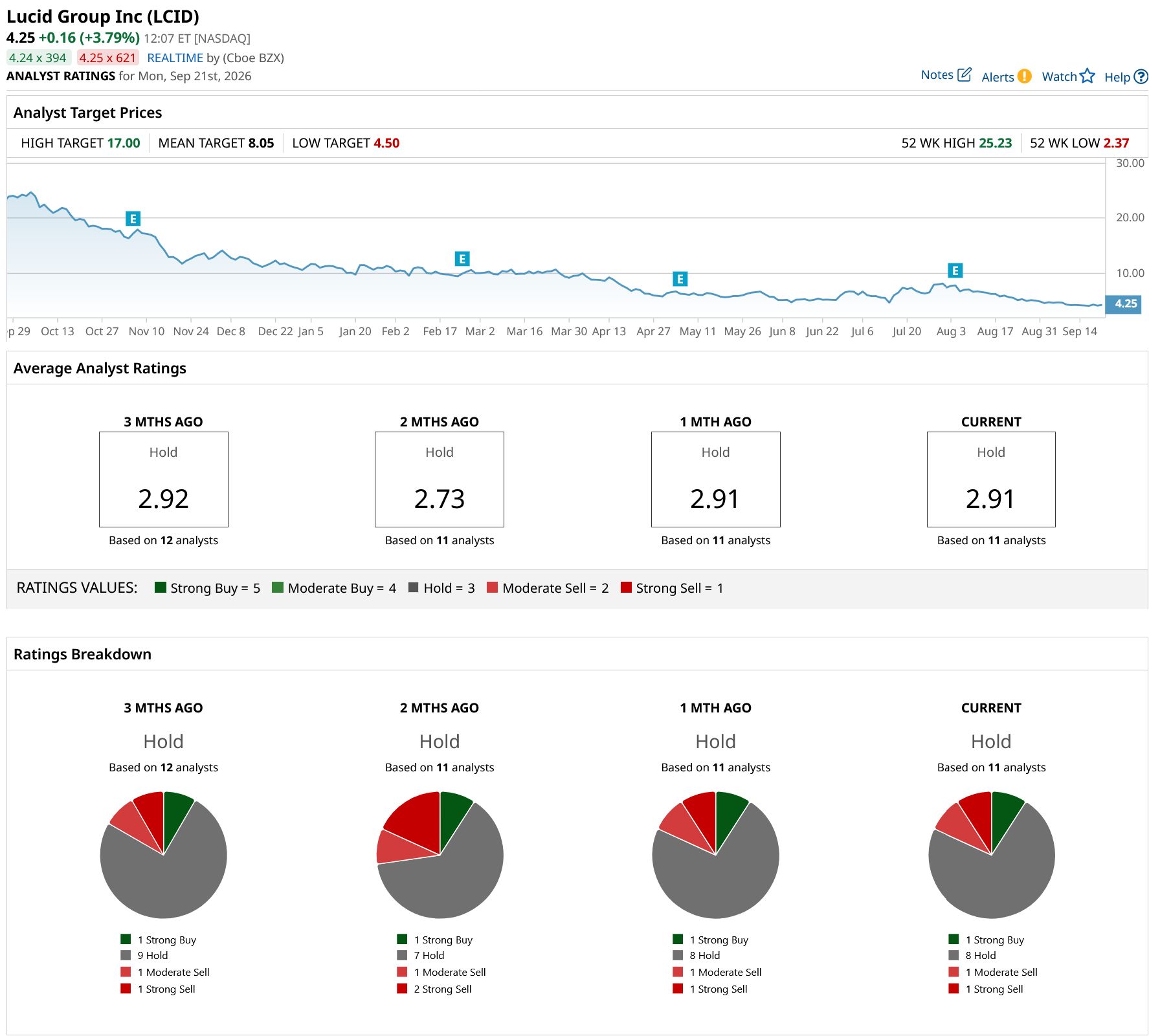
The consensus analyst view is “Hold,” based on 11 surveyed analysts, with an average price target of $8.05. That target implies approximately 89% upside from LCID’s current price. Such implied upside is notable, but it should not be mistaken for a forecast of a speedy recovery.
 www.barchart.com
Conclusion
Lucid’s Bolt partnership gives LCID stock a credible new growth story and opens a potential route for its Midsize platform into Europe’s emerging robotaxi market. However, the 25,000-vehicle target is not confirmed revenue, and Lucid must prove it can launch Midsize, control cash burn, and execute reliably. Near-term sentiment should benefit from the announcement, but sustained gains will require binding orders, clearer deployment milestones, and improving margins. LCID remains speculative, with meaningful upside if management delivers on its commitments.
On the date of publication, Ebube Jones did not have (either directly or indirectly) positions in any of the securities mentioned in this article. All information and data in this article is solely for informational purposes. For more information please view the Barchart Disclosure Policy here.
More news from Barchart
Lucid Just Struck a Partnership With Bolt on Mobility. What This Means for LCID Stock. Alphabet Pushes Deeper Into Voice AI With New Gemini Models Red Cat CEO Just Sold $1.6 Million of Stock. Wall Street Sees 144% Rally Ahead. DIS Stock Alert: What to Know as Disney Creates First-Ever Chief Technology Officer Role