

The space economy is taking off, and investors are starting to look beyond rockets and satellites to what could become one of the biggest technology opportunities of the 21st century. The excitement reached new heights after SpaceX (SPCX) went public with a bang in June 2026. The historic initial public offering (IPO) catapulted the space giant into the ranks of the world’s most valuable publicly traded companies by market capitalization, fueling optimism around satellite internet, artificial intelligence (AI), and the future of space-based applications.
While SPCX stock has given up some ground since its blockbuster debut, Cathie Wood doesn’t appear ready to write off the company’s long-term potential just yet. The founder of Ark Invest and one of Wall Street’s most prominent voices for her bold bets on disruptive technologies, Wood recently took to social media platform X to highlight the massive revenue potential of SpaceX’s Starship program. Wood suggested that each Starship launch could generate as much as $1 billion in revenue, while CEO Elon Musk’s ambitious target of 10,000 flights per year by 2030 could translate into a staggering $10 trillion revenue opportunity.
More Top Stocks Daily: Go behind Wall Street’s hottest headlines with Barchart’s Active Investor newsletter.
If SpaceX can come anywhere close to that vision, Wood believes its $1.77 trillion IPO valuation could ultimately look like a “deep value opportunity” in hindsight. That is a bold projection, but it underscores why SpaceX continues to command investor attention even after shares have pulled back from their debut. With satellite connectivity, AI, and next-generation space applications creating new opportunities across the industry, SpaceX has plenty of potential growth drivers — and with a high-profile investor like Wood highlighting Starship’s enormous revenue ambitions, the space giant certainly deserves a closer look.
About SpaceX Stock
Founded in 2002, SpaceX has grown into the largest space company in the U.S. and the world’s most active launch provider, conducting more launches annually than any other company. Its reusable Falcon 9 rockets have become a defining part of its business, helping reduce launch costs and expand access to space for a wide range of customers. From NASA and the U.S. Department of Defense to international space agencies and commercial satellite operators, SpaceX serves a diverse customer base that makes it a major participant in the global space industry.
But rockets are only part of the story. SpaceX also operates Starlink, its satellite internet network, which has become an increasingly important revenue driver. Starlink is estimated to contribute between 50% and 80% of SpaceX’s total revenue, providing a source of funding for the company’s broader technology development and space-exploration initiatives. That growing contribution gives investors another reason to pay attention to the business beyond its launch operations.
SpaceX’s reach expanded further in February 2026 with the merger of SpaceX and xAI, bringing together a major space and defense contractor with a rapidly growing AI company investing heavily in data-center infrastructure. The transaction reflects the increasingly close relationship between AI, communications, and space-related technologies, while broadening the scope of Musk’s ambitious technology empire.
At the center of SpaceX’s long-term vision is Starship, a fully reusable transportation system made up of the Super Heavy booster and the Starship upper stage. Designed to carry both crew and cargo, Starship is intended to support future missions to the moon, Mars, and other destinations. Starship remains central to Musk’s goal of enabling human transportation to Mars and establishing a sustained presence beyond Earth. However, substantial technical and operational challenges remain, making the project one of the most closely watched developments in the aerospace industry.
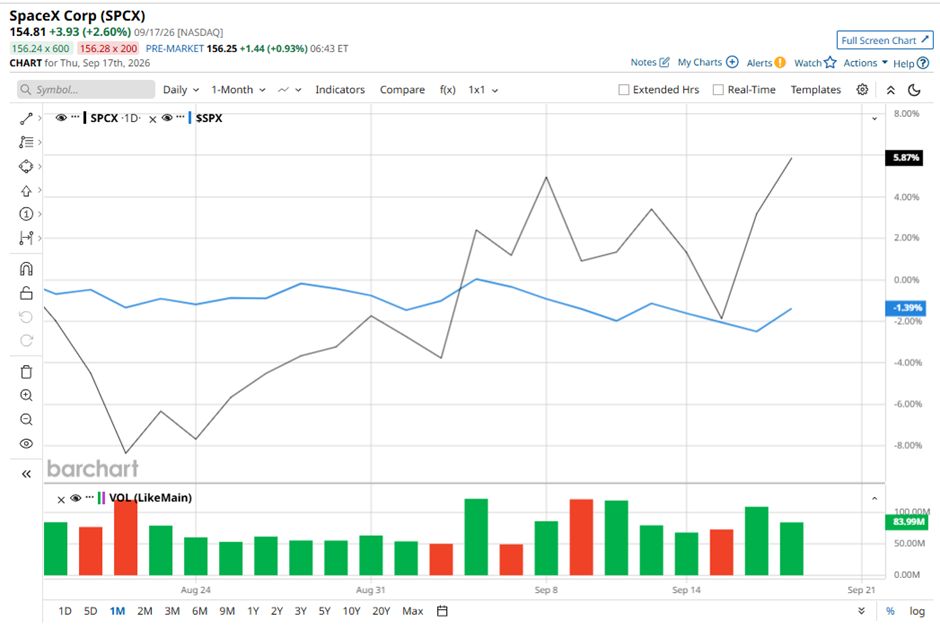
While SpaceX’s IPO was nothing short of historic, its journey as a public company has been far from smooth. SpaceX made a strong positive impact on space stocks when it debuted on June 12, 2026. The company priced its IPO at $135 per share, but shares opened at $150. However, the initial momentum did not last. Shares reached an all-time high of $225.64 on June 16, but SPCX stock is now more than 30% below its post-IPO peak.
Several factors have weighed on the stock, including soaring AI and data-center spending, unprofitability, high-profile technical setbacks, and looming insider share lockup expirations that could flood the market with additional shares. But despite the pullback, SpaceX remains a massive company with a market capitalization of about $2 trillion. SPCX stock is also up roughly 11% over the past month, outperforming the broader S&P 500 Index's ($SPX) gain of 1% during the same period.
 www.barchart.com
 The Financial Picture
SpaceX wasted little time making an impression on Wall Street. On Aug. 4, the company reported better-than-expected second-quarter fiscal 2026 results, marking its first earnings report since its IPO. The headline numbers comfortably topped consensus estimates, with strong growth across its core operations helping drive the beat. Total revenue surged 92% year-over-year (YOY) to $7.81 billion, coming in well above the $6.82 billion consensus estimate.
SpaceX also significantly narrowed its net loss to $541 million, down from more than $1 billion a year ago. On a per-share basis, SpaceX reported a loss of $0.09, beating the consensus estimate of a $0.21 loss. Anchored by Starlink, Connectivity remained the biggest financial engine of the enterprise; Connectivity revenue jumped 66% YOY to $4.29 billion, fueled by a doubling of total subscribers to 12 million across 167 markets.
Enterprise and government adoption emerged as another major growth catalyst, with revenue skyrocketing 108% to $1.8 billion, supported heavily by expanding contracts for the secure Starshield network. Meanwhile, SpaceX’s traditional space and launch business continued to operate largely as a funded research and development program. Space revenue grew 29% YOY to $962 million, helped by a richer mix of paying commercial and government customers.
The AI segment drew the most scrutiny from investors, however, accounting for the vast majority of the company’s capital expenditures. AI-related revenue soared 247% YOY to $2.56 billion, underscoring the rapid expansion of SpaceX’s AI ambitions.
Despite the impressive revenue growth, profitability remained uneven across SpaceX’s businesses. The space unit posted an operating loss of $542 million, while the AI unit recorded a loss of $1.26 billion. By contrast, Connectivity remained profitable, generating $1.66 billion in operating income during the quarter.
Still, the company’s strong Q2 performance was not enough to keep investors from focusing on its enormous spending plans. Capital expenditures jumped to $18.37 billion in Q2, up sharply from $2.83 billion in the year-ago period. The AI segment accounted for roughly 86% of total capex, raising concerns about the scale of investment required to support SpaceX's ambitious expansion. Those concerns triggered a sharp 14% selloff in SPCX stock on Aug. 5 despite the strong earnings beat.
Even with the spending surge, SpaceX closed the quarter with a formidable $100 billion in combined cash and marketable securities, bolstered by its recent IPO and a subsequent bond sale. The company also reported a substantial $47.5 billion backlog, providing visibility into future business activity.
What Do Analysts Think About SpaceX Stock?
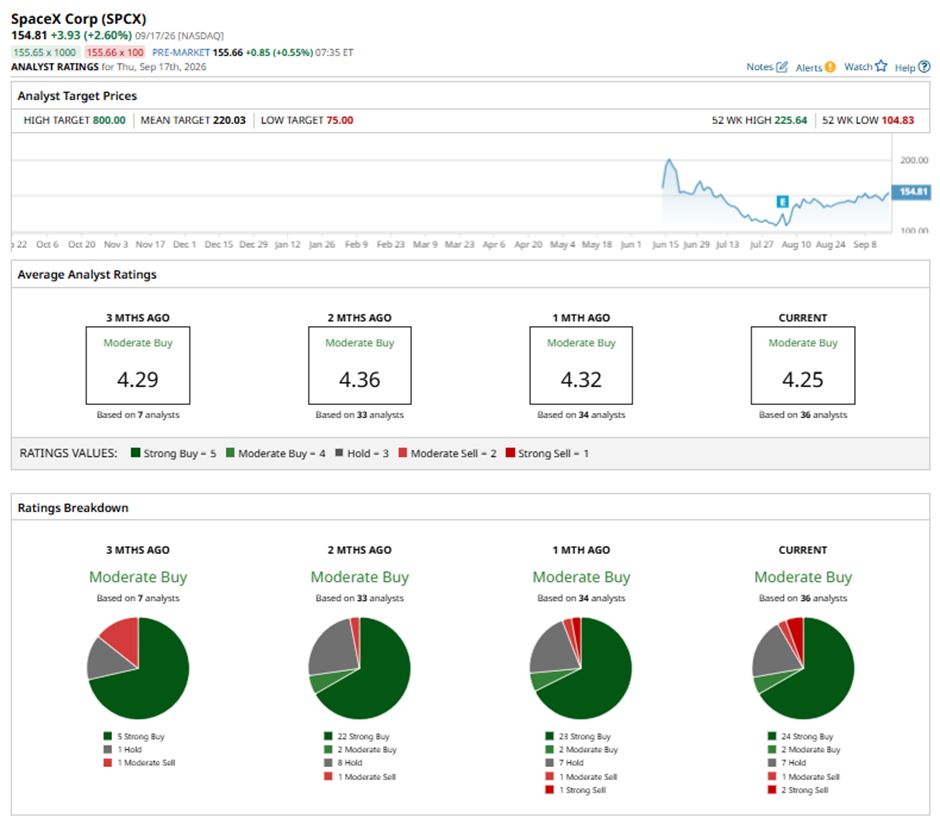
Overall, Wall Street remains optimistic about SpaceX, with SPCX stock carrying a consensus “Moderate Buy” rating. Of the 36 analysts covering the company, 24 recommend a “Strong Buy,” two have a “Moderate Buy” rating, seven have a “Hold” rating, one analyst has a “Moderate Sell,” and two recommend a “Strong Sell” rating.
The average price target of $220.03 points to potential upside of 45% from current levels. Meanwhile, the Street-high target of $800 suggests the stock could possibly surge a stunning 427%, highlighting the wide range of expectations surrounding SpaceX’s future growth.
 www.barchart.com
 On the date of publication, Anushka Mukherji did not have (either directly or indirectly) positions in any of the securities mentioned in this article. All information and data in this article is solely for informational purposes. For more information please view the Barchart Disclosure Policy here.
More news from Barchart
Why Cathie Wood Says SpaceX Stock Could Be a Deep-Value Buy Dear ON Semiconductor Stock Fans, Here’s What You Need to Know About ON’s Financial Analyst Day Netflix Stock Valuations Seem Attractive Amidst Growth Deceleration Concerns Grab Stock Is Worth the Risk as Valuations Fall to Historical Lows