

Microsoft’s (MSFT) Xbox business is entering a decisive stage of consolidation even as the company’s core financial engine gathers pace. On Sept. 22, Microsoft eliminated 268 roles across Halo Studios, other first-party teams, and Xbox Game Studios management. It also handed the development of the next Halo title to Activision, putting one of Xbox’s signature franchises under new leadership.
MSFT shares fell about 0.7% after the announcement. The move stands out as Microsoft’s broader business continues to expand, with fiscal 2026 revenue exceeding $331 billion, up 18%. By contrast, More Personal Computing, which includes Xbox, saw revenue decline 4% to $12.9 billion in the June quarter.
More Top Stocks Daily: Go behind Wall Street’s hottest headlines with Barchart’s Active Investor newsletter.
The reorganization, therefore, raises a bigger question: Is Microsoft’s Xbox overhaul simply a restructuring effort, or does the shift of Halo to Activision signal a bigger strategic change? Let’s dive in.
Microsoft’s Strong Earnings Core
Microsoft Corporation is a $3.72 trillion technology giant that develops and sells enterprise software, cloud-computing infrastructure, artificial intelligence services, productivity applications, cybersecurity tools, operating systems, devices, and gaming content.
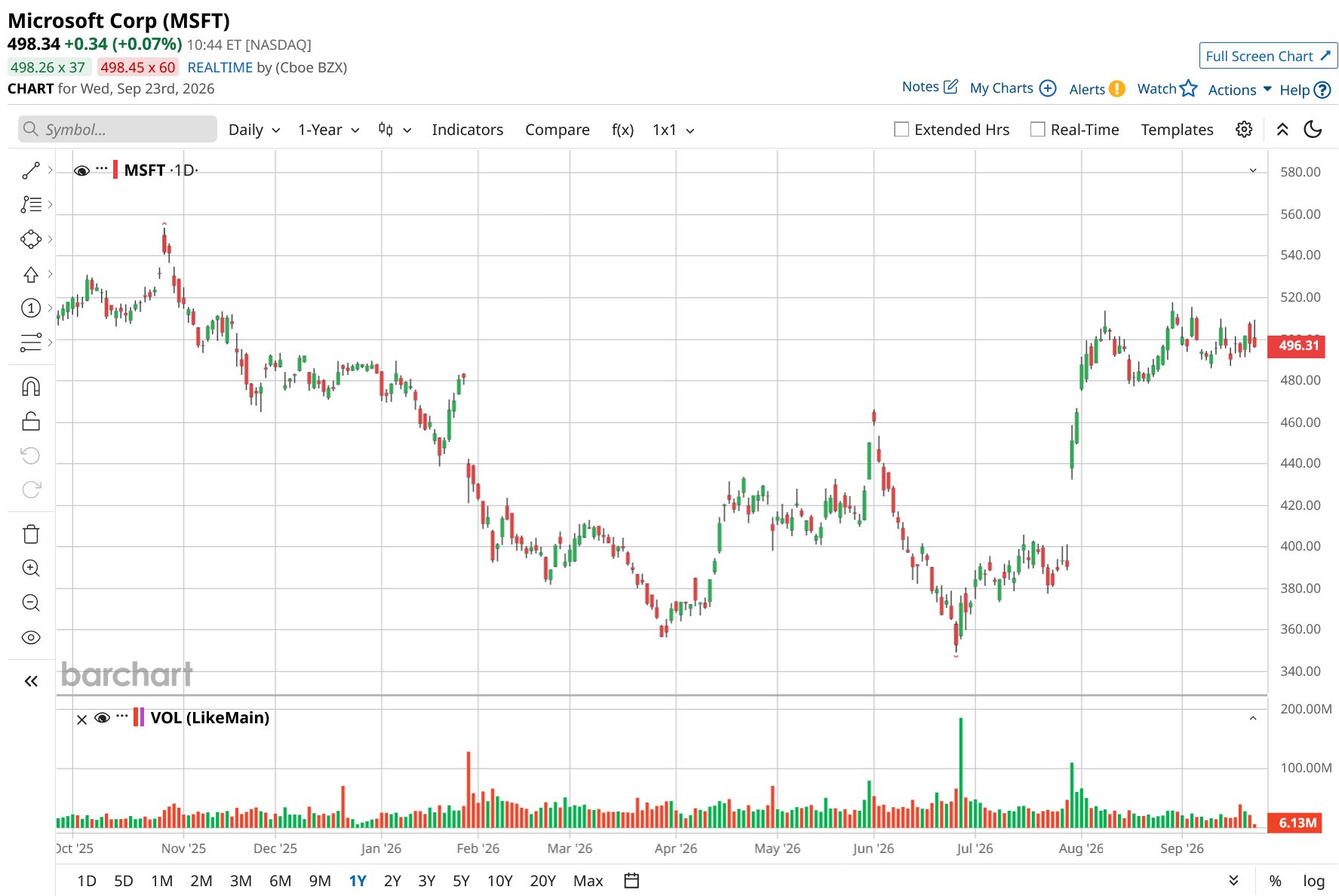
MSFT stock ended Sept. 22 at $498, gaining 2.97% so far in 2026 while remaining 3.2% below its level from a year earlier.
 www.barchart.com
 The stock commands a premium at 28.58x trailing earnings and a 1.59x PEG ratio, compared with sector medians of 25.18x and 1.26x, respectively. Microsoft’s quarterly dividend is $0.98 per share, supporting a $3.92 forward annual payout and roughly a 0.79% yield.
Microsoft released fiscal Q4 2026 earnings on July 29, reporting $90.01 billion in revenue, up 17.7% year-over-year (YoY) and $2.30 billion above the $87.71 billion consensus estimate. That sales outperformance translated into GAAP EPS of $4.81, which exceeded Wall Street’s $4.22 forecast by 14.1%.
Profitability remained robust, although gross margin declined to 67.2% from 68.6% a year earlier as AI infrastructure investment increased. Even so, Microsoft held its operating margin at 45.1%, though free-cash-flow margin fell to 21.8% from 33.4%.
Over the past five years, Microsoft nearly doubled annual revenue from $168.1 billion to $331.8 billion, representing a 14.6% annualized growth rate. That growth has been led by Intelligent Cloud, which represented 41.5% of quarterly sales and expanded 31.6% YoY.
Microsoft’s Xbox Reset Puts Halo and Activision in Focus
Microsoft’s decision to eliminate 268 Xbox roles is part of a restructuring. However, moving the next Halo game to Activision signals more than cost-cutting. Microsoft is changing how it manages its flagship Halo franchise.
The cuts affect Halo Studios, other first-party teams, and Xbox Game Studios management. A smaller Halo Studios group will remain to support existing games, the player community, and esports. Activision will develop the next Halo release through a new team separate from its Call of Duty organization.
The cuts are part of a larger Xbox reset. In July, Microsoft said it would eliminate up to 3,200 roles, or about 20% of its gaming workforce, over the following year. The company said its announced actions have brought the reorganization roughly 75% of the way to completion.
Microsoft acquired Activision Blizzard for $75.4 billion in 2023, adding development, publishing, live-service, and marketing capabilities. MSFT now wants Activision to contribute more than Call of Duty revenue. The unit must improve development execution and commercial returns across more Xbox-owned franchises.
Microsoft’s More Personal Computing segment, which includes Xbox, Windows OEM, devices, and search advertising, generated $12.9 billion in fiscal Q4 2026 revenue, down 4% YoY. Xbox content and services revenue fell 10%, while Windows OEM and Devices revenue declined 7%.
The savings from 268 eliminated roles are unlikely to materially affect earnings for a $3.72 trillion company. The key issue is whether the reset improves returns on Microsoft’s gaming assets. Microsoft is reducing overlapping functions, centralizing accountability, and placing franchise decisions within fewer operating groups.
While this is a restructuring in form, it is a broader strategic signal in substance. The next Halo game will be a practical test of whether Microsoft’s more centralized Xbox model can improve returns without weakening the creative identities that define its gaming portfolio.
What Are Analysts Pricing In?
Microsoft’s Nov. 4 earnings report will test whether AI-driven growth remains intact during its Xbox reorganization, with analysts expecting September-quarter EPS of $4.69. That compares with $4.13 a year earlier and implies 13.56% YoY growth.
JPMorgan sees ample room for those businesses to extend Microsoft’s growth runway. Analyst Samik Chatterjee lifted his price target to $625, a 25.5% upside. Chatterjee’s case rests on Microsoft’s ability to convert AI demand into durable enterprise revenue. The firm expects those tailwinds to support a materially higher share price through the end of 2027.
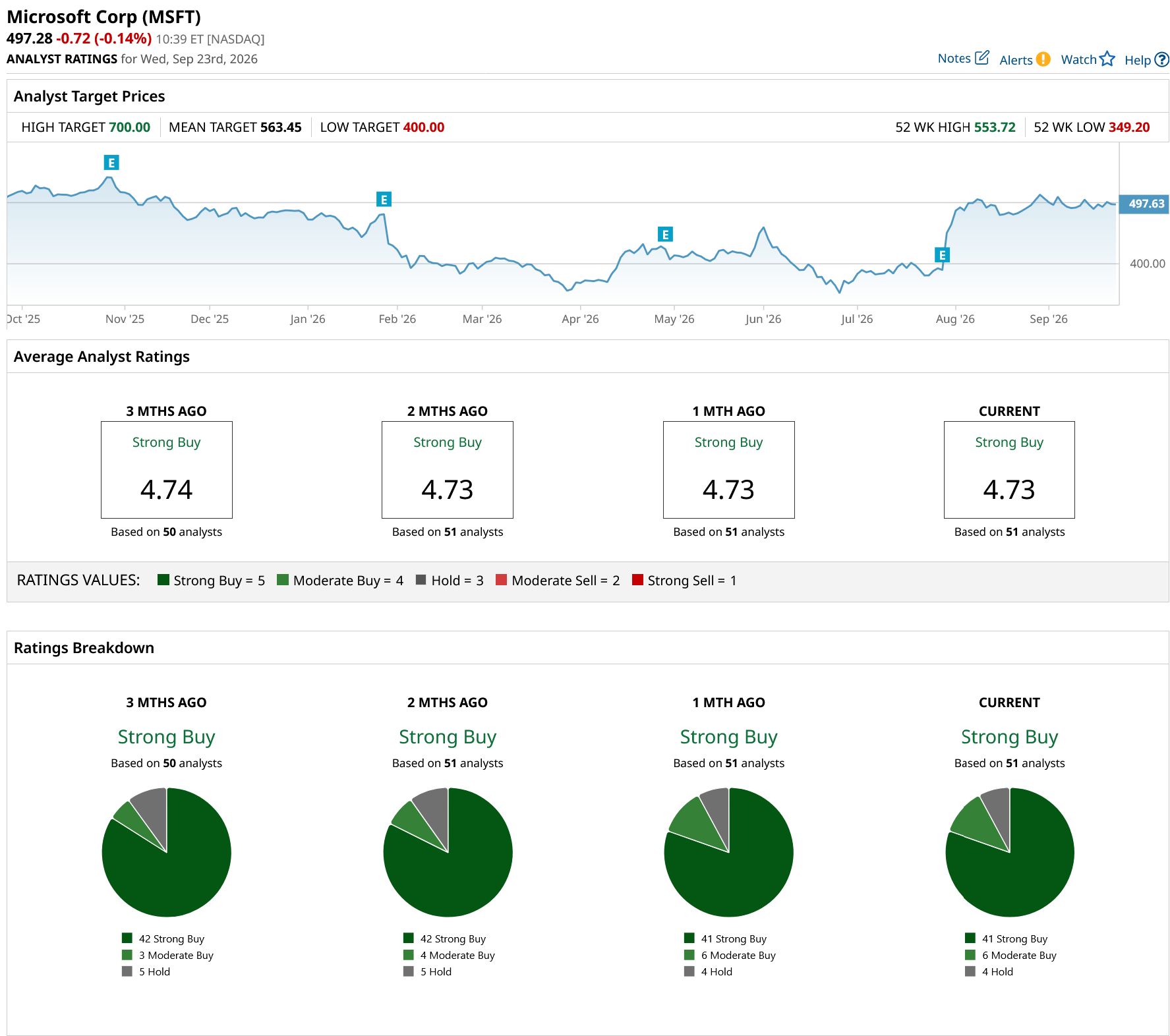
The broader analyst view remains constructive. Based on 51 analyst estimates, MSFT holds a consensus “Strong Buy” rating. Their average $563.45 price target implies 13.1% upside from MSFT’s Sept. 22 closing price of $498.
 www.barchart.com
 Conclusion
Microsoft’s latest Xbox moves look like more than a simple restructuring. Cutting 268 roles matters less financially than moving Halo development to Activision and reshaping studio oversight. The likely direction is a leaner Xbox built around fewer decision-makers and Activision’s execution scale. That could improve release discipline and returns, but Halo’s next chapter will determine whether efficiency comes without sacrificing the creativity that made the franchise central to Xbox.
On the date of publication, Ebube Jones did not have (either directly or indirectly) positions in any of the securities mentioned in this article. All information and data in this article is solely for informational purposes. For more information please view the Barchart Disclosure Policy here.
More news from Barchart
Yum China Stock Is Satistically Terrible. Here’s What Wall Street Isn’t Telling You. Microsoft Is Cutting 268 Xbox Roles as Activision Takes Over Halo. This Is a Simple Restructuring, Not a Broader Panic Signal for MSFT Stock. Nvidia Partner IonQ Sparks a Quantum Computing Stock Rally — Here’s One Way to Invest. Late Billionaire Charlie Munger Said American Medical Costs Are ‘A Disgrace’ And That Singapore Does It Better At ‘20% Of What We Pay’