


Stock picking for long-term total returns used to be the investing equivalent of the American Way. Now, drip by drip, stock by stock, and sector by sector, it is turning into the American Nightmare.
Somewhere along the way during the past decade or so, self-directed investors became convinced that stock-picking was the way to grow wealth and retire well. Maybe even at a relatively young age. However, the stocks that used to be the targets of that buy-and-hold activity have been going the wrong way.
More Yield, Less Trap: Sign up free to get Barchart’s daily Dividend Investor newsletter straight to your inbox.
Consider that over the past five years, the State Street SPDR Bloomberg 1-3 Month T-Bill ETF (BIL), an ETF that simply owns short-term T-bills, is up about 20% in total. That’s an easy bar to exceed for the 30 blue-chip companies in the Dow Jones Industrial Average ($DOWI), right?
Wrong. 11 of the 30 stocks have underperformed T-bills. Eight of those are down over a five-year time frame. Across the S&P 500 Index ($SPX), the data is similar.
The bottom line is that picking stocks is not the high-percentage shot it used to be, even in a bull market. What happens when the bears take over?
The Market Has Become a Casino, Not a Center of Commerce
The modern stock market is now gamified to the point where it functions essentially like a casino. While no one can predict the exact moment the game breaks, managing risk means refusing to get caught flat-footed when it does.
And lest anyone think this is just sour grapes, recall that very recently, I exited my best single trade ever.
So this is not about “don’t trade stocks.” It’s instead a warning that buying and holding isn’t a viable strategy anymore.
There are so many examples I can show you here, but I’ll focus on three companies that are among the 100 largest S&P 500 stocks.
Presenting My “Slash” Charts
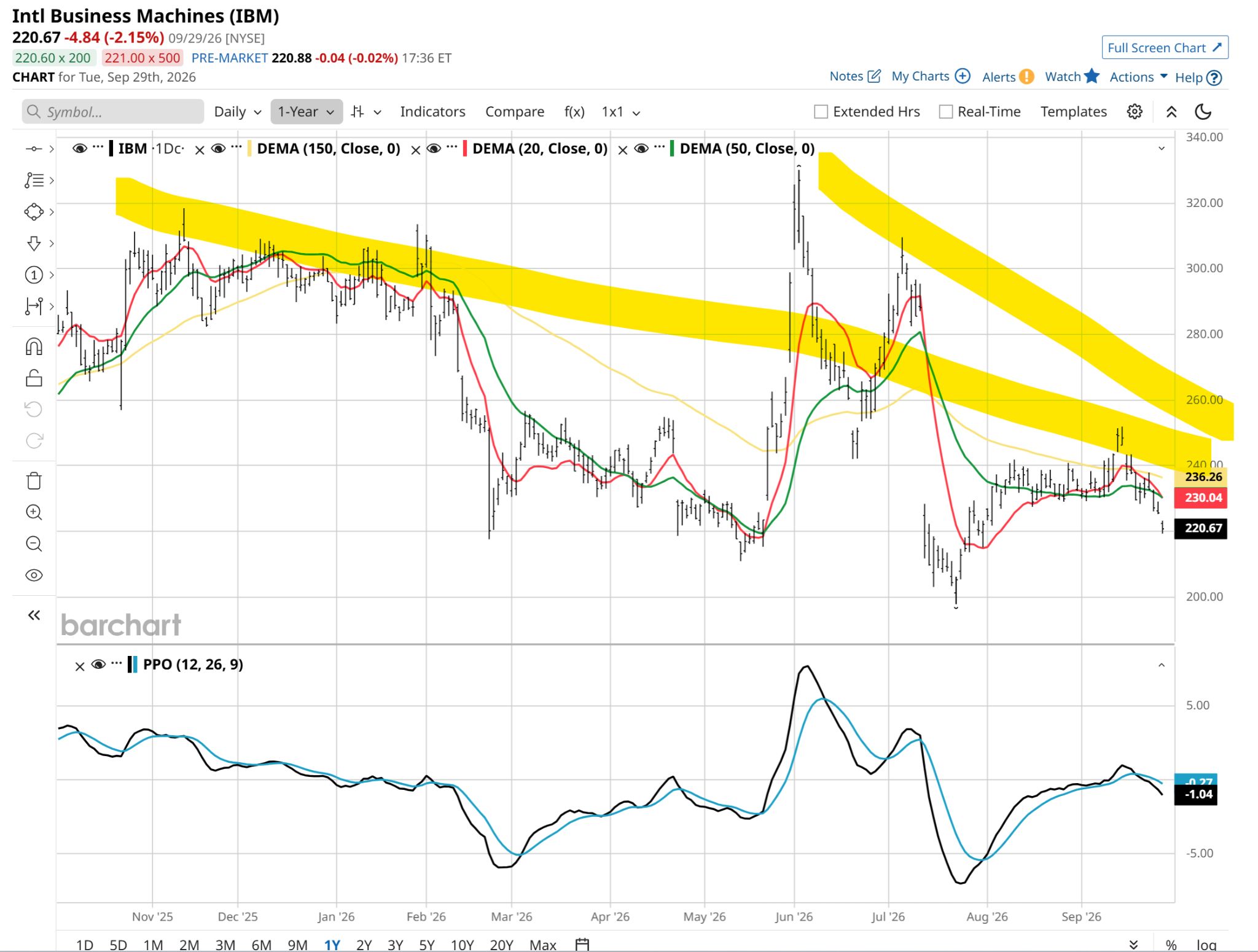
I’ve decided to coin the term “slash chart” for the trends I’m about to present. In these three examples, the technical pattern is so obvious, I don’t need to carefully place trend lines, support, and resistance levels.
I can simply do what I did here, and slash some highlighter-yellow lines through it.
The first case in point is International Business Machines (IBM). $100 points off from its $320-ish high level from 2025, there’s no sign of letup here in the chart. It just rolled over again.
 www.barchart.com
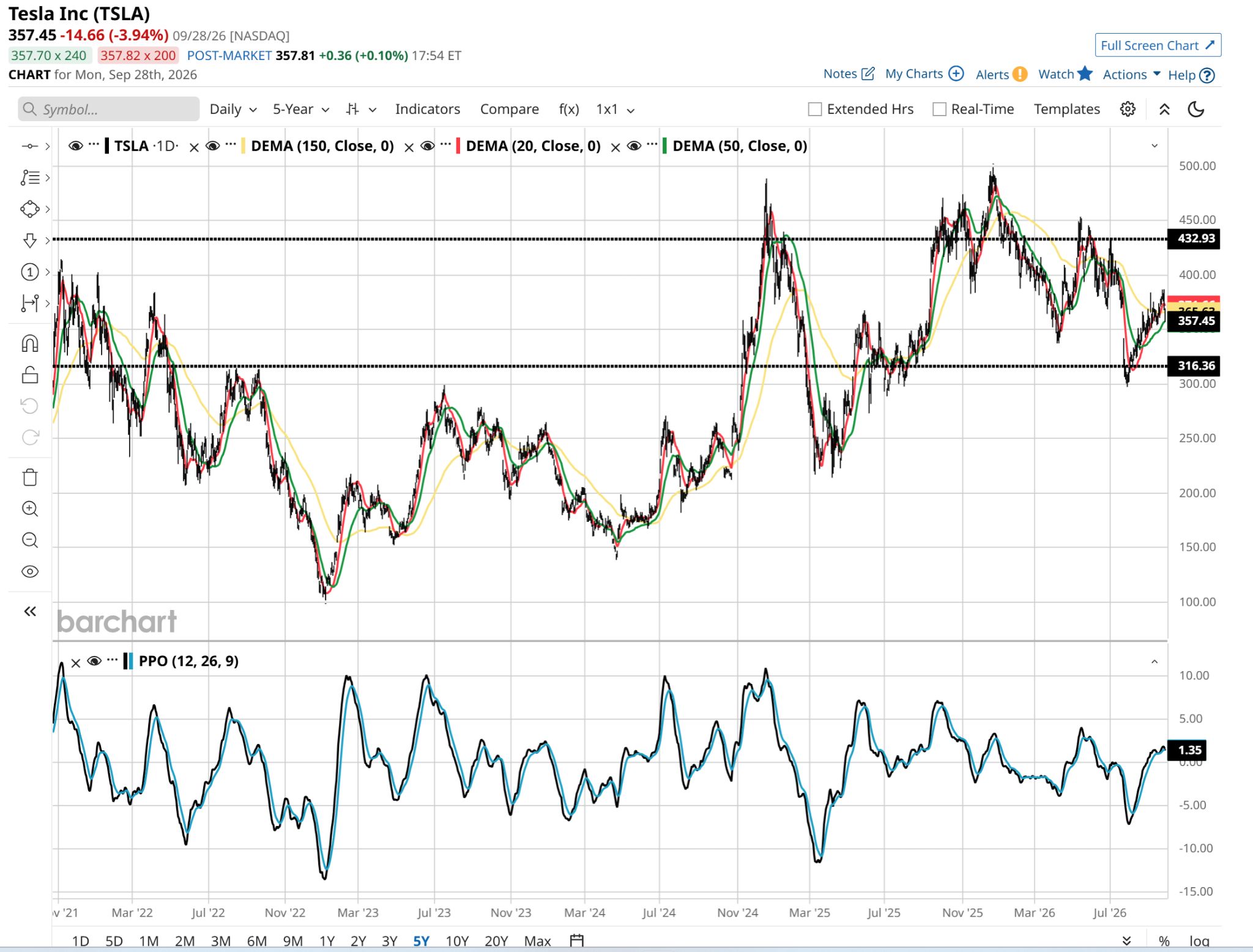
 That’s one typical pattern I see. Here’s a different one, using Tesla (TSLA). You might love Elon Musk and this company’s mission. But for five years, you’ve made less than no money.
 www.barchart.com
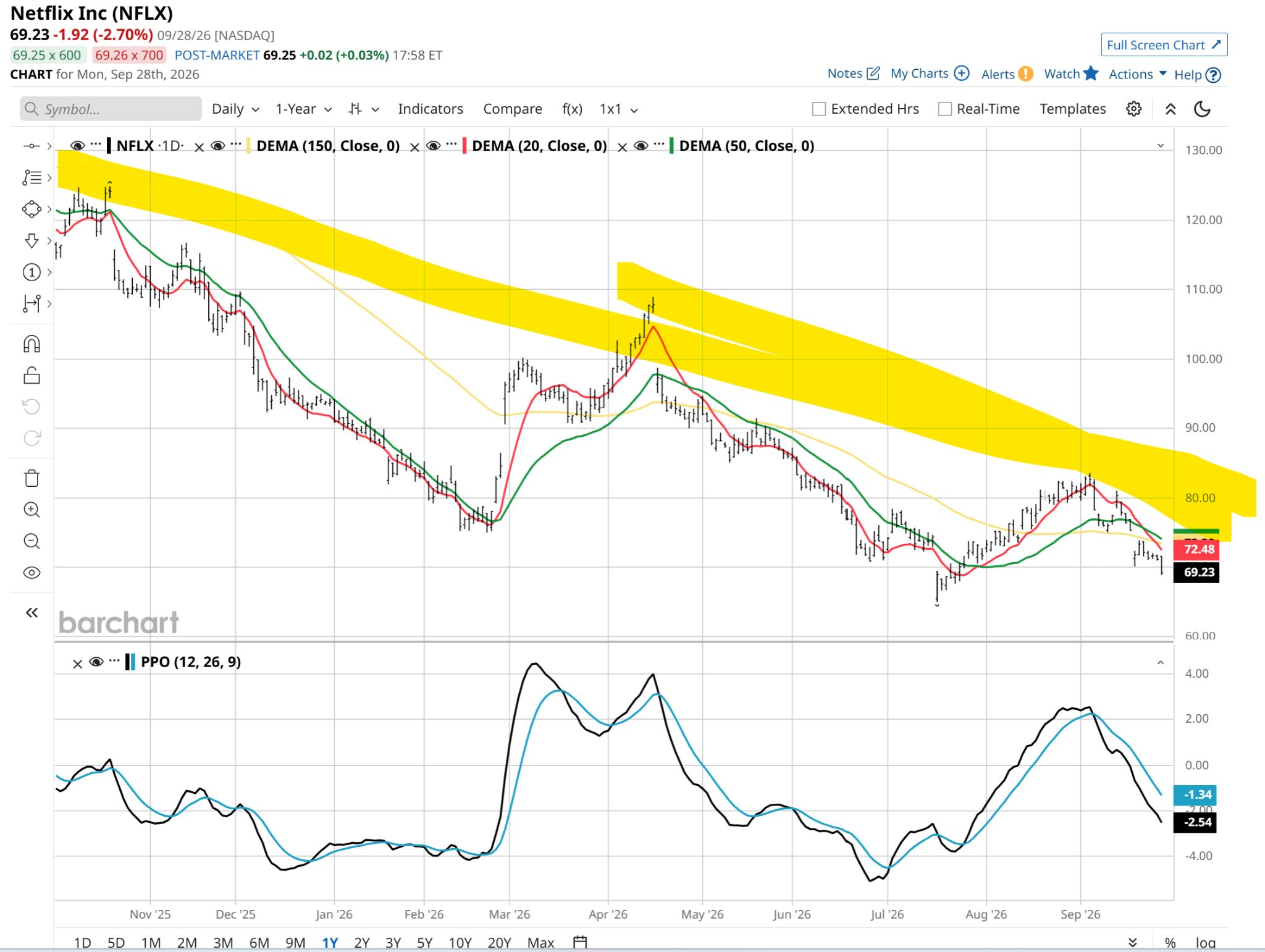
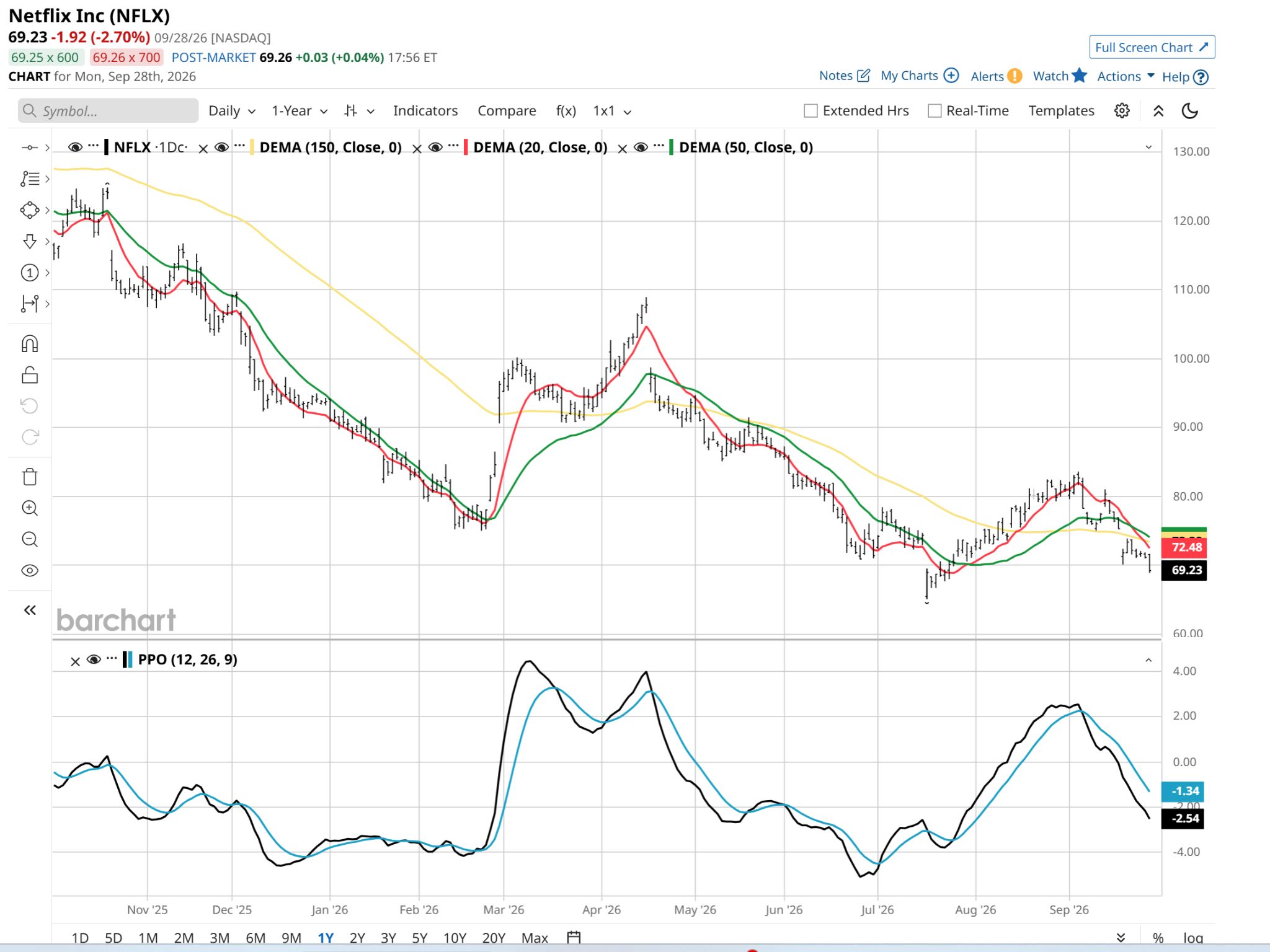
 And, here’s another variation. The “stock price cut in half, but still trending lower” look of Netflix (NFLX).
 www.barchart.com
  www.barchart.com
 Now, before you dismiss these examples as the market simply realizing these three stocks just aren’t that hot, take another look. Netflix in particular has suffered from an evolution in the streaming industry and a bad stretch in which its “wins” from offerings slowed.
That was all it took to cut the price of a former market darling in half. Relatively quickly, in fact. I can picture us having the same conversation down the road about AI stocks. And unfulfilled promises.
That doesn’t mean I won’t try to trade just about anything. But to buy stocks now under the guise of “a great long-term investment” increasingly seems like a bad idea. As they say, cheap can get cheaper.
The Hard Math of Bear Market Stock-Picking
Now to summarize that study. I looked at all 30 Dow stocks since the pandemic started in early 2020. To me, that’s about the only history that counts for prospective long-term stock selection activities.
I looked at those blue-chip stocks across the past three bear and bull cycles over that time. We had a drubbing in 2020, 2022, and again in 2025. In between? Stock market bliss!
The problem is that the down cycles do so much damage to most stocks that the up cycles are simply a process of getting back to even. Just take the case of Meta Platforms (META). A historic rally in a matter of weeks took the stock all the way back to highs it set last year. That’s not a bull market. It is a big trading range!
If we take the 30 Dow stocks over those three bear cycles noted above, that’s 90 chances for a stock to go up in a down market. How many instances did a stock go up out of those 90 times? Six. That’s it.
And except for a Chevron (CVX) oil price-related surge in 2022, most of those moves were barely in the green. The remaining 84 stocks suffered drawdowns ranging from 15% to 40%.
So, if we get a bull market, where a rising tide lifts all boats, stock picking for long-term investing could make a comeback. But it has been a very long time since that happened. It has been a case of few winners, a lot of losers, and many stocks that gyrate a lot but don’t go up over time.
And let’s not kid ourselves. Making a positive return in this market is just a moral victory. Because T-bills are yielding 4% again. Hoping to hand-pick the rare winner while the broader market rolls over offers abysmal odds. As the old joke goes: the chances are Slim and None, and Slim just left town.
Position Sizing: The Ultimate Survival Kit
If you choose to trade individual equities in this environment, strict position sizing is better than that old “free lunch” of diversification. Thinking of taking a 5% position in a stock within your portfolio? Maybe start with 1%-2% instead.
And remember, 15% annual returns in the stock market are not a guarantee, or even the historical norm. Look underneath the hood. When you do, you find things like this, from my study. Over the past five years:
⅓ of S&P 500 stocks did not beat T-bills ⅔ of S&P 500 stocks did not beat the SPYBut hey, good luck with that stock picking!
Rob Isbitts is a semi-retired CIO, former fiduciary investment advisor, and Barchart columnist. Check out his other work at ETFYourself.com (featuring the Fresh Charts weekly trading post), and ROAR.PiTrade.com, helping investors to better-manage their own portfolios.
On the date of publication, Rob Isbitts did not have (either directly or indirectly) positions in any of the securities mentioned in this article. All information and data in this article is solely for informational purposes. For more information please view the Barchart Disclosure Policy here.
More news from Barchart
Trying to Pick Individual Stocks to Buy Is the Most Pointless Thing Investors Can Do Now How I Traded the QQQ ETF for a 20X Gain – and What It Taught Me About Managing Risk There’s Nothing ‘Precious’ About the Charts of Gold and Silver Prices Here The Credit Rout Is No Longer a Distant Threat: 4 ETFs Show How a Looming Debt Collapse Could Hit Stocks