


Geospatial data company Planet Labs (PL) has confirmed that its prototype satellite built for Alphabet's (GOOGL)(GOOG) Google has been launched into orbit. Part of Google's Project Suncatcher, 19 other satellites were launched aboard SpaceX’s (SPCX) Transporter-18 rideshare mission. Project Suncatcher is Google's endeavor to test its Tensor Processing Units, or TPUs, in space. Overall, the launch was Planet Labs' 40th successful one, bringing the total number of satellites it has built and delivered into orbit to 718.
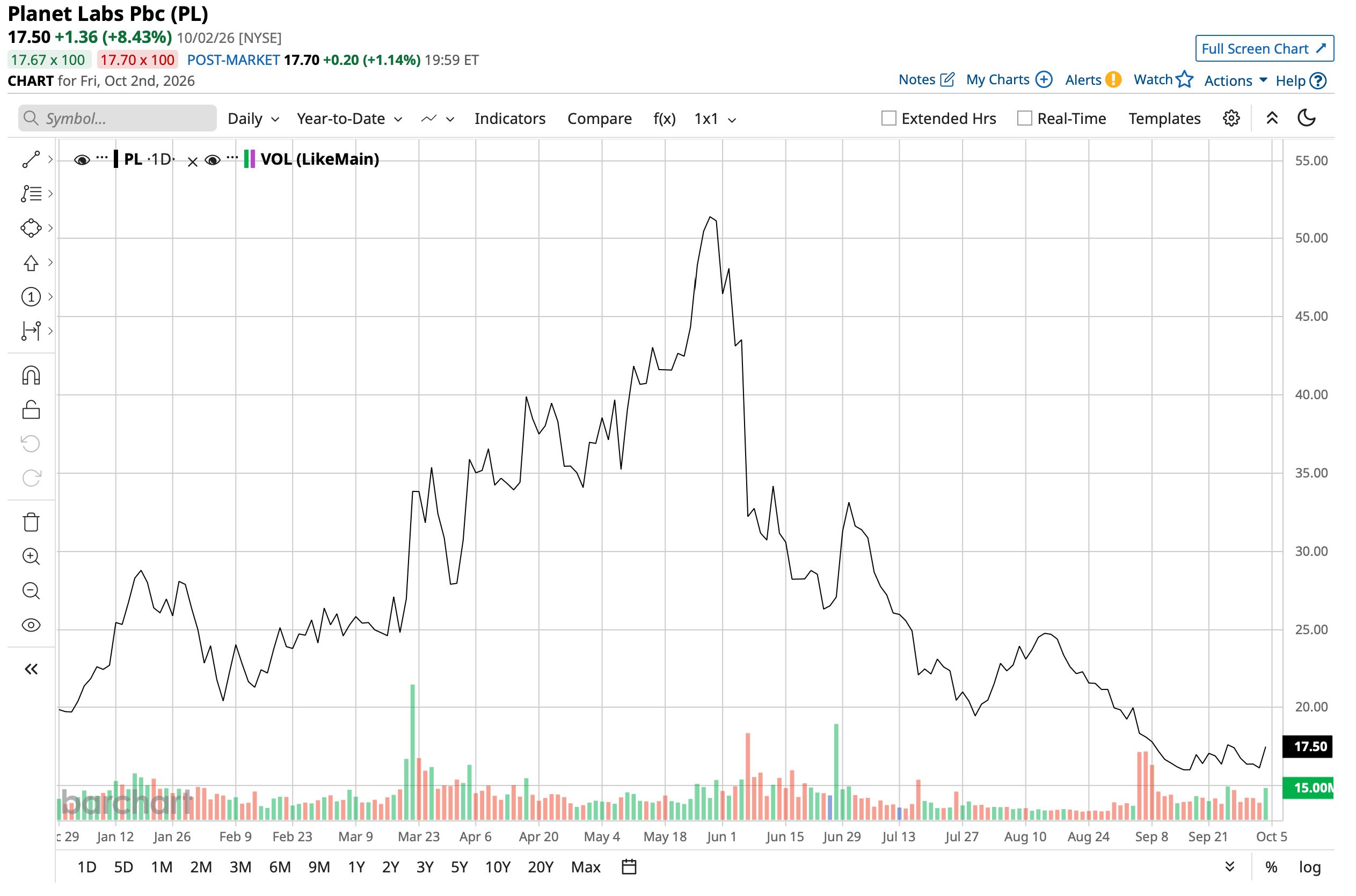
Shares of Planet Labs jumped on the news by 8.43% in Friday's trading session.
More Top Stocks Daily: Go behind Wall Street’s hottest headlines with Barchart’s Active Investor newsletter.
About Planet Labs
Founded in 2010 by three former NASA scientists, Planet Labs operates a huge constellation of Earth-imaging satellites, collects imagery of the planet continuously, and sells the resulting data, analytics, and satellite capabilities to governments and businesses. Its constellation collects imagery covering more than 350 million square kilometers per day.
Valued at a market cap of $6.4 billion, PL stock is down 11.3% on a YTD basis. But can this latest launch be the much-needed turning point the stock has been waiting for? Let's find out.
 www.barchart.com
 SaaS of a Different Kind
Planet Labs' shares may have been under pressure this year, but its 58% jump in revenue for the second quarter served as a reminder: The company is gaining momentum as a SaaS company, though of a different kind: Space Infrastructure as a Service.
The company's business has three primary focus areas. While Earth-imaging data provides Earth's images at very high frequencies through the company's satellites, under satellite services arrangements, Planet Labs can design and manufacture customer-owned satellites, arrange launches, provide ground infrastructure, and operate the spacecraft. It can also provide dedicated imaging capacity on Planet Labs-owned or customer-owned satellites. Finally, Planet offers analytics and AI, combining satellite imagery with machine learning and other analytics to turn raw images into actionable information.
Moreover, to cater to each of these areas, Planet Labs offers different cadences of satellites, such as SuperDove, Owl, SkySat, Pelican, and Tanger. SuperDoves are relatively small satellites providing roughly 3-meter-class multispectral imagery, with the company describing the constellation as the world's largest fleet offering near-daily 3-meter data. The current SuperDove sensor has eight spectral bands, making it useful for vegetation, agriculture, and environmental analysis. SuperDove has received endorsement from NASA itself, as it compared SuperDove with Sentinel-2 and commercial high-resolution systems, illustrating that Planet Labs occupies a distinct middle-resolution segment.
Then there are Pelican and Owl. The Gen-1 Pelican provides 50-cm-class imagery, with the planned Gen-2 Pelican designed for 30-cm-class imagery. Broadly, Pelican has been designed for faster tasking, improved optical performance, and lower-latency data delivery. Owl builds on this with it being designed to deliver 1-meter-class imagery at near-daily frequency across Earth's landmass, with a very wide 60+ km swath. However, Owl has yet to go live and is under development.
There is also SkySat. SkySat is Planet Labs' established high-resolution constellation and effectively represents the bridge between its monitoring and precision-imaging businesses. The space company currently operates 15 SkySats capable of producing 50-cm imagery, with the ability to revisit some locations as frequently as 10 times per day. Unlike SuperDove, which is designed primarily for broad monitoring, SkySat is a tasking business.
Finally, we land on Tanager, the company's hyperspectral satellite. Tanager's imaging spectrometer captures approximately 426 spectral bands across roughly 380–2,500 nanometers at 30-meter spatial resolution. This gives Tanager an edge, as different materials absorb and reflect electromagnetic radiation differently.
However, it's not like Planet Labs has no competition in the space space. Apart from Sentinel-2 mentioned earlier, Vantor's WorldView Legion has stronger absolute resolution, while BlackSky has a compelling high-frequency monitoring proposition. Then, in terms of hyperspectral imagery, Planet Labs faces specialists such as GHGSat and government missions.
Beat-and-Raise Q2 Not Enough to Dispel Persistent Loss Fears
Planet Labs' latest results for Q2 2026 left little to be desired as the company reported record revenues, raised guidance, and narrowing operating losses. Yet, the company continued to remain a loss-making entity, with gross margins showing a slight decline as well.
Revenues popped 58.1% from the previous year to $116.1 million, with a commensurate increase of 55.3% in gross profits to $65.6 million. Yet, gross margins slipped to 57% from 58% in the year-ago period. Losses, though, narrowed to $0.03 per share from $0.07 per share in the prior year.
Notably, the company raised its revenue guidance for fiscal 2027. Planet now expects revenue to be between $430 million and $441 million, higher than its previous forecast of $425 million to $441 million.
Further, remaining performance obligations and order backlog both remained solid, with material conversion expected in the near term. While 46% of the remaining performance obligations of $753.1 million are expected to convert in the next 12 months, about 50% of the Q2 backlog of $814.9 million is forecasted to accrue in the same period.
However, net cash from operating activities dropped to $68.4 million from $85.1 million, which is concerning for a loss-making company. Yet, Planet Labs ended the quarter with a cash balance of $415.1 million, much higher than its short-term debt levels of $3.6 million.
Having said that, PL stock trades at a significant premium. Its forward P/S and P/CF of 14.55 and 53.65, respectively, are well above the sector medians of 1.78 and 14.29, respectively.
Analyst Opinion
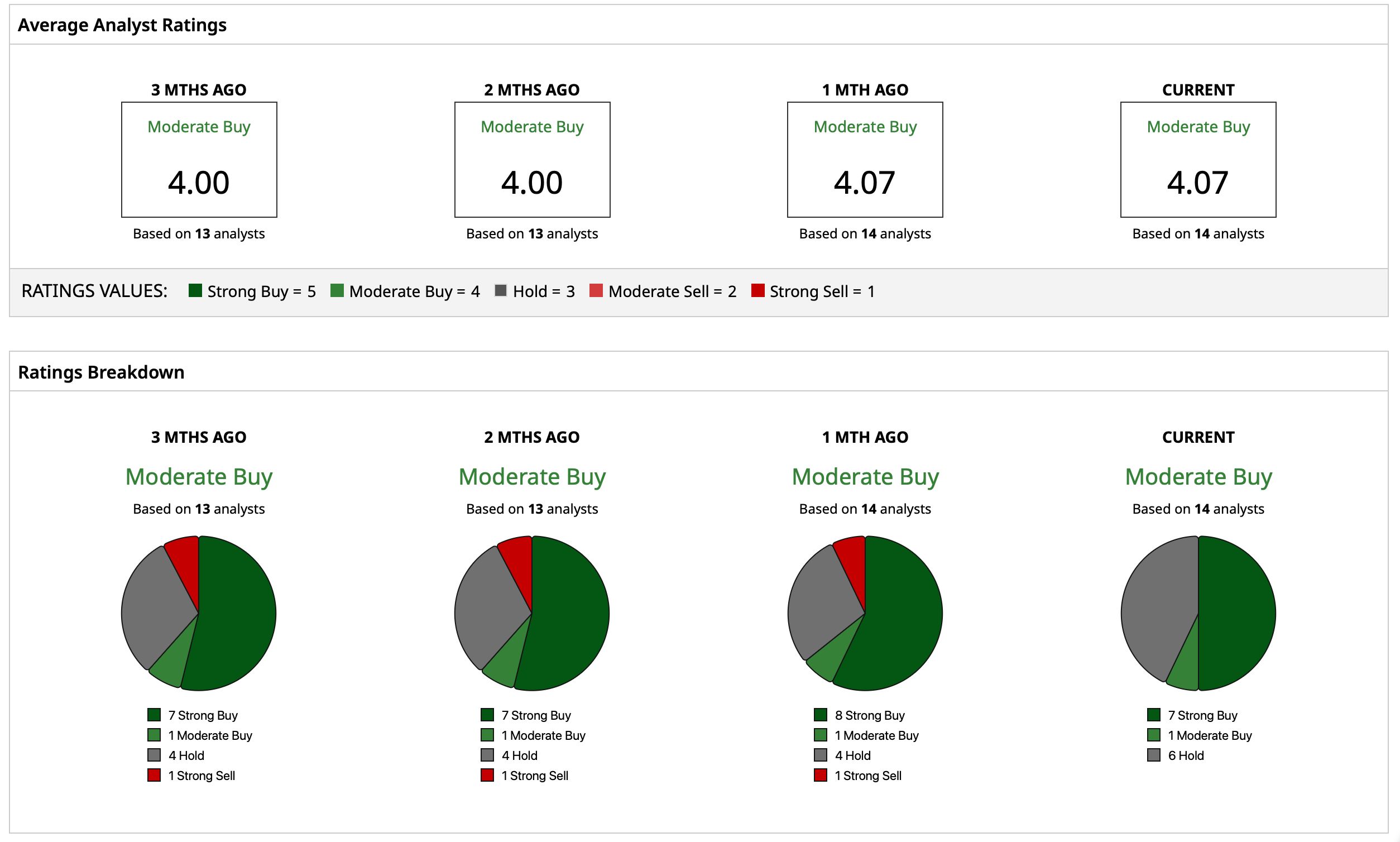
Thus, analysts have deemed PL stock to be a “Moderate Buy.” The mean target price of $35.42 indicates a potential upside of 102.4% from current levels. Out of 14 analysts covering the stock, seven have a “Strong Buy” rating, one has a “Moderate Buy” rating, and six have a “Hold” rating.
 www.barchart.com
 On the date of publication, Pathikrit Bose did not have (either directly or indirectly) positions in any of the securities mentioned in this article. All information and data in this article is solely for informational purposes. For more information please view the Barchart Disclosure Policy here.
More news from Barchart
How to Play FSLR Stock as First Solar Wages an International Solar Panel Legal Battle Microsoft Put Credit Spread Plays Are Working Well as Analysts Hike their MSFT Price Targets Planet Labs’s Satellite Was Just Launched into Orbit. What This Means for PL Stock. Following a Major Business Transformation, ChronoScale Is Doubling Down on AI Infrastructure Bet