

Snowflake (SNOW) spent years trying to convince investors that its growth slump was temporary. Now Wall Street is starting to believe it. Not only did Snowflake beat estimates in the fiscal second quarter, but growth has also started accelerating again, with AI becoming more integrated with the company's core data platform.
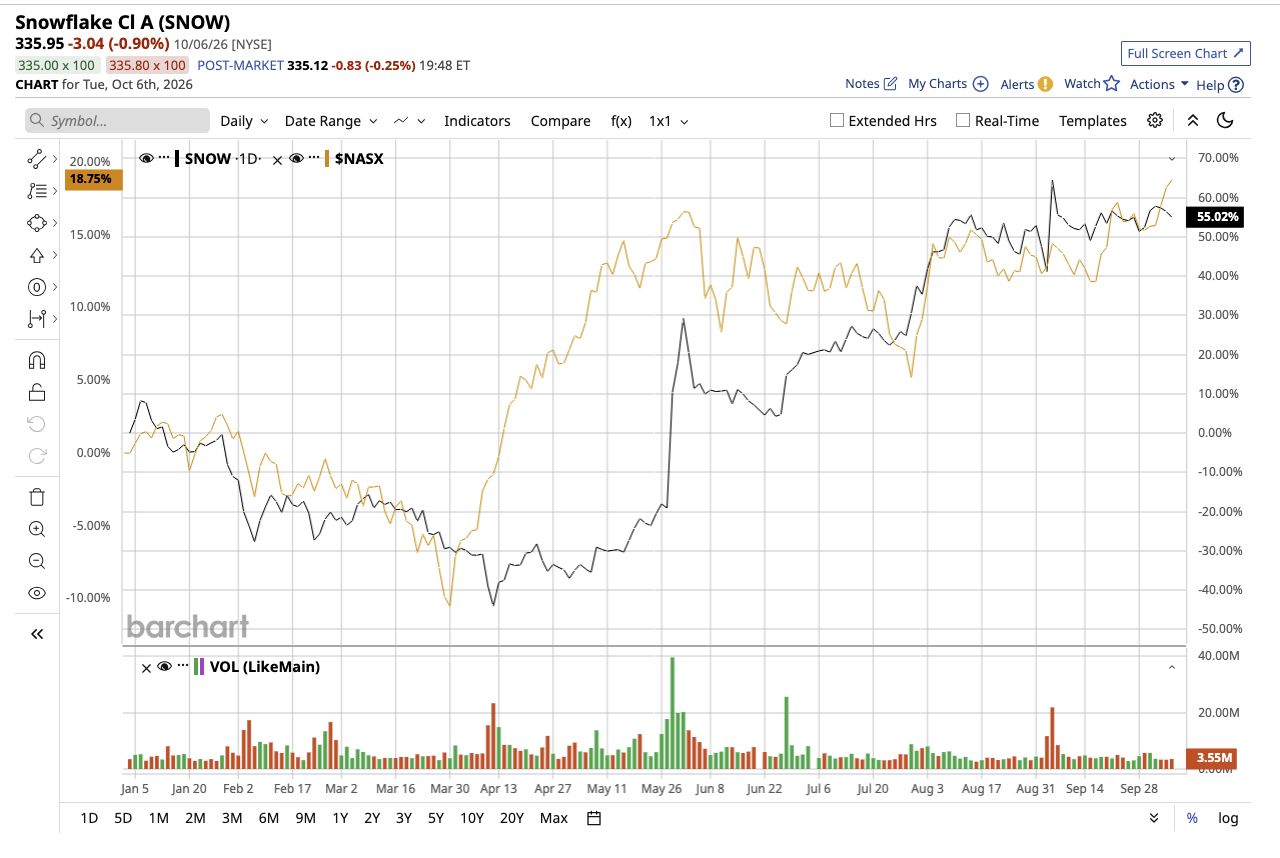
SNOW stock has already climbed 55% year to date, outperforming the Nasdaq Composite’s gain of 18%. And now many analysts have raised their target prices for SNOW stock to as high as $525. So, what changed in Snowflake's business that caused so many analysts to raise their targets?
More Top Stocks Daily: Go behind Wall Street’s hottest headlines with Barchart’s Active Investor newsletter.
 www.barchart.com
 Citi Sees the AI Flywheel Getting Stronger
Wall Street’s view has definitely shifted to the bullish side. Together, these views offer useful insights into what is changing in Snowflake's long-term investment case.
Citi analyst Tyler Radke raised his Snowflake price target to $490 from $395 while maintaining a Buy rating. The analyst stated that the second quarter of fiscal 2027 earnings supported the “AI-driven flywheel thesis.”
Valued at $119.6 billion, Snowflake provides the data infrastructure that enterprises use to store, process, analyze, and share data. Snowflake says, “AI is bringing new workloads onto the platform” because enterprises need governed data and business context to make AI useful. This usefulness showed up in its Q2 numbers. Snowflake generated $1.49 billion in product revenue, up 37% from the same period last year. Growth has now picked up for three quarters in a row. Management said the increase came from both the core data platform and a meaningful step-up in AI revenue.
Snowflake's net revenue retention rate stood at 126%, meaning existing customers were expanding their spending. The company added 692 net new customers during Q2, up 32% YOY, and 48 customers crossed $1 million in trailing-12-month spending during the quarter. Snowflake ended Q2 with 828 customers spending more than $1 million annually. This supports Citi’s thesis. AI is making Snowflake’s underlying data platform more valuable because customers need more data, more processing, and more AI-related workloads.
Stifel Is Looking Beyond One Strong Quarter
Stifel raised its Snowflake price target to $450 from $350 while keeping a Buy rating as the firm sees more growth ahead. The firm pointed to Snowflake's Q3 product revenue guidance of 37% to 38%, which implies another quarter of acceleration. Plus, management raised the fiscal 2027 product revenue guidance to $6.07 billion, representing 36% growth. Product revenue grew 37% this quarter, after growing 34% in the previous quarter and 30% in Q4 of fiscal 2026. This acceleration is important as Snowflake operates on a consumption-based model. Basically, customers use the platform for data workloads, and greater activity can translate into greater consumption.
Furthermore, its remaining performance obligations increased 30% YOY to $9 billion. Snowflake expects to recognize roughly 54% of that as revenue over the next 12 months. The company's own guidance says the elevated growth rate is expected to continue into Q3, which explains why Stifel is bullish.
Cantor Sees AI Creating Two Revenue Opportunities
Cantor Fitzgerald raised its price target to $430 from $405 and maintained an Overweight rating. Analyst Thomas Blakey pointed to Snowflake's strong Q2 results and its position as a beneficiary of secular AI growth, particularly because its AI products can generate incremental revenue while increasing consumption of the core cloud data platform. Snowflake said AI revenue increased meaningfully during the quarter, driven by its broader collection of products, including Cortex Code, CoWork, AI Functions, document processing, machine learning, and notebooks. Notably, Cortex Code adoption reached 5,800 accounts, up about 11% sequentially. Meanwhile, CoWork added around 2,000 net new accounts during Q2 and crossed 9,100 accounts in total.
Essentially, Cortex Code and CoWork allow users and developers to interact with that data using conversational language, while Snowflake provides the governance, security, and underlying infrastructure. This means that Snowflake can monetize AI capabilities while also potentially expanding the amount of work being performed on its existing platform.
Snowflake now has 65 customers generating more than $10 million in trailing-12-month product revenue, with 43% of them sharing data through Snowflake through at least one stable external connection. Snowflake aims to become the controlled layer through which enterprise data, applications, and AI agents interact. If customers increasingly utilize Snowflake for all three, AI can increase both the number of products Snowflake sells and the amount of activity running through its platform. This is exactly what the analyst meant.
The Bull Case Still Has a Valuation Problem
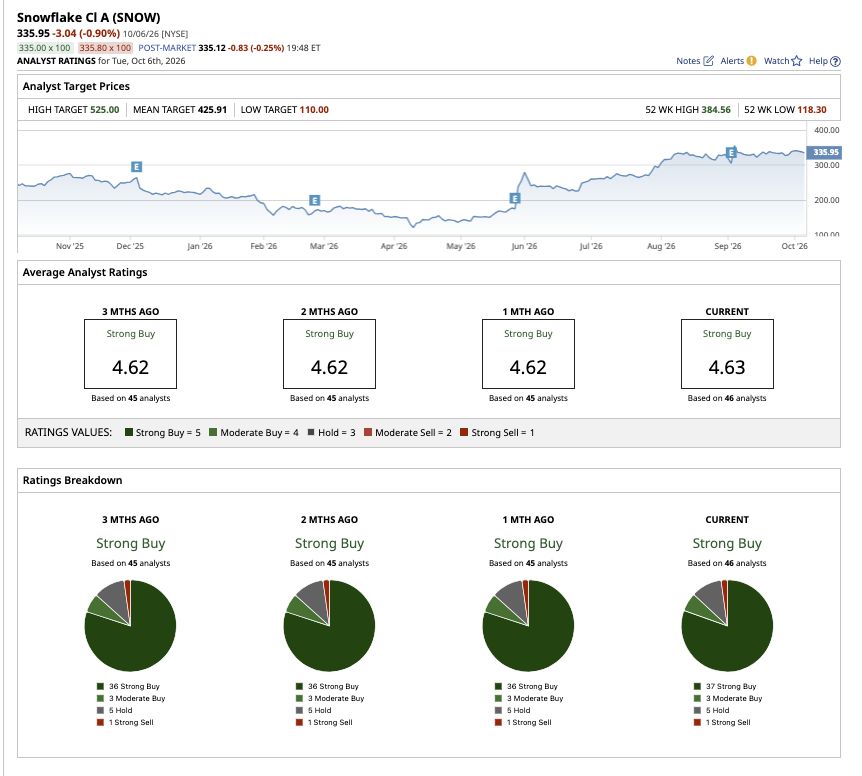
Besides these three, Citi, Barclays, J.P. Morgan, Bank of America, Goldman Sachs, Wells Fargo, Deutsche Bank, and a number of other firms raised the target price for SNOW. Overall, Wall Street is strongly bullish about SNOW stock, with 37 analysts of the 46 covering it rating it a “Strong Buy,” three rate it a “Moderate Buy,” five say it is a “Hold,” and one rates it a “Strong Sell.” The average target of $425.91 implies substantial upside of 26.7%, while the highest target price sits at $525, which suggests the stock can climb by 56% from here.
Currently, SNOW stock is trading at roughly 151x forward 2027 earnings, which are expected to increase by 77.8%. Analysts further expect earnings to increase by 35% in fiscal 2028. While Wall Street is clearly becoming more optimistic about the business, investors are not getting that optimism at a cheap price. Snowflake has to keep turning AI adoption into accelerating platform consumption, sustain growth around the upper-30% range, and continue expanding margins. The next phase of the story will be whether its earnings can grow quickly enough to catch up with the expectations already embedded in the stock.
 www.barchart.com
 On the date of publication, Sushree Mohanty did not have (either directly or indirectly) positions in any of the securities mentioned in this article. All information and data in this article is solely for informational purposes. For more information please view the Barchart Disclosure Policy here.
More news from Barchart
TSMC Could Partner with Elon Musk’s Terafab. How Intel Stock Could Lose Big. How to Play United Microelectronics Stock as Revenue Surges U.S. Stock Futures Slump as Oil Prices and Bond Yields Surge These 3 Catalysts Make Microsoft Stock a Bargain Before Year-End