

Nvidia (NVDA) just handed itself a $150 billion shopping budget, with the only thing to buy being its own stock.
On September 28, 2026, the board added that amount to the share repurchase program, which brings the total left to spend to $235 billion. In everyday terms, a share repurchase is a company buying back its own shares so each remaining share owns a bigger piece of the business.
More Top Stocks Daily: Go behind Wall Street’s hottest headlines with Barchart’s Active Investor newsletter.
As for the timeline, Nvidia expects to finish the program by the end of fiscal year 2028, which lands on Jan. 30, 2028, so today I'll focus on the speed and where the money will come from. Funny enough, Nvidia spent more on other companies' shares than on its own in the first half of this fiscal year, and I'll cover that later.
But the best place to begin is the pace, because the deadline asks Nvidia to buy back stock at roughly double its recent clip.
Finishing the $235 Billion Buyback by January 2028 Means Doubling the Pace
So far, Nvidia has been buying back about $20 billion of its own stock every quarter, with $20.2 billion in the first quarter of fiscal 2027 and $19.7 billion in the second quarter. That pace held when the board made its move, since the remaining authorization fell from $99.3 billion on July 26 to $85 billion right before the $150 billion increase on Sept. 28. That means about $14 billion was spent in those nine weeks, the same speed as before.
 Screenshot courtesy of www.nvidia.com
 But the new deadline asks for much more, because $235 billion spread over the roughly 16 months left through fiscal 2028 works out to about $44 billion a quarter, or a little more than double the old pace. In share terms, $235 billion buys close to 1.02 billion shares at the Oct. 1 close of about $231, or 4.2% of the 24.1 billion shares outstanding.
That said, the full 4.2% will not show up in the share count, because Nvidia also issues new shares to employees, and those awards added a net 46 million shares in the first half. If that continues, I think the share count will fall about 3.7% by the deadline, or 2.8% a year, compared with only 0.8% over the past year.
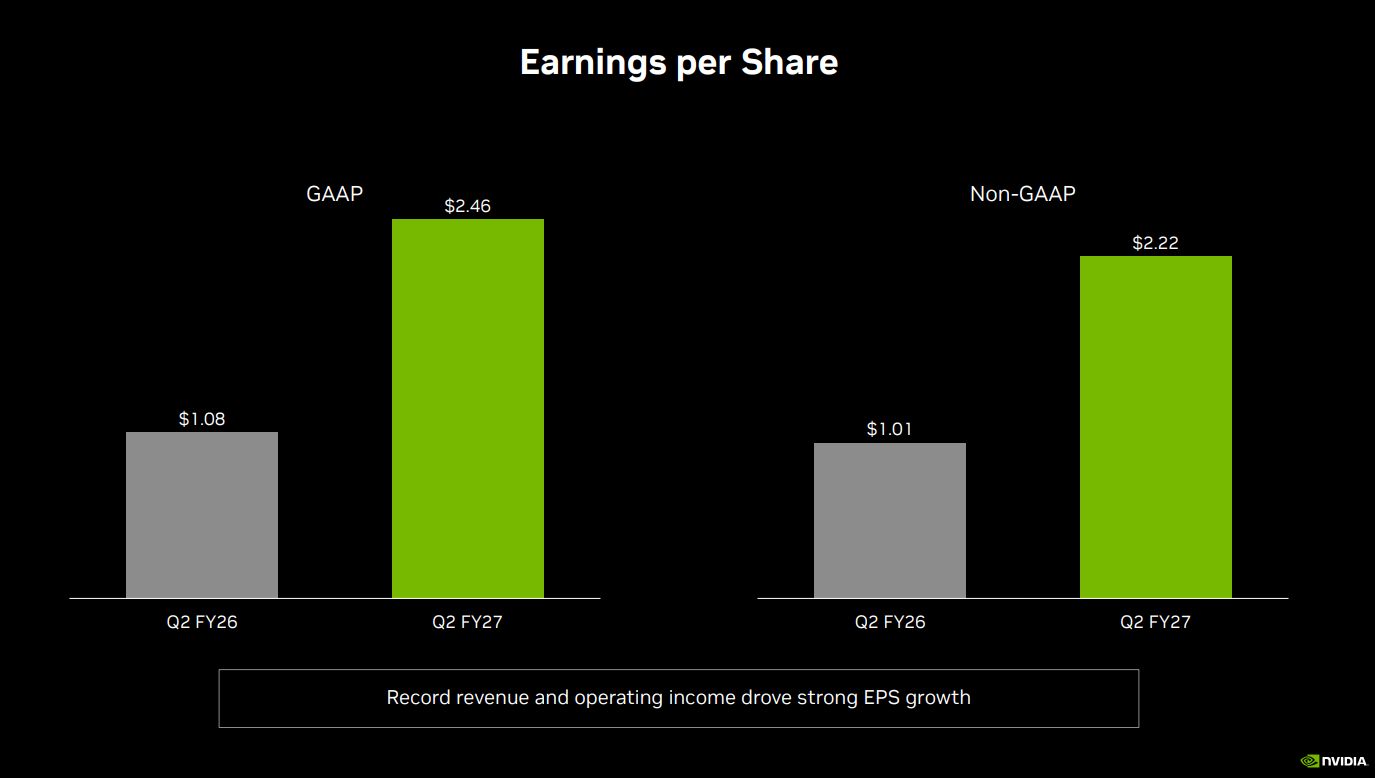
Personally, I see 2.8% a year as a nice little bonus next to guided revenue growth of about 70% for fiscal 2028. I think the real message is the commitment itself, since a board only signs up for $44 billion a quarter when it expects much more cash to come in.
 Screenshot courtesy of www.nvidia.com
 So the upcoming Nov. 17 report lets us check the pace, since the third quarter ends on Oct. 25, only four weeks after the increase. If Nvidia goes all-in right away, buybacks for the quarter will come in near $28 billion. A number closer to $21 billion would mean the old pace simply carried on.
Either way, I would not read too much into one quarter, because the deadline is only a goal and the program can be paused. Still, buying back stock this fast takes serious cash, and Nvidia has been spending plenty of it elsewhere.
Nvidia Spent More on Other Companies' Stock Than on Its Own
I had to read the cash flow statement twice because Nvidia spent $42.4 billion buying shares of other companies in the first half of fiscal 2027, topping the $39.0 billion spent on its own buybacks. A big chunk went to frontier AI labs like OpenAI and Anthropic, which are also major buyers of Nvidia's chips.
Management does not sound sorry about it either, because CFO Colette Kress said last quarter that Nvidia has put nearly $50 billion into these labs, and CEO Jensen Huang added that his only regret is not investing more and sooner. I take him at his word, because another $25 billion is already committed, with $18 billion of it due by the end of January.
However, my concern here is where the buyback sits in line. Kress said the plan is to return 50% or more of free cash flow, and that Nvidia intends to return the excess "net of strategic uses," which I read as investments getting paid ahead of everything else and the buyback getting whatever is left.
 Screenshot courtesy of www.nvidia.com
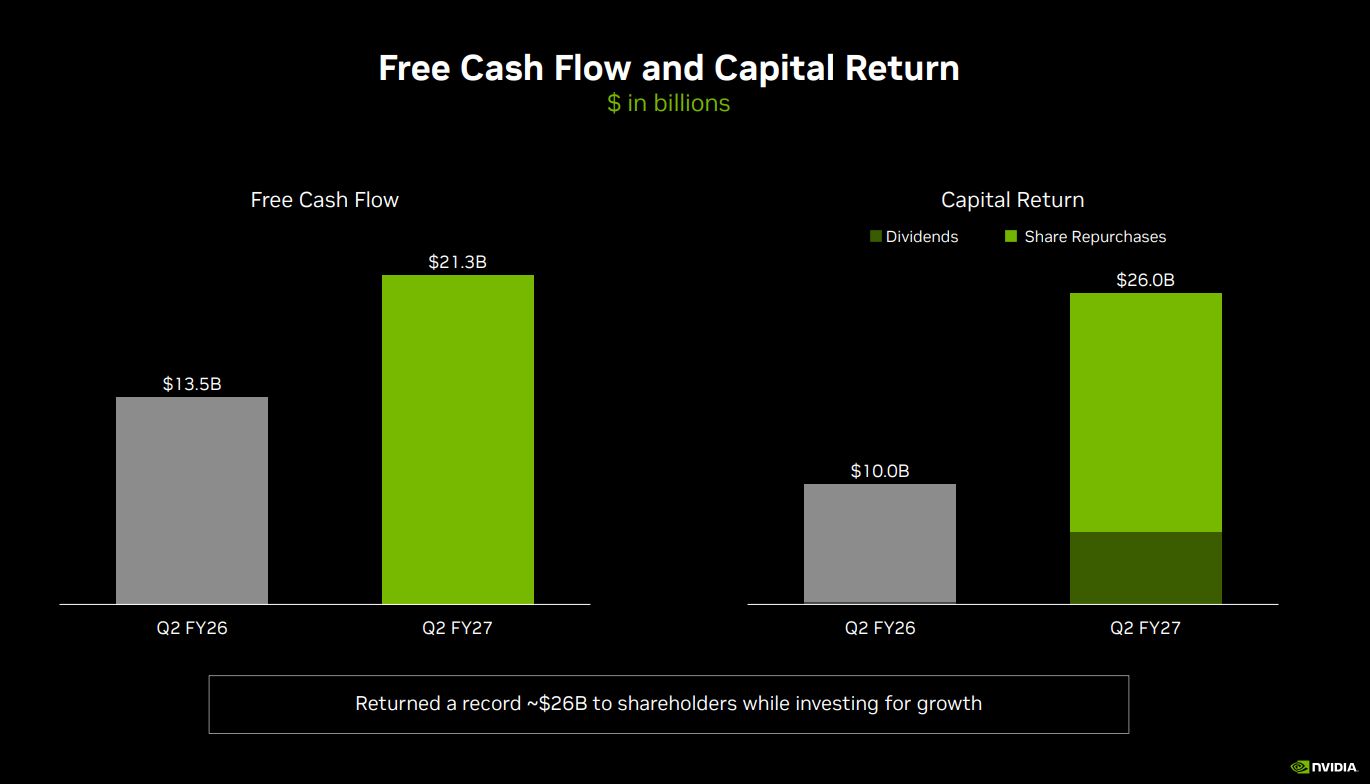
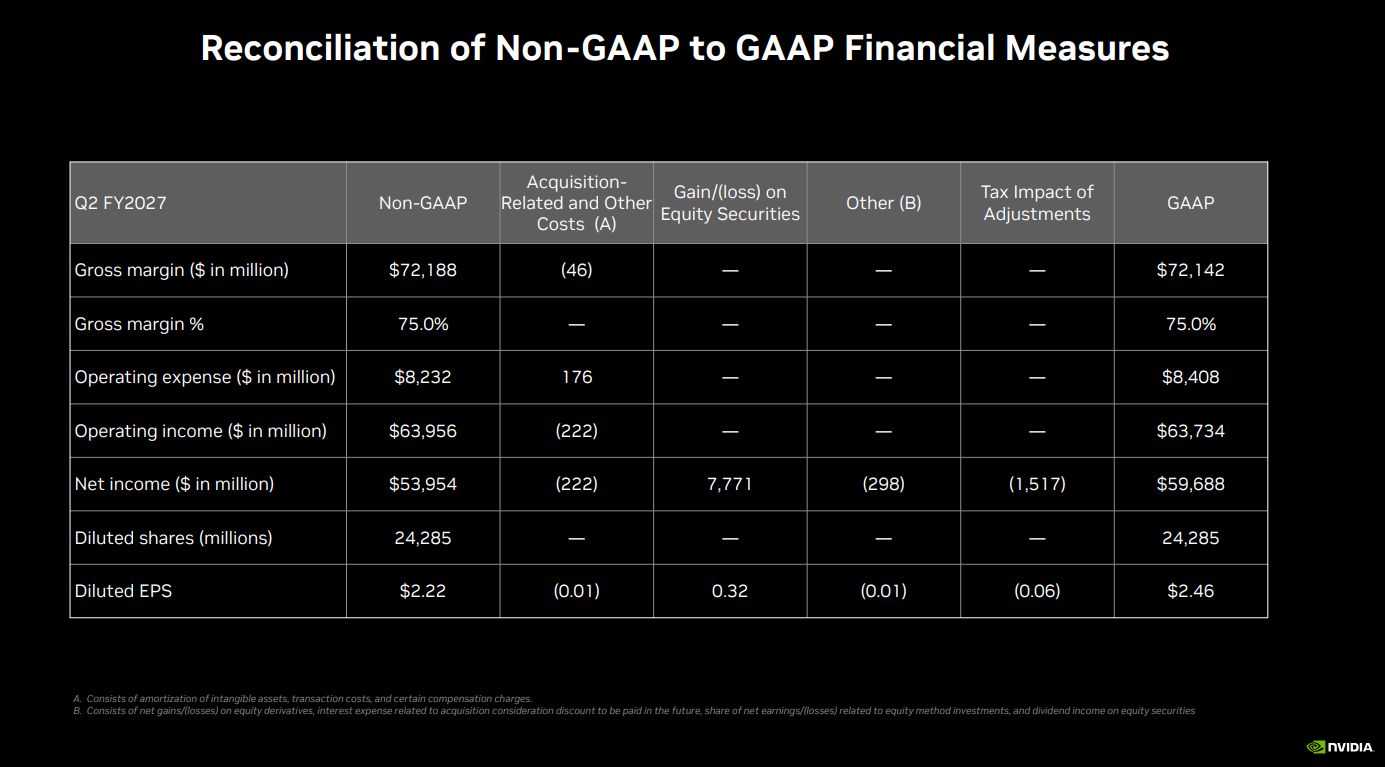
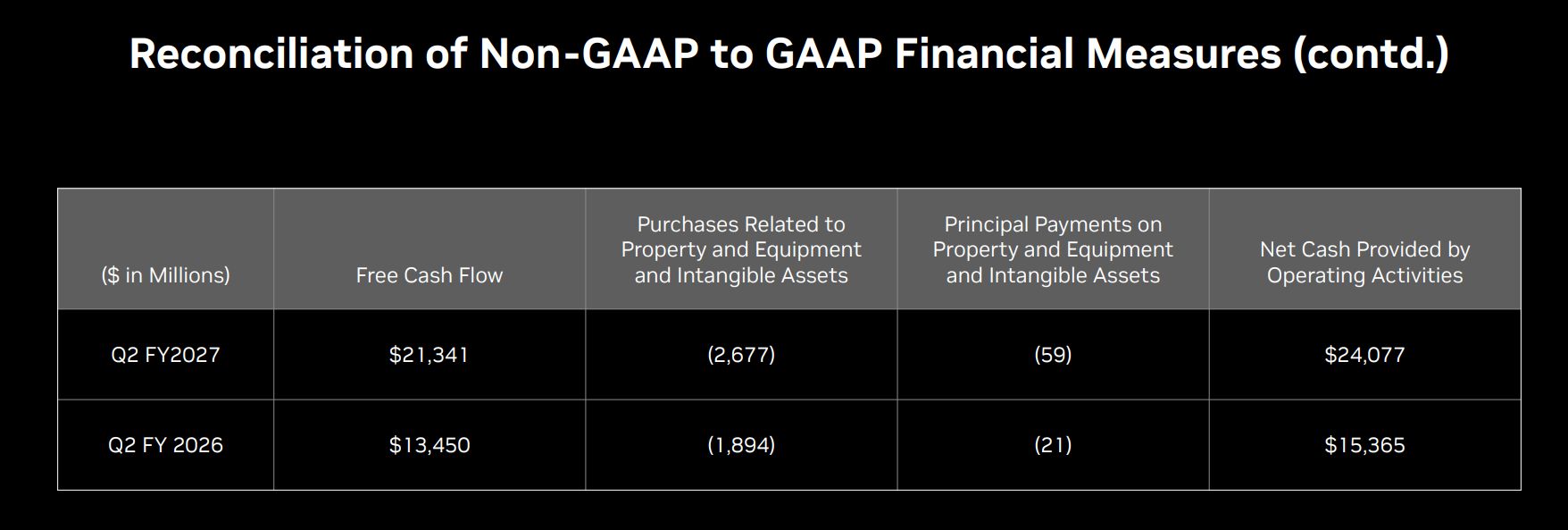
 To me, that leftover already looks tight, because buybacks and dividends added up to $25.8 billion in the second quarter while free cash flow was $21.3 billion, and Nvidia raised $25 billion through notes in June.
The math only gets harder from here, because a $44 billion buyback each quarter plus the dividend comes to about $200 billion a year, while free cash flow over the past four quarters was $126.9 billion. I think the gap can close with revenue guided to rise about 70% in fiscal 2028, as long as profits keep turning into cash.
Even so, I am not losing sleep over the investments themselves, because the whole portfolio is now carried at about $99 billion and Huang said he expects two of the labs to go public soon. Once that happens, I think Nvidia could sell some shares to help fund its own buyback, which would be a pretty neat way to close the loop.
 Screenshot courtesy of www.nvidia.com
 But what still bugs me is how circular it all looks, since Kress said the labs that Nvidia backs financially should make up roughly 25% of next year's business. For now, I prefer to give that slice a little less credit, at least until the labs are paying with money Nvidia did not help raise.
Of course, all of that cash depends on Nvidia having enough product to sell, and the company has been locking in supply in a big way.
Supply Commitments Jumped to $279 Billion From $119 Billion in One Quarter
Demand is running well ahead of what Nvidia can build. Specifically, Kress said customer forecasts point to about 100% growth next year, while she guided fiscal 2028 revenue up about 70% and called that a supply-constrained outlook.
 Screenshot courtesy of www.nvidia.com
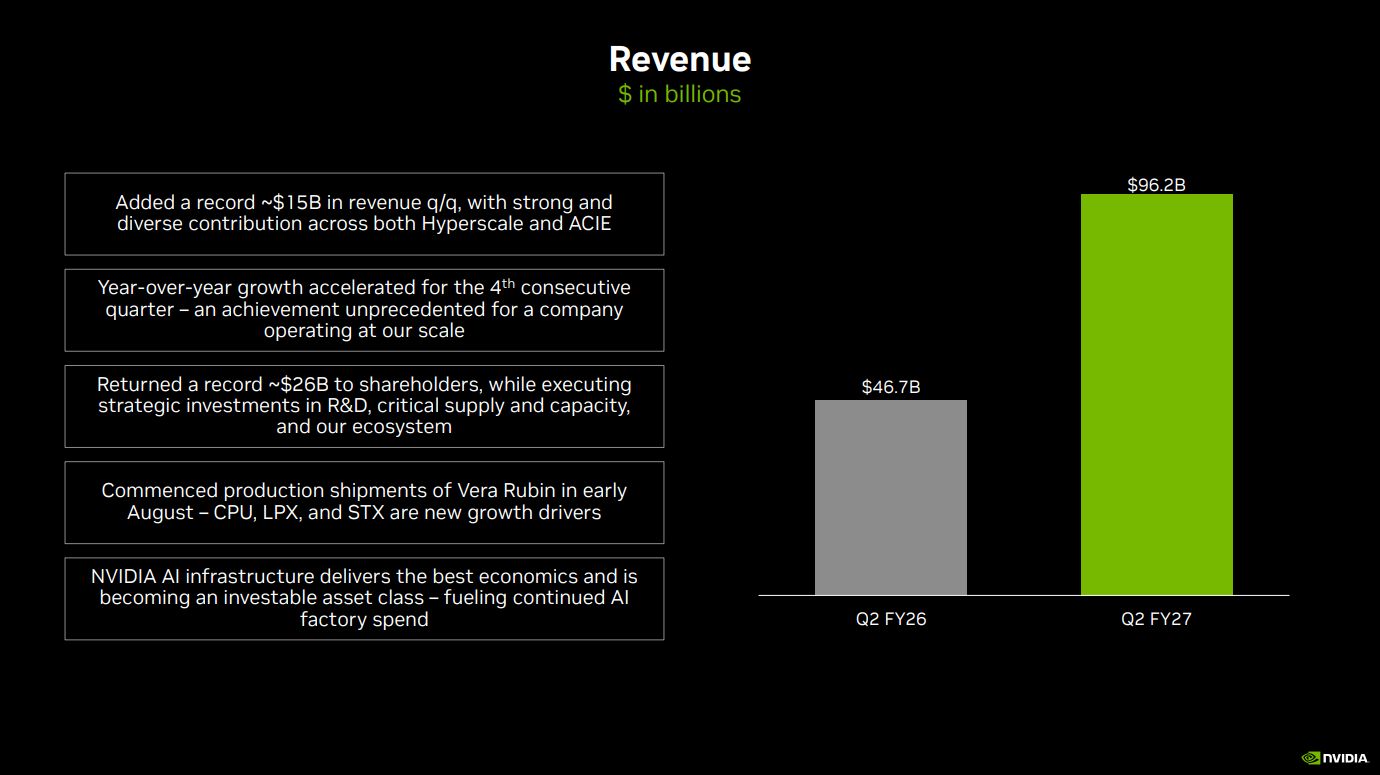
 I mean, 70% is no small number on its own. The first half plus the third-quarter guide already adds up to about $286 billion, so even if the fourth quarter only matches the third, fiscal 2027 lands near $394 billion. From there, I estimate fiscal 2028 revenue lands near $670 billion.
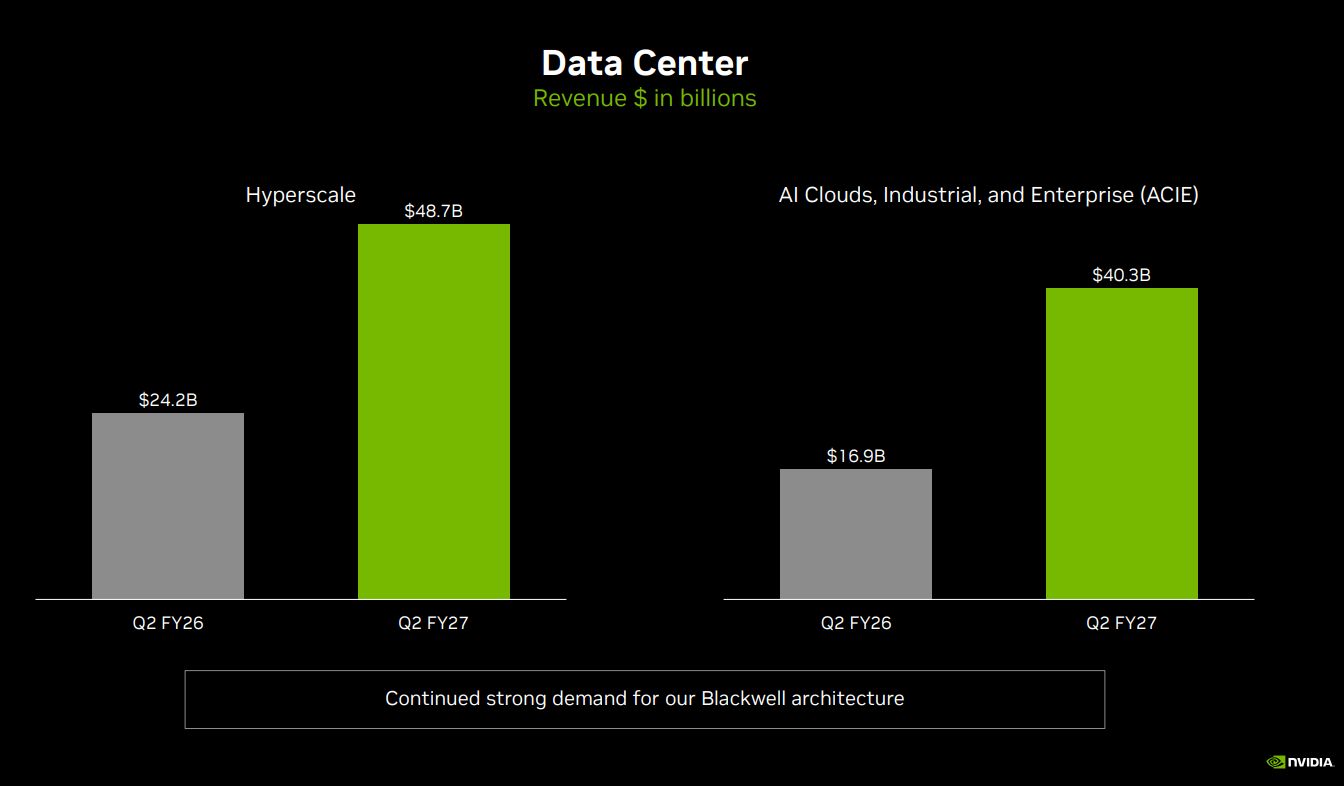
So the real question is whether Nvidia can deliver the 70% in the first place, and this is where the supply commitments give me comfort. The total jumped from $119 billion to $279 billion in just one quarter, mostly to secure memory, with $92 billion due over the rest of fiscal 2027, $87 billion in fiscal 2028, and $88 billion in fiscal 2029.
On that note, the $92 billion due over the next two quarters caught my eye too, because it is about 1.9 times the second quarter's cost-of-revenue pace, which I think is more than this year's shipments need. In other words, Nvidia is already buying for next year.
Even so, I like what these memory deals do to the competition. Memory is in short supply across the industry, so whatever Nvidia locks up for three years is supply that rivals have to fight over, and the technology partnership with SK hynix (SKHY) points the same way.
None of this comes cheap, of course, and the bill shows up in gross margin, which Kress sees settling between 72% and 73% in fiscal 2028, down from 75.0% last quarter. I am fine with that trade, because 70% more revenue at that margin still means roughly 65% more gross profit, and this is what would make a $44 billion quarterly buyback affordable.
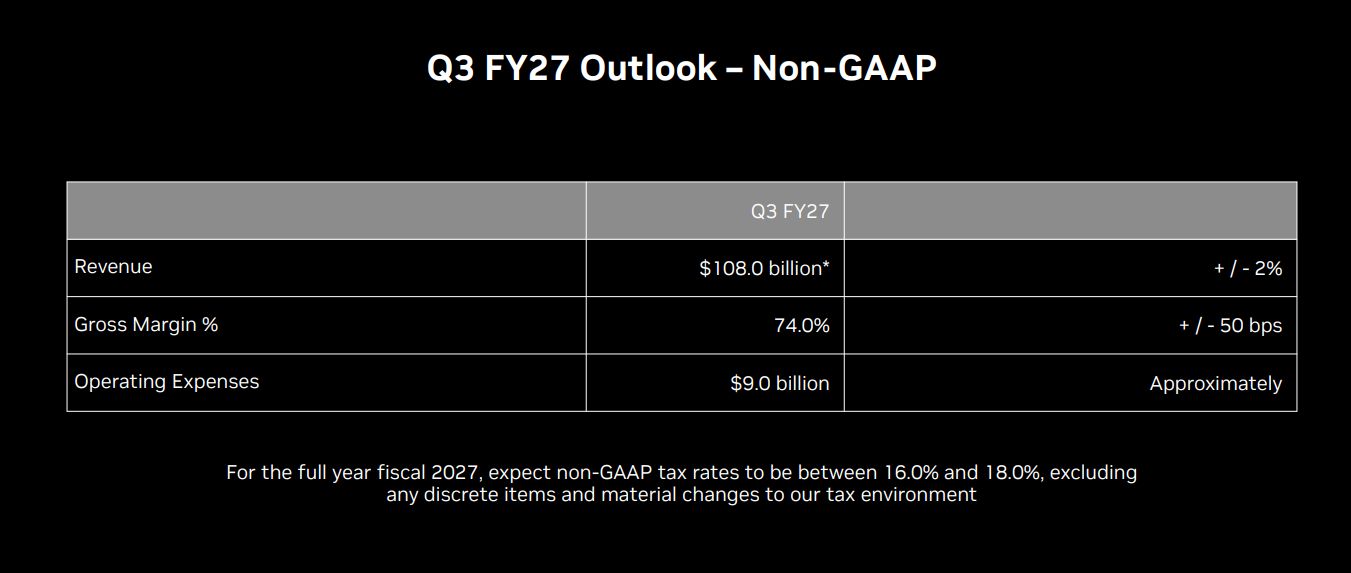
As for Nov. 17, I will check whether commitments keep climbing and whether the 70% outlook holds, along with third-quarter revenue against the $108 billion guide and the roughly 20% of data center sales expected from Vera Rubin.
 Screenshot courtesy of www.nvidia.com
 But my one worry is that Nvidia would be holding $279 billion of promises made at shortage prices if AI spending ever took a breather. For now, the growth looks well supported to me, which leaves the question of how quickly those sales turn into cash.
Why Nvidia's Customers Now Take 60 Days to Pay Instead of 45
Cash is coming in slower than it used to, which is the least comfortable part for me. Days sales outstanding went from 45 to 60 in the second quarter, with receivables up 55% to $63.1 billion from the first quarter, while revenue grew only 18% over the same stretch. Nvidia says this came from longer payment terms on very large orders from investment-grade customers, and the quarterly filing adds that those terms can run anywhere from 90 days to one year.
 Screenshot courtesy of www.nvidia.com
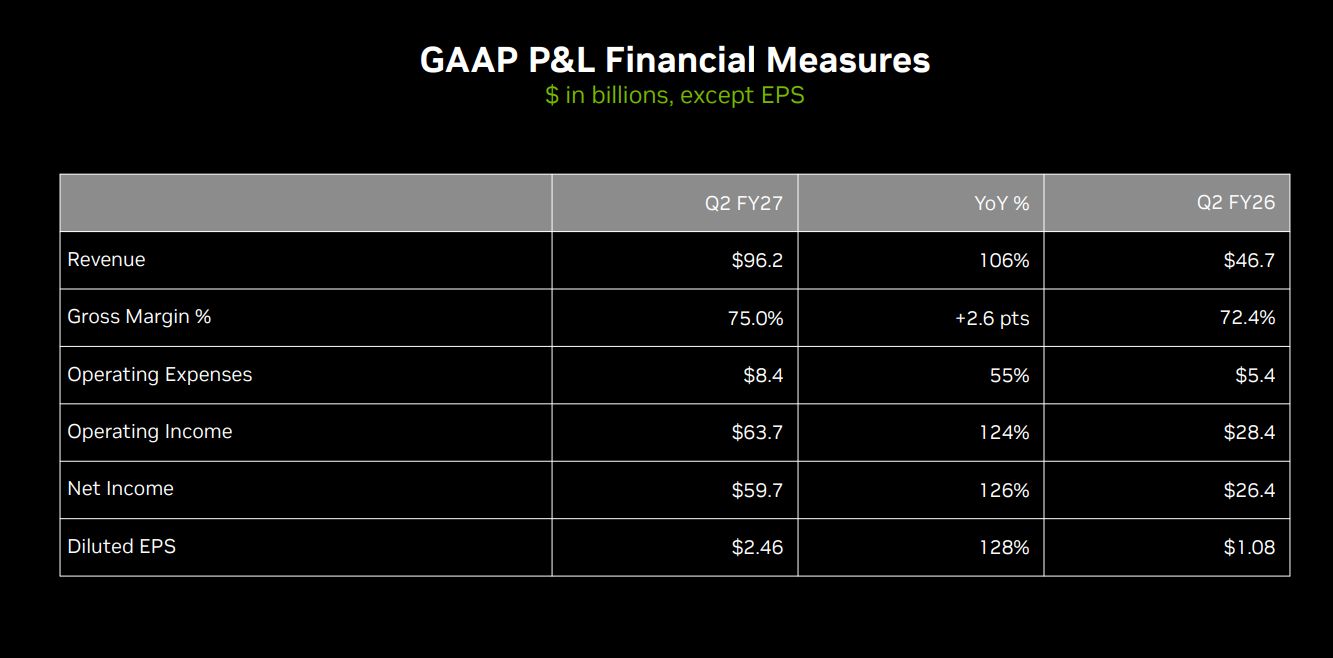
 Investors can see the effect right on the cash flow statement, where receivables soaked up $22.3 billion and operating cash flow came in at $24.1 billion against net income of $59.7 billion. To be fair, $7.8 billion of that net income was investment gains that were never going to be cash, and even after backing those out, less than half of the profit showed up in the bank.
 Screenshot courtesy of www.nvidia.com
 In other words, I see this as a quiet form of lending, because Nvidia has the deepest pockets in an industry where customers are building faster than lenders can keep up. Easier terms help close deals, so I get why management is doing it.
Still, credit quality looks fine to me, since these are financially strong buyers and others are still paying early, with $15.6 billion of customer advances in the first half. But I want to keep an eye on concentration, because five customers now hold 70% of receivables.
All of that matters for the buyback, because slower collections and a faster buyback pull on the same pile of cash. At the third-quarter revenue guide of $108 billion, 60 days of sales works out to about $71 billion of receivables, so the balance grows by about $8 billion even if terms stop stretching.
If terms do keep stretching, each added day ties up about $1.2 billion, so I think another 15-day slide would lock up around $18 billion, or roughly 40% of a $44 billion quarterly buyback.
Nvidia has the cushion for that, with $56.6 billion in cash and marketable debt securities on hand and a $25 billion commercial paper program it hasn't touched. I think the likelier outcome is a slower buyback, or Nvidia borrowing again like it did with the $25 billion of notes in June.
So when the Q3 fiscal 2027 report comes out on Nov. 17, I'll look at days sales outstanding before anything else. If it's at 60 or lower, I think the second quarter jump was just a few big contracts landing at once. If it's creeping into the high 60s, then longer terms are becoming the norm for how Nvidia does business, and I'd be less relaxed about the buyback.
So after weighing the pace, the supply, and the cash, where do I land on the stock?
Why I Still Think Nvidia Is a Sound Investment Right Now
For what it's worth, I think now's a great time to buy and hold Nvidia. I say that knowing full well it won't be a smooth ride, and I'd be lying if I didn't say this company gives me pause. I've followed enough stocks to know the perfect setup rarely shows up, and waiting for it usually costs more than it saves.
To me, this is a business that keeps giving shareholders good reasons to stick around, and a buyback that has to run at double its recent pace is one more, as long as the cash shows up. That's about as much as I ask for. So if investors can live with a few bumps, I think it deserves a spot in their portfolios.
On the date of publication, Rick Orford did not have (either directly or indirectly) positions in any of the securities mentioned in this article. All information and data in this article is solely for informational purposes. For more information please view the Barchart Disclosure Policy here.
More news from Barchart
Nvidia's $235 Billion Stock Buyback Has a Catch Nobody Is Talking About Sunrun’s Unusual Options Activity Points to 3 Possible Multimillion-Dollar Bets Marvell Stock Is Surging on Raised Guidance. How to Play MRVL Here. Goldman Sachs Just Upgraded Palantir Stock. Here's Why