


Little has gone right for FMC (FMC), and it has slid from one low to the next. The stock fell over 30% yesterday, Oct. 15, after it issued a shock Q3 guidance, saying it expects revenues to land between $65 million and $125 million, a fraction of what analysts were modelling.
FMC’s Big Q3 Guidance Miss
FMC expects to report adjusted losses before interest, tax, depreciation, and amortization (EBITDA) between $510 million and $565 million when it releases its Q3 earnings later this month. Management said that while it expects to comply with debt covenants as of the end of Q3, it “intends to engage in discussions with its bank group on potential further modifications to its covenants over the next year to provide greater flexibility.”
More Top Stocks Daily: Go behind Wall Street’s hottest headlines with Barchart’s Active Investor newsletter.
Following yesterday’s crash, FMC has extended its year-to-date (YTD) decline to almost 60%. The dismal price action hasn’t merely been a 2026 thing for FMC, as it has been sliding for years and losing nearly 94% of its market cap over the last decade.
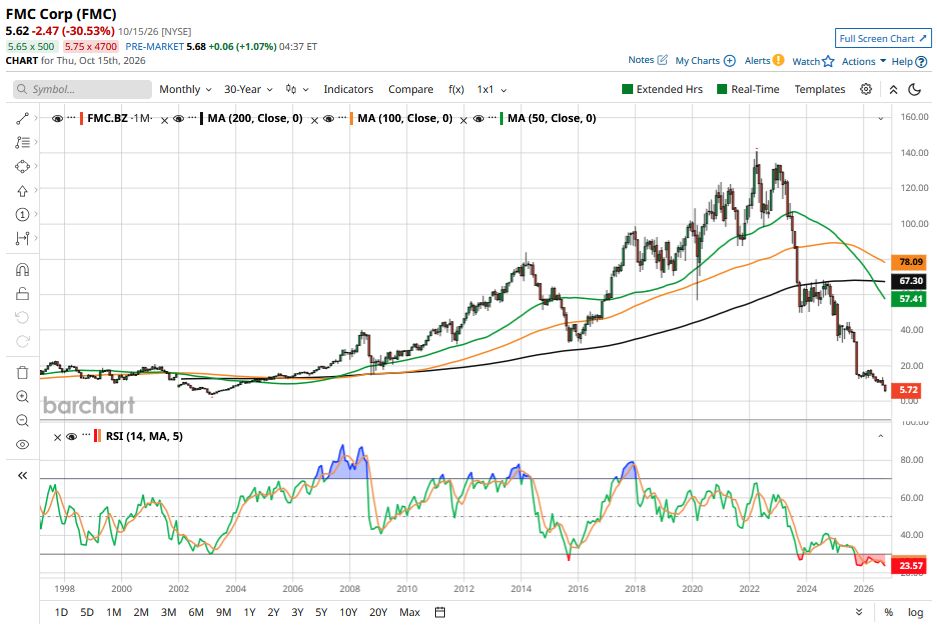 www.barchart.com
In July, I noted that FMC was a high-risk buy. The stock did rise from those levels, and last month I noted it was time to “sell” FMC as it was facing a perfect storm. To be honest, while I did expect FMC to drop, I wasn’t expecting such a massive crash as we saw yesterday.
FMC Takes Steps to Lower Channel Inventories
In its release, FMC said it took “commercial actions” in Q3 that hit its revenues by between $625 million and $675 million. Specifically, the company slashed the prices of some of its products with channel customers. It said that “these products entered the channel under different cost structures, intellectual property positions and competitive conditions.” However, given the competition from generics and the resultant price erosion, these products were not moving in the supply chain due to higher prices. The company had been addressing the issue gradually over the last few quarters, but it determined that “more comprehensive actions are necessary” amid the current market environment and therefore made major moves.
FMC also modified its pricing mechanism. Previously, it set a high gross price and then provided heavy rebates. Now, the company intends to “significantly reduce” the gap between gross and net prices, which would mean a lower gross price and lower rebates.
Battling Falling Sales and Too Much Debt
FMC is facing some serious challenges that are reflected in its price action. The company has lost patent protection on some of its most profitable, higher-margin flagship chemicals, particularly the insecticide ingredient Rynaxypyr, which is leading to higher competition from lower-priced generics. At the same time, buyers have been cautious and are either shifting to cheaper generics or reducing the number of applications.
FMC’s balance sheet is also stretched, and it had a net debt (gross debt minus cash) of $3.8 billion at the end of June. After the crash yesterday, FMC’s net debt is now over four times its market cap. Needless to say, it is an unsustainable situation, particularly as its earnings have taken a beating.
How To Play FMC Stock
FMC has been working on a turnaround, and while the recent actions will be a drain on sales in the near term, they could help improve replenishment demand in the coming quarters.
As part of the turnaround, FMC is exiting uncompetitive ingredients and formulation production assets and shifting production to low-cost sources in Asia. At the same time, it is focusing on new molecules and is diversifying away from insecticides by adding new herbicides to its portfolio. This diversification would help the company during periods when demand for insecticides is low, as has been the case this year. The company is also addressing balance sheet issues by selling non-core assets, which would help it repay some of its debt.
Meanwhile, FMC's valuations have taken a beating after the crash, and the stock trades at a forward enterprise value (EV)-to-sales multiple of 1.35x. The price-to-sales multiple appears even more tempting at 0.25x, but given its high debt, I prefer using the EV-to-sales multiple.
All said, I believe yesterday’s price action was a bit of an overreaction, as these measures may help improve inventory flow in FMC's supply chain. While FMC remains a high-risk speculative play, there could be some more near-term selling pressure as analysts slash their targets and doubts grow over the sustainability of the company's dividend. Even so, I am buying the dip given the reasonable valuations.
On the date of publication, Mohit Oberoi had a position in: FMC . All information and data in this article is solely for informational purposes. For more information please view the Barchart Disclosure Policy here.
More news from Barchart
Here’s Why Cathie Wood Just Bet $12.1M on Archer Aviation Stock FMC Stock Tumbles to Multi-Year Lows After Earnings Shocker. It Looks Worth the Risk Here Cathie Wood Is Avoiding Micron. Micron Bulls Might Want to Celebrate Why Northland Downgraded Astera Labs Even Though It Expects Earnings to Rise