


Allstate (ALL) was one of the top 50 unusually active options on Thursday at 17.45. The Nov. 20 $250 put was one of 16 puts in the top 50, compared to 34 calls. Unsurprisingly, calls outnumbered puts 54% to 46% on the day’s 70.92 million volume, 13.3% higher than the 90-day average.
The major indices were largely in bloodbath territory, with the Nasdaq Composite down 2.6% and the S&P 500 down 1.21%. Tech stocks were hit especially hard, marking their worst day since June. Allstate was up 3.2%.
Can’t Get Enough Options?: Join the list for Barchart’s daily unusual options report, delivered free.
The University of Michigan released its October Consumer Sentiment Index this morning. It checked in at 46.3, the second-lowest figure since the university began tracking consumer sentiment in 1977.
In today’s unusual options activity, I cover Allstate’s unusual options activity from yesterday and why it's a perfect foundation for implementing a Wheel Strategy, which involves selling Cash-Secured Puts for premium income until you acquire the shares through assignment by the buyer. You then turn around and sell Covered Calls for premium income until the buyer calls the shares away.
Sports fans will undoubtedly be watching Game 1 of the World Series tonight between the Tampa Bay Rays and the Milwaukee Brewers. I have no favorite; I hope it’s anywhere near as good as last year’s 7-game spectacular between the Blue Jays and the Dodgers.
Have an excellent weekend.
The Allstate Options in Question

As I said in the introduction, the Nov. 20 $250 put made yesterday’s top 50 unusually active options. It was one of only two on the day, the other being the Nov. 20 $230 put.
The former is the more prototypical option for the wheel strategy because its delta is 0.3258, giving a 67% chance the share price will expire worthless in 30 days, but enough risk for considerably higher premium income.
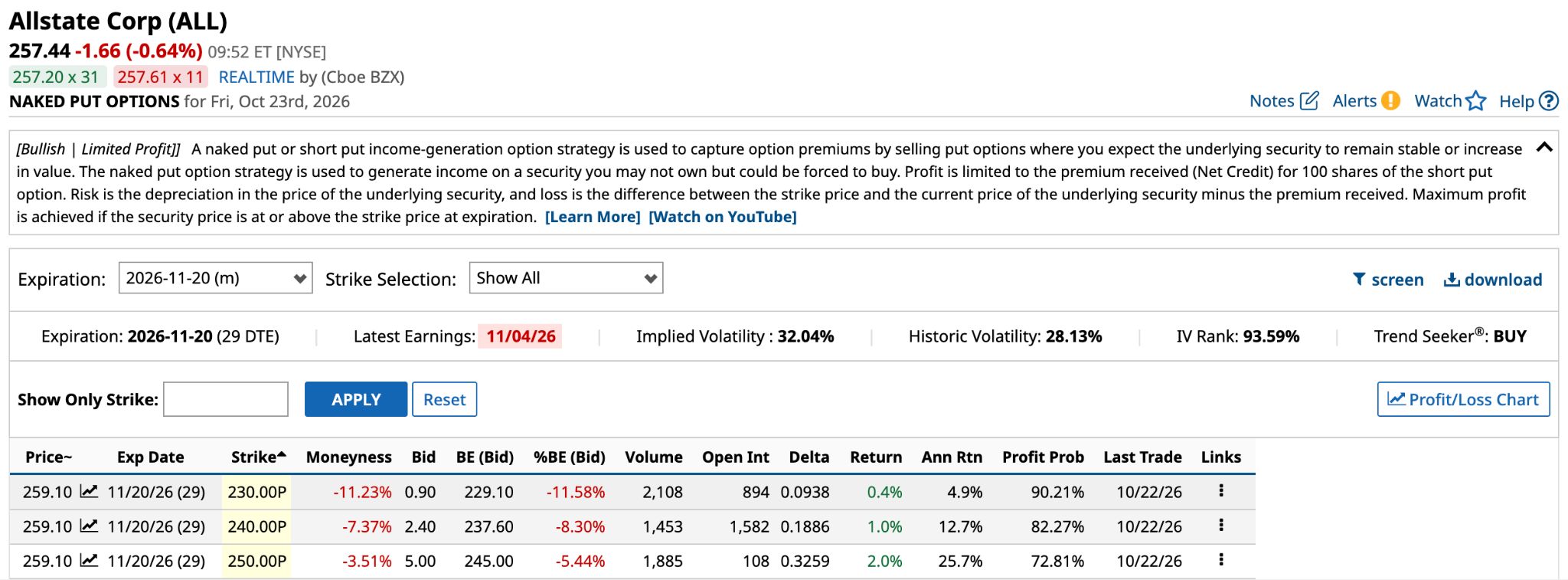
The two unusually active puts are shown above, along with the $240 put, which balances premium income with the likelihood of the share price expiring OTM (out-of-the-money).
The most important two things to remember about selling cash-secured puts: 1) You want to own the stock, and 2) You have the cash in your trading account to buy 100 shares. In Allstate’s case, that’s between $23,000 and $25,000.
As I said earlier, the $250 put is the prototypical strike price for income generation, ultimately leading to share ownership. Successful traders using the wheel strategy tend to look for DTEs (days to expiration) between 30 and 45 days, when time decay is balanced between too slow and too fast. It is often referred to as the “sweet spot” for traders.
Allstate's expected move over the next month is 2.91%. The IV (implied volatility) of 32.04% is considerably higher than its HV (historical volatility) of 28.13%. This gives it an IV rank of 93.59%, meaning its IV is 93.59% of its high over the past year.
Allstate reports its Q3 2026 results on Nov. 4, the day after the midterm elections. A poor result could push its shares down more than the expected 2.91%.
For this reason, I see the $240 put as a safer middle ground. While the annualized return is half that of the $250 put, it’s still 1% per month, which is never a bad thing. Also, with the $2.40 bid, you’d buy the shares, if assigned, at $237.60, $7.40 a share less than the $250 put.
Remember, you do cash-secured puts when you want to own the stock. This gives you a slightly better price. However, if an unforeseen event sends the stock tumbling, you risk buying the shares at the strike price at a loss. This is definitely not a risk-free options strategy.
Why Own ALL Stock?
Allstate is one of the largest personal lines insurers in the U.S. It aims to grow its market share by offering auto, homeowners, and other personal lines insurance, along with protection products such as extended warranty contracts offered through Walmart (WMT), Home Depot (HD), and Costco (COST).
Since launching its Transformative Growth plan in 2019, it has doubled personal lines new business to 11.6 million policies through a mix of its own agents, independent agents, and direct-to-consumer.
Property and casualty insurance premiums are the company's largest revenue generator, accounting for 89% of its $67.69 billion in 2025 revenue. Over the past three years, its combined ratio, a financial metric that measures an insurance company’s underwriting profitability, has fallen from 104.3 in 2023 to 84.9 in 2025. Under 100 is good; over 100 is not. It’s headed in the right direction.
That’s led to much higher profitability. In 2023, it had an adjusted net loss of $316 million. In 2024, that jumped to a $4.55 billion profit and more than doubled in 2025 to $10.17 billion, or 15% of revenue.
If you consider Wall Street’s opinion, you probably don’t. Of the 25 covering Allstate, only 10 rate it a Buy (3.52 out of 5), with a $270.74 target price, only about 6% above its current share price.
However, if you’re looking for a stock that has delivered consistent performance over the last decade, it’s had only two years of negative total returns: -0.32% in 2020 and -19.33% in 2018, and a 10-year annual return of 15.61%. That’s more than acceptable for risk-averse investors.
If you look at Allstate’s total yield (dividend yield + buyback yield) between 2016 and 2026, you’ll notice it was above 7% in six of 10 years. More importantly, in years (4) where the average dividend yield was over 2%, the average buyback yield was 5.75%, suggesting that the insurer’s capital allocation strategy has included aggressive buybacks in years where the share price hit rough patches.
Over the past 10 years, Allstate repurchased $15.82 billion of its stock, with 36% of the buybacks in 2021 and 2022, when it paid an average of $125.22 per share to buy 46 million shares, at prices less than half of what it trades for today.
The Bottom Line on Allstate
As I said earlier, Allstate reports Q3 2026 results on Nov. 4, the day after the midterms. The company reported its third-quarter catastrophe losses on October 15. They were $1.65 billion, up 196% from $558 million in Q3 2025. Nearly half the losses ($748 million) were from August wind and hailstorm damage.
Investors are concerned that higher catastrophe losses will reduce the company’s future profitability. If this happens, it will likely only be temporary. If you’re a long-term investor, this shouldn’t dissuade you. Catastrophe losses are a normal part of the business.
In the first nine months of 2026, its catastrophe losses were $4.61 billion, 2.9% lower than in the same period in 2025 and 1.3% higher than in 2024. The difference between the highest and lowest catastrophe loss levels is less than $200 million. For a company with annual revenues near $70 billion, it’s not a serious issue.
Allstate’s unusual options activity highlights an opportunity to generate income through the wheel strategy. Selling November $230/240/250 puts balances premium income with a discounted entry price, backed by improving profitability, attractive valuation and shareholder returns.
Allstate is expected to earn $36.21 a share in 2026. Its shares trade at 7.0 times this estimate. According to S&P Global Market Intelligence, Allstate’s average P/E ratio over the past decade is 14.22x. At half that, ALL is a buy even though it's up 22% in 2026.
If you’re looking for a stock to use to implement the wheel strategy, Allstate’s unusual options activity has laid the foundation.
On the date of publication, Will Ashworth did not have (either directly or indirectly) positions in any of the securities mentioned in this article. All information and data in this article is solely for informational purposes. For more information please view the Barchart Disclosure Policy here.
More news from Barchart
Allstate’s Unusual Options Activity Sets the Stage for an Income-Generating Wheel Strategy The Best Trillion-Dollar Stock To Sell Puts On Isn’t Tesla Or Broadcom Unusual Options Activity: LEAPS Offer Low-Cost Rebound Bets on 2 Beaten-Down Consumer Stocks Get Paid to Wait: Buy NU Holdings at a Discount or Earn Options Income