

Here’s the thing about Anthropic’s (ANT) relationship with hyperscalers like Alphabet (GOOG) (GOOGL) and Meta Platforms (META). They are collaborators, and they are competitors. So if you are confused by all of that “circular financing,” you are certainly not alone.
That tangled web isn't just an academic debate for venture capitalists. It is showing up in real time on the tape. Specifically, it is starting to cause serious trouble for the Communication Services Select Sector SPDR Fund (XLC).
More Top Stocks Daily: Go behind Wall Street’s hottest headlines with Barchart’s Active Investor newsletter.
 www.barchart.com
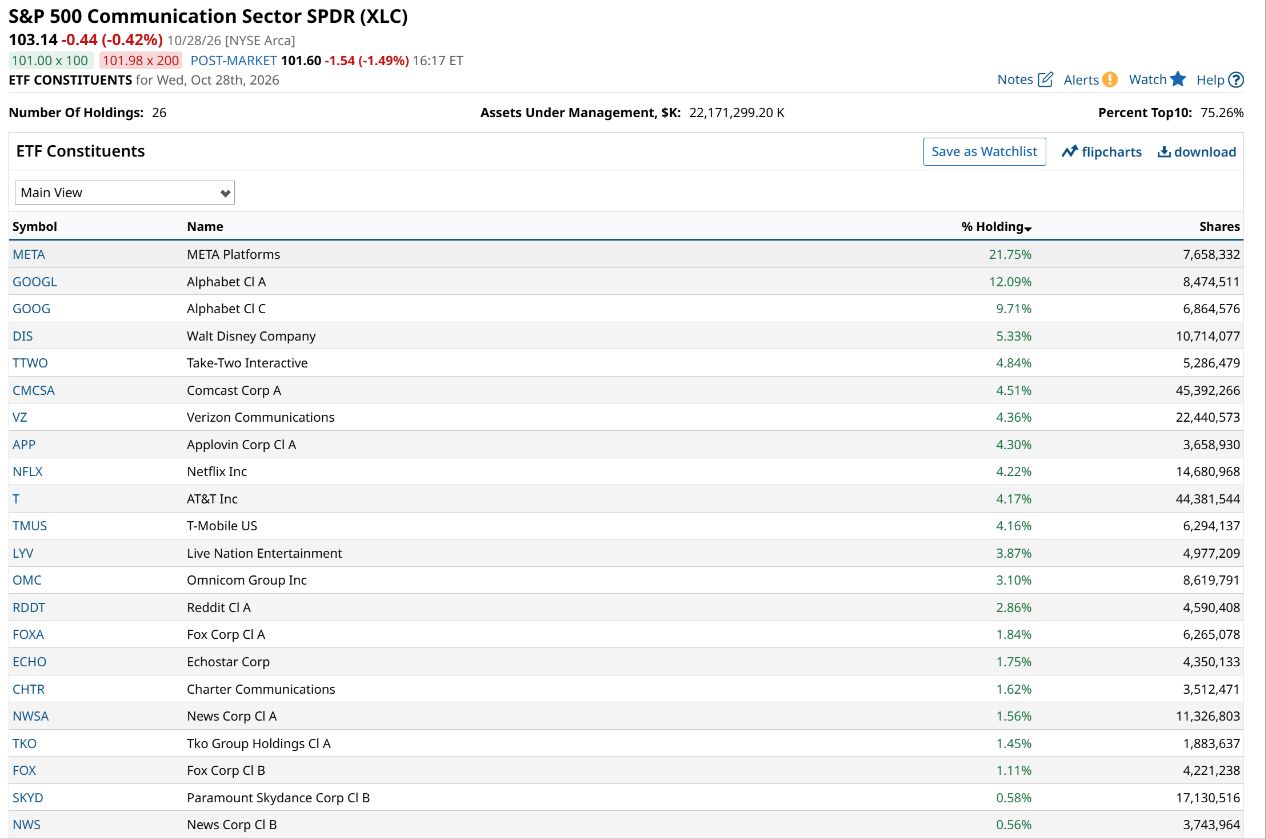
That table shows one of the modern stock market’s classic issues on full display. If you want broad diversification in the communication sector, one of 11 subdivisions of the S&P 500 Index ($SPX), you can’t rely on the biggest index fund with that sector tag.
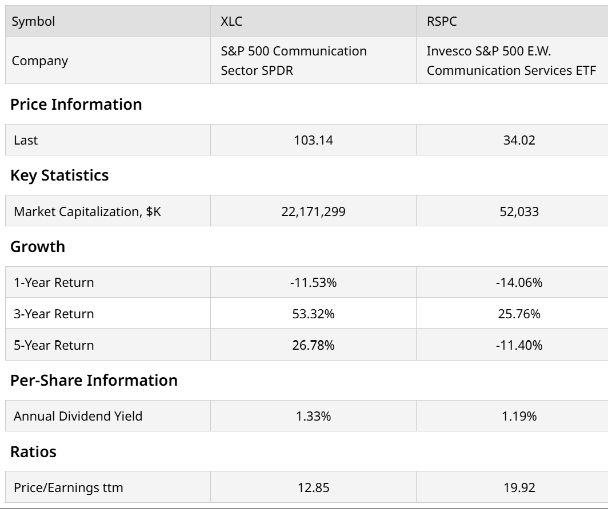
The equal-weighted version for the communications sector is the Invesco S&P 500 E.W. Communication Services ETF (RSPC), and as we see here, it is a fraction of the size of the S&P 500 Communication Sector SPDR (XLC). We’re talking $22 billion in assets for XLC versus only $52 million for RSPC.
XLC has performed much better over time. And its hyper-focused portfolio, topped by a pair of hyperscalers (44% in META and GOOG/GOOGL combined), trades at about a 35% trailing price-to-earnings (P/E) ratio discount to RSPC.
 www.barchart.com
In the game that is predicting the success of ANT post-IPO next month, I think the sudden vulnerability in XLC could be a bearish signal.
If Google and Meta are firing on all cylinders, XLC looks like a genius growth play. But if their AI spending triggers margin compression, or if their cloud and advertising dominance faces friction, XLC drops fast.
Recently, the cracks have begun to show. Investors are no longer giving hyperscalers a blank check to spend hundreds of billions on custom silicon and server farms without showing immediate, tangible returns on invested capital.
As valuation scrutiny mounts, both META and GOOGL have started dragging on XLC. That’s the type of dark cloud over the AI trade that could take some shine off the upside potential for ANT in the coming weeks and months, once it crosses the threshold to become a public company.
Google and Meta’s Relationship With Anthropic
To understand why Meta and Google are stumbling, look at how they interact with Anthropic. Google is one of Anthropic's largest financial backers and primary cloud compute providers. Every time Anthropic trains a frontier Claude model, Google Cloud books revenue.
At the same time, Google is pouring tens of billions into its own proprietary model ecosystem, Gemini, aggressively pitching enterprise clients to bypass third-party models entirely. Google is simultaneously acting as Anthropic’s landlord, its banker, and its fiercest commercial rival.
Meta took an entirely different path. Instead of locking its frontier models behind an expensive API paywall, Mark Zuckerberg open-sourced the Llama family, releasing top-tier model weights to the public for free. Meta’s goal: Commoditize the model layer.
By giving away those high-grade enterprise AI capabilities, Meta is driving the market price of foundational intelligence toward zero. If businesses can run and fine-tune open-source models at a fraction of the cost, paying premium token pricing for proprietary models like Claude becomes a very hard sell in corporate IT budgets.
What All of This Means for the ANT IPO
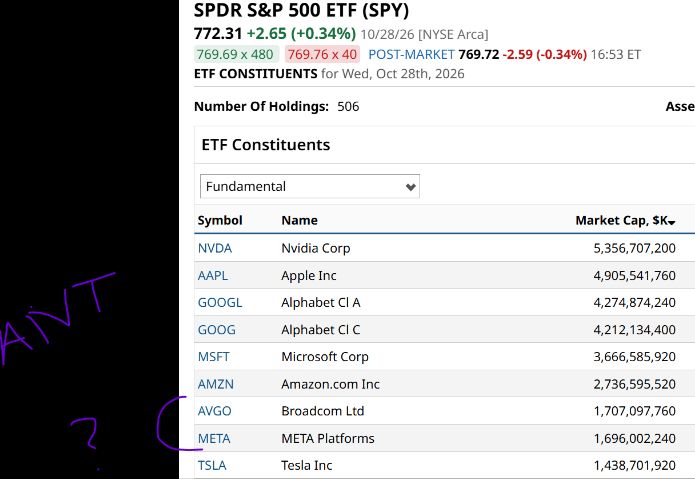
Underwriters are floating valuation figures between $1.5 trillion and $2 trillion. A valuation of that scale requires public investors to believe that Anthropic will generate monopolistic, software-like gross margins for the next decade. Below, I’ve indicated where it would slot into the S&P 500 at some point, based on that valuation and accounting for the company’s full value.
 www.barchart.com
We don’t need ANT to be a public company currently to get a preview of what might impact its stock price down the road. The cost of compute is crushing hyperscalers. If Meta and Google are experiencing valuation pushback due to unsustainable AI capex, public markets will not tolerate Anthropic’s massive, non-cancelable compute liabilities. When the landlords are feeling the pinch, the tenant is in far worse shape.
Meta might just be starting to train the corporate world not to pay software margins for frontier intelligence. If enterprise buyers can substitute Claude with an open-source alternative, Anthropic's revenue projections fall flat. That’s the type of thing that will likely surface in the market’s eyes some time after the IPO frenzy fades. But I think it is a real threat.
And with ANT’s primary partner (Google) actively developing competing software to replace it, customer acquisition costs surge. Anthropic must spend aggressively on sales and marketing just to keep enterprise clients from migrating to Google’s native ecosystem.
Here’s the picture that could be starting to form from all of this intertwined mega-cap business.
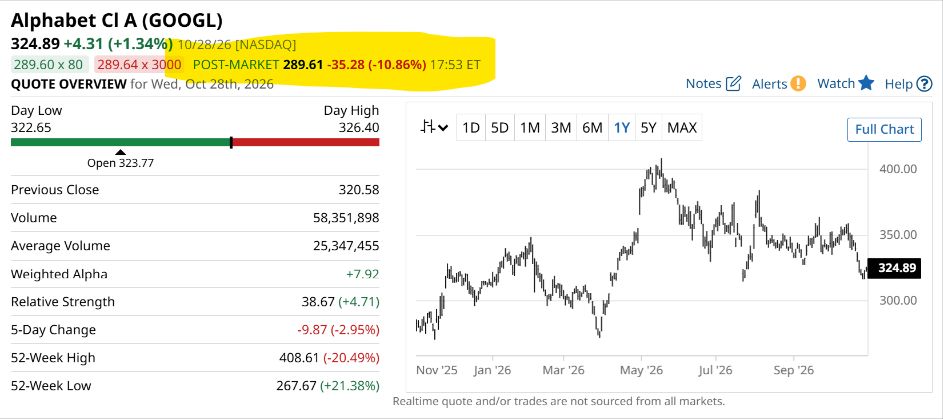
As I write this, Google’s stock is cratering after hours on Wednesday. By 11%. One in every nine dollars invested in it a few hours earlier is gone. For now, at least.
 www.barchart.com
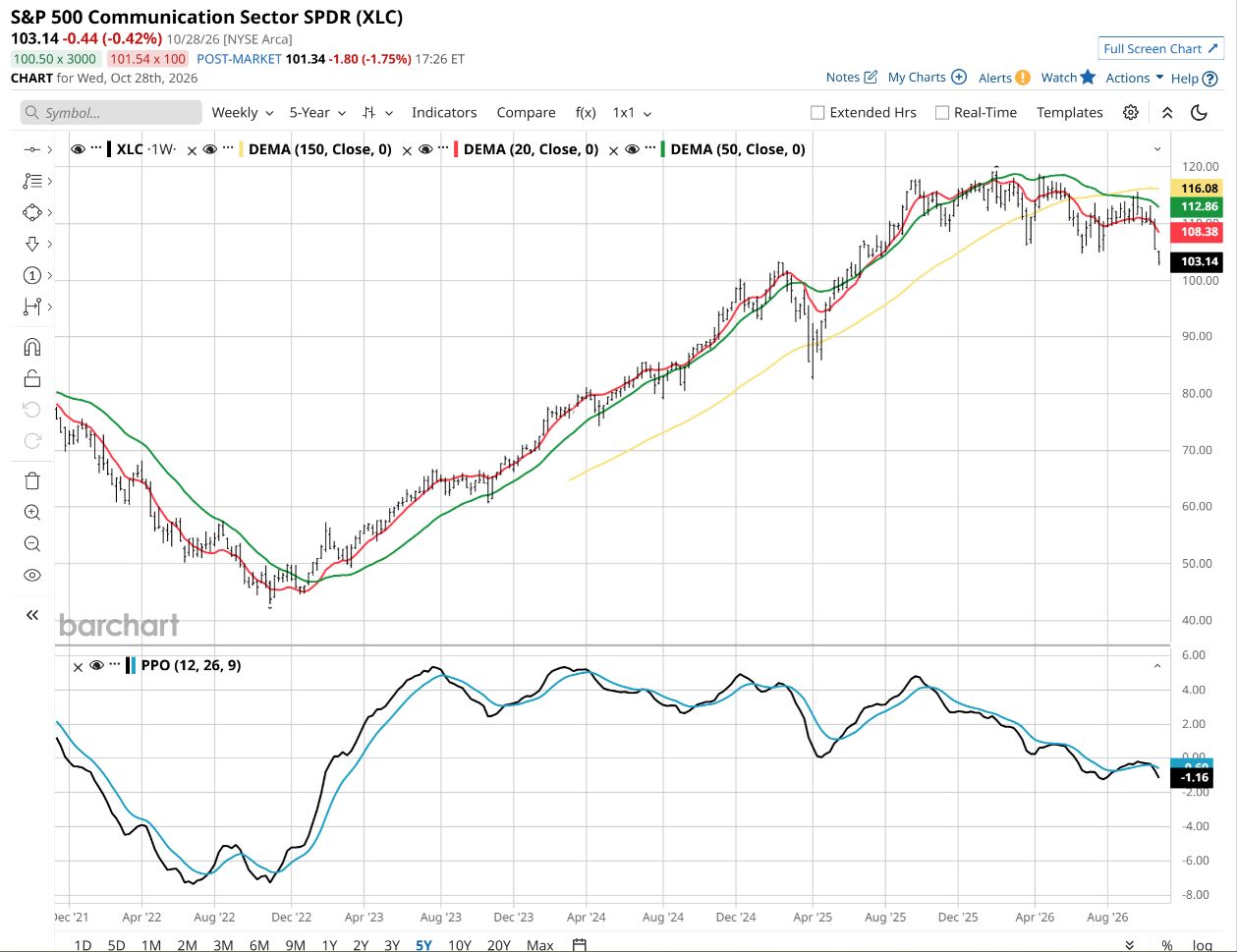
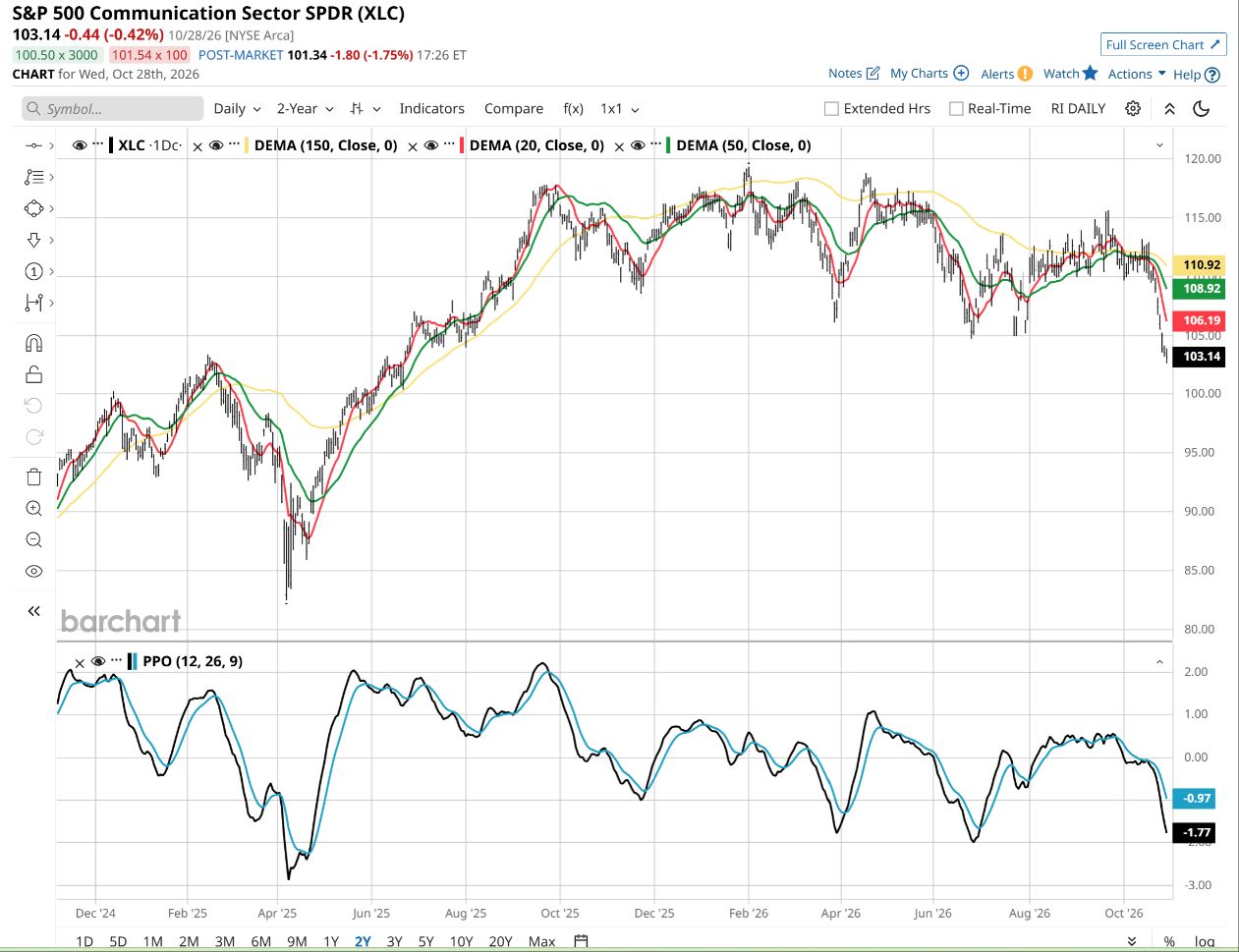
And this is XLC. The chart is as of Wednesday's market close. But it was already breaking down and appears to be retracing its way back to around $100 a share, or around where it was in June of 2025.
 www.barchart.com
 www.barchart.com
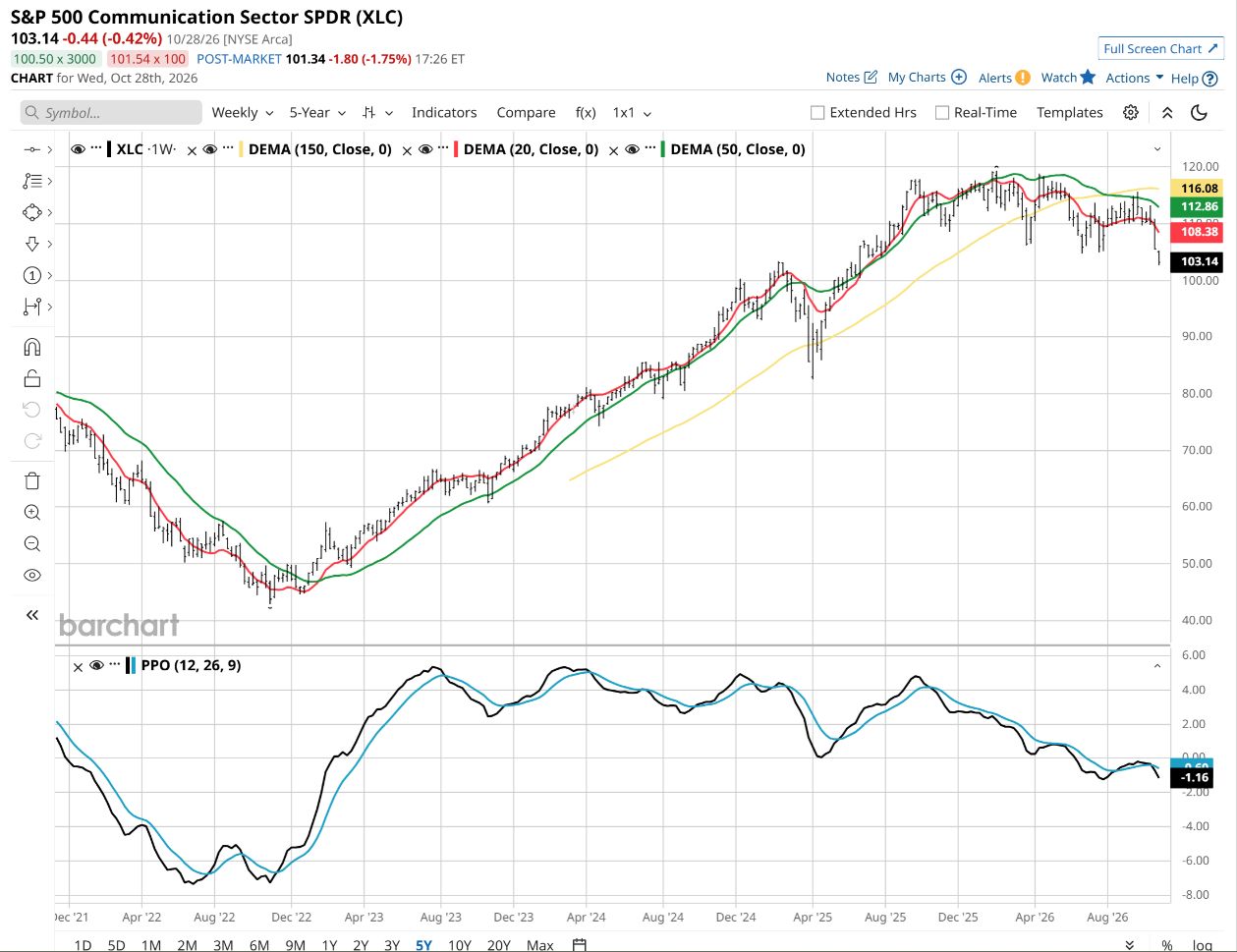
What is more concerning for XLC, Meta, and Google fans, as well as the other large-cap stocks atop XLC, such as Disney (DIS), Verizon (VZ), and Netflix (NFLX), is the weekly chart below.
 www.barchart.com
A daily chart that is rolling over can be rescued by a couple of stellar earnings reports. Barring some immediate change of heart by the market, that’s not what is happening here.
Hey, at least you can short the future misery of these stocks through an exchange-traded fund (ETF) that bets on a decline in the communications sector? OK, just kidding. You can’t. You could for a while, but all three ETFs devoted to doing that were closed by their issuers a while back. Due to lack of interest. Go figure.
Rob Isbitts is a semi-retired CIO, former fiduciary investment advisor, Barchart columnist, and straight-talker. Download his new free e-book on hedged bond investing for retirement at ETFYourself.com. His research and model portfolios are at ROAR.PiTrade.com.
On the date of publication, Rob Isbitts did not directly have a position in any of the securities mentioned in this article. All information and data in this article is solely for informational purposes. For more information please view the Barchart Disclosure Policy here.
More news from Barchart
Anthropic's Frenemies Meta and Google Are Showing Cracks In the AI Trade. What That Tells Us About the Anthropic IPO. SoFi Stock Is Ready for Its Next Big Move. Here's Why. SK hynix's Solidigm Is Mulling a $45 Billion Chip Plant Investment. What This Means for SKHY Stock. SpaceX Reportedly Faces Higher Borrowing Costs on Its $40 Billion GPU Deal. What It Means for SPCX Stock.