


To be blunt, DoorDash (DASH) is an agonizingly difficult idea. Ranked as a 56% Sell by the Barchart Technical Opinion indicator, the justification for this label mainly comes down to the nearly 14% trailing-month loss of DASH stock. Fundamentally, the company suffers from asset integration risks and competitive pressures from rival food-delivery services.
At the same time, DoorDash stock has also (temporarily) benefitted from a record third-quarter performance and a robust earnings beat. Further, the strategic acquisition of Instacart for approximately $17 billion has generated plenty of buzz. In theory, the move should help expand the company’s grocery footprint, issuing a direct challenge to major retail competitors.
Can’t Get Enough Options?: Join the list for Barchart’s daily unusual options report, delivered free.
While it’s perhaps not the cleanest contrarian case, there is an argument to be made regarding mean reversion — especially for those who are short-term options traders. In some ways, this might be an easier job than attempting to forecast the end valuation of DASH stock over the next several years. I would argue that more time compounds event risk, where unknown external variables may wreak havoc on sentiment.
To be fair, an options-based swing trade carries its own distinct risks, including compressed time risk. Nevertheless, the basic principle of a beaten-down security seeking equilibrium is relatively credible. Better yet, the historical data adds weight to the equilibrium argument.
In the past five years, it has been an observed pattern that whenever DoorDash stock is stuck in an extremely bearish state, the typical response is a transition over the next several weeks toward a bullish state.
If this common (but not guaranteed) pattern were to materialize this time around, a speculative exposure to the 180/190 bull call spread expiring Dec. 18 may be of interest to aggressive risk-takers.
Caution is the Key Rule for DASH Stock
Now, when I say that the 180/190 spread is speculative, I’m not playing mind games here: it means exactly what you think it means. You would be entering the trade at your own risk. Based on a lognormal probability distribution — what I would colloquially term “laboratory conditions” — the aforementioned idea is a bad deal.
Let’s lay out the framework. Based on a 30-day implied volatility of 51.8%, the options market is implying a 68% chance that DoorDash stock will terminate between $143.77 and $193.52 at the end of the December monthly options chain (Dec. 18).
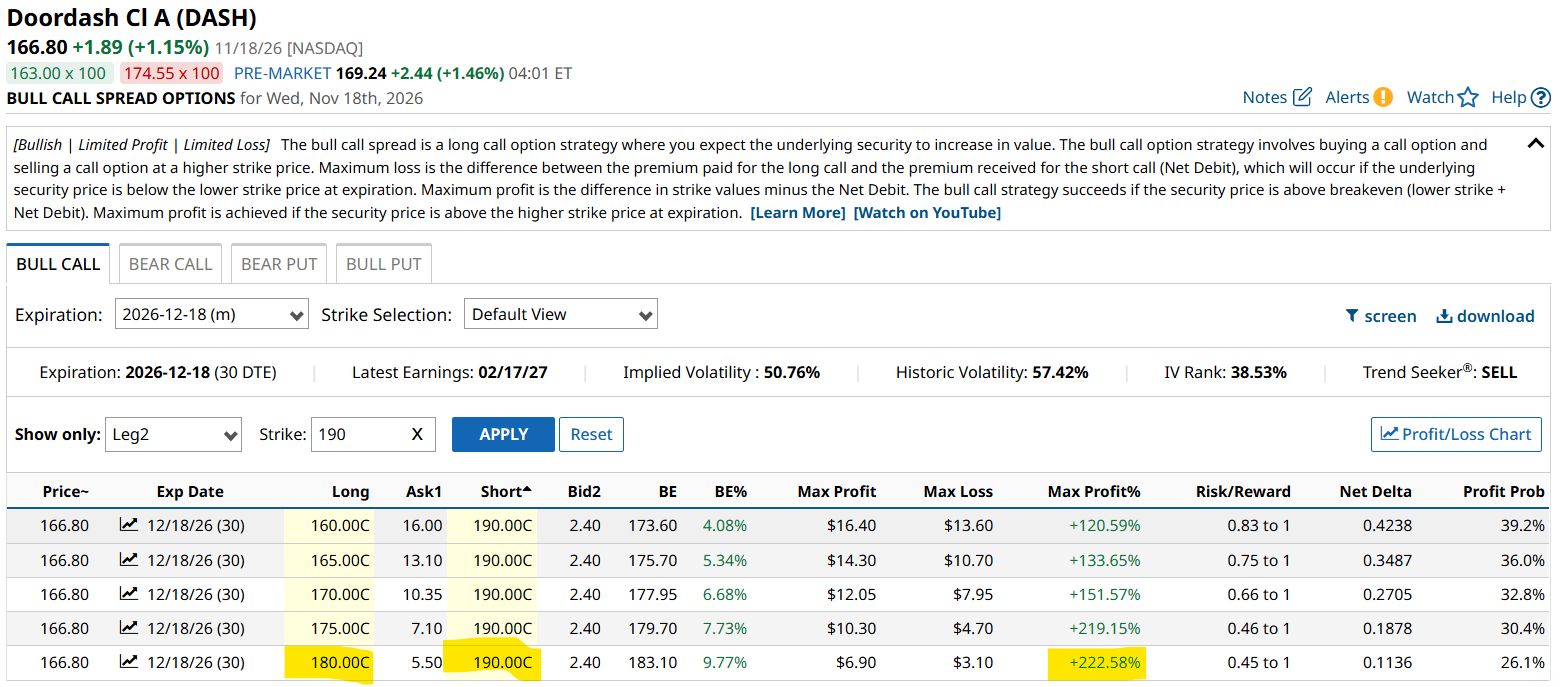
Of course, for the above bull spread to be fully profitable, DASH stock must trigger the $190 second-leg strike on expiration. Using the calculations from the probability distribution formula, the terminal probability at $190 sits at 19.43%.
Consider, then, the key statistics for the bull spread:
Net debit (upfront cash) required of $310. Maximum payout (American-style odds) of 222.58%. Win probability (from the probability distribution) of 19.43%.If we were to run an expected value (EV) calculation using these stats, we would get a value of $115.70 below zero. This would translate to a return on capital (ROC) of -37.3%. Obviously, we would consider that to be a bad deal.
To clarify, a negative EV doesn’t guarantee that our outcome will be negative. But it does mean that, over many instances of the same trade, you are statistically more likely to lose money.
We know that the market will offer what it offers so the net debit and payout metrics are beyond our control. However, the win probability is an open question. Just because institutions use laboratory conditions as a pricing benchmark doesn’t mean that you personally are beholden to use the calculated estimate.
That’s where DASH stock gets interesting.
Banking on the Transitional Trend of DoorDash Stock
Earlier, I stated that DASH stock has a tendency of transitioning from a bearish state to a bullish one. Specifically, in the trailing two months, DASH printed 10 weekly candlesticks — and only three of these candlesticks were positive (where Friday’s close was higher than Monday’s open). In other words, there is a seven-to-three ratio between negative-to-positive weekly sessions.
My argument, therefore, is an inductive inference. Whenever this 7-to-3 ratio has materialized in the charts over the past five years, the typical (though not guaranteed) result is an upward trend that rises beyond what would be normally expected under aggregate conditions.
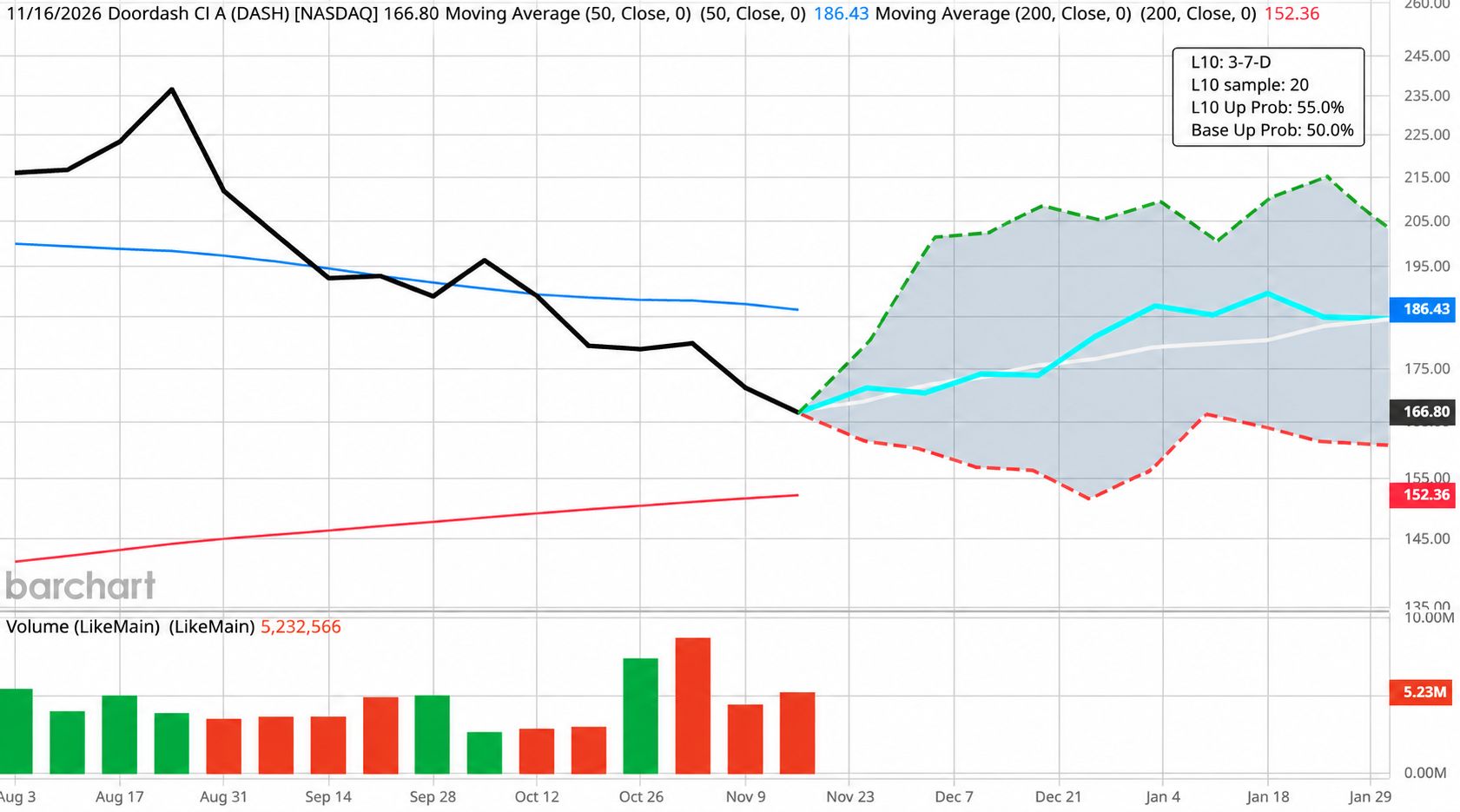
In terms of win probability, the historical data (filtered for the 7-to-3 ratio) estimates a range between 35% and 40%. At the low end, we would calculate an EV of $40 or an ROC of +12.9%. At the high end, the EV would stand at $90, translating to an ROC of +29%.
Again, the main risk comes down to the ultimate accuracy of the estimated probability. Using standard lognormal calculations, the risk-reward profile favors the credit seller (i.e. not you). In contrast, using state-transitional logic statistically incentivizes the trade for the debit buyer.
I’ll reiterate that it’s not the cleanest contrarian case. However, for the bold speculator, DASH stock does make a case for itself.
On the date of publication, Josh Enomoto did not directly have a position in any of the securities mentioned in this article. All information and data in this article is solely for informational purposes. For more information please view the Barchart Disclosure Policy here.
More news from Barchart
DoorDash (DASH) Stock Is a Tricky Play That Could Lead to a 222% Payout DVN Short Strangle Takes Advantage of High Implied Volatility I Used This Options Strategy to Profit from the Post-IPO Plunge in SpaceX. Now I’ll Use It Again on ANT Stock After Anthropic Starts Trading. Carnival Corp Has Unusual Out-of-the-Money Put Options Volume - Is This a Signal CCL is Undervalued?