


Construction Partners (ROAD) was one of 435 securities trading on Nasdaq that hit new 52-week lows on Tuesday, more than five times as many as those hitting new 52-week highs.
The Alabama-based infrastructure construction company’s new 52-week low of $68.38 was one of only six names trading above $50. It was the company’s 19th new 52-week low in the past 12 months. Its shares are down 34% over this period.
More Top Stocks Daily: Go behind Wall Street’s hottest headlines with Barchart’s Active Investor newsletter.
As recently as May 8, it traded at an all-time high of $151, almost eight years after it went public, when it sold 11.95 million Class A shares at $12.
Despite the 53% correction in its share price in less than seven months, it’s still up nearly sixfold from its IPO pricing.
This is clearly a business that should continue to benefit from America’s need for new and rebuilt infrastructure assets.
The Barchart Technical Opinion is a 100% Strong Sell in the near term. In the long term, buying around $70 could prove to be a big winner for investors willing to jump in.
Should you buy on the dip? I’ll consider why it makes sense.
ROAD’s Valuation Rarely Has Been This Reasonable
When Construction Partners went public in 2018, it had Sept. 30, 2017, annual revenue of $568.2 million, $64.2 million EBITDA (earnings before interest, taxes, depreciation and amortization), and $93.9 million in total debt. At its IPO, the Class A and Class B shares outstanding gave it a market cap of $618.2 million.
At its IPO, its market cap was 1.1 times revenue, 9.6 times EBITDA, and total debt was 1.5 times EBITDA.
Fast forward to fiscal 2026. It had $3.67 billion in revenue, $480.1 million in EBITDA, and $2.0 billion in total debt. Today’s market cap is $4.04 billion, 1.1 times revenue, 7.6 times EBITDA, and total debt is 4.2 times EBITDA.
So, by these three metrics, its market cap/revenue and market cap/EBITDA have either stayed the same or fallen. At the same time, the total debt multiple has grown nearly three-fold as it made $2.39 billion in acquisitions along the way.
The share price has gotten hammered since it released the preliminary Q4 2026 results on Nov. 5 before the markets opened, losing nearly 22% of its value that day. It’s fallen another 13% through November. As I write this Wednesday morning, the stock is down 3.5%.
That explains the 100% strong sell recommendation based on the technicals, but fundamentally, the business remains quite healthy. The company expects $4.23 billion in revenue at the midpoint of its guidance, translating to 15% growth in 2026. EBITDA for 2027 should be $602.5 million, up 15% from last year.
Analysts' biggest concern is margins. The company’s guidance calls for an adjusted EBITDA margin of 14.2%, the same as in 2026 but 90 basis points lower than in 2024. However, five years ago, the EBITDA margin was 9.9%, so the company’s growth strategy combining organic growth with acquisitions has moved the needle on profitability.
The question is: how much are you willing to pay for that improvement? The chart shown below is Construction Partners’ TEV/EBIT multiple since going public. It hasn’t been this low since November 2020. At 19.57x, it is well below the eight-year average of 33.47x.
At the very least, buying ROAD stock in the $60s wouldn’t be overpaying based on its historical valuation. It might not be a $151 stock, but equally, it’s not a $30 stock either.
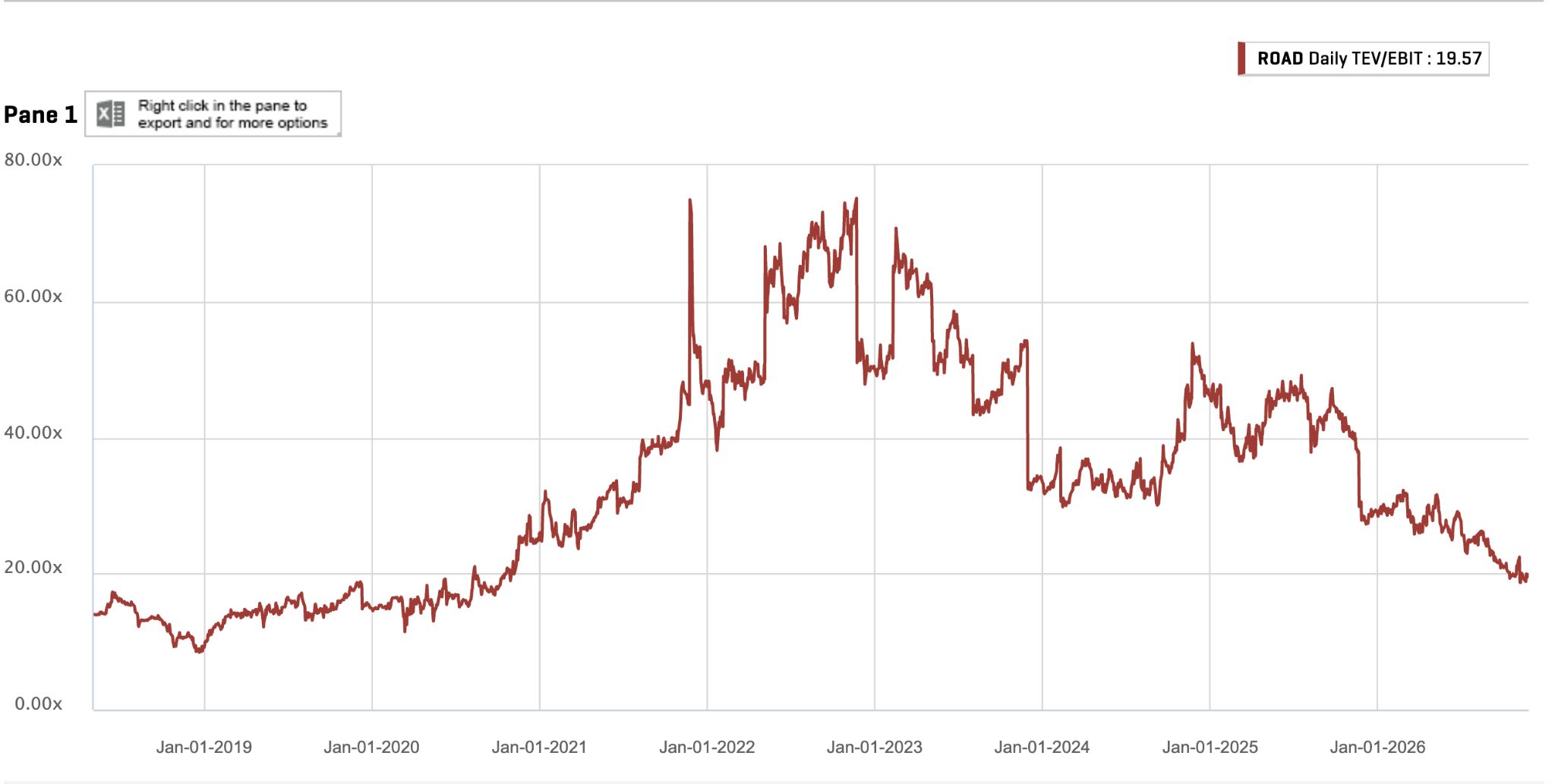
Source: S&P Global Market Intelligence
The Backlog Remains Healthy
In October 2025, at the company’s Investor Day, it announced ROAD 2030, management’s plan to grow the business. Targets included $6.03 billion in 2030 revenue, $1.03 billion in EBITDA, and a 17.0% EBITDA margin.
While the 17% margin looks tough to meet, diesel prices in 2026 really hurt its progress. Should the Trump administration stay away from relaunching its war with Iran, that margin is sure to return to 15% or higher in 2027. Given it was less than 10% in 2021, I don’t see why it can't meet that target.
As CFO Gregory Hoffman said on the Q4 2026 conference call, the company made three acquisitions between Sept. 30 and Nov. 4, adding $65 million in backlog that should be realized in fiscal 2027. Construction Partners’ backlog at the end of 2026 was $3.29 billion, up 9% from a year ago.
Its ongoing pursuit of acquisitions will continue to provide future backlog, revenues, and the potential for margin improvement. It typically acquires businesses with weaker margins than its own and can quickly improve them through technology and patient bidding. Unless interest rates go sky-high, it should be able to keep the growth tap on for the foreseeable future.
In the past four years, its organic growth has been 8.7% in 2023, 6.8% in 2024, 8.4% in 2025, and 6.9% in 2026. In 2027, it expects 7% organic growth at the midpoint of its guidance.
That consistent 6-8% organic growth is vital to the business’s future. If it acquires businesses to grow without organic growth, the business will eventually implode because of the additional debt assumed.
As long as this number stays above 6%, there is reason to be optimistic, because it’s done an excellent job integrating past acquisitions. That’s not easy to do.
Using Cash Flow for Acquisitions
As I said in the previous section, the company has done a good job integrating its acquisitions. It’s not enough to buy businesses; you have to ensure they are a good cultural fit and, equally important, in the right markets.
For example, in 2026, it made seven acquisitions, all in Sun Belt states: 2 in Texas, 2 in Florida, 2 in Oklahoma, and 1 in Tennessee, paying $520.4 million in cash and stock, an average of $74 million per acquisition. These acquisitions added $667.1 million, an average of $95.3 million, or 0.8x sales. Very reasonable.
The biggest year for acquisitions in its history was 2025, when it made five purchases for $1.5 billion, a considerably higher average than is historically typical. These were platform acquisitions intended to support future bolt-on acquisitions as needed in these five markets.
In this way, Construction Partners acts like a quasi-private equity firm, adding portfolio companies, both platform and bolt-on, building the value of the collective. Only it isn’t looking to sell the acquired businesses after 5-7 years, as is the usual timeframe for private equity firms.
So, how much of acquisitions is paid for by cash flow, debt, and stock issuance?
In 2026, it paid out $520.4 million for the seven acquisitions. Of that, $280.7 million came from net new borrowings, $197 million from cash on the balance sheet, and about $43 million from stock. The company finished 2026 with a net leverage ratio of 3.24x (Net debt to EBITDA). It wants that down to 2.5x as soon as possible.
Despite the big increase in the leverage ratio over the past two years — it was 1.9x at the end of 2024 — it still finished 2026 with EBITDA almost five times its interest expense for the year.
Excluding the transformational platform acquisitions in 2025, it can self-finance bolt-on acquisitions in most years. That’s a very good thing.
The Bottom Line on ROAD Stock:
We are in volatile times right now. So, there’s no guarantee that ROAD won’t keep sliding lower. However, if you’re a patient, risk-tolerant investor, I don’t see why its share price won’t be in triple digits a year from now. If volatility scares you, Construction Partners might not be for you.
On the date of publication, Will Ashworth did not directly have a position in any of the securities mentioned in this article. All information and data in this article is solely for informational purposes. For more information please view the Barchart Disclosure Policy here.
More news from Barchart
As Long as You’re Comfortable With Volatility, Buy This Beaten-Down Value Stock at New 52-Week Lows Nvidia Stock and Cathie Wood Collide as Ark Sells $107 Million in NVDA Shares How Investors Should Approach Anthropic as ANT Stock Dives Below Its $83 IPO Price Protect Your Portfolio from a Rainy Day with This Insurance Stock – Up 40% in 2026