


AbbVie ABBV stock has risen 8.9% so far this year as investor confidence strengthened in the company's post-Humira growth strategy. Despite Humira's U.S. patent expiry in 2023, AbbVie has successfully replaced much of the blockbuster's lost revenues with strong growth from Skyrizi and Rinvoq, easing concerns over its long-term earnings outlook.
AbbVie's consistently better-than-expected financial performance has also been a key driver of the increase. Strategic business development, like the recently announced acquisition of Apogee Therapeutics APGE, has further strengthened the investment case.
However, though the stock’s recent price increase will impress investors, those with a long-term investment horizon should make a decision based on the company’s fundamentals after carefully analyzing its strengths and weaknesses.
ABBV’s Successful Immunology Drugs — Skyrizi and Rinvoq
Sales of Humira are declining due to loss of exclusivity (LOE) and biosimilar erosion. However, AbbVie has successfully navigated the LOE of Humira, a drug that once generated more than 50% of its total revenues. It has accomplished this by launching two other successful new immunology medicines, Skyrizi and Rinvoq, which are performing extremely well, bolstered by approvals in new indications, and should support top-line growth in the next few years.
In 2026, AbbVie expects combined Skyrizi and Rinvoq sales of more than $31 billion, reflecting strong demand for all approved indications. Combined, Skyrizi and Rinvoq are expected to deliver more than 20% growth in 2026.
Strong immunology market growth, market share gains and momentum from new indications, as well as the potential for five new indications for Rinvoq over the next few years, are expected to drive Skyrizi and Rinvoq’s growth. Rinvoq could be approved for two indications — vitiligo and alopecia areata in 2026/early 2027. In addition, phase III data with Rinvoq in hidradenitis suppurativa and systemic lupus erythematosus are expected in 2026. AbbVie believes that the next wave of potential approvals in Rinvoq could add roughly $2 billion to peak-year sales for the product.
However, AbbVie expects a low single-digit pricing headwind for both Skyrizi and Rinvoq in 2026 and over the next few years. Moreover, the launch of J&J’s JNJ new oral pill for moderate-to-severe plaque psoriasis, Icotyde, has increased competitive pressure for Skyrizi, which can impact the product’s prescription trends. However, AbbVie seems confident that it can navigate competition from Icotyde.
ABBV’s Oncology and Neuroscience Drug Contributions
AbbVie is also benefiting from strong momentum outside immunology. AbbVie’s neuroscience portfolio is also contributing to top-line growth, driven by higher sales of Botox Therapeutic, depression drug Vraylar, newer migraine drugs Ubrelvy and Qulipta and new Parkinson’s disease drug, Vyalev.
The initial international launch uptake of Vyalev, a transformative therapy for treating advanced Parkinson’s disease, approved in late 2024, has been encouraging. AbbVie expects Vyalev to achieve blockbuster status in 2026. AbbVie’s Parkinson’s disease franchise, comprising Vyalev and once-daily oral treatment tavapadon (under review in the United States; FDA decision expected in the third quarter of 2026), is viewed as a key driver of growth in neuroscience. AbbVie believes that the Parkinson’s disease franchise has a more than $5 billion peak sales potential.
AbbVie has built a substantial oncology franchise with Imbruvica and Venclexta. However, its oncology sales have slightly slowed down as higher Venclexta sales and contributions from new drugs, Elahere, Epkinly and Emrelis, are being offset by an expected decline in Imbruvica sales. However, AbbVie believes the oncology pipeline is robust with several study readouts and initiations expected this year.
AbbVie’s Robust Pipeline & M&A Spree
AbbVie boasts a robust pipeline and expects important data readouts, regulatory submissions and approvals throughout 2026
Over the next couple of years, AbbVie expects new product approvals for tavapadon and pivotal data readouts for key pipeline candidates, lutikizumab (hidradenitis suppurativa), Temab-A (metastatic colorectal cancer) and etentamig (third-line-plus multiple myeloma). In May, the FDA approved AbbVie’s key pipeline candidate, Decnupaz/pivekimab sunirine for blastic plasmacytoid dendritic cell neoplasm in the United States. These new products/pipeline programs have the potential to drive long-term growth for AbbVie, while Skyrizi and Rinvoq should boost near-term growth.
AbbVie is also evaluating Skyrizi-based combination regimens with candidates like ABBV-382 (anti-α4β7) and ABBV-701 (anti-TL1A) to create best-in-class, durable remission therapies in inflammatory bowel disease.
AbbVie has been on an acquisition spree over the past couple of years to bolster the early-stage pipeline that should drive long-term growth. It is signing several M&A deals in the immunology space, its core area, while also signing some early-stage deals in oncology and neuroscience. The approximately $10.9 billion acquisition of Apogee is expected to strengthen its late-stage immunology pipeline.
ABBV’s Struggling Aesthetics Segment & Humira Erosion
Sales of Humira are declining due to biosimilar erosion. The launch of Humira biosimilars in the United States in 2023 significantly eroded the drug’s sales in 2024 and 2025. Humira sales declined around 50% in 2025. Humira sales continue to decline in 2026 as more plans exclude branded Humira and move to exclusive biosimilar contracts.
AbbVie has been seeing soft sales of its Aesthetics unit for the past couple of years. Continued macro challenges and economic headwinds are hurting Aesthetics sales. Global aesthetics sales are projected to be $5 billion in 2026, flat from 2025 levels, as moderate growth in Botox Cosmetic is likely to be offset by continued decline in Juvederm sales due to continued headwinds in key dermal filler markets.
ABBV Stock Price, Valuation and Estimate Revision
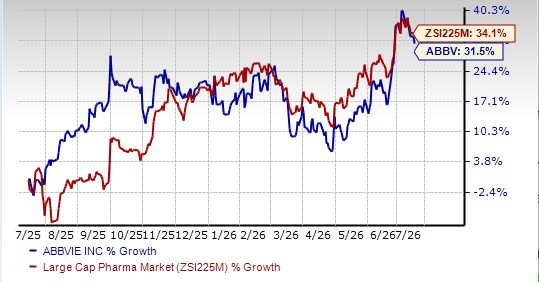
ABBV stock has risen 31.5% in the past year compared with an appreciation of 34.1% for the industry.
ABBV Stock Underperforms Industry
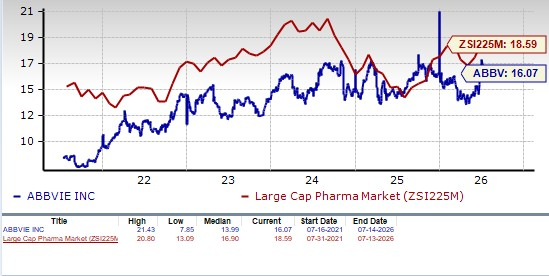
From a valuation standpoint, AbbVie is reasonably priced. Going by the price/earnings ratio, the company’s shares currently trade at 16.07 forward earnings, lower than 18.59 for the industry. However, the stock is trading above its five-year mean of 13.99.
ABBV Stock Valuation
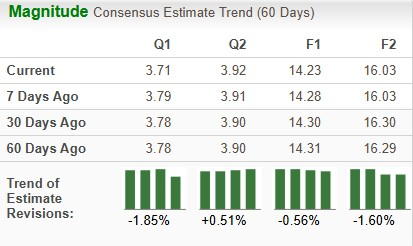
Earnings estimates for 2026 have declined from $14.30 to $14.23 over the past 30 days, while those for 2027 have declined from $16.30 to $16.03 over the same time frame.
ABBV Estimate Movement
Short-Term Investors Can Exit ABBV Stock
AbbVie combats its share of headwinds, including the impact of Humira LOE, slowing oncology sales, evolving competitive dynamics for Skyrizi and continued macro woes for Aesthetics. However, the company has faced its biggest challenge — Humira’s patent cliff — quite well and looks well-positioned for continued strong growth in the years ahead.
AbbVie expects a year of robust growth in 2026. It expects total revenues to rise around 10% in 2026, backed mainly by significant momentum in immunology and neuroscience products, which are demonstrating significant growth and delivering share gains in growing markets. It expects high single-digit revenue growth through 2029. Long-term investors can continue to retain this stock as its long-term prospects remain intact.
However, estimates have declined recently due to costs related to the Apogee acquisition. Short-term investors may consider exiting this Zacks Rank #4 (Sell) stock for now as estimates are declining and investing in some better-ranked drug stocks like Lilly, J&J, AstraZeneca and others.
You can see the complete list of today’s Zacks #1 Rank (Strong Buy) stocks here.
Radical New Technology Could Hand Investors Huge Gains
Quantum Computing is the next technological revolution, and it could be even more advanced than AI.
While some believed the technology was years away, it is already present and moving fast. Large hyperscalers, such as Microsoft, Google, Amazon, Oracle, and even Meta and Tesla, are scrambling to integrate quantum computing into their infrastructure.
Senior Stock Strategist Kevin Cook reveals 7 carefully selected stocks poised to dominate the quantum computing landscape in his report, Beyond AI: The Quantum Leap in Computing Power .
Kevin was among the early experts who recognized NVIDIA's enormous potential back in 2016. Now, he has keyed in on what could be "the next big thing" in quantum computing supremacy. Today, you have a rare chance to position your portfolio at the forefront of this opportunity.
See Top Quantum Stocks Now >>Want the latest recommendations from Zacks Investment Research? Today, you can download 7 Best Stocks for the Next 30 Days. Click to get this free report
AbbVie Inc. (ABBV): Free Stock Analysis Report
Johnson & Johnson (JNJ): Free Stock Analysis Report
Apogee Therapeutics Inc. (APGE): Free Stock Analysis Report
This article originally published on Zacks Investment Research (zacks.com).