

Block XYZ and PayPal Holdings PYPL stand out as key players in the fintech space. They continue to transform digital payments and commerce, albeit with distinct strategies: PayPal leverages its global, two-sided payments and commerce platform, whereas Block excels through the dual ecosystem of Square and Cash App.
PayPal is gaining ground through Venmo’s growth and cost savings plan, whereas Block stands out for its expanding Square merchants network and Cash App usage. Let’s examine the pros and cons of each to see which might earn a place in your portfolio.
The Case for Block
Block continues to expand its integrated fintech platform, with its Square and Cash App ecosystems providing end-to-end solutions across payments, commerce, banking, investing and lending. In first-quarter 2026, the company reported decent performance, with net revenues increasing 4.9% year over year. Total gross profit climbed 27.1%, with Cash App rising 38.3% and Square increasing 9.4%.
Square, Block’s merchant-facing ecosystem, remains strong. In the first quarter of 2026, Square Gross Payment Volume (GPV) rose 13.2% year over year. Additionally, the company partners with more than 140 independent sales organizations to complement its direct sales and extend reach to new sellers. In July 2026, Dimassi’s Mediterranean Buffet and Honolulu Cookie Company expanded their partnerships with Square, deepening their use of the platform to scale their footprint.
Square is expanding its AI commerce strategy with a new ChatGPT app and Claude plugin. The initiative is designed to help sellers appear when customers ask AI assistants where to eat, shop or book services, while enabling users to place orders directly through those AI experiences. The initial rollout covers U.S. food and beverage sellers using Square Online Ordering.
Cash App is the primary engine behind Block’s momentum, evolving from a simple peer-to-peer payments tool into a comprehensive financial platform for digitally native users. It now spans payments, banking, commerce and Bitcoin trading, embedding itself deeper into customers’ financial lives. Cash App continues to make transactions fast, more convenient and more personalized. In June 2026, it launched Cash App Tags, NFC-enabled physical payment accessories that let customers pay with a single tap without a phone or a card.
While Block faces headwinds, including sensitivity to macroeconomic conditions, intensifying competition and a younger-user base concentration, its diversified revenue streams, solid fundamentals and ongoing product innovation counterbalance those risks. These strengths position the company for durable growth and make it an attractive fintech investment.
The Case for PayPal
PayPal is a global digital payments company that enables consumers and merchants to send, receive and manage money securely across nearly 200 markets worldwide. The company provides a wide range of solutions, including consumer payments, merchant services, peer-to-peer transfers via Venmo and Braintree (now PayPal Enterprise Payments). PayPal delivered decent first-quarter results, with revenues rising 7.2% year over year and Total Payment Volume (“TPV”) climbing 11%.
Venmo, PayPal’s money movement platform, has become a go-to wallet for younger, digitally native consumers. In the first quarter of 2026, Venmo TPV hit new records, growing sequentially to 14% year over year and marking the sixth consecutive quarter of double-digit growth. In March 2026, Venmo broadened its reach by enabling users to send and receive funds with hundreds of millions of PayPal users across 90 markets. This marks Venmo's largest market expansion since the app’s launch.
PayPal is executing a major transformation plan aimed at saving more than $1.5 billion over the next two to three years. The company expects the first wave of savings to come from structural realignment, including removing duplication and layers from its organizational structure. A second wave is expected to result from broader AI deployment and automation initiatives. Management believes these savings will provide greater flexibility to reinvest in growth initiatives and strengthen the company’s long-term financial profile.
However, PayPal faces macroeconomic headwinds and operates in a highly competitive global payments industry. The nature of the business makes it vulnerable to foreign exchange fluctuations. The company reiterated its 2026 guidance while reporting first-quarter 2026 results, with TM$ expected to decline slightly and non-GAAP EPS projected to range from a low single-digit decline to slightly positive growth.
How Do Zacks Estimates Compare for XYZ & PYPL?
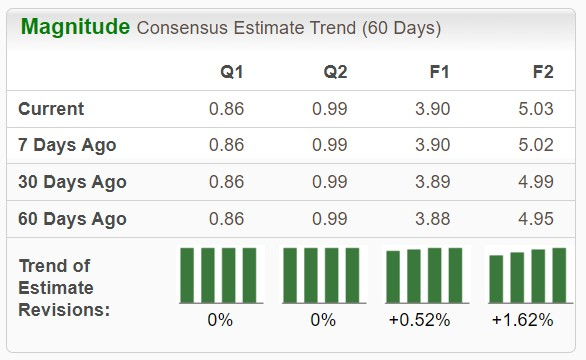
The Zacks Consensus Estimate for Block’s 2026 sales and EPS implies a year-over-year increase of 8.05% and 64.56%, respectively. EPS estimates have been trending northward over the past month.
Image Source: Zacks Investment Research
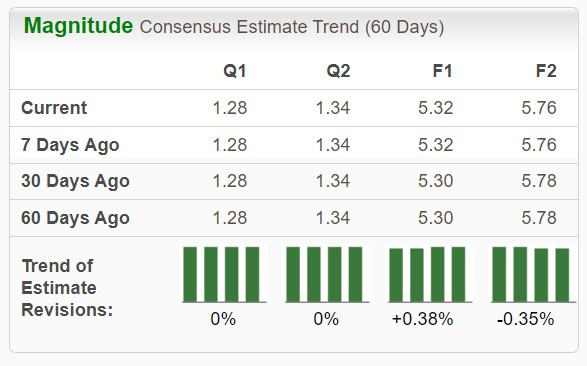
Meanwhile, the consensus estimates for PayPal’s 2026 sales and EPS indicate a year-over-year rise of 3.40% and 0.19%, respectively. EPS estimates have been trending upward over the past month.
Image Source: Zacks Investment Research
Price Performance: XYZ vs. PYPL
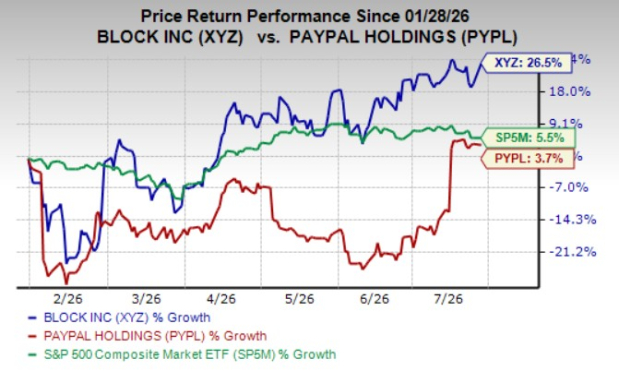
Over the past six months, shares of XYZ have outperformed PYPL and the S&P 500 composite.
Image Source: Zacks Investment Research
Valuation: XYZ vs. PYPL
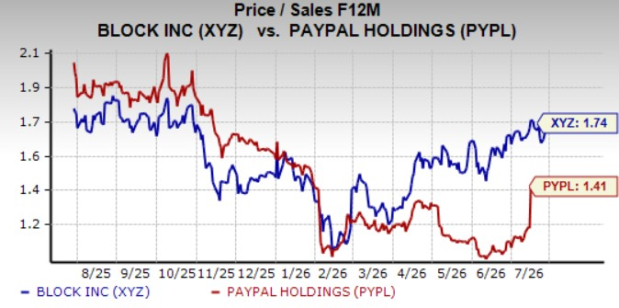
In terms of forward 12-month Price/Sales (P/S), XYZ stock is trading at 1.74X, above PYPL, which is currently trading at 1.41X. XYZ is trading above its one-year median of 1.53x, while PYPL is trading below its one-year median of 1.18x.
From a valuation perspective, we note that Block shares are trading at a premium to PayPal.
Image Source: Zacks Investment Research
Conclusion: Block Remains Strong
Block and PayPal are reshaping digital payments and commerce, though they are taking different routes. PayPal’s emphasis on global wallet connectivity and cost savings program targets scale and margin improvement, but mixed macroeconomic conditions, intense competition and foreign exchange fluctuations cloud its growth outlook.
In contrast, Block maintains a robust payments ecosystem with strong historical foundations. For investors choosing now, Block stands out as the smarter, lower-risk pick because of its powerful ecosystem, profitability, long-term potential and positive trend in earnings estimates revisions.
Currently, Block sports a Zacks Rank #1 (Strong Buy), while PayPal carries a Zacks Rank #3 (Hold). You can see the complete list of today’s Zacks #1 Rank stocks here.
Beyond Nvidia: AI's Second Wave Is Here
The AI revolution has already minted millionaires. But the stocks everyone knows about aren't likely to keep delivering the biggest profits. AI’s second wave is moving from infrastructure to implementation and these companies are at the forefront of this transition, positioned to become what Amazon and Google were to the internet era.
See Stocks Now >>Want the latest recommendations from Zacks Investment Research? Today, you can download 7 Best Stocks for the Next 30 Days. Click to get this free report
PayPal Holdings, Inc. (PYPL): Free Stock Analysis Report
Block, Inc. (XYZ): Free Stock Analysis Report
This article originally published on Zacks Investment Research (zacks.com).