


Moderna MRNA has gained renewed investor attention after its personalized mRNA-based cancer therapy delivered positive results in a late-stage study. The therapy has been developed in collaboration with Merck MRK.
Moderna’s Cancer Therapy Delivers First Phase III Win
The study, called INTerpath-001, evaluated intismeran autogene (V940/mRNA-4157) in combination with Merck’s blockbuster immunotherapy Keytruda in patients with high-risk (Stage IIB-IV) melanoma whose tumors had been removed through surgery. The study met its primary endpoint of recurrence-free survival (RFS), which measures how long patients remain free of cancer recurrence . The regimen also met a key secondary goal of distant metastasis-free survival (DMFS), meaning patients stayed free of cancer spreading to other parts of the body for longer.
The success in melanoma could be just the beginning for intismeran. Moderna and Merck are testing intismeran across a broader range of cancers, with nine phase II and phase III studies underway in indications including non-small cell lung cancer (NSCLC), bladder cancer and renal cell carcinoma. The broader development program could significantly expand the potential opportunity for intismeran if the therapy continues to deliver positive results in other cancers.
For Moderna, the success also provides stronger validation that its mRNA platform could be used in areas beyond infectious-disease vaccines. The company has largely built its business around mRNA-based vaccines for infectious diseases, while intismeran represents a different application of the technology. The therapy is personalized to each patient’s tumor, highlighting the potential to expand Moderna’s mRNA platform beyond vaccines into cancer treatment.
However, investors should also look beyond this development and evaluate the company's broader fundamentals before determining how to approach the stock.
Moderna Building Toward a Diversified Respiratory Portfolio
The company is gradually building a broader respiratory portfolio to reduce its reliance on COVID-19 vaccines. Moderna has already expanded into RSV with mResvia and more recently added seasonal influenza with the approval of mFlusiva, which is expected to be available for the 2026/2027 U.S. respiratory season. It has also secured an EU nod for mCombriax, its combination influenza and COVID-19 vaccine, although the product is not expected to launch in Europe until 2027.
Together, these products give Moderna a growing presence across major respiratory vaccine categories and create additional opportunities to offset the longer-term normalization of COVID-19 demand. The company is also looking beyond these products to expand its respiratory franchise. Late-stage programs targeting norovirus and bird flu provide additional potential growth opportunities, while Moderna’s mRNA platform allows it to rapidly update vaccines as viral strains evolve.
Moderna Leverages Its mRNA Platform Beyond Vaccines
The success of intismeran is particularly significant in light of Moderna’s three-horizon strategy outlined at its recent Science Day event. The company places intismeran in Horizon 1 alongside its established infectious-disease vaccines and rare-disease therapeutics. These programs represent the company’s near-term opportunities as Moderna works to build multiple growth engines beyond its COVID-19 franchise.
Moderna’s ambitions, however, extend beyond its current late-stage programs. Horizon 2 includes additional mRNA-based therapeutic approaches already moving through development, including cancer antigen therapies, T-cell engagers, cell-therapy enhancers and an investigational therapy for multiple sclerosis. Horizon 3 comprises earlier-stage technologies, including in-vivo CAR-T and CAR-M cell therapies, which could become future growth platforms for the company.
Taken together, the three horizons show that Moderna is looking to evolve from a company primarily known for vaccines into a broader mRNA medicines platform. The phase III success of intismeran therefore represents not only an important milestone for one oncology program but also an early validation of Moderna’s strategy to apply its technology across multiple therapeutic areas.
Competition Remains a Hurdle
Moderna also faces strong competition across the markets it is entering. In RSV, mResvia competes with Pfizer’s PFE Abrysvo and GSK’s Arexvy, while the seasonal influenza market includes established players such as Sanofi, CSL Seqirus and GSK. Its COVID-19 franchise continues to compete with Pfizer/BioNTech BNTX and Sanofi/Novavax, while competition could also emerge in combination vaccines as these companies develop flu/COVID products.
In oncology, Moderna faces competition at the platform level from BioNTech, which is also developing an individualized mRNA-based cancer therapy in collaboration with Roche. As Moderna seeks to expand intismeran across multiple tumor types, competition could limit market penetration and increase the importance of clinical differentiation, regulatory execution and commercial rollout.
Pipeline & Regulatory Setbacks Pose a Concern for Moderna
While Moderna has made progress across its pipeline, several programs continue to face clinical and regulatory uncertainty. The company recently announced that a late-stage study on its norovirus vaccine did not meet the statistical criteria for early success at the interim analysis. The company is preparing to enrol an additional cohort before a definitive result. The regulatory path for mCombriax in the United States also remains unresolved as Moderna awaits FDA guidance on a potential refiling.
The company has also discontinued programs following unsuccessful development, most recently including its CMV vaccine candidate. Such setbacks highlight the inherent clinical and regulatory risks associated with Moderna’s broad pipeline and show that a large number of programs does not guarantee successful commercialization.
MRNA Stock Performance, Valuation & Estimates
Year to date, MRNA stock has significantly outperformed the industry, as seen in the chart below. During this timeframe, the stock also outdid the broader Medical sector and the S&P 500.
MRNA Stock Outperforms Industry, Sector & S&P 500
Image Source: Zacks Investment Research
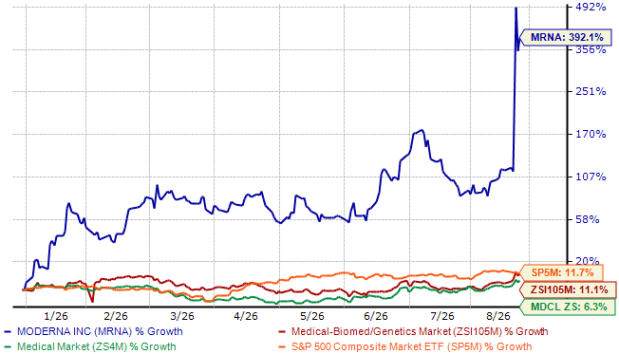
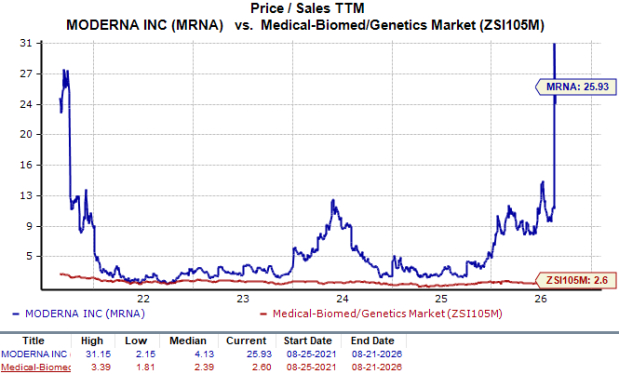
From a valuation standpoint, Moderna appears to be trading at a premium compared to the industry. Based on the price/sales (P/S) ratio, the company’s shares currently trade at 25.93, trailing 12-month sales value, higher than 2.60 for the industry.
Image Source: Zacks Investment Research
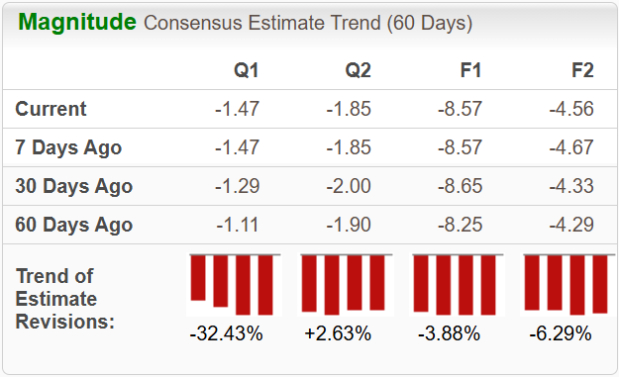
Estimates for Moderna’s 2026 loss per share have improved from $8.65 to $8.57 in the past 30 days. However, those for 2027 have widened from $4.33 to $4.56 during the same period.
Image Source: Zacks Investment Research
How to Play MRNA Stock?
Moderna’s growth story is beginning to look meaningfully different from the one that defined the stock over the past several years. The company now has multiple potential avenues to rebuild its business, with oncology offering the most significant opportunity to expand the platform into a new therapeutic area. This gives the stock greater long-term growth potential than it had when its prospects were largely tied to the COVID-19 franchise.
That said, the turnaround is likely to take time. Moderna still needs to convert its expanding pipeline and newer products into meaningful and sustainable revenue growth while navigating considerable competitive and execution risks. Investors should therefore focus less on an immediate recovery in financial performance and more on whether the company can steadily establish new sources of growth.
Therefore, we advise investors with a long-term horizon to stay invested in this Zacks Rank #3 (Hold). Moderna’s expanding opportunities provide a stronger foundation for long-term growth, but investors should remain patient as the company works to translate its pipeline investments into sustainable commercial growth.
You can see the complete list of today’s Zacks #1 Rank (Strong Buy) stocks here.
Beyond Nvidia: AI's Second Wave Is Here
The AI revolution has already minted millionaires. But the stocks everyone knows about aren't likely to keep delivering the biggest profits. AI’s second wave is moving from infrastructure to implementation and these companies are at the forefront of this transition, positioned to become what Amazon and Google were to the internet era.
See Stocks Now >>Want the latest recommendations from Zacks Investment Research? Today, you can download 7 Best Stocks for the Next 30 Days. Click to get this free report
Moderna, Inc. (MRNA): Free Stock Analysis Report
Pfizer Inc. (PFE): Free Stock Analysis Report
Merck & Co., Inc. (MRK): Free Stock Analysis Report
BioNTech SE Sponsored ADR (BNTX): Free Stock Analysis Report
This article originally published on Zacks Investment Research (zacks.com).