


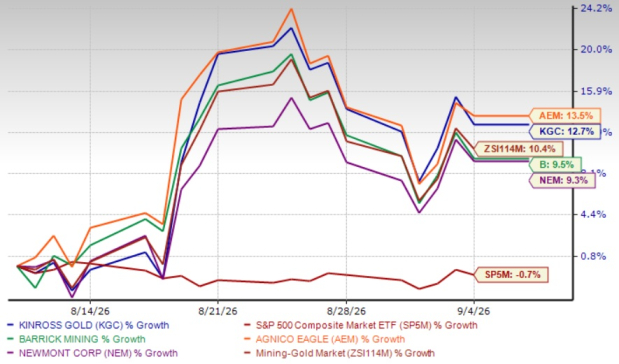
Kinross Gold Corporation’s KGC shares have gained 12.7% in the past month, thanks to a rebound in gold prices and the company’s better-than-expected earnings, driven by higher realized prices and strong margins.
KGC has outperformed the Zacks Mining – Gold industry’s 10.4% increase and the S&P 500’s 0.7% decline. Its gold mining peers, Barrick Mining Corporation B, Newmont Corporation NEM and Agnico Eagle Mines Limited AEM have gained 9.5%, 9.3% and 13.5%, over the same period.
KGC’s One-month Price Performance
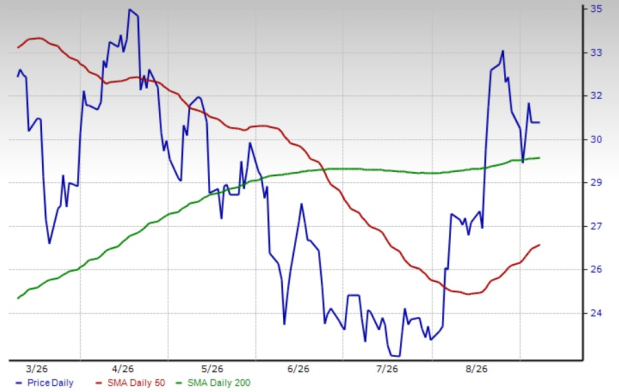
Technical indicators show that KGC broke above the 50-day simple moving average (SMA) on Aug. 5, 2026, driven by the gold price recovery. It also crossed its 200-day SMA last Wednesday. The 50-day SMA has been below the 200-day SMA since a death crossover on June 24, 2026, signaling a bearish trend.
Kinross Trades Above 50-Day SMA
Let’s take a look at KGC’s fundamentals to better analyze how to play the stock.
Development Projects to Underpin KGC’s Production Growth
Kinross has a strong production profile and boasts a promising pipeline of exploration and development projects. Its key development projects and exploration programs remain on track. These projects are expected to boost production and cash flow, and deliver significant value. The successful execution of these projects will position the company for a new wave of low-cost, long-life production.
KGC is progressing with the construction of three organic growth projects to expand its U.S. portfolio. This is aimed at extending mine life and optimizing costs. The projects are Round Mountain Phase X and Bald Mountain Redbird 2 in Nevada, and the Kettle River–Curlew project in Washington. Together, the projects are expected to contribute significantly to Kinross’ U.S. production profile. They are expected to contribute 3 million ounces of life-of-mine production to KGC’s portfolio, adding grades and mine lives.
The Great Bear project also advanced in the second quarter, with surface construction for advanced exploration 93% complete, the first exploration-decline blast completed on July 27, 2026, and main-project detailed engineering about 50% complete. Lobo-Marte adds longer-dated optionality and is expected to deliver about 350,000 ounces of annual steady-state production. KGC expects Great Bear and Lobo-Marte together to contribute about 850,000 ounces per year of higher-grade, lower-cost production over time.
Meanwhile, Tasiast and Paracatu remain the anchor assets in Kinross’ portfolio and continue to provide lower-cost production. They remain the key contributors to KGC's cash flow generation and account for more than half of its production. Both Tasiast and Paracatu delivered solid production performance in the second quarter and remain on track to meet the company’s 2026 guidance.
Kinross’ Strong Financial Health Backs Capital Allocation
KGC ended second-quarter 2026 with robust liquidity of $4.4 billion, including cash and cash equivalents of roughly $2.7 billion. Its liquidity increased from $3.9 billion in the prior quarter. The company also logged attributable free cash flow of $726.8 million in the second quarter and $1.56 billion in the first half of 2026, driven by the strength in gold prices, cost management and strong operating performance.
Kinross’ strong liquidity and solid free cash flow add strength to its growth plans and debt reduction efforts, while driving shareholder value. KGC attained a net cash position of about $1.9 billion at the end of the second quarter. With $1.7 billion in available credit (as of June 30, 2026) and no debt maturities until 2033, Kinross is well-positioned to support growth while strengthening its balance sheet and boosting shareholder returns.
Kinross returned more than $275 million to its shareholders in the second quarter and approximately $615 million year to date through July 29, 2026, including $520 million of share repurchases. Since resuming buybacks in April 2025, it has repurchased more than $1.1 billion of shares. KGC continues to target returning 40% of 2026 free cash flow through combined dividends and buybacks.
KGC offers a dividend yield of 0.5% at the current stock price. It has a payout ratio of 6% with a five-year annualized dividend growth rate of roughly 3.8%.
Favorable Gold Prices to Drive KGC’s Margins and Cash Flow
Elevated gold prices should boost KGC’s profitability and drive cash flow generation. While gold prices have fallen from their January 2026 peak of nearly $5,600 per ounce, they remain supportive.
Bullion came under renewed pressure after hitting a more than three-month high near $4,650 per ounce in late August 2026. Prices fell to a more than three-week low near $4,300 an ounce last Wednesday. A spike in oil prices amid heightened U.S.-Iran tensions intensified inflation concerns, while higher Treasury yields and a stronger dollar reduced gold's appeal. These, combined with increased expectations for a U.S. interest rate hike, weighed on gold. Bullion prices have again climbed to above $4,400 an ounce as the greenback and Treasury yields eased from recent highs. However, rising rate-hike expectations are again weighing on the yellow metal lately.
Higher Production Costs a Drag on KGC’s Margins
KGC remains exposed to headwinds from higher production costs. Its attributable production cost of sales was $1,336 per gold equivalent ounce in the second quarter, up from $1,074 a year ago, while the first-half figure rose to $1,358 from $1,056 in the prior-year period. The increase reflected higher fuel, royalty and labor costs. It saw second-quarter attributable all-in-sustaining costs (AISC) — a critical cost metric for miners — of $1,821 per ounce, marking a 22% increase from the year-ago quarter.
Kinross expects AISC to be $1,730 per ounce (+/-5%) for 2026, indicating a year-over-year increase from $1,571 per ounce in 2025, partly due to inflationary impacts. AISC is expected to be adversely impacted by cost inflation from elevated crude oil prices. The higher cost base reduces operating leverage and makes future margin expansion more dependent on realized gold prices and execution of productivity and grade-enhancement initiatives.
Kinross Faces Limited Near-Term Production Growth
Kinross’ attributable production was 492,326 gold equivalent ounces in the second quarter, down 4% year over year, and first-half output of 984,889 ounces was also about 4% lower. Management continues to forecast around 2 million attributable ounces for each of 2026, 2027 and 2028, indicating little volume growth before the next wave of projects contributes. Third-quarter production is expected to be in line with the first two quarters, with a higher fourth quarter as Round Mountain moves into Phase S. The stable multi-year production outlook means earnings and cash flow remain more dependent on gold prices, cost control and timely project execution.
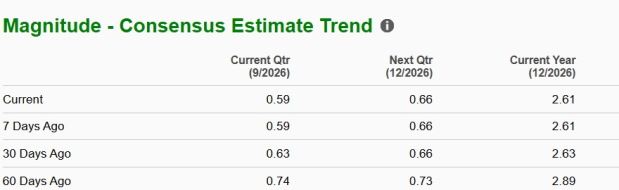
KGC’s Earnings Estimates Southbound
The Zacks Consensus Estimate for KGC’s 2026 earnings has been going down over the past 60 days. The consensus estimate for third-quarter 2026 earnings has also been revised lower over the same time frame.
A Look at Kinross Stock’s Valuation
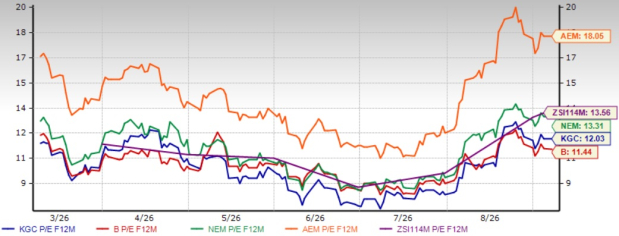
Kinross is currently trading at a forward 12-month earnings multiple of 12.03, an 11.3% discount to the peer group average of 13.56X. KGC is trading at a discount to Newmont and Agnico Eagle and at a premium to Barrick Mining. Kinross Gold currently has a Value Score of A. Barrick Mining and Newmont have a Value Score of B each, while Agnico Eagle carries a Value Score of D.
KGC’s P/E F12M Vs. Industry, B, NEM & AEM
How Should Investors Play the KGC Stock?
Kinross boasts a robust development pipeline and a healthy financial position. The company continues to deliver solid financial results while prioritizing shareholder returns, supported by strong free cash flow generation and rapid deleveraging amid favorable gold prices. However, elevated production costs amid an inflationary environment remain a concern. This, coupled with declining earnings estimates, casts a pall on the company's prospects. Retaining this Zacks Rank #3 (Hold) stock will be prudent for investors who already own it.
You can see the complete list of today’s Zacks #1 Rank (Strong Buy) stocks here.
Zacks' Research Chief Names "Stock Most Likely to Double"
Our team of experts has just released the 5 stocks with the greatest probability of gaining +100% or more in the coming months. Of those 5, Director of Research Sheraz Mian highlights the one stock set to climb highest.
This top pick is a little-known satellite-based communications firm. Space is projected to become a trillion dollar industry, and this company's customer base is growing fast. Analysts have forecasted a major revenue breakout in 2025. Of course, all our elite picks aren't winners but this one could far surpass earlier Zacks' Stocks Set to Double like Hims & Hers Health, which shot up +209%.
Free: See Our Top Stock And 4 Runners UpWant the latest recommendations from Zacks Investment Research? Today, you can download 7 Best Stocks for the Next 30 Days. Click to get this free report
Kinross Gold Corporation (KGC): Free Stock Analysis Report
Newmont Corporation (NEM): Free Stock Analysis Report
Agnico Eagle Mines Limited (AEM): Free Stock Analysis Report
Barrick Mining Corporation (B): Free Stock Analysis Report
This article originally published on Zacks Investment Research (zacks.com).