


The reinsurance market is entering a phase where the source of capital is changing. Gallagher Re estimates that total dedicated reinsurance capital rose 5% to $688 billion in the first half of 2026. Traditional reinsurance capital increased 4% to $541 billion, while non-life alternative capital grew faster, rising 9% to $147 billion. Strong investor returns, net inflows and continued growth in catastrophe bonds supported the increase.
Alternative capital is becoming an important source of capacity for the global reinsurance industry. For reinsurers, the most relevant part is non-life alternative capital, which is increasingly deployed through catastrophe bonds, collateralized reinsurance, and sidecars. These allow investors to participate in insurance risks and give reinsurers an additional source of capital beyond their own balance sheets.
The market is expanding rapidly. According to Aon, global alternative capital reached a record $144.5 billion as of June 30, 2026, growing at an annual rate of about 8.3% over the past five years. Catastrophe bond issuance reached a record $24.9 billion in the 12 months ended June 30, 2026, while outstanding cat bond volume climbed 17% year over year to $63.4 billion. Sidecar capital also reached about $23 billion, roughly 50% above year-end 2024. Importantly, alternative capital is also expanding into casualty and other longer-tail lines, moving beyond its traditional focus on catastrophe risks.
This gives reinsurers more alternative capital, which means more capacity to support insurance risks. By using third-party capital, reinsurers can potentially support more business and transfer part of the risk to investors. This can improve capital efficiency, support underwriting growth and generate additional fee income.
The shift also creates challenges. Greater capacity can increase competition and pressure reinsurance pricing, particularly in property catastrophe markets.Gallagher Re said P&C reinsurance premiums declined 6% for its composite in the first half of 2026, reflecting a softening rate environment. With alternative capital continuing to grow, reinsurers could face intensified competition during the 2027 renewal season.
Therefore, the biggest beneficiaries may not be the reinsurers that simply write more premiums. Instead, companies that can combine strong underwriting with efficient use of third-party capital may be better positioned to protect returns as market conditions soften.
Against this backdrop, RenaissanceRe Holdings RNR, Arch Capital Group, Ltd ACGL and Everest Group EG are well-positioned to benefit from the growing role of alternative capital.
3 Reinsurers to Watch
With the help of the Zacks Stock Screener, we have selected three stocks with an impressive Value Score of A or B. RNR, ACGL and EG each carry a Zacks Rank #3 (Hold) at present. You can see the complete list of today’s Zacks #1(Strong Buy) Rank stocks here.
RenaissanceRe: Based in Pembroke, Bermuda, RNR is a global provider of property, casualty and specialty reinsurance and insurance. The company is also one of the industry's leading managers of third-party capital through its Capital Partners platform, which gives institutional investors access to reinsurance risks through vehicles such as DaVinci, Medici and Vermeer. RNR has been managing third-party capital for more than two decades.
The platform is becoming a meaningful source of earnings diversification. RenaissanceRe generated $177.2 million of fee income in the first half of 2026, up from $125.4 million a year earlier. At the same time, strong underwriting performance provides a solid base for further capital deployment, with the company reporting $599.1 million of underwriting income and a 72.8% combined ratio in the second quarter of 2026. The combination of profitable reinsurance operations and a scaled third-party capital platform positions RNR to benefit as alternative capital continues to expand.
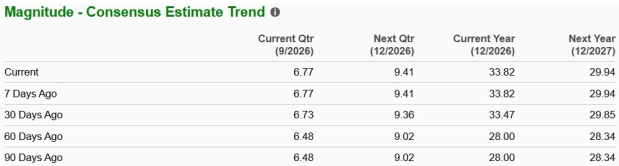
Estimates for RNR’s 2026 bottom line have risen 3.6% over the past 30 days and suggest an 8.4% increase from the year-ago reported number. Its expected long-term earnings growth is pegged at 6.5%.
Image Source: Zacks Investment Research
Arch Capital: Based in Pembroke, Bermuda, ACGL primarily offers insurance, reinsurance and mortgage insurance across the world. has long incorporated institutional capital into its reinsurance strategy through its capital markets operations[KPD1.1]. Its alternative-capital activities include catastrophe bonds and collateralized vehicles, primarily focused on property catastrophe reinsurance.
Arch is increasingly using third-party capital as part of its broader risk-management strategy. In the second quarter of 2026, reinsurance business generated $410 million of underwriting income, with a 77.5% combined ratio. Profitable underwriting gives Arch greater flexibility to deploy third-party capacity without relying solely on its own balance sheet. As alternative capital expands, Arch's ability to combine its underwriting expertise with third-party capacity could help it manage capital more efficiently while maintaining attractive returns.
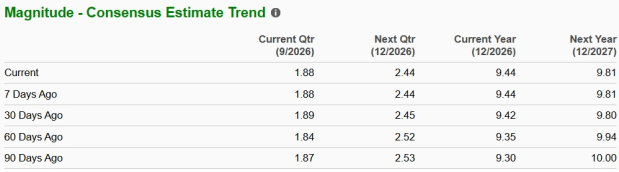
Estimates for ACGL’s 2026 bottom line have risen 0.4% over the past 30 days but suggest a 4.1% decrease from the year-ago reported number. Its expected long-term earnings growth is pegged at 2.2%.
Image Source: Zacks Investment Research
Everest: Based in Hamilton, Bermuda, Everest operates a diversified global insurance and reinsurance business spanning property, casualty and specialty risks. Everest is expanding its third-party capital platform through Mt. Logan Capital Management, which provides institutional investors access to Everest-originated reinsurance risks. The strategy is already gaining scale. Mt. Logan had approximately $3.4 billion of AUM as of July 1, 2026, up 89% from the beginning of 2025.
Everest is also using alternative capital to expand into casualty reinsurance. In June 2026, the company partnered with Stone Point Insurance Solutions to launch Annapurna Re, a casualty reinsurance sidecar expected to deploy about $600 million of third-party capital over three years. By expanding third-party capital into casualty and specialty reinsurance, Everest can access additional capacity as alternative capital moves beyond property catastrophe risks.
Estimates for EG’s 2026 bottom line have risen 0.7% over the past 30 days and suggest a 19.4% increase from the year-ago reported number. Its expected long-term earnings growth is pegged at 9.6%.
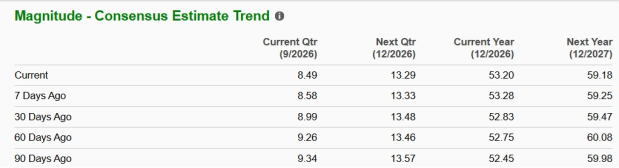
Image Source: Zacks Investment Research
Research Chief Names "Single Best Pick to Double"
From thousands of stocks, 5 Zacks experts each have chosen their favorite to skyrocket +100% or more in months to come. From those 5, Director of Research Sheraz Mian hand-picks one to have the most explosive upside of all.
This company targets millennial and Gen Z audiences, generating nearly $1 billion in revenue last quarter alone. A recent pullback makes now an ideal time to jump aboard. Of course, all our elite picks aren’t winners but this one could far surpass earlier Zacks’ Stocks Set to Double like Nano-X Imaging which shot up +129.6% in little more than 9 months.
Free: See Our Top Stock And 4 Runners UpWant the latest recommendations from Zacks Investment Research? Today, you can download 7 Best Stocks for the Next 30 Days. Click to get this free report
RenaissanceRe Holdings Ltd. (RNR): Free Stock Analysis Report
Arch Capital Group Ltd. (ACGL): Free Stock Analysis Report
Everest Group, Ltd. (EG): Free Stock Analysis Report
This article originally published on Zacks Investment Research (zacks.com).