


Energy Fuels Inc. UUUU and Cameco Corporation CCJ are well positioned to benefit from strengthening global demand for nuclear energy and the resulting need for reliable uranium supplies. While Energy Fuels is ramping up uranium production and expanding its rare earth elements (REE) business to capture opportunities across the critical materials value chain, Cameco leverages its large-scale uranium operations, diversified nuclear fuel cycle capabilities and strategic investments in nuclear technology to support long-term growth.
For investors seeking exposure to the nuclear energy sector, the two companies offer distinct investment propositions. Comparing their operating performance, growth prospects, earnings estimates and valuations can help determine which stock offers the more attractive risk-reward profile today.
The Case for UUUU
Energy Fuels has produced nearly two-thirds of all uranium in the United States since 2017. The company is scaling up uranium production while investing in rare earth processing and downstream capabilities to capitalize on growing demand for nuclear fuel and critical materials.
In the second quarter of 2026, Energy Fuels mined approximately 315,000 pounds of uranium, bringing first-half production to 740,000 pounds. Finished uranium production reached 865,000 pounds in the quarter and 1.7 million pounds in the first half, exceeding the low end of its full-year production guidance of 1.5-2.5 million pounds. The company expects to mine 2-2.5 million pounds of contained uranium in 2026 and sell 1.5-2 million pounds through spot and contracted transactions.
In March 2026, it successfully produced terbium (Tb) oxide at pilot scale, becoming the first U.S. company in decades to achieve this milestone. In August, its terbium oxide was qualified by one of the world's largest rare earth permanent magnet manufacturers outside China, marking progress toward commercializing its heavy rare earth capabilities.
Energy Fuels’ second-quarter revenues jumped 496% year over year to $25.1 million, driven by higher uranium sales volumes and realized prices. The company sold 310,000 pounds of uranium at an average realized price of $80.48 per pound compared with 50,000 pounds at $77 per pound in the year-ago quarter.
Costs applicable to revenues surged 192% to $10.7 million on higher uranium volumes sold, partially offset by lower weighted average cost per pound of uranium sold. Standby costs surged 61% year over year due to higher permitting activities at Roca Honda and Whirlwind and increased maintenance activities at Nichols Ranch. Selling, general and administration were up 31% year over year, reflecting increases in general headcount, salaries and benefits. UUUU also incurred $10.7 million in transaction and integration costs. The company reported a net loss of 13 cents per share in the quarter, wider than the year-ago quarter’s loss of 10 cents per share.
The company has six uranium supply contracts with U.S. nuclear utilities with deliveries extending to 2032. As of June 30, 2026, contracted volumes totaled 3.20 million base pounds, with minimum and maximum deliveries of 2.77 million and 4.72 million pounds, respectively.
Energy Fuels has a substantial pipeline of uranium development projects. The Whirlwind mine and Nichols Ranch ISR project alone could add up to 500,000 pounds of annual uranium production within a year of a development decision. Other major projects, including Roca Honda, Bullfrog and Sheep Mountain, collectively contain nearly 70 million pounds of uranium resources.
UUUU has begun expanding its White Mesa Mill to enable large-scale production of heavy rare earth oxides. Its acquisition of Australian Strategic Materials (ASM) adds the Korean Metals Plant in Ochang, South Korea, which currently has the capacity to produce 1,300 tons of neodymium-iron-boron (NdFeB) alloy annually. Expansion is underway to increase NdFeB alloy capacity at the Korean Metals Plant to 3,600 tons per year.
The plant also possesses commercial metallization capabilities for neodymium-praseodymium (NdPr) and is developing metallization capabilities for dysprosium (Dy) and Tb. This complements Energy Fuels' NdPr, Tb and Dy oxide production and expansion initiatives at its White Mesa Mill in Utah.
Energy Fuels is also seeking to move further downstream through its planned acquisition of permanent magnet manufacturer Vacuumschmelze (“VAC”), announced in June 2026. If completed, potentially as early as the first quarter of 2027, the deal would give UUUU exposure across a broader portion of the rare-earth value chain, from mineral resources and processing to finished magnetic products.
The Case for CCJ
Cameco remains one of the largest and most established uranium producers globally. Its tier-one mining and milling operations are capable of producing more than 30 million pounds of uranium concentrates annually (its share). Cameco accounted for 15% of global uranium production in 2025.
Beyond mining, the company has a diversified presence across the nuclear fuel cycle, including refining, conversion and fuel services. Its strategic stakes in Westinghouse and Global Laser Enrichment add long-term optionality tied to reactor deployment and enrichment technologies.
In the second quarter of 2026, Cameco’s total revenues were down 7% to CAD 814 million ($588 million) due to weaker performance in both segments. Uranium sales volumes fell 18% to 7.1 million pounds, reflecting normal quarterly delivery timing and Cameco's disciplined contracting strategy, which calls for lower planned deliveries in 2026.
Lower volumes were offset by a 15% increase in the Canadian dollar average realized price to CAD 93.13 per pound, leading to a 7% year-over-year decline in Cameco’s uranium revenues to CAD 659 million ($469 million). Fuel Services revenues fell 6% to CAD 152 million ($108 million) as a 13% increase in realized prices offset an 18% decline in volumes.
Higher purchased material costs, product-loan impacts and the Cigar Lake maintenance shutdown pushed uranium-segment costs up about 3%. Fuel Services costs increased 1%, with higher unit costs offset by lower volumes.
Adjusted earnings fell 75% year over year to CAD 0.18 per share (13 cents) due to lower uranium sales volumes and a sharp decline in Cameco’s equity earnings from Westinghouse. The year-ago quarter benefited from significant Westinghouse revenues related to the Czech Republic’s Dukovany nuclear project.
Cameco maintained its uranium production projection between 19.5 million pounds and 21.5 million pounds for 2026. Production guidance for the fuel services segment is 13-14 million kgUs. The company expects 2026 uranium deliveries of 29-32 million pounds and uranium revenues of CAD 2.7-2.9 billion, based on a higher realized-price assumption of CAD 91-96 per pound.
At the midpoint, uranium revenues would decline about 2% from 2025 because of lower deliveries. Fuel Services revenues are projected at CAD 610-650 million, implying roughly 12% growth. Overall, Cameco expects total 2026 revenues of CAD 3.32-3.57 billion. The midpoint represents about a 1% decline from 2025.
Despite near-term fluctuations in deliveries and earnings, Cameco benefits from substantial long-term contract visibility. The company has commitments to deliver an average of about 28 million pounds annually over the next five years. It is investing to expand production, extend Cigar Lake’s mine life to 2036 and increase McArthur River and Key Lake output toward their licensed capacity of 25 million pounds on a 100% basis. Cameco also recently raised its ownership in Cigar Lake to 57.418%.
How do Estimates Compare for Energy Fuels & Cameco?
The Zacks Consensus Estimate for Energy Fuels’ 2026 revenues indicates a year-over-year surge of 107%. The company is expected to incur a loss of 25 cents per share in 2026, suggesting a narrower loss than the 38 cents reported in 2025. The Zacks Consensus Estimate for UUUU’s revenues for 2027 indicates a year-over-year gain of 64.8% to around $225 million. Earnings estimates for 2027 are pegged at 3 cents per share.
The Zacks Consensus Estimate for Cameco’s 2026 revenues of $2.44 billion implies a year-over-year decline of 2%. The consensus mark for earnings of $1.07 per share indicates year-over-year growth of 3.9%. The Zacks Consensus Estimate for Cameco’s 2027 revenues suggests year-over-year growth of 11% to $2.71 billion, with EPS expected to rise 80.8% to $1.94 per share.
Image Source: Zacks Investment Research
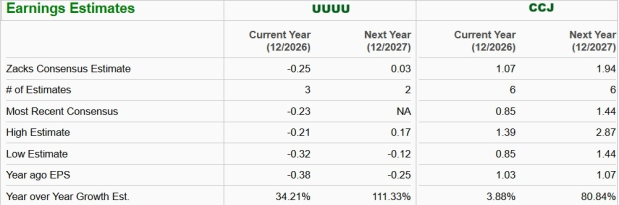
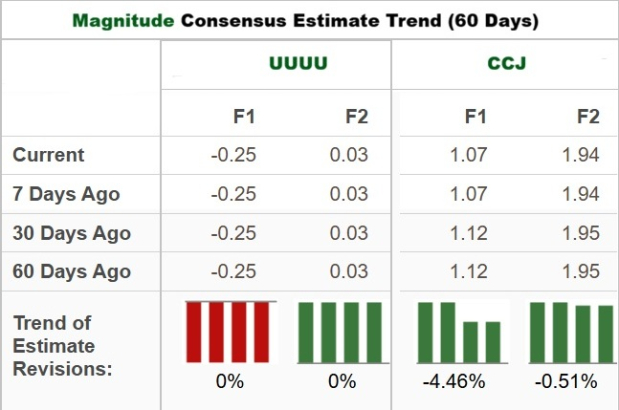
Earnings estimates for UUUU have remained unchanged over the past 60 days, while those for 2027 have moved up. Earnings estimates for both years for CCJ have moved down over the past 60 days.
Image Source: Zacks Investment Research
UUUU & CCJ: Price Performance & Valuation
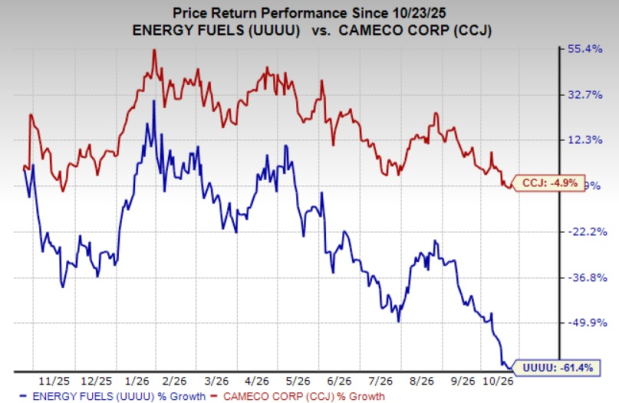
Energy Fuels’ stock has declined 61.4% in the past year compared with Cameco’s 4.9% dip.
Image Source: Zacks Investment Research
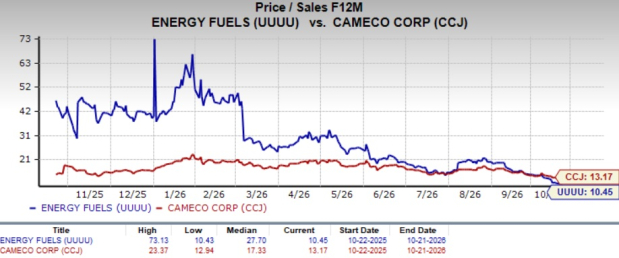
Energy Fuels is trading at a forward price-to-sales multiple of 10.45X, while Cameco’s forward sales multiple sits at 13.17X.
Image Source: Zacks Investment Research
Conclusion
Both Energy Fuels and Cameco currently carry a Zacks Rank #3 (Hold), suggesting a balanced approach is warranted. However, Cameco appears to be the more attractive choice for investors seeking relatively established operations, scale and long-term revenue visibility. Its large production base, long-term uranium supply contracts and exposure to multiple stages of the nuclear fuel cycle provide a stronger operating foundation. Although near-term earnings have weakened and analyst estimates have moved lower, Cameco's projected 2027 earnings growth offers a potential recovery catalyst.
Energy Fuels, meanwhile, offers greater potential for growth through rising uranium production and its expanding rare earth and permanent magnet businesses. Its substantially lower share price performance and decreased forward sales multiple may appeal to investors willing to accept higher execution and profitability risks. However, its wider quarterly loss, integration costs and ambitious expansion plans make its investment case more dependent on successful project execution.
Overall, Cameco is the preferred option for investors prioritizing operating scale, diversification and greater earnings visibility, while Energy Fuels is better suited to risk-tolerant investors seeking higher potential growth from uranium and rare earth expansion.
You can see the complete list of today’s Zacks #1 Rank (Strong Buy) stocks here.
7 Best Stocks for the Next 30 Days
Just released: Experts distill 7 elite stocks from the current list of 220 Zacks Rank #1 Strong Buys. They deem these tickers "Most Likely for Early Price Pops."
Since 1988, the full list has beaten the market more than 2X over with an average gain of +23.9% per year. So be sure to give these hand picked 7 your immediate attention.
See them now >>Want the latest recommendations from Zacks Investment Research? Today, you can download 7 Best Stocks for the Next 30 Days. Click to get this free report
Cameco Corporation (CCJ): Free Stock Analysis Report
Energy Fuels Inc (UUUU): Free Stock Analysis Report
This article originally published on Zacks Investment Research (zacks.com).