


Bristol Myers Squibb BMY and Merck & Co. MRK are major global drugmakers with expansive, diversified portfolios.
Bristol Myers concentrates on developing breakthrough therapies across oncology, hematology, immunology, cardiovascular disease, neuroscience and beyond.
Merck stands out for its leadership in oncology, complemented by strong positions in infectious diseases and vaccines.
Both companies have an established presence in oncology and strong drug pipelines, making it difficult to choose between the two. Bristol Myers’s Opdivo competes directly with Merck's Keytruda in the cancer immunotherapy market, with both companies seeking to strengthen their oncology franchises through pipeline innovation and label expansions. A comparison of their financial performance, growth prospects, pipeline potential, risks and valuations can help identify the more attractive investment opportunity.
The Case for BMY
BMY’s Growth Portfolio has emerged as the key contributor to its revenue expansion, comprising leading brands such as Opdivo, Opdivo Qvantig, Orencia, Yervoy, Reblozyl, Camzyos, Breyanzi, Opdualag, Zeposia, Abecma, Sotyktu, Krazati and Cobenfy. These products accounted for approximately 57% of the company’s total revenues in the first nine months of 2026, underscoring their growing contribution to overall performance.
Opdivo Qvantig, Reblozyl, Camzyos, Breyanzi and Opdualag are among the portfolio’s major growth contributors. Although sales of blockbuster cancer immunotherapy Opdivo dropped, largely reflecting the ongoing shift toward subcutaneous Opdivo Qvantig in the United States, strong demand for Qvantig across its approved tumor types is helping cushion the decline. Qvantig has now reached an annualized revenue run rate of more than $1.3 billion.
Opdualag continues to see solid global demand, benefiting from its established position as a leading first-line treatment for melanoma in the United States. Reblozyl, which Bristol Myers developed in collaboration with Merck, is also delivering strong sales growth, supported by increasing adoption as a first-line treatment for anemia associated with myelodysplastic syndromes (MDS).
Breyanzi is gaining market share, driven by its differentiated therapeutic profile and growing adoption across approved large B-cell lymphoma indications in the United States and international markets.
Camzyos, Bristol Myers’ cardiovascular drug, is gaining traction as more clinicians prescribe it and its use expands in community healthcare settings.
Sotyktu is further strengthening Bristol Myers’ immunology franchise following its approval for psoriatic arthritis, expanding its commercial opportunity beyond plaque psoriasis.
Cobenfy also represents a potential long-term growth driver. Its encouraging initial commercial performance in schizophrenia, along with the possibility of future label expansions, could increase its contribution to revenues over time.
However, the portfolio transition remains a key challenge. BMY’s Legacy Portfolio remains under pressure from generic competition, with key drugs such as Revlimid, Pomalyst, Sprycel and Abraxane contributing to a 3% revenue decline in the first nine months of 2026.
The FDA recently granted accelerated approval to iberdomide, in combination with daratumumab and hyaluronidase-fihj and dexamethasone (ZDd), under the brand name Zenbexus, for adults with multiple myeloma who have received at least one prior line of therapy. Zenbexus is the first FDA-approved cereblon E3 ligase modulator, representing a novel class of cereblon-modulating protein degraders for multiple myeloma.
Bristol Myers is focusing on cost optimization to support margins. However, its aggressive deal-making strategy has significantly increased leverage. As of Sept. 30, 2026, the company reported a debt-to-capital ratio of 64.7%, with $12.9 billion in cash and equivalents versus $41.8 billion in long-term debt, highlighting a key financial risk alongside its growth ambitions.
The Case for MRK
Merck boasts more than six blockbuster drugs in its portfolio. Keytruda, Merck’s immuno-oncology drug, is the company’s top-selling product. The drug has played a pivotal role in driving top-line revenue growth over the past few years.
Growth engine Keytruda is approved for various oncology indications either as a monotherapy or in combination with other drugs. Sales are benefiting from the rapid uptake across earlier-stage indications. Continued strong momentum in metastatic indications is also boosting sales growth.
In September 2025, the FDA also approved Keytruda Qlex (pembrolizumab and berahyaluronidase alfa-pmph) as a subcutaneous injection for adults with most solid tumor indications already approved for Keytruda.
Sales of Keytruda/ Keytruda Qlex (accounted for 53% of total sales in the third quarter of 2026) grew 6% in the third quarter of 2026.
Merck is currently evaluating Keytruda across a wide variety of cancers and treatment settings and targets peak sales of $35 billion by 2028.
However, Keytruda will lose patient exclusivity in 2028, adversely impacting the top line.
Nonetheless, Merck’s other oncology drugs — Welireg and Lynparza (in partnership with AstraZeneca) — are also performing well and contributing to top-line growth.
The pulmonary arterial hypertension drug, Winrevair, witnessed a strong launch and should drive significant growth in the long term.
Meanwhile, Merck’s Animal Health business is a key contributor to its top-line growth, witnessing strong demand driven by the livestock portfolio.
Merck is also making efforts to strengthen its vaccine portfolio in the wake of declining Gardasil sales. Its new 21-valent pneumococcal conjugate vaccine, Capvaxive, has seen strong uptake.
The company has been striving to drive both organic and inorganic growth through mergers and acquisitions (M&A). Consequently, MRK’s phase III pipeline has almost tripled since 2021.
The acquisitions of Cidara Therapeutics, Terns Pharmaceuticals and Verona Pharma have further expanded its portfolio.
The company expects more than $70 billion of potential non-risk-adjusted commercial opportunity for the current pipeline by the mid-2030s.
However, MRK is facing generic competition for several of its key drugs (Januvia and Janumet, Isentress/Isentress HD, Bridion and Difici), which will impact the top line.
Sales of Gardasil, one of the key products in Merck’s portfolio, are also expected to decline due to weak demand in China and Japan.
How Do Estimates Compare for BMY & MRK?
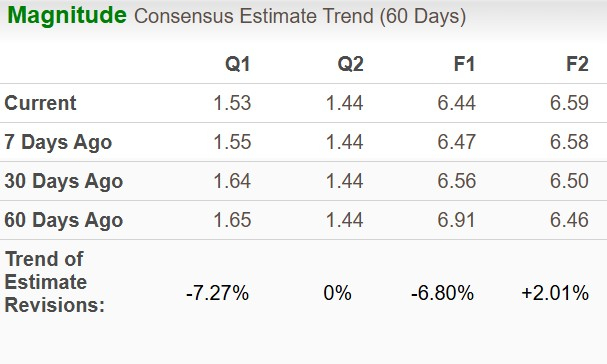
The Zacks Consensus Estimate for BMY’s 2026 sales implies a year-over-year increase of 4.04% and the same for earnings per share suggests an improvement of 4.72%. Over the past 30 days, EPS estimates for 2026 have moved south, while those for 2027 have moved north.
BMY’s Estimate Movement
Image Source: Zacks Investment Research
MRK’s Estimate Movement
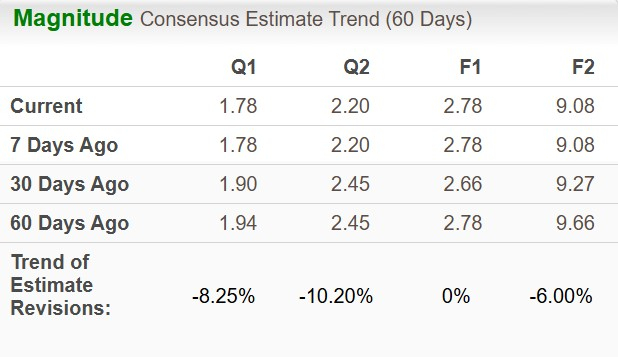
The Zacks Consensus Estimate for MRK’s 2026 sales implies a year-over-year increase of 3.60%, while that for EPS suggests a decline of 69.04%. EPS estimates for 2026 have moved north in the past 30 days, while those for 2027 have moved south.
Image Source: Zacks Investment Research
Price Performance & Valuation of MRK & BMY
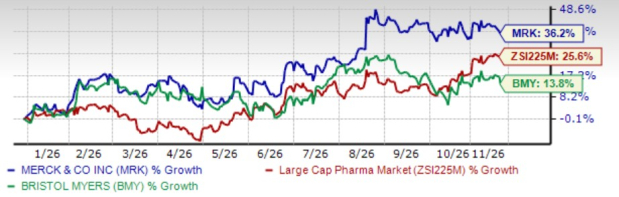
From a price-performance perspective, MRK has outperformed the large-cap pharma industry in the past year, while BMY underperformed the same. Shares of MRK and BMY have gained 36.2% and 13.8%, respectively, compared with the industry’s 25.6% rise in the said period.
Image Source: Zacks Investment Research
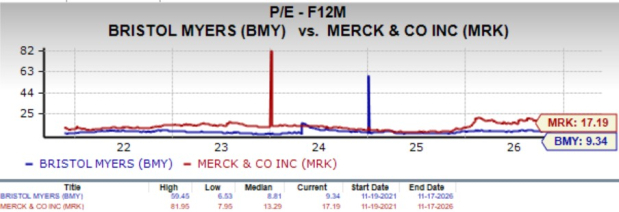
From a valuation standpoint, we use the P/E ratio of the large-cap pharma industry to compare these companies. Going by the same, MRK is slightly more expensive than BMY. MRK’s shares currently trade at 17.2X forward earnings, higher than 9.34X for BMY. The large-cap pharma industry currently trades at 19.71X forward earnings.
Image Source: Zacks Investment Research
Both MRK and BMY have an attractive dividend yield. This is a strong positive for investors. However, BMY's dividend yield of 4% is higher than MRK’s 2.35%.
Which Stock Is a Better Option for Now?
Large-cap pharma and biotech companies are often viewed as relatively defensive plays within the healthcare sector.
Since both BMY and MRK stocks currently carry a Zacks Rank #3 (Hold), choosing one over the other could be tricky. You can see the complete list of today’s Zacks #1 Rank (Strong Buy) stocks here.
MRK appears to be the better investment choice over BMY, supported by its stronger stock performance, leadership in oncology, diversified growth drivers and expanding pipeline. Although Keytruda faces patent expiration risks in 2028, Merck is building additional growth engines. Its recent acquisitions have also strengthened its long-term growth prospects.
While MRK trades at a premium to BMY, its valuation remains below the industry average. BMY offers a higher dividend yield and attractive growth opportunities from its Growth Portfolio, but generic erosion in its Legacy Portfolio and elevated debt add to its risks.
Overall, MRK's stronger business momentum and broader growth opportunities make it the more compelling choice for investors despite its lower dividend yield.
Discover the Stocks Our Experts Want to Own This Quarter
Each quarter, four Zacks editors compile their favorite stocks into one report. As a sign of the times, three of this quarter's picks can potentially cash in on the massive AI boom. One grew its commercial revenue more than 140% last quarter.
The fourth stock is an online retailer posting its most significant growth since the pandemic. Its shares jumped more than 25% after its last earnings report, then pulled back, giving investors a chance to capitalize on what could be a longer-term bullish trend.
Get Your Free Ultimate Four Report >>Want the latest recommendations from Zacks Investment Research? Today, you can download 7 Best Stocks for the Next 30 Days. Click to get this free report
Bristol Myers Squibb Company (BMY): Free Stock Analysis Report
Merck & Co., Inc. (MRK): Free Stock Analysis Report
This article originally published on Zacks Investment Research (zacks.com).