
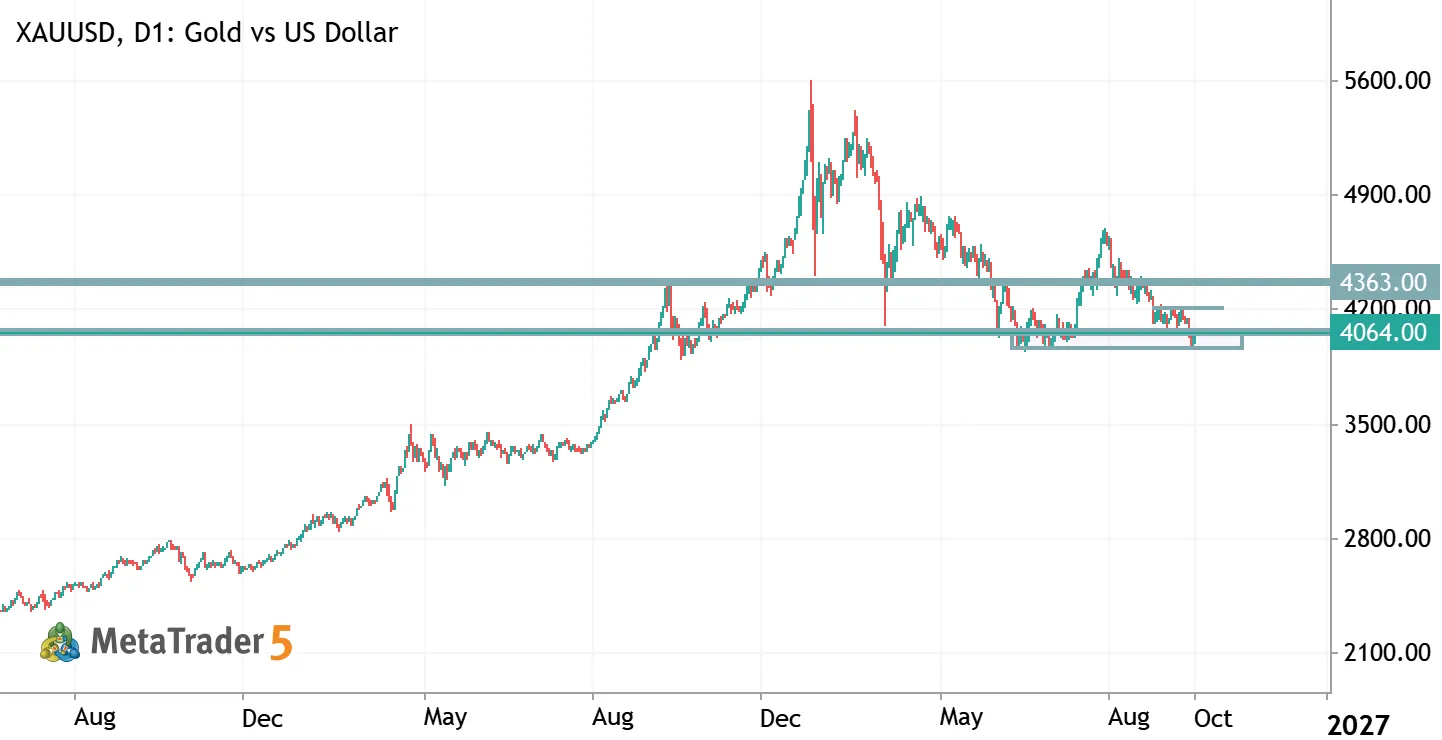
Gold is once again approaching a critical technical level. Following a substantial correction, XAUUSD is testing the psychological $4,000 mark, which coincides with the highest-volume price area of the past year.
Can gold resume its bullish trend? How do high Federal Reserve interest rates, inflation, and rising oil prices affect the precious metal? Let's examine the technical outlook and three probability-based scenarios for the next 3–6 months.
XAUUSD Technical Analysis: Why Is $4,000 So Important?
The daily gold chart shows a sequence of lower highs, indicating weakening buying pressure. Bulls have yet to restore the previous upward momentum.
The key battle is now taking place around $4,000 — both a major psychological level and the highest-volume area over the past year.
Holding this support could open the door to a recovery toward $4,180–4,200. However, a sustained break below $4,000 would increase the risk of a deeper correction.
The next major long-term support area is located near $3,500, where significant historical trading volumes from the past five years coincide with the daily 200-period exponential moving average (EMA-200).
For now, however, I do not consider such a deep decline my primary scenario.
Why Is Gold Falling? Fed Rates, Inflation, and the US Dollar
One of the main factors weighing on gold is the elevated real yield on US Treasury securities.
Rising oil and energy prices increase inflation risks, limiting the Federal Reserve's ability to cut interest rates.
When real bond yields rise, investors gain an increasingly attractive alternative to gold, which does not generate interest income.
A stronger US dollar, reflected in the DXY index, can create additional downward pressure on XAUUSD.
However, this relationship is not absolute. During periods of geopolitical uncertainty or financial instability, gold may continue attracting demand even when interest rates remain high.
The Paradox: High Interest Rates Could Eventually Support Gold
Prolonged restrictive monetary policy raises borrowing costs, discourages consumption, and reduces business investment.
Over time, this may lead to slower US economic growth, rising unemployment, and weaker inflationary pressure.
If economic conditions deteriorate significantly, the Federal Reserve may eventually need to lower interest rates. In the event of systemic financial stress, additional liquidity support measures could also become necessary.
In other words, the very factor putting pressure on gold today could eventually create the conditions for its recovery.
This would be particularly relevant if falling interest rates were accompanied by declining real yields and a weaker dollar.
What Could Trigger a Gold Price Collapse Toward $3,500?
In my view, the most dangerous environment for gold would combine a resilient US economy, a strong dollar, and persistently elevated real interest rates.
Suppose US inflation stabilizes around 4–5%, while economic growth remains positive and unemployment stays relatively low.
Under such conditions, the Federal Reserve could be forced to maintain restrictive monetary policy for an extended period. A hypothetical interest-rate range of 5–6% cannot be ruled out.
If geopolitical tensions ease at the same time and investors begin taking profits following gold's previous rally, investment demand could weaken considerably.
This combination would create conditions for a deeper XAUUSD correction.
Gold Price Forecast 2026: Three Scenarios
Scenario 1. Gold Recovery — 45%
Buyers defend $4,000, real Treasury yields stabilize, and the US dollar stops strengthening.
The first upside target would be $4,180–4,200.
Scenario 2. Continued Correction — 35%
Gold establishes itself below $4,000, the Fed maintains a hawkish stance, and real yields remain elevated.
The market continues searching for a new price equilibrium at lower levels.
Scenario 3. Deeper Decline Toward $3,500 — 20%
A sustained breakdown below $4,000 is accompanied by a stronger dollar, persistently high real interest rates, and weakening safe-haven demand.
The next major technical area would be $3,500.
These probabilities represent subjective scenario assessments rather than the output of a statistically calibrated forecasting model.
Key XAUUSD Support and Resistance Levels
- $4,180–4,200: Nearest significant resistance area.
- $4,000: Psychological support and the highest-volume area of the past year.
- $3,500: Major long-term volume zone and daily EMA-200.
These levels should be treated as price zones rather than exact reversal points.
Conclusion: Will Gold Rise or Fall?
In my view, it is still premature to consider a decline toward $3,500 the most likely outcome.
High real interest rates are certainly putting pressure on XAUUSD. However, prolonged monetary tightening could eventually slow the US economy and force the Federal Reserve to reconsider its policy stance.
For now, $4,000 remains the key dividing line.
Holding this level would preserve the potential for recovery, while a confirmed breakdown accompanied by rising real yields would require a reassessment of the outlook.
The central question is what comes first: a meaningful slowdown in the US economy or a prolonged period of elevated inflation and restrictive Federal Reserve policy?
The answer, in my opinion, will largely determine gold's medium-term direction.
XAUUSD market analysis — October 2026. This material is for informational purposes only and does not constitute personalized investment advice.

 Profilo MQL5
Nuovo commento