


Truist Financial’s TFC first-quarter 2026 earnings of $1.09 per share beat the Zacks Consensus Estimate of 99 cents by 10.1%. The bottom line was up 25.3% from 87 cents a year ago.
Results were primarily aided by a rise in net interest income (NII) and higher fee income. Further, a higher average loan balance offered support. An increase in expenses and higher provisions were the undermining factors.
Net income available to common shareholders was $1.38 billion, up 19% from the prior-year quarter.
TFC’s Revenue Mix Reflects Higher Interest Income
Total revenue of $5.15 billion rose 5.2% year over year. The top line beat the consensus estimate of $5.14 billion. The metric benefited from improved net interest income (NII), supported by fixed-rate asset repricing and loan growth.
NII was $3.60 billion compared with $3.51 billion in the first quarter of 2025. The net interest margin (NIM) rose 1 basis point (bp) to 3.02%.
Non-interest income was $1.55 billion, up 11.6% from $1.39 billion a year ago. Strength in investment banking and trading income, wealth management income and mortgage banking income supported fee generation during the quarter.
Truist Cost Trends Show Mixed Signals on Profitability
Non-interest expense totaled $2.98 billion, up 2.6%. This was largely due to higher personnel costs tied to salaries, incentives and benefits related to hiring.
Profitability metrics improved alongside the earnings growth. Return on average common equity was 9.3% and return on average tangible common equity was 13.8% in the quarter, while the efficiency ratio improved to 57.9% from 59.3% in the prior-year period, signaling better operating leverage.
TFC’s Credit Quality Weakens
Provision for credit losses increased to $479 million from $458 million a year ago.
The net charge-off (NCO) ratio of 0.61% of average loans and leases was broadly stable compared with the year-ago quarter.
Asset quality also showed some pressure in problem assets. Total non-performing assets were $1.79 billion as of March 31, 2026, higher than $1.62 billion a year earlier, while non-performing loans and leases were 0.50% of loans and leases held for investment, up 2 bps year over year.
The allowance for loan and lease losses was 1.53% of loans and leases held for investment, down from 1.58% a year ago.
Truist Balance Sheet and Capital Return Remain in Focus
Balance sheet trends were steady, with average loans and leases of $329.0 billion versus $307.5 billion in the year-ago quarter. Average deposits were $398.9 billion compared with $392.2 billion a year earlier, reflecting gradual growth in funding.
Capital return was a notable highlight in the quarter. Truist returned $1.8 billion to shareholders through dividends and common share repurchases, including $1.1 billion of buybacks. The common equity Tier 1 ratio was 10.8% at quarter end, unchanged sequentially, indicating capital generation was sufficient to offset shareholder returns.
TFC Projects Steady Near-Term Results
For the second quarter of fiscal 2026, management expects taxable-equivalent revenues of about $5.2 billion to be stable, while non-interest expenses are projected to rise 3-4%. The company also indicated planned share repurchases of roughly $1.2 billion in the second quarter.
For full-year 2026, Truist expects taxable-equivalent revenues to rise about 4% and non-interest expenses to increase roughly 1.75%. The Truist also guided to an NCO ratio of around 55 bps and indicated a lower effective tax rate outlook.
Our Take on Truist Financial
Decent loan demand and TFC’s business restructuring/expansion initiatives are expected to continue supporting its top line. A solid balance sheet position is another positive. However, elevated expenses, given a tough operating environment, are a major headwind.
Truist Financial Corporation Price, Consensus and EPS Surprise
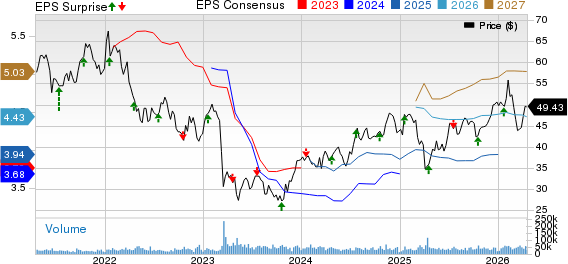
Truist Financial Corporation price-consensus-eps-surprise-chart | Truist Financial Corporation Quote
Truist Financial currently carries a Zacks Rank #3 (Hold). You can see the complete list of today’s Zacks #1 Rank (Strong Buy) stocks here.
Performance of TFC’s Peers
KeyCorp’s KEY first-quarter 2026 earnings from continuing operations of 44 cents per share outpaced the Zacks Consensus Estimate of 41 cents. The bottom line reflected a 33.3% rise from the prior-year quarter.
KEY’S results primarily benefited from higher NII and non-interest income. Higher average loan balances, along with lower provisions, were other tailwinds. However, higher expenses hurt the results to some extent.
The PNC Financial Services Group, Inc. PNC has delivered adjusted earnings per share of $4.32 in the first quarter of 2026, beating the Zacks Consensus Estimate of $4.12 and up from $3.51 a year ago.
Results reflected higher net NII, a rise in the NIM, and strong loan and deposit growth, aided by the FirstBank acquisition (completed in January 2026). However, higher expenses were a headwind for PNC.
#1 Semiconductor Stock to Buy (Not NVDA)
The incredible demand for data is fueling the market's next digital gold rush. As data centers continue to be built and constantly upgraded, the companies that provide the hardware for these behemoths will become the NVIDIAs of tomorrow.
One under-the-radar chipmaker is uniquely positioned to take advantage of the next growth stage of this market. It specializes in semiconductor products that titans like NVIDIA don't build. It's just beginning to enter the spotlight, which is exactly where you want to be.
See This Stock Now for Free >>Want the latest recommendations from Zacks Investment Research? Today, you can download 7 Best Stocks for the Next 30 Days. Click to get this free report
The PNC Financial Services Group, Inc (PNC): Free Stock Analysis Report
KeyCorp (KEY): Free Stock Analysis Report
Truist Financial Corporation (TFC): Free Stock Analysis Report
This article originally published on Zacks Investment Research (zacks.com).