


Keros Therapeutics KROS reshaped its financial profile in 2025 by pairing a major licensing transaction with a shift in development responsibilities. The result was a step-change in reported revenue and a meaningful reduction in internal research and development burden.
The key question for 2026 is whether that reset truly lowers dilution risk, or simply replaces one form of uncertainty with another.
KROS Revenue Surge Came From Partner Economics
Keros posted a total 2025 revenue of $244.1 million, up sharply from $3.6 million in 2024. The increase came almost entirely from partner-related economics rather than commercialization.
License revenue was $205.4 million, driven by recognition of a $200.0 million upfront payment and a $10.0 million development milestone under the Takeda agreement for elritercept. Service and other revenue totaled $38.7 million, largely tied to transition services under the same arrangement, including clinical and manufacturing support.
Importantly, Keros has not recorded product sales to date, leaving the top line dependent on licensing and services rather than a repeatable commercial base.
Keros Deal Terms Shift Spend Off the P&L
The Takeda collaboration does more than add revenue. It also changes what Keros must fund directly. Elritercept development responsibilities and related expenses transitioned to Takeda, which materially lowered Keros’ research and development load.
That shift showed up clearly in quarterly expense trends. In the fourth quarter, research and development expense fell to $17.9 million, down 61% year over year, explicitly tied to the transition of elritercept responsibilities and expenses to Takeda.
For investors focused on dilution risk, this matters because it can reduce internal cash burn. A structurally leaner research and development base can give management more flexibility to prioritize the company’s remaining pipeline and pace spending through upcoming clinical milestones.
KROS Milestone Visibility Matters More Than Headlines
The Takeda deal delivered immediate, visible financial impact through the upfront payment and early milestone recognition. Those items helped drive 2025 results and reshaped near-term optics.
The tradeoff is that milestone cadence is not inherently predictable. With no guided milestone schedule and no commercial engine supporting routine revenue, forward results can normalize lower and remain volatile. That volatility can flow through to valuation, particularly when investors try to underwrite future cash needs without repeatable drivers.
This is a key distinction for 2026. The presence of potential future milestones and royalties can preserve upside, but uncertainty around timing can still keep revenue and sentiment choppy.
Keros Therapeutics, Inc. Price and Consensus
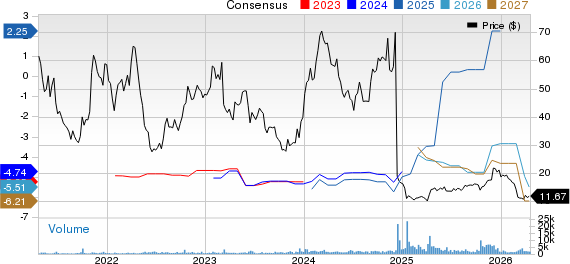
Keros Therapeutics, Inc. price-consensus-chart | Keros Therapeutics, Inc. Quote
Keros Runway Extends Into 1H 2028
Keros ended 2025 with cash and cash equivalents of $287.4 million as of Dec. 31, 2025. Management stated that this balance is expected to fund planned operating expenses and capital expenditures into the first half of 2028, contingent on current operating assumptions.
A runway stretching into the first half of 2028 helps reduce near-term financing pressure. It also gives the company time to execute on planned clinical steps for rinvatercept, including a phase II start in Duchenne muscular dystrophy in the second quarter of 2026 and planned regulatory engagement for amyotrophic lateral sclerosis in the second half of 2026.
KROS Capital Returns Reduced Share Count
Keros’ year-over-year cash decline was driven primarily by capital return actions executed in 2025. Cash fell 49% from $559.9 million to $287.4 million.
Management cited an issuer tender offer of approximately $194.4 million and separate repurchases totaling approximately $180.6 million as the main uses of cash. These actions reduced shares outstanding to 19.5 million at year-end.
The tender offer details underscore the scale of the program. Keros repurchased 10.95 million shares at $17.75 each, completing a $375 million capital return program, representing roughly 35.9% of outstanding common stock.
Keros Expenses Show Mixed Signals Post-Partnering
Post-partnering, operating expenses are sending mixed signals that investors may track for operating leverage. Research and development dropped sharply following the Takeda transition, while overhead moved higher.
In the fourth quarter, general and administrative expense rose 10% year over year to $11.7 million.
This combination can be read two ways. Lower research and development can support a lower-burn model. At the same time, rising general and administrative expenses can pressure the path to operating discipline unless it stabilizes as the pipeline advances.
KROS Valuation Anchors on Book Value
The valuation framework here is tied to book value rather than sales momentum. As of Apr. 20, 2026, KROS traded at 0.76x trailing 12-month book value per share. Over the past five years, the multiples ranged from 0.53x to 7.21x, with a five-year median of 3.85x.
The $15 price target cited in the analysis is based on applying a 0.98x trailing 12-month book value multiple.
That book-value anchor can be especially relevant for a company without product sales and with revenue largely driven by partner economics. It also frames how investors may compare Keros to other Duchenne muscular dystrophy players such as Sarepta Therapeutics SRPT and PTC Therapeutics PTCT, where competitive dynamics remain active even as Keros focuses on execution and partner-enabled cost leverage.
KROS Zacks Rank
Keros currently carries a Zacks Rank #3 (Hold). You can see the complete list of today’s Zacks #1 Rank (Strong Buy) stocks here.
Research Chief Names "Single Best Pick to Double"
From thousands of stocks, 5 Zacks experts each have chosen their favorite to skyrocket +100% or more in months to come. From those 5, Director of Research Sheraz Mian hand-picks one to have the most explosive upside of all.
This company targets millennial and Gen Z audiences, generating nearly $1 billion in revenue last quarter alone. A recent pullback makes now an ideal time to jump aboard. Of course, all our elite picks aren’t winners but this one could far surpass earlier Zacks’ Stocks Set to Double like Nano-X Imaging which shot up +129.6% in little more than 9 months.
Free: See Our Top Stock And 4 Runners UpWant the latest recommendations from Zacks Investment Research? Today, you can download 7 Best Stocks for the Next 30 Days. Click to get this free report
Sarepta Therapeutics, Inc. (SRPT): Free Stock Analysis Report
PTC Therapeutics, Inc. (PTCT): Free Stock Analysis Report
Keros Therapeutics, Inc. (KROS): Free Stock Analysis Report
This article originally published on Zacks Investment Research (zacks.com).