


AST SpaceMobile (ASTS) is not a sleepy stock right now. It has been one of the market’s most-watched space names, thanks to a huge run-up, a bold long-term story, and the idea that it could one day bring cell service from orbit straight to ordinary smartphones.
But the latest headline was not a good one.
More Top Stocks Daily: Go behind Wall Street’s hottest headlines with Barchart’s Active Investor newsletter.
Blue Origin’s New Glenn rocket had carried AST SpaceMobile’s BlueBird 7 satellite, and AST later said the satellite ended up in a much lower orbit than planned and was declared lost. That news shook investors and pushed ASTS shares lower, adding fresh doubts about how much risk is baked into the story.
The big question now is whether this is just a rough launch-related setback or a sign that ASTS stock has already gone too far.
Why the Blue Origin Failure Hit So Hard
The market did not like this news because AST SpaceMobile is still in the proving stage. This is a company with a huge vision, but it depends on flawless execution to get there.
AST is building a space-based cellular network using huge low-Earth-orbit (LEO) satellites. The idea is simple in theory and massive in ambition. Instead of relying only on towers on the ground, AST wants to beam LTE and 5G signals directly to standard smartphones around the world.
That promise is what makes the stock exciting. It is also what makes every launch matter so much.
BlueBird 7 was supposed to be another step forward. Instead, the satellite was placed too low, and the company said it cannot be used. Even though insurance is expected to help cover the loss, the launch failure reminded investors that AST’s business model depends heavily on rocket partners, orbital accuracy, and timing.
A Huge Rally Left Little Room for Mistakes
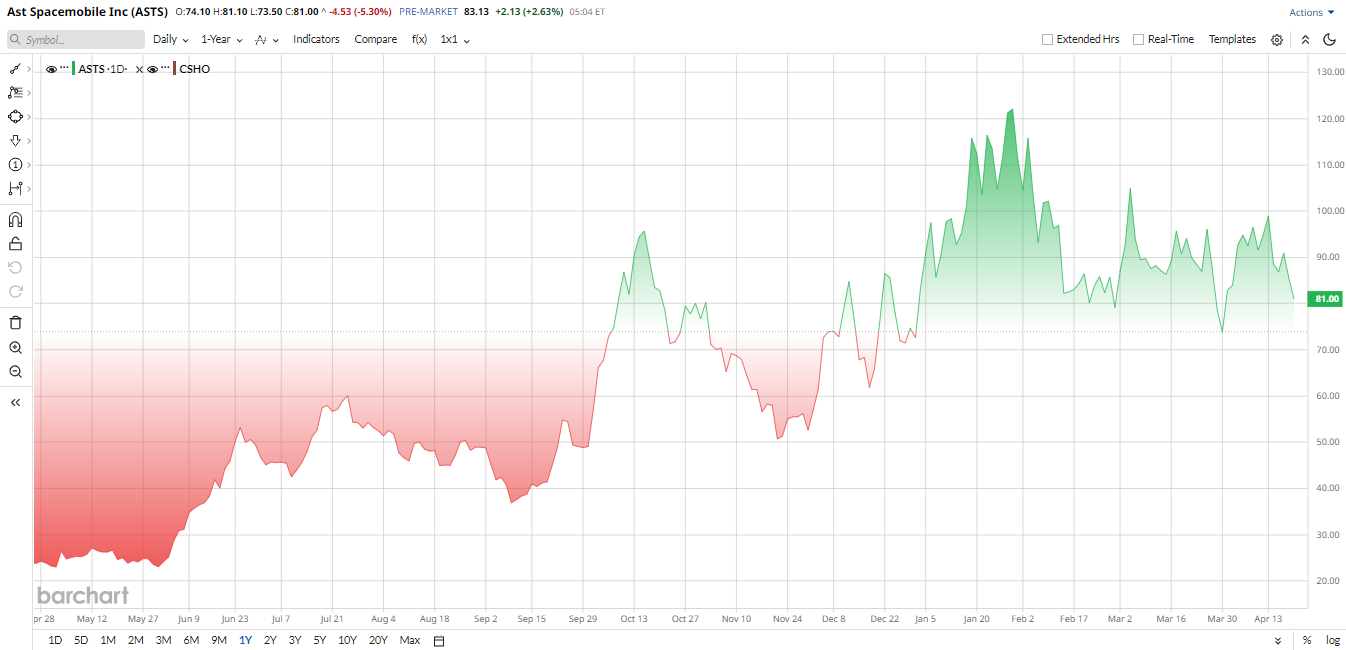
AST SpaceMobile's stock has already had a monster run. Over the past year, shares climbed about 250% as investors piled into space tech and satellite communication names.
That kind of move can be exciting. It can also make a stock fragile.
When momentum names rise that fast, the market starts demanding perfection. Any delay, failed launch, or technical problem can trigger a sharp drop. That's precisely what happened here. After the Blue Origin news, ASTS slipped roughly 10% to 15% over a short stretch as traders rushed for the exits.
 www.barchart.com
 The Business Is Real, But Still Early
The bullish case for AST SpaceMobile is not just hype. The company has signed real partners, real contracts, and real funding.
AST works with major telecom names such as AT&T (T), Verizon (VZ), Vodafone (VOD), and others. Its goal is to create a satellite network that extends mobile coverage to places where traditional towers do not reach. That could open a huge market, especially in remote areas and underserved regions.
The company also says it booked more than $1 billion in contracts and generated about $71 million in 2025 revenue. That is meaningful progress for a business that is still pre-profit and still burning cash.
Still, this is not a mature telecom company. It is a startup with an expensive roadmap. It must build satellites, launch them, keep them functioning, and convince carriers that the service is reliable enough to scale.
That is a hard job even in the best of conditions.
The Financial Picture Is Improving, but Losses Remain Big
AST just reported its March-quarter results, and the numbers showed a company that is still heavily investing in its future.
Revenue was limited in the quarter because AST did not have major new launches to support near-term sales. Meanwhile, engineering and development spending stayed high as the company continued building out its constellation.
Losses were still large. Adjusted EPS came in around negative $0.25, about flat with the prior year, and the company continued to report a sizeable net loss. Research and development spending also remains elevated, reflecting the cost of scaling this kind of network.
There is one major cushion. AST ended the quarter with about $3.9 billion in cash and short-term investments. That gives the company a lot more breathing room than many early-stage space names.
So the balance sheet is not the immediate problem. Execution is.
Wall Street Still Sees Big Upside, but Not Everyone Agrees on ASTS Stock
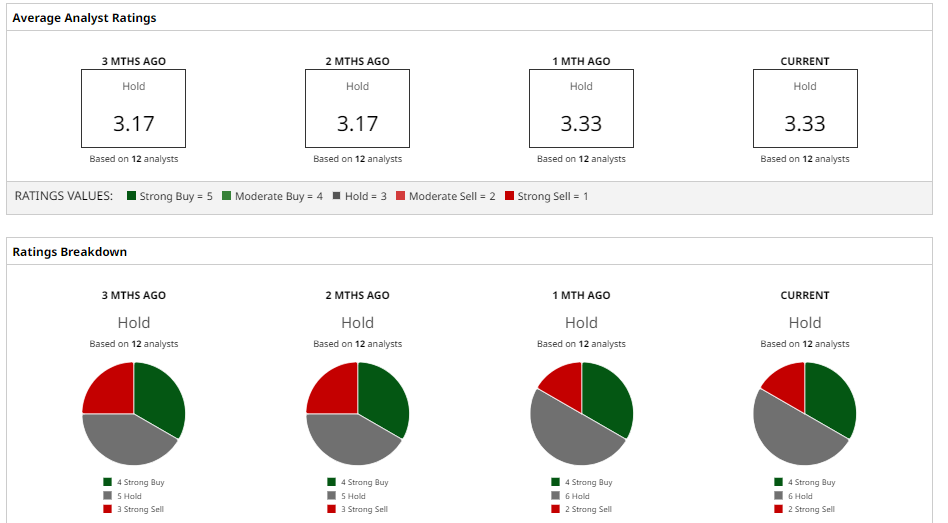
Analysts remain divided on AST SpaceMobile, and that makes sense. The upside case is enormous if the company succeeds. The downside case is just as real if launches disappoint or commercialization takes longer than expected.
The average analyst target is around $92, which suggests ASTS stock may already be close to fair value near current levels but has almost 14% upside still.
Some analysts remain optimistic, including Deutsche Bank, which still rates it a “Buy,” though it trimmed its target. Others are much more cautious. Scotiabank has stayed negative and points to mission concerns after the launch failure.
That spread says a lot about ASTS. This is not a simple value stock or a straightforward growth story. It is a high-risk, high-reward bet on one of the biggest infrastructure ideas in telecom.
 www.barchart.com
 On the date of publication, Nauman Khan did not have (either directly or indirectly) positions in any of the securities mentioned in this article. All information and data in this article is solely for informational purposes. For more information please view the Barchart Disclosure Policy here.
More news from Barchart
Missed Nvidia? AMD Could Be Your Second Chance to Earn Massive AI Gains TSLA Stock Catalyst: Get Ready for a Larger Model Y After the Blue Origin Satellite Failure, Is It Time to Sell AST SpaceMobile Stock? As Lam Research Joins the Tesla Terafab, Should You Buy, Sell, or Hold LRCX Stock?