

Tech giant Apple (AAPL) is making a bold reset at the top, with its biggest leadership shakeup in over 15 years pointing to a renewed focus on products and innovation. The company is handing the reins to hardware leaders, signaling a move away from the supply-chain-driven era under Tim Cook and toward tighter hardware-software integration to power its next wave of growth. On April 20, Apple revealed that John Ternus, currently Senior Vice President of Hardware Engineering, will take over as CEO starting Sept. 1, following Cook’s decade-long tenure.
At the same time, Johny Srouji has stepped into the role of Chief Hardware Officer with immediate effect. In his expanded position, Srouji will oversee both hardware engineering and hardware technologies, bringing key teams under a single leadership structure. This newly combined division will be organized into five main areas, according to Bloomberg. The structure will focus on hardware engineering, silicon, advanced technologies, platform architecture, and project management, bringing key functions together under a more unified approach.
More Top Stocks Daily: Go behind Wall Street’s hottest headlines with Barchart’s Active Investor newsletter.
So, with Apple doubling down on these core areas, the company is positioning itself for a more innovation-led future. Thus, here’s a closer look at the stock.
About Apple Stock
Headquartered in Cupertino, California, Apple has long stood as one of the most powerful names in global tech. Its edge goes beyond blockbuster devices like the iPhone, Mac, Apple Watch, and AirPods. What truly sets Apple apart is how these products work together through a tightly connected ecosystem of hardware, software, and services, creating a smooth experience that keeps users deeply tied to the brand. Apple’s reach stretches across smartphones, personal computing, digital content, and cloud services.
At the same time, it is pushing into next-generation opportunities like artificial intelligence (AI), wearables, and mixed reality, showing a strategy that builds on its core strengths while preparing for what’s ahead, rather than relying only on its legacy products. The company made waves on April 20 with a major leadership transition. CEO Tim Cook will step down on Sept. 1 after more than a decade leading the company, with John Ternus set to take over as only the third CEO since 1997.
Cook will remain involved as executive chairman, continuing to support the company and engage with global policymakers. While Cook oversaw Apple’s rise to nearly a $4 trillion valuation, driven by his expertise in supply chain efficiency and service growth, the company has been seen as lagging in the fast-moving generative AI space. This is especially true when compared to rivals like Microsoft (MSFT), OpenAI, and Alphabet (GOOG) (GOOGL), and even having to borrow their tech to keep Siri relevant.
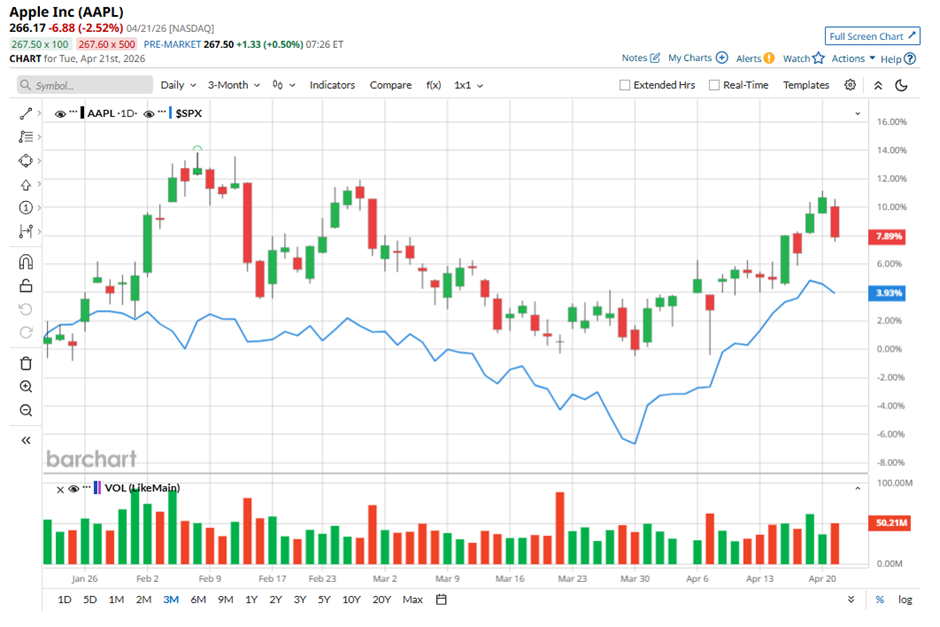
And the current leadership reshuffle reflects a push to close that gap. Even so, Apple’s grip on the market remains strong. It continues to rank among the world’s most valuable companies, and its stock performance backs that up. Shares of this mega-cap company have surged almost 36.76% over the past year, beating the S&P 500 Index ($SPX), which gained 35% during the same stretch. The momentum has carried into recent months as well, with AAPL up 10% in the past three months versus a 3.25% rise for the broader market.
 www.barchart.com
 Apple’s Q1 Earnings Highlights
Apple opened fiscal 2026 on a strong note, delivering a first-quarter performance that once again highlighted its position as a cornerstone of the tech industry. In results released on Jan. 29, the company topped Wall Street forecasts on both revenue and profit, with growth largely fueled by continued demand for its flagship iPhone lineup. Total revenue climbed 15.6% year-over-year (YOY) to $143.76 billion, comfortably beating the $137.81 billion consensus estimate.
The iPhone remained the primary growth engine. Sales rose 23.3% annually to $85.3 billion, supported by robust demand for the iPhone 17 series launched in September 2025. CEO Tim Cook described the period as a record-setting quarter, noting strong performance across all geographic segments. Greater China, which includes Taiwan and Hong Kong, stood out in particular, with revenue jumping 38% to $25.5 billion, underscoring Apple’s expanding global reach.
Performance across other product categories was more mixed. iPad revenue edged up 6.3%, while Mac sales declined 7% amid weaker trends in the broader PC market. The Wearables, Home, and Accessories segment, including products like AirPods and Apple Watch, fell roughly 2%, pointing to softer discretionary spending in that category.
Even so, Apple’s ecosystem continues to grow at scale. Its active installed base reached 2.5 billion devices, up from 2.35 billion a year ago, reinforcing the strength of its global user base. Meanwhile, the high-margin services segment, spanning offerings like Apple TV+, iCloud, advertising partnerships, and AppleCare, grew 14% YOY to $30 billion, providing a steady and increasingly important source of revenue.
On the profitability front, Apple reported earnings per share of $2.84, marking an 18.3% increase from the prior year and surpassing the $2.65 estimate. CFO Kevan Parekh also emphasized the company’s strong cash generation, with operating cash flow nearing $54 billion, allowing Apple to return close to $32 billion to shareholders during the quarter. Overall, the results highlighted both the resilience of Apple’s core business and evolving trends across its broader portfolio.
Looking ahead, attention now turns to Apple’s upcoming second-quarter earnings release scheduled after market close on April 30. Analysts currently expect Q2 earnings to reach $1.91 per share, representing a near 15.8% YOY increase.
What Do Analysts Think About Apple Stock?
Wall Street has largely cheered Apple’s leadership reset, calling it a well-timed and logical move given John Ternus’s deep experience spanning over two decades. Morgan Stanley analyst Erik Woodring expects little change to Apple’s core playbook across hardware, services, and software, but believes the transition could spark fresh investor enthusiasm as the market looks ahead to Apple’s next phase, particularly around AI, new product categories, and supply chain evolution.
At the same time, Melius Research analyst Ben Reitzes flagged the timing, just ahead of the upcoming earnings report, as the only surprise, suggesting it may help clear the stage for a strong quarterly showing. The analyst remains bullish with a $350 price target, pointing to potential upside drivers like AI enhancements, a major Siri update at WWDC this June, and the next iPhone cycle, which could include a premium foldable device.
Reitzes also highlighted Johny Srouji’s elevation to Chief Hardware Officer as a key positive, noting his strong engineering credentials. Echoing the upbeat tone, JPMorgan Chase analyst Samik Chatterjee sees the leadership reshuffle as a timely move, especially as competition intensifies around next-generation devices and AI capabilities.
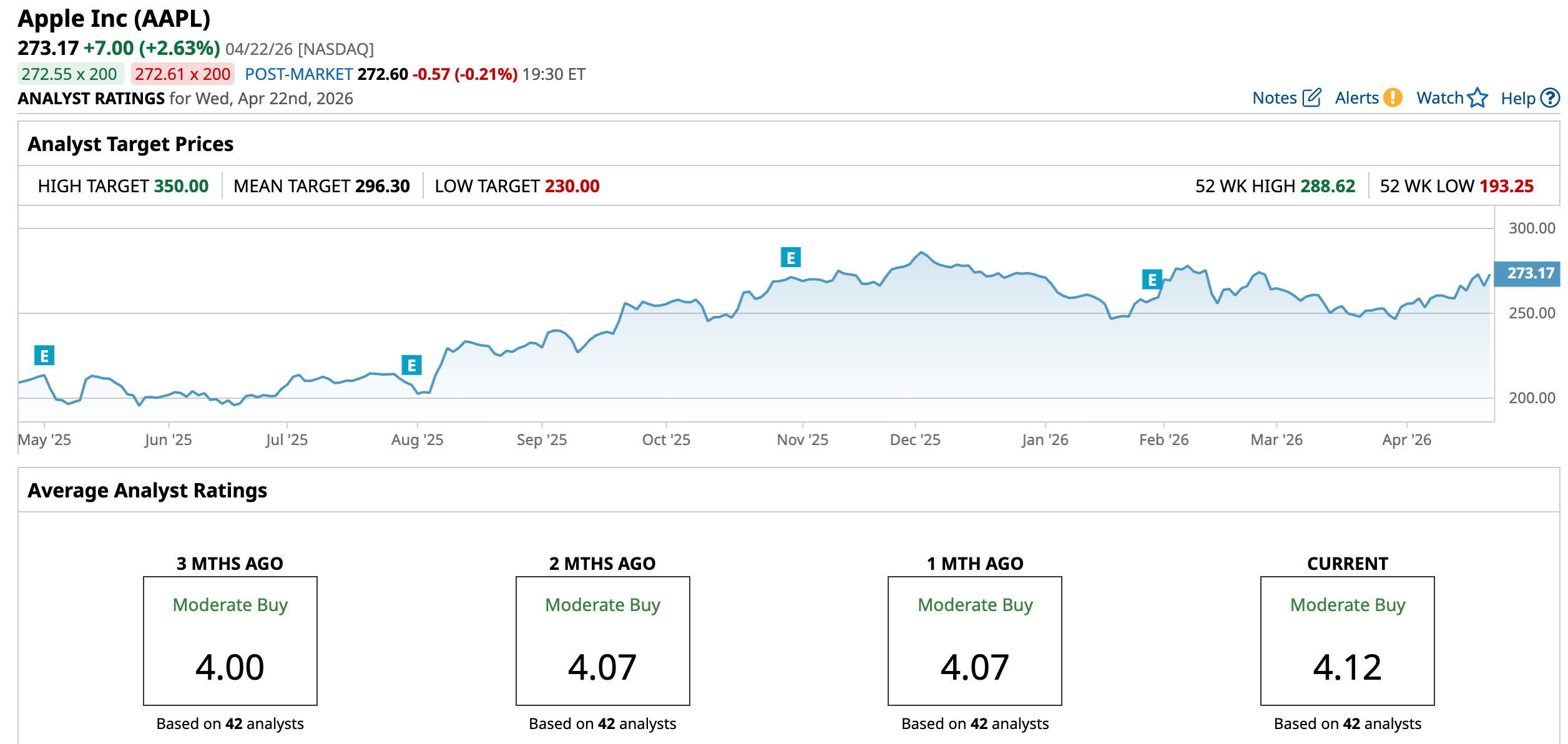
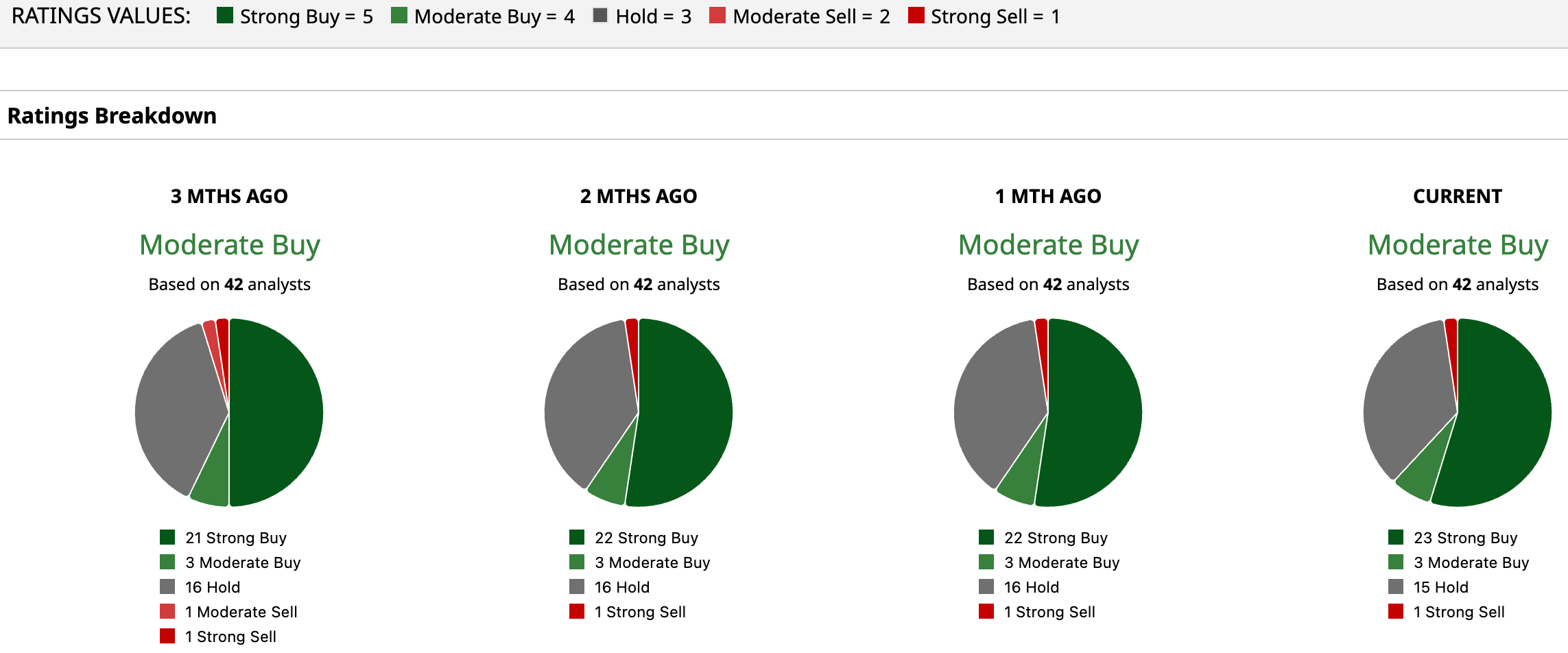
Overall, Wall Street’s outlook on Apple remains firmly upbeat. The stock carries a consensus “Moderate Buy” rating, supported by a clear tilt toward bullish calls. Out of 42 analysts, 23 rate it a “Strong Buy,” three suggest a “Moderate Buy,” 15 take a neutral “Hold” stance, and just one maintains a bearish “Strong Sell” view.
Moreover, the upside story is still intact. The average price target of $296.30 implies roughly 8.5% potential upside, while the most optimistic target of $350 suggests the stock could climb more than 28% in the months ahead.
 www.barchart.com
  www.barchart.com
 On the date of publication, Anushka Mukherji did not have (either directly or indirectly) positions in any of the securities mentioned in this article. All information and data in this article is solely for informational purposes. For more information please view the Barchart Disclosure Policy here.
More news from Barchart
With Hardware Center Stage at Apple, Here Are 5 Key Areas to Watch What You Don’t Know About ETFs Might Hurt You. Rob’s Here to Help. ‘Strong Customer Interest’ Lifts QuantumScape Stock, but the Real Catalyst Could Be a Brewing Short Squeeze Super Micro Computer Stock Plunges on Lost Oracle Contract, but Supply Chain Excesses Could Be the Bigger Problem for SMCI