


When markets become uncertain, investors often shift their attention from the fastest-growing companies to those that can keep generating cash in almost any environment. That is where telecom stocks become more interesting. AT&T and Verizon may not be flashy, but both sell essential services, both generate billions in cash flow, and both offer sizable dividends.
The question is: Which one looks more compelling today?
More Yield, Less Trap: Sign up free to get Barchart’s daily Dividend Investor newsletter straight to your inbox.
AT&T Inc. (T)
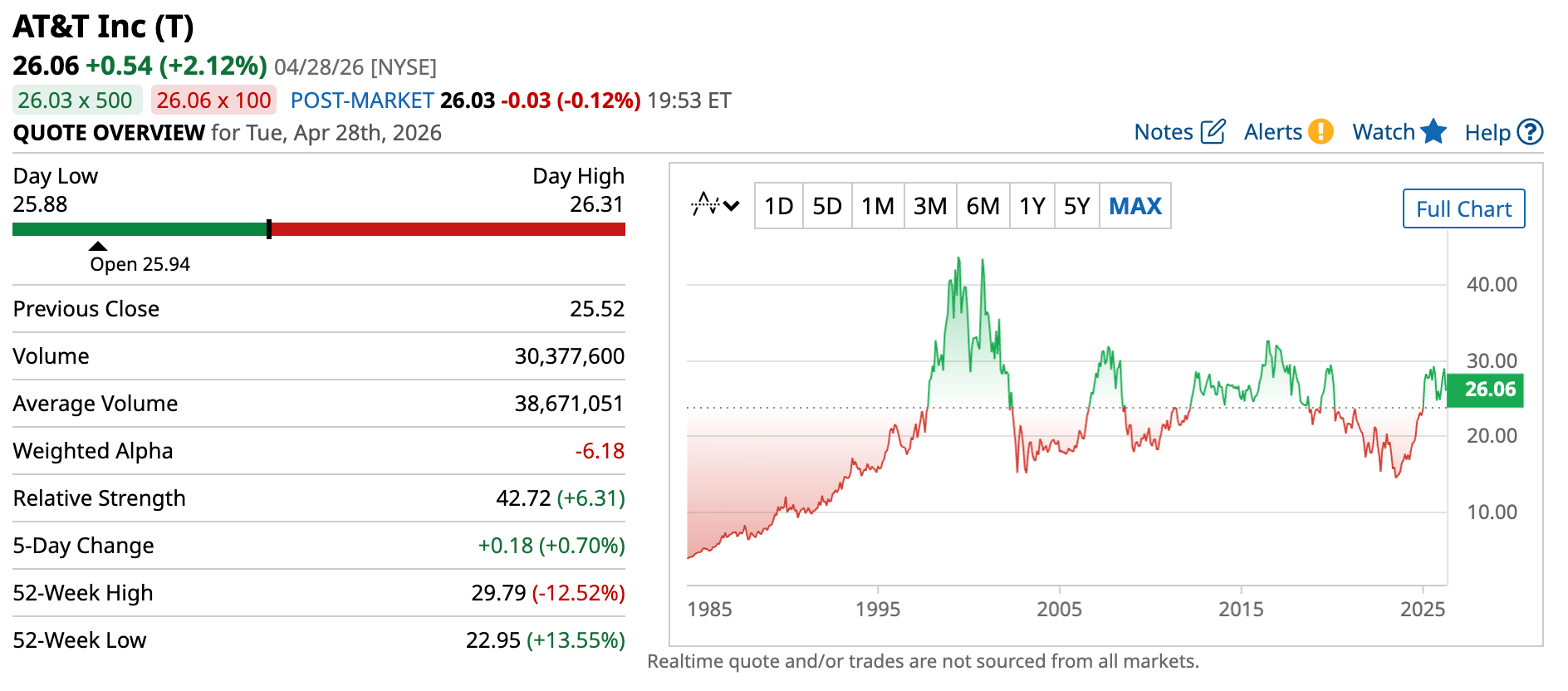
First up is AT&T, one of the biggest telecom companies in the country. It provides wireless service, fiber internet, and broadband to millions of consumers and businesses. In other words, AT&T makes money by providing the phone and internet services people rely on every day.
At the time of writing, the stock is trading at around $26.06.
Verizon (VZ)
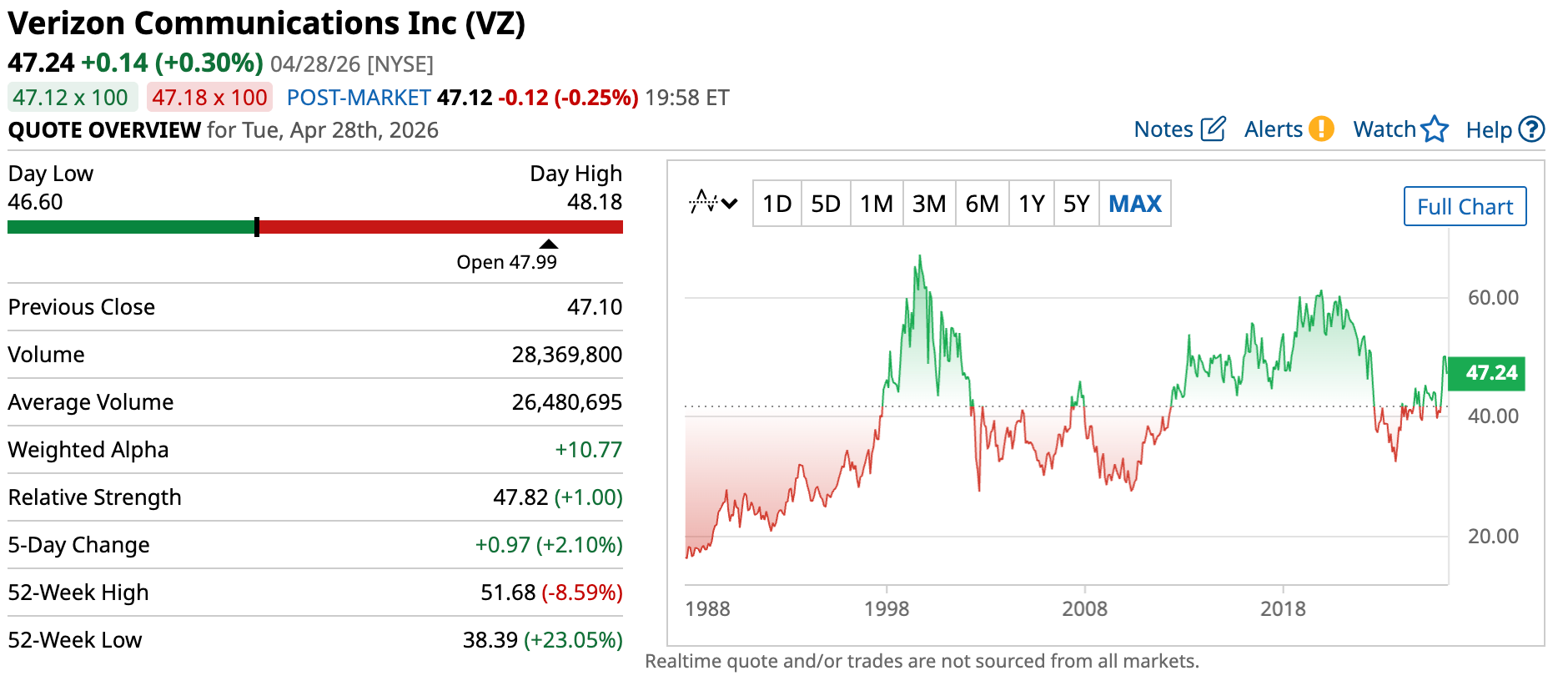
Next up is Verizon, the other telecom heavyweight in this comparison. It is one of the largest wireless providers in the country, offering mobile service, broadband, and network solutions to both consumers and businesses. Like AT&T, Verizon makes money by providing the same kinds of phone and internet connectivity people use every day.
Verizon stock is trading at approximately $47.24.
While both businesses may look similar, which company is worth owning? Let’s find out.
Business model comparison: AT&T vs Verizon
AT&T and Verizon may operate in the same industry, but they are far from being the same company.
AT&T makes most of its money from the wireless segment. On top of that, there’s the fiber internet segment, its high-speed internet service delivered over fiber-optic cables, which the company views as a key growth driver. Regardless, the goal is to generate recurring revenue and deepen customer relationships by bundling internet with mobile service.
Meanwhile, Verizon also gets the majority of its revenue from wireless, and that’s especially clear in its postpaid phone business, which is one of the more stable verticals in the telecom market. The company also offers broadband and business network services to meet household and corporate demand. Today, Verizon is still best known for the scale and consistency of its wireless operations.
So, while both companies make money by selling connectivity, AT&T looks more tied to its fiber expansion story, while Verizon leans more on the strength and stability of its wireless business.
What do the numbers say in Q1’FY26?
At this point, there’s no clear winner, so let’s look at what their latest quarterly financials look like.
| Metric (Q1'26) | AT&T | Verizon |
| Sales | $31.5 billion | $34.4 billion |
| Net Income | $3.8 billion | $5.1 billion |
| Operating Cash Flow | $7.6 billion | $8.0 billion |
| P/E (ttm) | 12.07x | 9.85x |
Verizon led on sales, reporting $34.4 billion in revenue versus $31.5 billion for AT&T. VZ also had the edge in operating cash flow, which came in at $8.0 billion, compared with $7.6 billion for AT&T. Operating cash flow shows how much cash a business is generating from its normal operations, and it gives a better sense of how much room a company has to support its payout.
Valuation is where Verizon also starts to stand out. Its P/E ratio (ttm) is nearly 10, while AT&T is just over 12. For context, the sector average is almost 19. The P/E ratio compares a stock’s price with its earnings, so it is a simple way to see whether investors are paying more or less for each dollar of profit. On that basis, both stocks still look reasonably priced, but Verizon looks cheaper.
So while Verizon has the edge in revenue, reported profit, operating cash flow, and valuation, AT&T looks more tied to its fiber expansion and convergence story. To sum it up, Verizon looks like the cheaper stock, while AT&T looks more growth-oriented around fiber and bundled connectivity.
Dividend story
Now, for income-focused investors, this might be what you’re waiting for.
AT&T pays $1.11 per share annually, yielding about 4.3%. Verizon pays $2.83 annually, which translates to a higher yield of around 6%.
There is also some dividend history behind both names. AT&T once had a 30-year streak of annual dividend increases, while Verizon is currently on a 19-year streak.
So, while both stocks appeal to income investors, Verizon looks like the stronger dividend play right now thanks to its higher yield and still-active streak of increases.
What do the analysts say?
Wall Street is generally bullish on both stocks.
A consensus among 28 analysts rates AT&T stock a “Moderate Buy,” scoring 4.11 out of 5. The mean to high target prices suggest between ~18% and ~38% potential upside.
Meanwhile, a consensus among 29 analysts also rates Verizon stock a “Moderate Buy,” though with a lower score of 3.76 out of 5- but, it's actually ticked higher over the last three months. Its mean to high target prices suggest between ~8% and ~50% potential upside.
So while both stocks are still viewed favorably by analysts, AT&T has a stronger overall rating, while Verizon offers more upside potential.
Verdict
Both stocks have a buy case, especially for income investors.
Verizon leads on revenue, valuation, yield, reported profit, operating cash flow, and dividend growth streak. AT&T stands out more on fiber expansion, bundled connectivity, and analyst sentiment.
If the focus is on dividend income and a cheaper valuation, Verizon looks like the stronger pick right now. But if you believe in AT&T’s growth in fiber, convergence, and a somewhat steadier overall business picture, this may make a stronger case. Both have their strengths, but for dividend-focused investors, Verizon may have the edge at the moment. Of course, if it were me, I’d hedge my bets and consider buying both.
On the date of publication, Rick Orford did not have (either directly or indirectly) positions in any of the securities mentioned in this article. All information and data in this article is solely for informational purposes. For more information please view the Barchart Disclosure Policy here.
More news from Barchart
AT&T Yields 4.3% and Verizon Yields 6%. Which Telecom Stock Will Actually Pay You More in the Long Term? Warren Buffett’s Berkshire Hathaway Is Losing Money in This Dividend Stock: Can It Work for You? Verizon Stock Had Its Best Day Since January as Investors Bet on a Multibillion-Dollar Hyperscaler Deal. Should You Buy VZ? Investors Are Waiting for the Nike Stock Turnaround. Will the Latest 1,400 Job Cuts Be Enough?