

AbbVie (ABBV) has built a solid reputation among passive income-focused investors, backed by an impressive 54-year streak of dividend hikes. Much of that success has been fueled by Humira, a blockbuster drug that has generated enormous cash flows and helped fund the dividend payouts. So when Humira began losing exclusivity and biosimilar competition intensified, many investors feared that AbbVie’s dividend streak might come to an end.
However, AbbVie's recent first-quarter report shows that it can thrive well beyond Humira — while keeping its dividend strength firmly intact. Let's take a closer look.
More Yield, Less Trap: Sign up free to get Barchart’s daily Dividend Investor newsletter straight to your inbox.
 www.barchart.com
Humira Once Defined AbbVie’s Business
Humira was long-considered the crown jewel of AbbVie’s portfolio. The drug treated multiple autoimmune diseases including rheumatoid arthritis, psoriasis, and Crohn’s disease, becoming a massive cash machine for the company over the years. However, as biosimilar competitors entered the market, Humira sales inevitably declined. In Q1, Humira global sales fell to $688 million, down more than 40% year-over-year (YOY) operationally due to biosimilar competition.
But AbbVie was prepared for Humira’s decline and had planned ahead with its immunology drugs Skyrizi (which treats various psoriatic diseases) and Rinvoq (which treats rheumatoid arthritis and psoriatic arthritis, among other conditions). In Q1, total immunology revenue reached $7.3 billion, marking growth of around $1 billion from the prior-year period. Notably, global sales for Skyrizi climbed 29% YOY to $4.5 billion. Management emphasized that Skyrizi has gained a competitive advantage due to its strong efficacy on both skin and joint symptoms, durable long-term outcomes, and convenient quarterly dosing.
Similarly, global sales for Rinvoq rose 20% YOY to $2.1 billion. For the full year, management expects Skyrizi to generate revenue of $21.6 billion and Rinvoq’s revenue to land at $10.2 billion. Combined, those two medications alone are becoming larger than Humira’s peak contribution in several markets.
Additionally, AbbVie’s neuroscience portfolio is becoming another growth engine. In Q1, total neuroscience revenue climbed more than 24% operationally to $2.9 billion. Prescription growth remained strong across both bipolar disorder and major depressive disorder treatment, while psychiatry drug Vraylar reported global sales of $905 million, up 18%. The company is also developing treatments in oncology and obesity.
Massive Manufacturing Expansion Plans
AbbVie is planning a huge $100 billion commitment toward research and capital investments over the next decade. As part of this, it plans to invest $1.4 billion in a new pharmaceutical manufacturing campus in North Carolina. Additionally, another $380 million is intended for two new plants in North Chicago. These facilities are expected to support production across immunology, neuroscience, oncology, and obesity therapies.
Such large-scale investments might spook investors as to whether AbbVie can sustain its dividend payouts of around 65% of earnings. However, these investments signal management’s confidence that AbbVie’s next-generation portfolio will continue to drive significant long-term demand.
During the Q1 earnings call, management reassured investors that capital allocation priorities include investing heavily in the business while continuing to return capital to shareholders through its “strong and growing dividend.” Furthermore, its financial position — with a cash balance of $5.2 billion — remains solid enough to support continued dividend growth alongside aggressive spending.
AbbVie’s Dividend Strength Remains Intact
A major reason AbbVie is a favorite among dividend investors is because of its five decades of consistent dividend payouts and hikes. This 54-year streak has earned it status as a Dividend King, a title that is awarded to companies who have increased their dividends for 50 years in a row. AbbVie also offers an attractive forward yield of 3.3%, which is much higher than the healthcare sector and the market average.
The Q1 report shows that AbbVie’s dividend strength remains intact despite Humira’s decline. In fact, it is no longer dependent on a single blockbuster drug and rapidly expanding is replacement portfolio. Dividend investors were worried that AbbVie's best days would end with Humira. However, they may be relieved to find today that the company has successfully entered a new chapter of diversified and sustainable growth, while preserving its dividend growth story.
What Does Wall Street Say About This Dividend King?
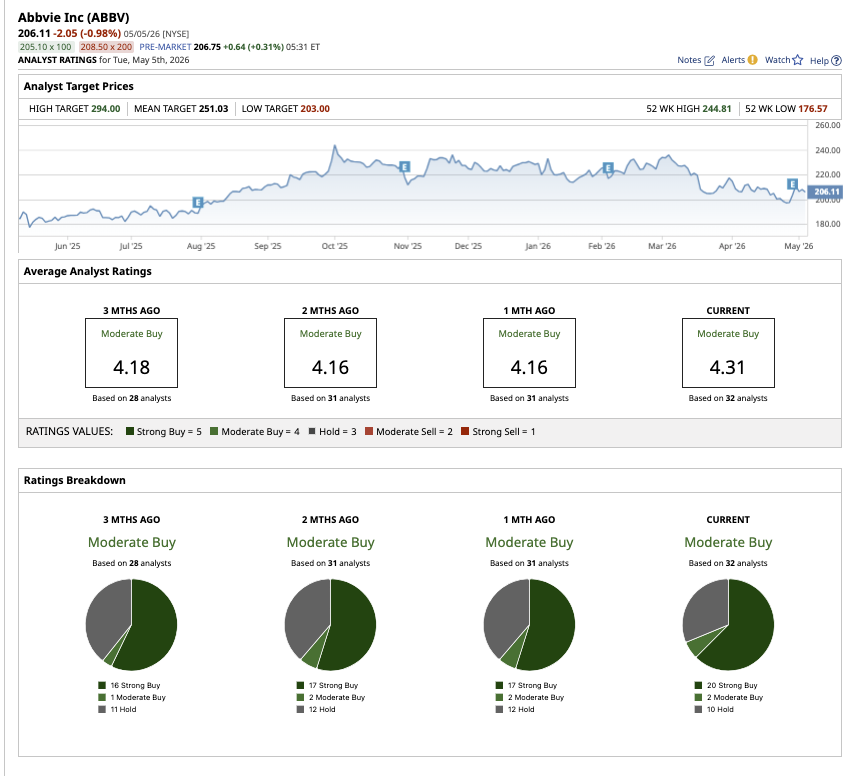
Overall, ABBV stock has a consensus “Moderate Buy” rating on Wall Street. Out of the 32 analysts covering the stock, 20 have a “Strong Buy” rating, two suggest a “Moderate Buy,” and 10 recommend a “Hold.”
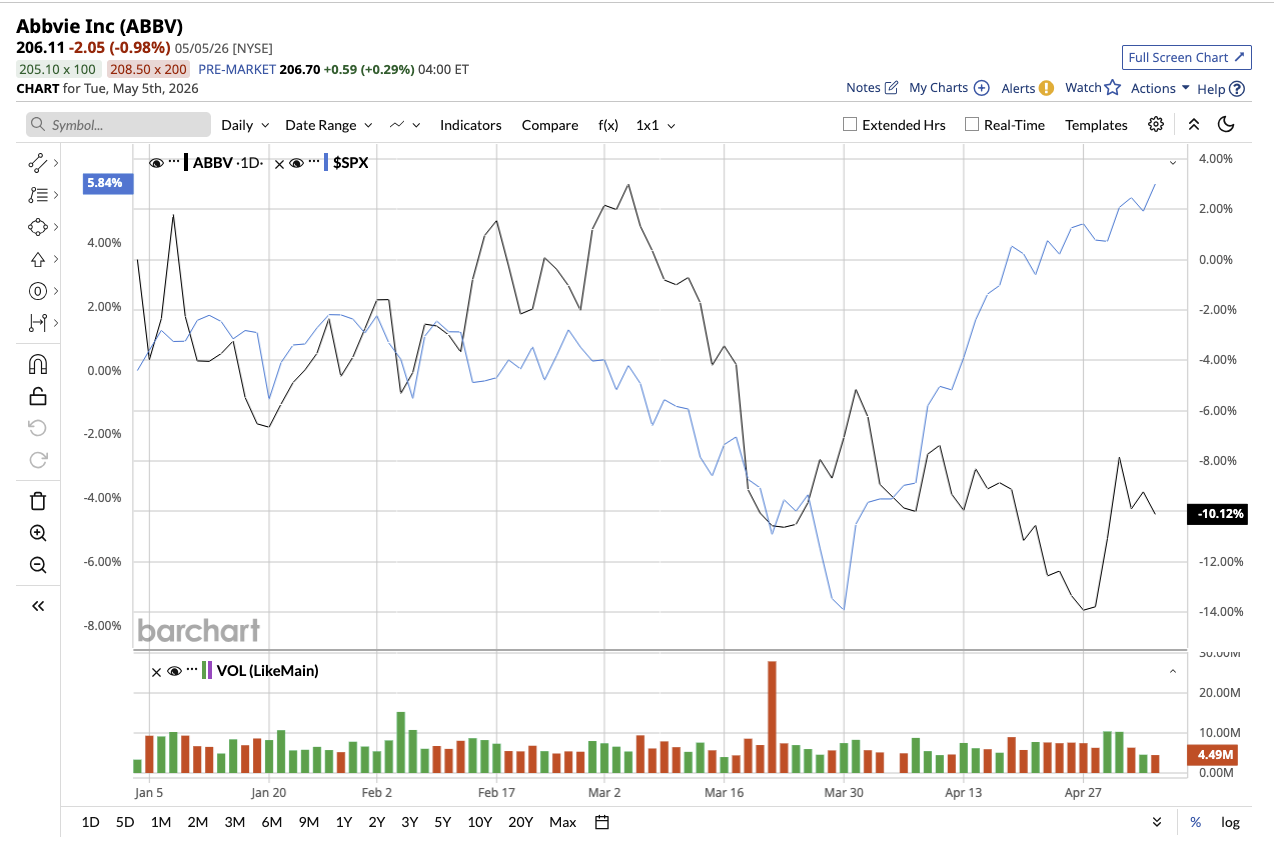
ABBV stock is down 11% year-to-date (YTD), but analysts expect 24% potential upside from current levels based on the average target price of $251.03. Plus, its high price estimate of $294 suggests that the stock could rally as much as 45% over the next 12 months.
 www.barchart.com
 On the date of publication, Sushree Mohanty did not have (either directly or indirectly) positions in any of the securities mentioned in this article. All information and data in this article is solely for informational purposes. For more information please view the Barchart Disclosure Policy here.
More news from Barchart
AbbVie Delivers Strong Q1 Earnings Beyond Humira. This Dividend King Still Shines. 3 Dividend Aristocrats With Soaring Profits That Wall Street Says to Buy Now Time to Buy: This Cheap High-Yield Dividend Stock Is Trading Near Multi-Year Lows Ignore the Amazon Trucking Noise and Buy UPS Stock for Its High Yield Near 7%