

Bill Ackman’s latest venture into the public markets was supposed to be a big deal. The high-profile hedge fund manager launched Pershing Square USA (PSUS) with the promise of bringing his stock-picking prowess to a broader base of investors through a closed-end fund (CEF) structure. Given Ackman’s track record and his reputation as one of Wall Street’s most outspoken hedge fund managers, expectations were high that the offering would be met with strong demand and a smooth market debut.
Instead, PSUS shares stumbled immediately after listing. The stock opened well below its $50 IPO price and quickly traded at a notable discount to its net asset value (NAV), raising eyebrows across the investment community. Ackman has since offered an explanation. He suggested that the post-IPO selloff was driven largely by “technical” factors tied to retail investors. That narrative, however, raises further questions.
More Top Stocks Daily: Go behind Wall Street’s hottest headlines with Barchart’s Active Investor newsletter.
With institutional investors reportedly accounting for the bulk of the capital raised, can retail investors really shoulder most of the blame for PSUS’ rocky start? And more importantly, does the early discount signal temporary technical pressure—or a more structural challenge common to CEFs? Let’s take a closer look.
About Pershing Square USA Stock
Pershing Square USA, Ltd. is a new, U.S.-domiciled closed-end investment fund managed by Bill Ackman’s Pershing Square Capital Management. It went public on the New York Stock Exchange (NYSE) last Wednesday, as part of a landmark $5 billion dual listing. Notably, Ackman also listed shares of his management firm, Pershing Square Inc. (PS), which now trade under the ticker “PS.” Investors who participated in the IPO received one “bonus” share of PS for every five shares of PSUS purchased at $50 each. The closed-end fund is intended to make Ackman’s investment expertise accessible to the broader public. Mr. Ackman is a veteran hedge fund manager and Wall Street impresario known for his bold, contrarian investment bets. While it remains unclear what Ackman intends to buy for his new CEF, the prospectus states that he will target 12 to 15 large-cap North American stocks and should deploy the offering proceeds within 60 days. The portfolio is anticipated to somewhat mirror his European fund, which holds positions in Alphabet (GOOG) (GOOGL), Amazon (AMZN), and Meta Platforms (META), along with more traditional bets such as Fannie Mae (FNMA) and Hertz Global Holdings (HTZ).
Closed-end funds, a relatively niche type of mutual fund, issue a fixed number of shares that subsequently trade on an exchange like a stock. Essentially, this means the funds can trade at prices that significantly diverge from their NAVs.
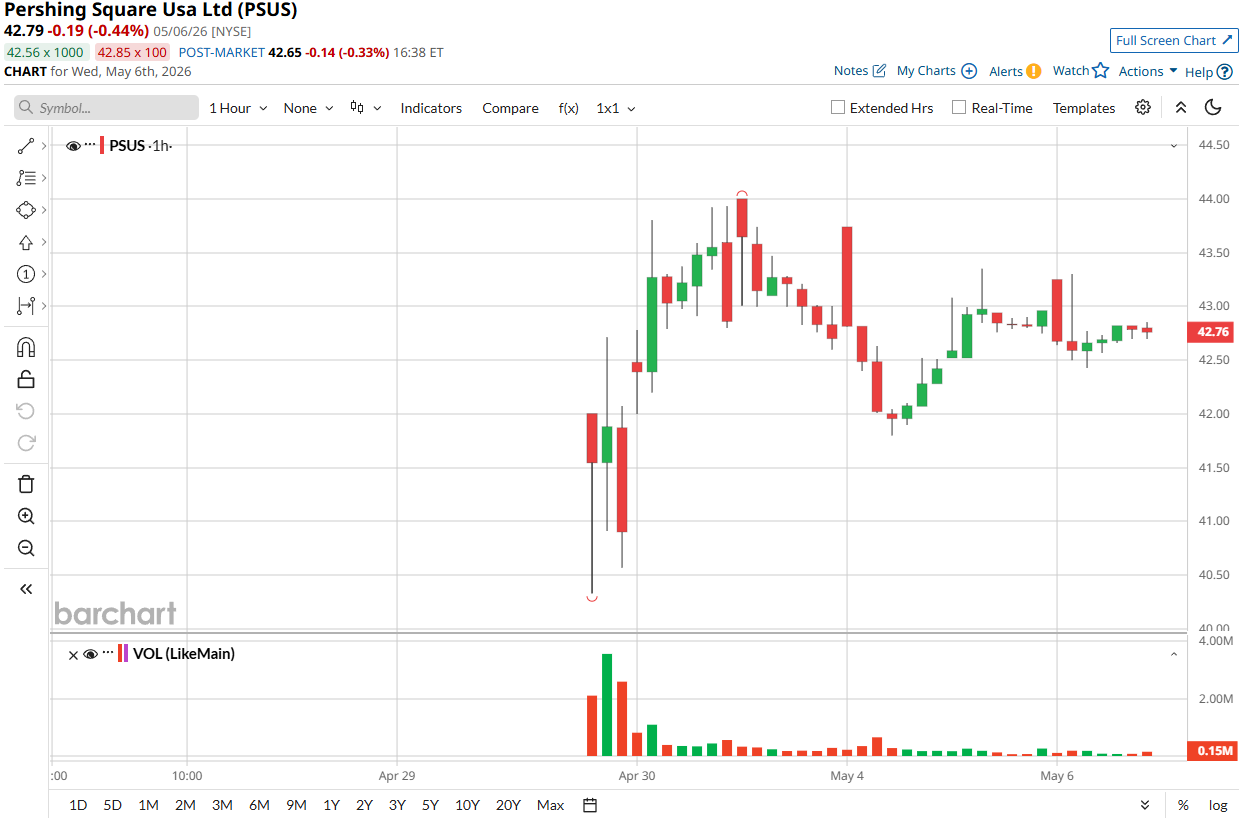
And that proved to be the case for Pershing Square USA. PSUS shares, initially priced at $50, closed on Wednesday at $42.79, representing a discount of 14.4%.
 www.barchart.com
 Bill Ackman "Blames" Retail Investors as His New Fund Stumbles in Wall Street Debut
Shares of Bill Ackman’s new stock-picking fund opened about 18% below the IPO price at $41 last Wednesday, suggesting that some IPO investors were already looking to exit their positions. PSUS shares ended their first trading day at $40.90. A day later, Mr. Ackman blamed retail investors for the slump, adding he expects the shares to recover.
Ackman suggested that retail investors overcommitted to the IPO, received the shares they requested, but then lacked the cash to pay for them and were forced to sell, Reuters reported. “We had a whole bunch of people dump that stock yesterday for technical reasons,” he said. And, in theory, that could very well be the case.
Retail investors often place large orders in high-demand IPOs, expecting that only a small portion of their orders will ultimately be filled. That’s because the bulk of IPO share allocations typically go to large institutional investors. However, Ackman told Barron’s in an interview that he wanted to take a different approach with his new fund: “I want this to be an entity that favors retail investors, as opposed to giving all the benefits to the institutions.”
Ackman believes the fund’s weak debut was due to retail investors lacking an understanding of how to invest in IPOs. "In retrospect, I made a mistake," he reportedly said. "I favored retail allocations over institutional allocations, which is almost never done."
Are Retail Investors Really Responsible for PSUS’ Post-IPO Slide?
I used the phrase "in theory" earlier because some numbers I’m about to discuss cast doubt on whether retail investors can truly be blamed for Pershing Square USA’s poor debut.
Once again, Pershing Square USA raised $5 billion through the offering. The deal size was at the low end of a $5 billion to $10 billion range (I will return to that range a bit later). And the first key number here is that Ackman had secured about $2.7 billion in demand from a group of institutional investors before broadly marketing the deal to retail and institutional buyers, meaning that more than 50% of the funds raised in the IPO were technically unavailable to retail investors.
Second, Ackman reportedly stated that he and his employees committed approximately $500 million in cash to the Pershing Square USA IPO. That, in turn, left an even smaller portion of shares available for retail investors in the IPO.
Third, Reuters reported that Ackman said institutional investors accounted for more than 80% of the capital raised. Meanwhile, Bloomberg reported that institutional investors made up roughly 85% of the offering. That implies retail participation of about 15% to 20%, meaning that Ackman attracted less than $1 billion in demand from individual investors, raising questions about how they could be blamed for the weak debut, even from a technical standpoint. Moreover, the fact that Pershing Square USA’s IPO was priced at the low end of its $5-$10 billion target range signals lukewarm investor demand, suggesting that retail investors may have been skeptical and largely sat out the offering rather than overcommitting and then selling their shares.
Ackman later clarified in a post on X that he was “not blaming” retail investors, but rather “explaining what we believe had occurred” in terms of technical selling pressure. Still, the phrase "technical selling" was tied to retail investors who allegedly overcommitted to the IPO, received their allocations, lacked the cash to pay for them, and were therefore forced to sell, implying that Ackman continues to view retail participation as the main reason for the fund’s weak debut.
Will PSUS Shares Stage a Comeback?
Ackman told Barron’s that PSUS’ discount stemmed from a mix-up in retail share allocations and would likely resolve quickly. “Once that technical overhang is gone, I believe it’s going to trade at a premium, or at least at NAV,” he said. With that, Mr. Ackman is confident that Pershing Square USA shares will ultimately rebound and trade at $50 or higher.
However, investors should remain cautious, as there is a compelling argument that Pershing Square USA may continue trading at a discount to its NAV. The majority of U.S. CEFs actually trade at discounts to their NAV. The average monthly discount across all CEFs over the past 20 years has been 4.9%, according to Morningstar. And according to Matisse Capital, nearly 90% of CEFs are currently trading below their NAV. That said, discounts are a common issue among CEFs.
CEFs often trade at a premium when they are in high demand. Because CEFs have a fixed number of shares, high buying pressure in the secondary market drives prices above the underlying asset value. So, it remains to be seen whether Pershing Square USA will be able to attract enough investor interest to drive its shares above NAV.
On the date of publication, Oleksandr Pylypenko had a position in: GOOGL , AMZN , META . All information and data in this article is solely for informational purposes. For more information please view the Barchart Disclosure Policy here.
More news from Barchart
Dell Just Got a New Street-High Price Target as Agentic AI Sweetens the Bull Case Bill Ackman’s New IPO Was Supposed to Be a Big Deal. Now He’s Blaming Retail Investors as PSUS Stock Falls. For Lucid Motors Stock, Robotaxis Are Now the Whole Story Wall Street Is Bullish on These 2 Asia ETFs. It’s Time to Party Like It’s the 1980s.