

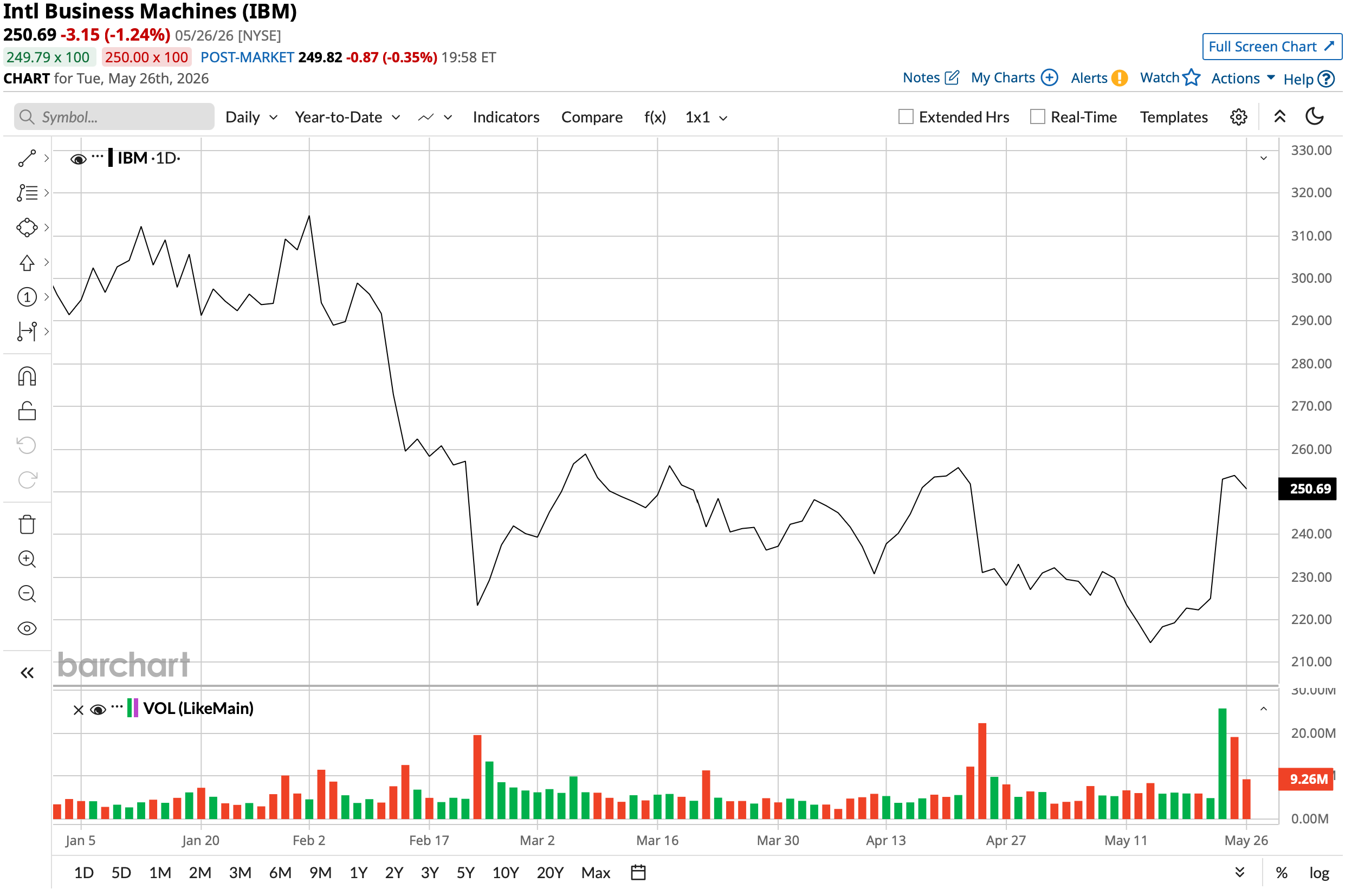
International Business Machines (IBM), more commonly known as IBM, is not hogging any significant spotlight in the current era of artificial intelligence (AI). Unsurprisingly, while shares of Nvidia (NVDA), Broadcom (AVGO), Advanced Micro Devices (AMD), and others have rallied like there's no tomorrow, IBM stock has traded as a laggard. Shares of IBM are up just 0.5% on a year-to-date (YTD) basis and about 14% over the past 52 weeks.
However, while IBM may have missed the bus in terms of AI, it surely doesn't want to miss the next big thing. To that end, one recent development just boosted the company's prospects in the quantum computing space.
More Top Stocks Daily: Go behind Wall Street’s hottest headlines with Barchart’s Active Investor newsletter.
 www.barchart.com
 IBM's $1 Billion Government Backing
Under the CHIPS and Science Act, the federal government is set to grant $1 billion to IBM to set up a quantum computing chip manufacturing company. Named Anderon, IBM claims that it will be first U.S. pure-play quantum foundry. IBM itself will match the contribution while providing personnel and other assets for the company, which will be based out of Albany, New York.
“IBM has pioneered quantum computing for decades,” said CEO Arvind Krishna on the news. "Our work in silicon wafer fabrication has been a key to IBM's success and will be critical to enable a broader quantum technology landscape that will reshape global innovation and economic competitiveness. With the support of the U.S. Department of Commerce, Anderon will be well-positioned to fuel America's fast-growing quantum technology industry."
While quantum computing has been garnering attention in recent years, IBM has actually been at it for more than five decades now. In fact, many of the field's most important technical achievements — including the development of the transmon qubit — were built in part by IBM.
The company's public-facing journey began in earnest in 2016, when it placed the first quantum processor on the cloud. Most recently, at the Quantum Developer Conference in November 2025, IBM unveiled the Nighthawk processor and its experimental Loon chip, which demonstrated "all hardware elements of fault-tolerant quantum computing" while also proving real-time error decoding in under 480 nanoseconds.
Notably, the Nighthawk processor features 120 qubits and 218 next-generation tunable couplers, with a software stack delivering 24% accuracy improvements for dynamic circuits and over 100 times lower cost for HPC-powered error mitigation. Competing companies like IonQ (IONQ) use trapped ion technology while D-Wave (QBTS) specializes in quantum annealing for optimization problems, both of which target narrower use cases than IBM's superconducting approach. IBM's roadmap targets quantum advantage by the end of 2026 and the world's first large-scale fault-tolerant quantum computer, codenamed Starling, by 2029. That's a timeline no pure-play competitor has articulated with comparable hardware evidence behind it.
Still, issues persist. The most pertinent is the difficulty of converting extraordinary engineering milestones into predictable enterprise revenue before competitors close the hardware gap. Moreover, IBM itself has acknowledged that quantum will not replace classical computers but instead form the core of a quantum-centric supercomputing architecture, which means the commercialization path runs through enterprise customers who are still years away from having workloads ready to run on quantum hardware at scale.
Conversely, the ecosystem dependency is also a real risk. Qiskit's developer dominance is impressive today, but if a competing framework gains traction at a critical mass of research institutions, IBM's moat could narrow quickly. Geopolitically, China is also making substantial government-backed investments in quantum computing, creating a state-funded competitive pressure that no private sector roadmap can easily outspend over a decade-long development horizon.
IBM Posts an Impressive Q1
Despite being perceived to be wandering in the wilderness of AI irrelevance, IBM continues to grow its revenue and earnings impressively. Moreover, earnings have surpassed Street expectations consecutively over the past nine quarters, including the latest period.
In the first quarter of 2026, revenue increased 9% year-over-year (YOY) to $15.9 billion. Software, consulting, and infrastructure revenues climbed 11%, 4%, and 15% YOY, respectively. Non-GAAP gross margins improved to 57.7% from 56.6% in the year-ago period.
Meanwhile, diluted EPS rose 19% YOY to $1.91, ahead of the consensus estimate of $1.81 per share. The increase in earnings also came along with a bump in the dividend. IBM will now pay a quarterly dividend of $1.69 per share. IBM stock currently offers a dividend yield of 2.65%. Having raised its dividend for more than 25 years straight, IBM is considered a “Dividend Aristocrat.”
Net cash from operating activities for Q1 stood at $5.2 billion compared to $4.4 billion in the prior year, as the company closed the quarter with a cash balance of $10.8 billion. This was higher than IBM's short-term debt levels of $8.7 billion.
On the valuation front, IBM stock is also attractively priced. Its forward price-to-earnings (P/E) ratio, price-to-sales (P/S) ratio, and price-to-cash flow (P/CF) ratio of 20.5 times, 3.5 times, and 14.9 times are all below or in-line with the respective sector medians.
What Do Analysts Think of IBM Stock?
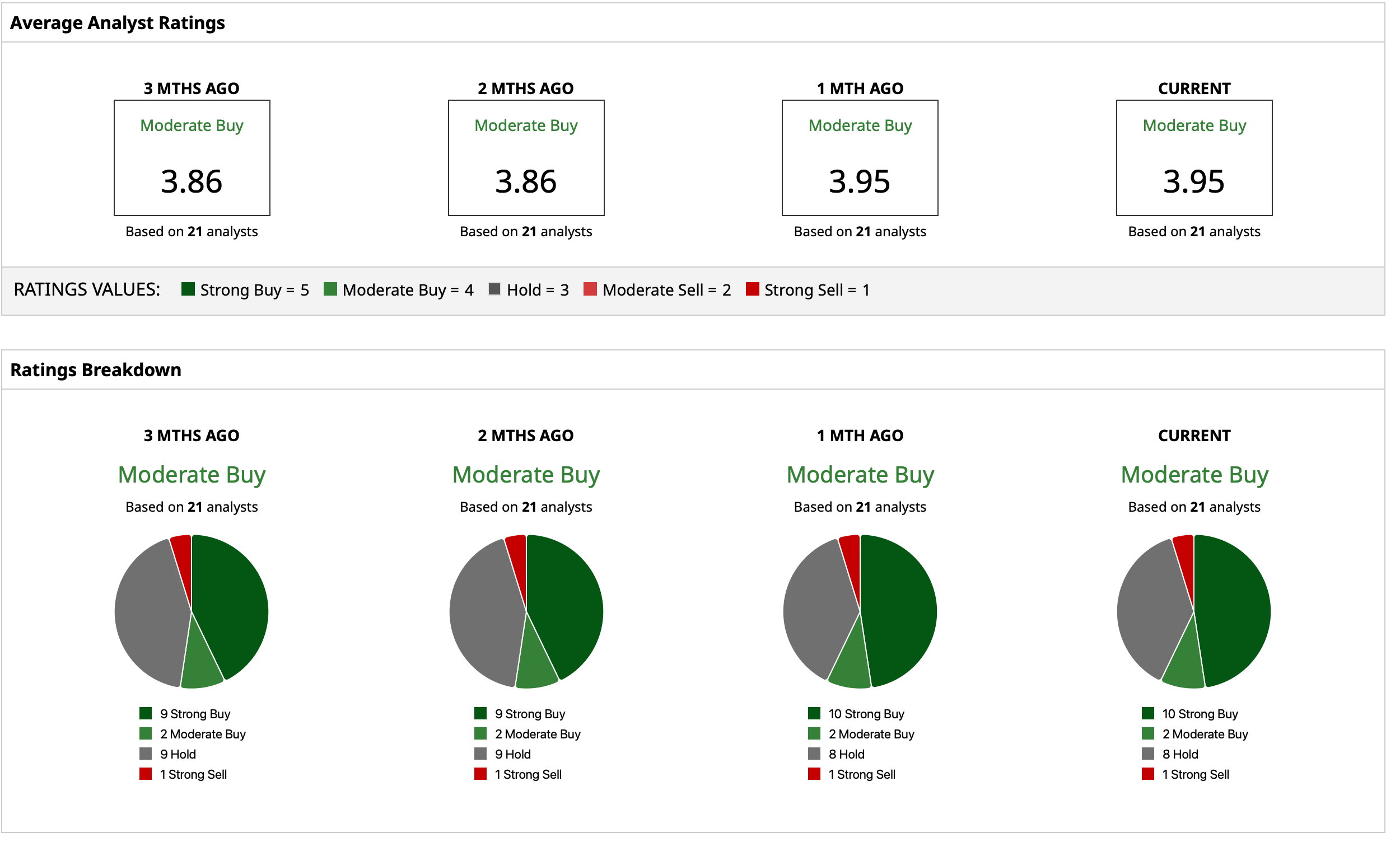
Analysts have an overall rating of “Moderate Buy” for IBM stock. The mean target price of $293.45 has already been surpassed by shares, while the Street-high target of $365 suggests potential upside of more than 22% from current levels. Out of 21 analysts covering the stock, 10 have a “Strong Buy” rating, two have a “Moderate Buy” rating, eight have a “Hold” rating, and one analyst has a “Strong Sell” rating.
 www.barchart.com
 On the date of publication, Pathikrit Bose did not have (either directly or indirectly) positions in any of the securities mentioned in this article. All information and data in this article is solely for informational purposes. For more information please view the Barchart Disclosure Policy here.
More news from Barchart
Down 28%, Netflix Stock Is Suddenly a Bargain IBM Missed the Bus on AI. New Federal Funding Means IBM Stock Could Be a Winner in Quantum Computing. A Giant Short Squeeze Could Be Brewing in Wolfspeed Stock You’ve Likely Never Heard of This Stock, But Data Center Demand Just Took Shares to New 52-Week Highs