

The world's largest company by market cap and chip major Nvidia (NVDA) has acquired Kumo AI, a developer of foundational models catering primarily to the financial sector, for a reported value of $400 million. The team at Kumo comprising of the founding team of CEO Vanja Josifovski, head of engineering Hema Raghavan, and chief scientist Jure Leskovec are now a part of Nvidia.
The latest acquisition comes among a number of them by Nvidia in recent years, headlined by the $20 billion buyout of Groq.
More Top Stocks Daily: Go behind Wall Street’s hottest headlines with Barchart’s Active Investor newsletter.
Notably, Nvidia is known for its hegemony in GPUs. However, with inference and agentic AI rapidly becoming the next frontier of the AI battle, Nvidia is gearing up for the same. While the launch of a specific AI chip for laptops was the most recent display, the latest purchase of Kumo AI is a step in that direction as well.
But will Kumo AI be a valuable addition to Nvidia's stable? And what purpose will it serve for the company?
Kumo Brings Specific Strengths
Agentic AI is for specific tasks. And Kumo's expertise in building frontier models for the finance domain positions it well for Nvidia to cater to that sector in the future, perhaps with a purpose-built GPU or CUDA-based agentic AI capabilities. But these are mere speculations. Let's have a look at what Kumo will bring to Nvidia's table immediately.
KumoRFM is the key here. KumoRFM is the world's first foundation model built specifically for relational data, allowing businesses to generate predictions such as customer churn identification, item recommendations, or fraudulent transaction detection directly from their enterprise data, with no need to manually build and train separate models for each task. Speed and accuracy are the hallmarks.
KumoRFM delivers results in seconds with no manual effort, achieves 20 times faster time to value, and, when fine-tuned to a specific task, delivers 30% to 50% higher accuracy compared to traditional approaches. The April 2026 follow-up model, KumoRFM-2, pushed things further still. Built on a new Relational Graph Transformer architecture published at ICLR 2026, KumoRFM-2 processes data at 5 gigabytes per second with 20 million lookups per second, requires zero training, and scales to 500 billion rows of data. Impressively, on the SAP SALT enterprise benchmark, KumoRFM scores 89% accuracy compared to 75% for PhD data scientists using XGBoost and 63 percent for LLM plus AutoML approaches, with zero feature engineering and zero training time.
Notably, Nvidia may integrate Kumo's models into its AI foundry software, or use Kumo's researchers to develop new enterprise foundation models, with the acquisition expanding Nvidia's portfolio of AI models optimized for its hardware and giving companies more tools to build and customize models on top of its platform.
 www.barchart.com
 Financials Leave Little Room for Complaints
Nvidia continued its strong performance in the most recent quarter, delivering robust growth, surpassing expectations on both revenue and earnings, and providing an upward revision to its outlook.
Revenue for the period increased 85% year-over-year to $81.6 billion, driven largely by data center sales which advanced 92% to $75.2 billion. For the second quarter, the company anticipates revenue of $91 billion, excluding any contribution from China, compared with analyst projections of $91.73 billion.
Earnings per share rose to $1.87, reflecting a 140% gain from the year ago period and comfortably beating the consensus estimate of $1.75. This marked the ninth straight quarter in which Nvidia exceeded profit forecasts. Gross margins also improved markedly, expanding to 75% from 60.8% in the prior year.
Cash generation stayed healthy, with net cash from operating activities climbing to $50.3 billion from $27.4 billion a year earlier. At the end of the fiscal first quarter, the company held $13.2 billion in cash while carrying a modest short-term debt balance of $1 billion.
In terms of valuation, NVDA stands out from many of its Magnificent Seven counterparts as its metrics remain relatively reasonable. The forward P/E ratio of 24.04x sits below the sector median of 25.98x, while the forward P/S multiple of 13.30x and P/CF multiple of 45.46x compare to sector medians of 3.60x and 20.66x, respectively.
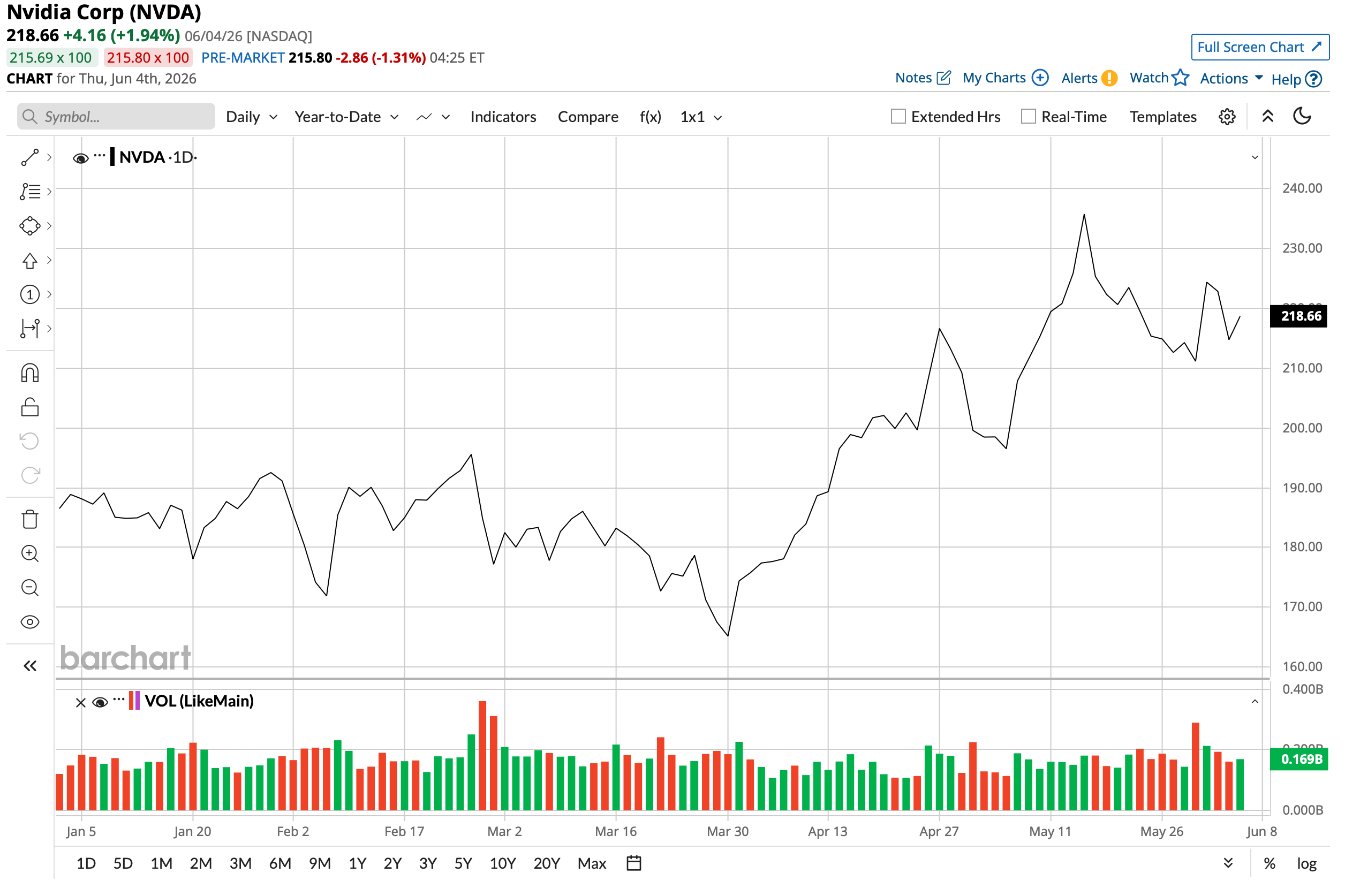
Overall, with a market capitalization of $5.3 trillion, NVDA stock has advanced 10.6% year-to-date.
Analyst Opinion
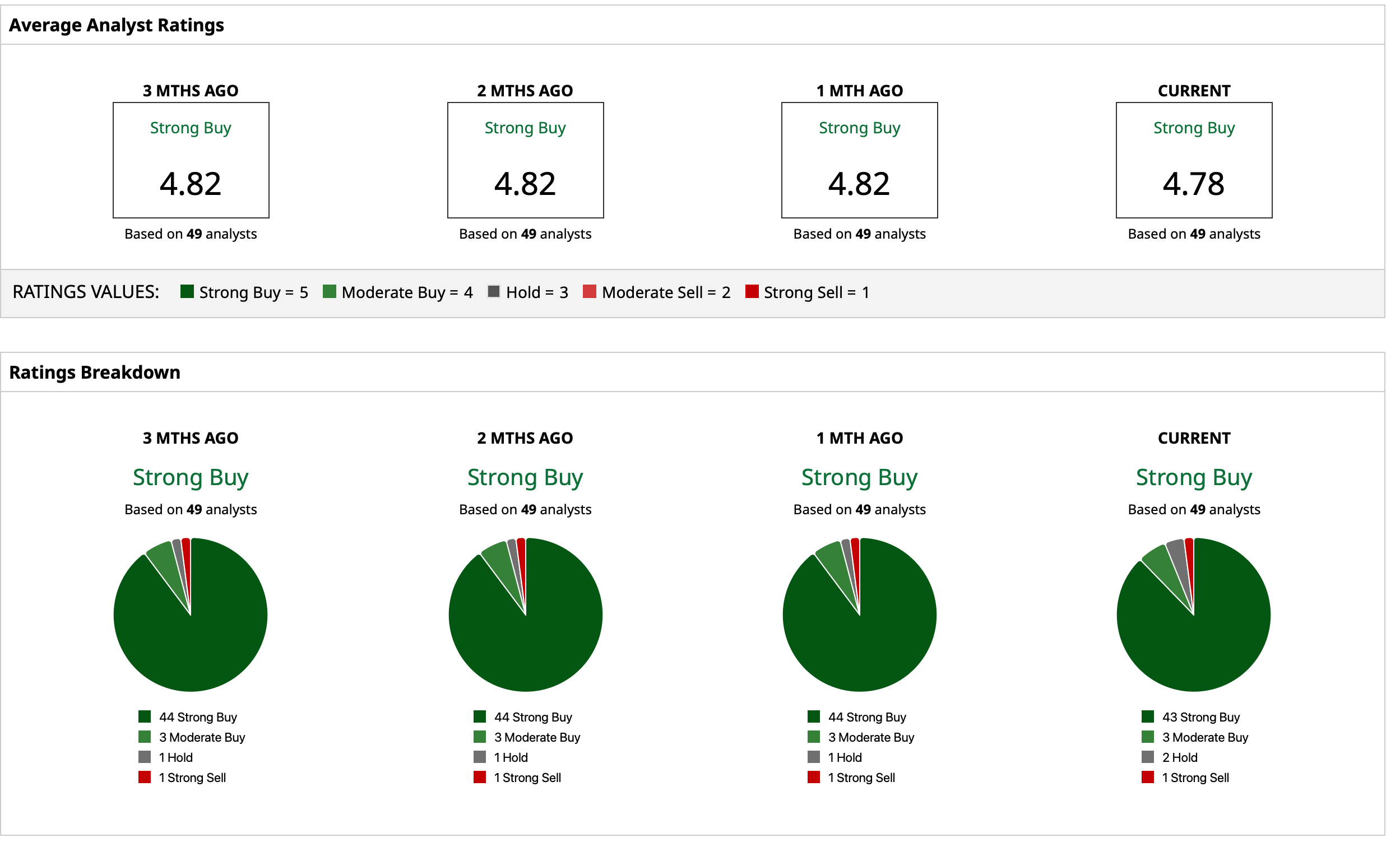
Thus, analysts' optimism around NVDA stock continues, earmarking it a rating of “Strong Buy.” The mean target price of $302.32 indicates an upside potential of 38.3% from current levels. Out of 49 analysts covering the stock, 43 have a “Strong Buy” rating, three have a “Moderate Buy” rating, two have a “Hold” rating, and one has a “Strong Sell” rating.
 www.barchart.com
 On the date of publication, Pathikrit Bose did not have (either directly or indirectly) positions in any of the securities mentioned in this article. All information and data in this article is solely for informational purposes. For more information please view the Barchart Disclosure Policy here.
More news from Barchart
Nvidia Acquires Kumo AI for $400 Million. What That Means for NVDA Stock. Why 1 Veteran Analyst Doubled Her Micron Stock Price Target for 2026 Why Cathie Wood and Berkshire Hathaway Both Love Google Stock Here UnitedHealth Stock Jumps on Upgrade From Bank of America. UNH Is No Longer Just an Insurance Company.