


AST SpaceMobile (ASTS) has been chasing one of the most ambitious goals in telecom to turning satellites into cell towers in space. The company is building a cellular network in space that connects directly to everyday smartphones, aiming to eliminate dead zones and expand broadband access by working alongside wireless carriers rather than replacing them. That vision is about to take another major step forward.
AST SpaceMobile has marked June 17 as the target launch date for BlueBird 8, 9, and 10, three next-generation satellites scheduled to lift off aboard a Falcon 9 rocket from Cape Canaveral, Florida. These satellites are expected to deliver nearly double the peak data speeds achieved by the company’s first-generation BlueBird satellites, further expanding the capabilities of its growing network.
More Top Stocks Daily: Go behind Wall Street’s hottest headlines with Barchart’s Active Investor newsletter.
For AST SpaceMobile investors, June 17 is more than just another launch date on the calendar. It’s a closely watched milestone that could move the company one step closer to turning its bold space-to-smartphone vision into a commercial reality.
About AST SpaceMobile Stock
Founded in 2017 and based in Midland, Texas, AST SpaceMobile is building what it says will be the world’s first global cellular broadband network that connects directly to ordinary smartphones, eliminating the need for specialized hardware, satellite phones, or device modifications.
Using its growing fleet of BlueBird satellites, AST aims to deliver 4G and 5G broadband services, including voice, data, video calls, and app connectivity, even in areas beyond the reach of traditional cell towers. The company’s mission is to close coverage gaps for billions of mobile users while bringing internet access to underserved regions worldwide. To make that vision a reality, AST has partnered with more than 50 mobile network operators, helping extend connectivity to billions of subscribers through existing wireless networks. Its market capitalization currently stands at around $33.9 billion.
Owning ASTS stock has rarely been a smooth ride. The company is trying to build something few have attempted before and investors have experienced plenty of ups and downs along the way. This year alone, launch delays and deployment issues involving Blue Origin added fresh uncertainty, and now ASTS’ 60-month beta is at a lofty 2.60, reinforcing its reputation as one of the market’s volatile growth stocks.
Still, ASTS has repeatedly shown an ability to bounce back from setbacks. In late April, shares came under pressure after the BlueBird 7 low-Earth-orbit deployment failure. Yet the selloff did not last long. Within days, investors had a new reason to get excited when the Federal Communications Commission granted AST SpaceMobile commercial authority to provide direct-to-device cellular broadband service across the U.S. The approval marked a major step toward turning the company's ambitious vision into a commercial reality.
Earlier in the year, another catalyst helped fuel optimism. In February, the company announced its first prime government contract through the U.S. Space Development Agency’s HALO program, a deal worth roughly $30 million. The announcement added to a growing list of partnerships that already includes major names such as Verizon Communications (VZ), AT&T (T), Vodafone (VOD), real estate investment trust American Tower (AMT), and Alphabet's Google (GOOGL).
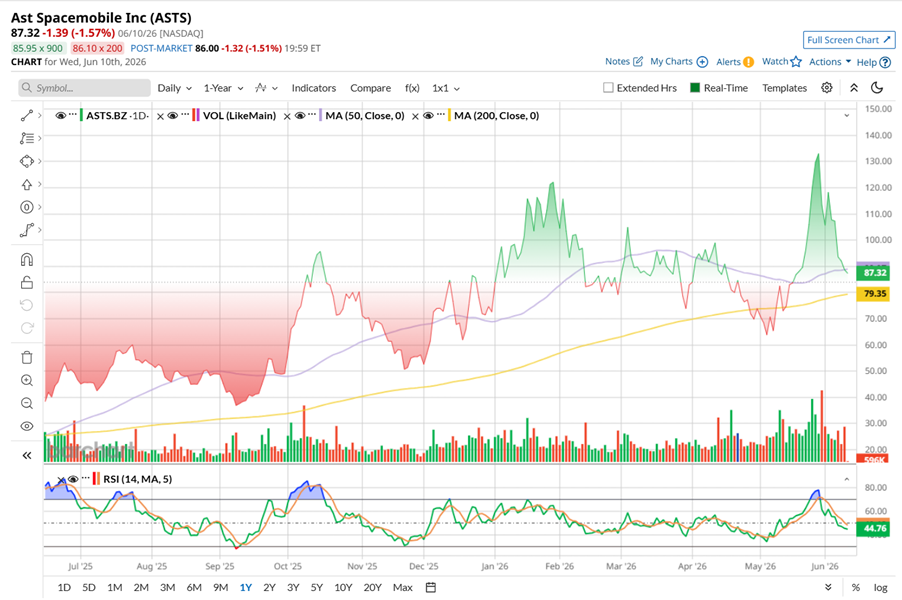
The stock’s long-term performance shows the reason many investors have stayed along for the ride. Over the past 52 weeks, ASTS has surged 156.79%, even after pulling back 30.7% from its late-May peak of $133.86. Shares remain up 28.94% year-to-date (YTD), although recent sentiment has cooled, with the stock falling roughly 12.7% over the past five days.
Technically, ASTS stock still shows a steady long-term trend. The stock remains above its 200-day moving average, but it has recently slipped below its 50-day moving average after a sharp pullback from late-May highs. Momentum has cooled notably, with the 14-day RSI dropping to 47.84 from overbought levels above 70 last month. That suggests buying pressure has eased and traders have become more cautious in the near term.
 www.barchart.com
 A Snapshot of AST SpaceMobile's Q1 Report
For a company trying to build a cellular network from space, expectations tend to be sky-high. AST SpaceMobile has captured investors’ imagination with its massive BlueBird satellites, which feature the largest commercial communications arrays ever deployed in low Earth orbit. But when the company reported its first-quarter 2026 results on May 11 after the market close, the numbers fell short of those lofty expectations.
Leading into the earnings release, ASTS stock had gained as investors anticipated another step forward in the company’s ambitious growth story. Instead, the report delivered a reality check. AST posted a loss of $0.66 per share, up 230% year-over-year (YOY) and wider than Wall Street's expectations. It marked the company’s fifth consecutive earnings miss. Revenue rose impressively by 1,952% annually to $14.7 million, driven by gateway deliveries and U.S. Government milestones met. But top line came in well below analyst forecasts.
AST SpaceMobile ended the quarter with roughly $3.5 billion in cash, cash equivalents, and restricted cash, giving it a sizable financial cushion as it continues building out its satellite network. Management said the company's balance sheet is well equipped to support future BlueBird satellite launches, broaden global spectrum access, pursue government-related space opportunities, and strengthen its overall financial position by lowering costly debt.
Management also highlighted the company’s manufacturing strength, with more than 500,000 square feet of global production and operations facilities supporting future growth. CEO Abel Avellan emphasized AST’s 95% vertically integrated manufacturing model, arguing that the strategy gives the company greater control over production as it ramps up satellite deployment in the years ahead.
Looking ahead, management expects revenue to increase steadily throughout 2026 as the company begins generating more income from commercial gateway deployments and government-related projects. At the same time, AST is accelerating its network buildout. With launch agreements in place across multiple providers, including SpaceX and Blue Origin, the company is expanding its ability to deploy satellites at scale while ramping up production capacity to support a faster rollout.
Analysts monitoring AST expect the company’s losses to be around $0.28 per share in Q2, with revenue anticipated to surge to $34.6 million. Looking ahead, fiscal 2026 loss per share is projected to be $1.47. But the tide could turn quickly by the next fiscal year. Losses are anticipated to surge 74.2% annually to -$0.38 in fiscal 2027.
Why the June 17 Launch Matters for AST SpaceMobile Investors
The next big test for AST SpaceMobile is just around the corner, with BlueBird 8, 9, and 10 scheduled to launch next week, with the launch window opening at 2:39 a.m. EDT. While the schedule remains subject to factors such as weather and launch readiness, investors will be watching closely as the company continues building out its satellite constellation.
These next-generation BlueBird satellites are expected to deliver nearly twice the peak data speeds of AST’s initial Block 1 satellites, which recently demonstrated download speeds of 98.9 Mbps directly to standard smartphones. Each satellite features a massive commercial communications array spanning roughly 2,400 square feet, similar to the already deployed BlueBird 6.
The spacecraft also incorporate AST’s stackable satellite architecture, allowing multiple satellites to be launched efficiently on a single mission. With every successful deployment, AST SpaceMobile expands the reach and capacity of its planned space-based cellular network, bringing its direct-to-device connectivity vision closer to large-scale commercial service.
What Do Analysts Expect for AST SpaceMobile Stock?
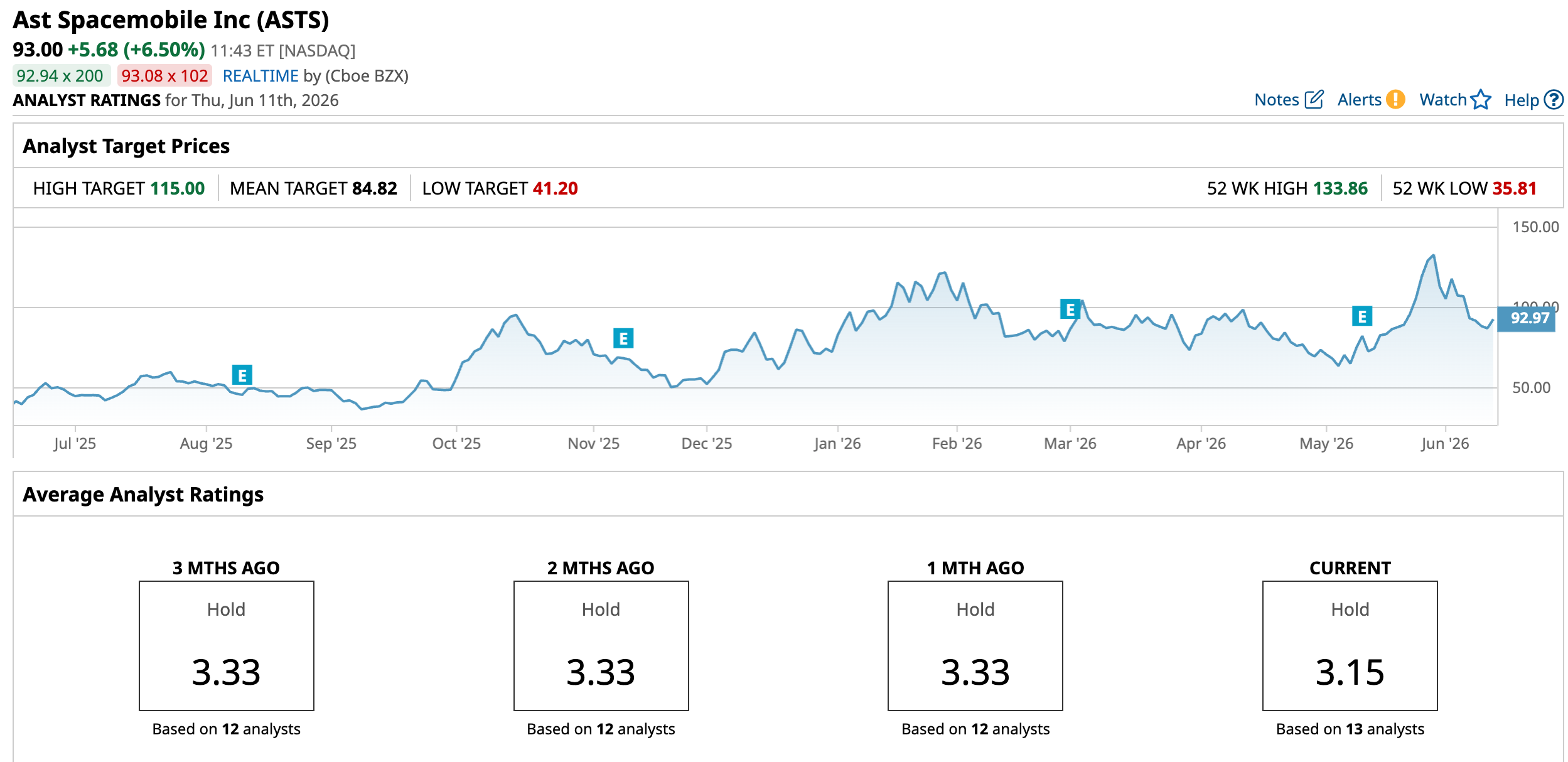
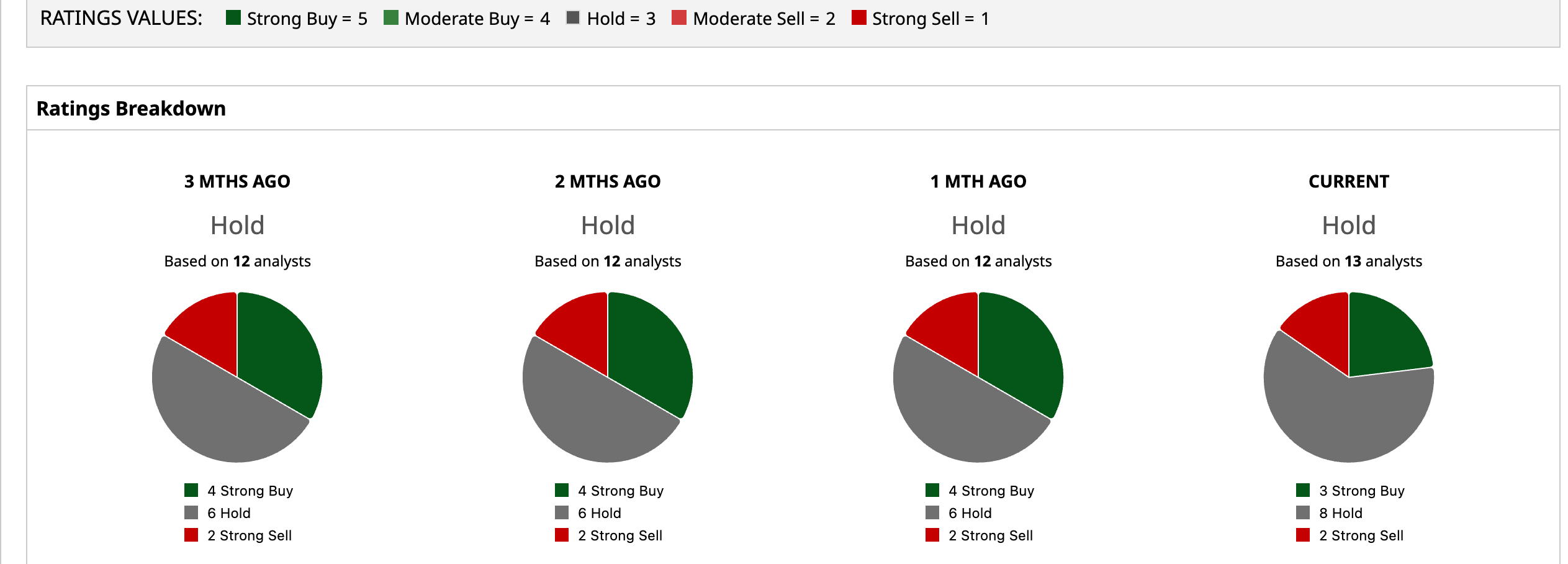
Overall, the stock has a “Hold” consensus rating. Out of 13 analysts, three now rate it a “Strong Buy,” eight calls it a “Hold,” and the remaining two analysts are outright bearish with a “Strong Sell” ratings.
Wall Street has not completely given up on ASTS. While the stock currently trades above the mean price target of $84.82, the Street-high target of $115 suggests ASTS could climb roughly 23.7% from here.
 www.barchart.com
  www.barchart.com
 On the date of publication, Sristi Suman Jayaswal did not have (either directly or indirectly) positions in any of the securities mentioned in this article. All information and data in this article is solely for informational purposes. For more information please view the Barchart Disclosure Policy here.
More news from Barchart
CubeSmart Stock Is Primed for a Breakout – and It Pays You to Wait with a 5.1% Dividend Yield Dear AST SpaceMobile Stock Fans, Mark Your Calendars for June 17 HOOD Stock Pops as Robinhood Plans to Enter the IPO Market as Underwriter Waymo Is Doubling Down on Self-Driving Car Ambitions. What That Means for GOOGL Stock.