

The artificial intelligence (AI) race is rapidly expanding beyond chatbots and digital assistants into the physical world, where AI-powered robots could transform industries ranging from manufacturing and logistics to healthcare and consumer services. Against this backdrop, Chinese technology giant Alibaba Group Holding Limited (BABA) has taken another major step in its AI ambitions, unveiling a new suite of AI models designed specifically for robots.
Alibaba Group has launched the Qwen Robot Suite, a new set of AI models designed to help robots understand their surroundings, navigate complex environments, and perform real-world tasks using natural language instructions. Developed by Alibaba’s Tongyi Lab, the suite includes models for robotic manipulation, navigation, and embodied AI applications. The company said the technology is already being tested with select Alibaba Cloud robotics customers, highlighting its push into the fast-growing Physical AI market amid intensifying competition.
More Top Stocks Daily: Go behind Wall Street’s hottest headlines with Barchart’s Active Investor newsletter.
As investors look for the next frontier of AI-driven growth, Alibaba’s latest move underscores its determination to become a key player in what could be a multi-trillion-dollar robotics market.
About Alibaba Group Stock
Alibaba is a Chinese multinational technology conglomerate, best known for its dominance in e-commerce (Alibaba.com, Taobao, Tmall), cloud computing, digital media, logistics, and financial services. Headquartered in Hangzhou, China, the company operates a sprawling ecosystem that serves consumers, merchants, and enterprises globally. Alibaba has a market cap of around $257.76 billion.
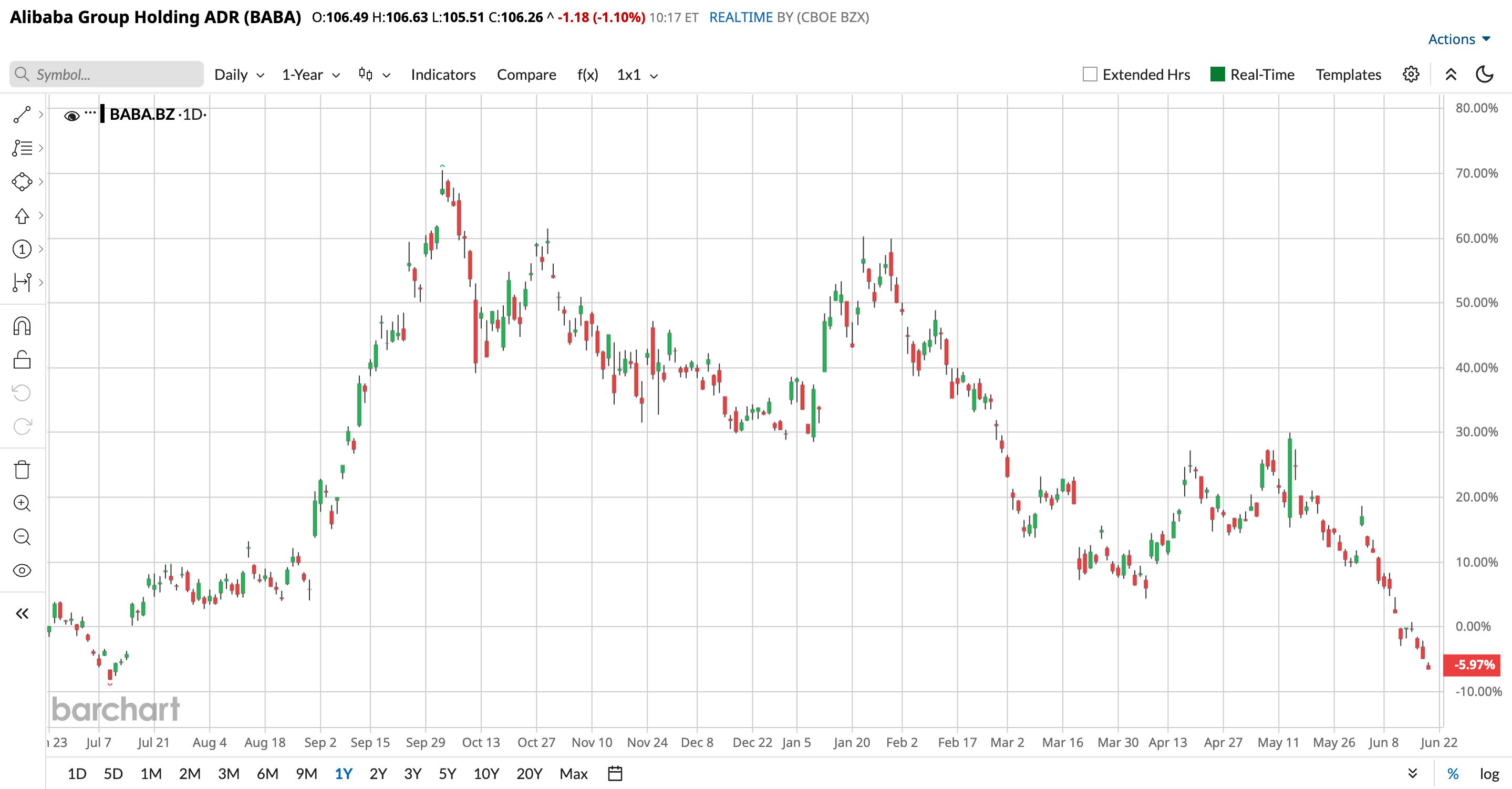
Alibaba stock has endured a difficult 2026, giving back a significant portion of the gains it generated during its AI-driven rally earlier. After reaching a 52-week high of $192.67 in October 2025, shares have retreated sharply amid concerns about slowing consumer spending, heavy AI and cloud investments, and pressure on profitability. BABA is currently 44.8% below its 52-week high.
The recent sell-off has been particularly severe. Over the past month, Alibaba shares have fallen 20.19%, reflecting investor concerns following earnings and broader weakness in Chinese technology stocks.
Year-to-date (YTD), the stock has declined 27.44%, making it one of the weaker-performing large-cap technology stocks in 2026 despite continued growth in its cloud and AI businesses. The stock is down 6.28% over the past year.
 www.barchart.com
 The stock is trading at a premium compared to its industry peers at 16.68 times forward earnings.
Bleak Bottom-Line Performance
Alibaba Group reported its fiscal fourth-quarter and full-year 2026 financial results on May 13, with results highlighting a major strategic shift toward AI, cloud infrastructure, and quick commerce investments.
For the fiscal fourth quarter ended March 31, Alibaba generated revenue of RMB 243.4 billion ($35.3 billion), representing 3% year-over-year (YOY) growth. Moreover, Cloud Intelligence revenue surged 38% YOY, with external cloud revenue accelerating 40%, fueled by strong enterprise AI demand. Management said AI-related products now account for roughly 30% of external cloud revenue.
Despite the revenue growth, profitability deteriorated sharply. Quarterly non-GAAP net income plunged significantly to just RMB 86 million ($12 million) from RMB 29.85 billion in the prior-year quarter. Non-GAAP earnings per ADS fell to RMB 0.62, missing analyst expectations by a wide margin. Income from operations swung to a loss of RMB 848 million ($123 million) compared with operating income of RMB 28.5 billion a year earlier, as Alibaba ramped up spending on AI infrastructure, cloud capacity, user acquisition, and quick commerce expansion.
For full fiscal year 2026, Alibaba reported revenue of RMB 1.02 trillion ($148.4 billion), up 3% YOY. However, operating profitability weakened materially. Income from operations declined 64% YOY to RMB 50.2 billion ($7.3 billion), while adjusted EBITA dropped 56% to RMB 76.4 billion ($11.1 billion).
Full-year non-GAAP net income fell 62% to RMB 60.7 billion ($8.8 billion), while non-GAAP earnings per ADS dropped 59% YOY to RMB 26.80, a decrease of 59%. Free cash flow was an outflow of RMB 46.6 billion ($6.8 billion) compared with an inflow of RMB 73.9 billion in fiscal 2025.
Management emphasized that the deterioration in near-term profitability was intentional and tied directly to long-term AI monetization opportunities. Management stated that Alibaba plans to exceed its previously announced RMB 380 billion ($56 billion) AI investment target over the next three years, citing strong early returns from AI cloud demand and enterprise adoption.
Analysts expect the company’s EPS to improve 109% YOY to $6.75 in fiscal 2027 and rise 40.4% to $9.48 in fiscal 2028.
What Do Analysts Expect for Alibaba Stock?
Despite persistent regulatory and macroeconomic uncertainties, Wall Street remains largely bullish on Alibaba’s long-term prospects. Investors are increasingly shifting their focus away from near-term geopolitical and policy challenges and toward the company’s fundamental strengths, including a recovering cloud business, growing AI-related revenue opportunities, and its leading position in China’s vast e-commerce market.
Last month, Benchmark reaffirmed its “Buy” rating and $220 price target on Alibaba, citing strong momentum in the company’s AI and cloud computing businesses, as well as improving economics in its quick-commerce operations.
Similarly, Bernstein SocGen reiterated its “Outperform” rating and $180 price target, reflecting confidence in Alibaba’s ability to capitalize on long-term growth opportunities despite the current headwinds.
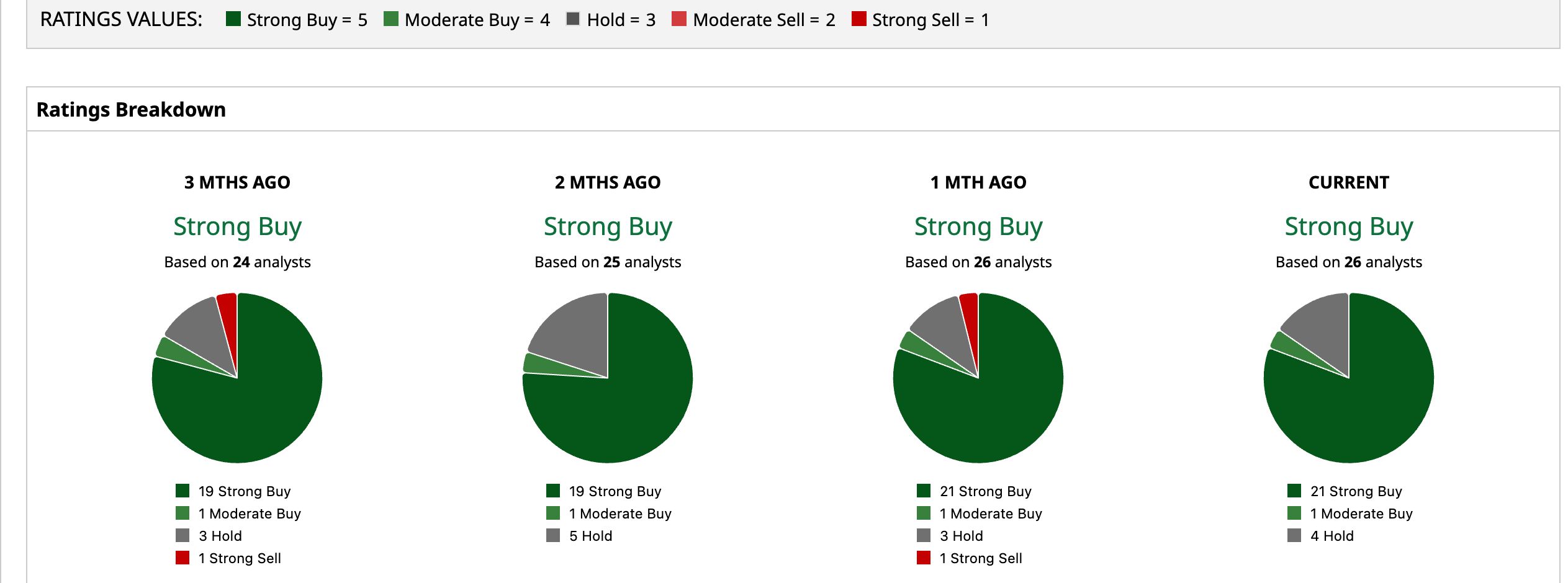
Overall, Alibaba has a consensus “Strong Buy” rating. Of the 26 analysts covering the stock, 21 advise a “Strong Buy,” one suggests a “Moderate Buy,” and the remaining four analysts give a “Hold” rating.
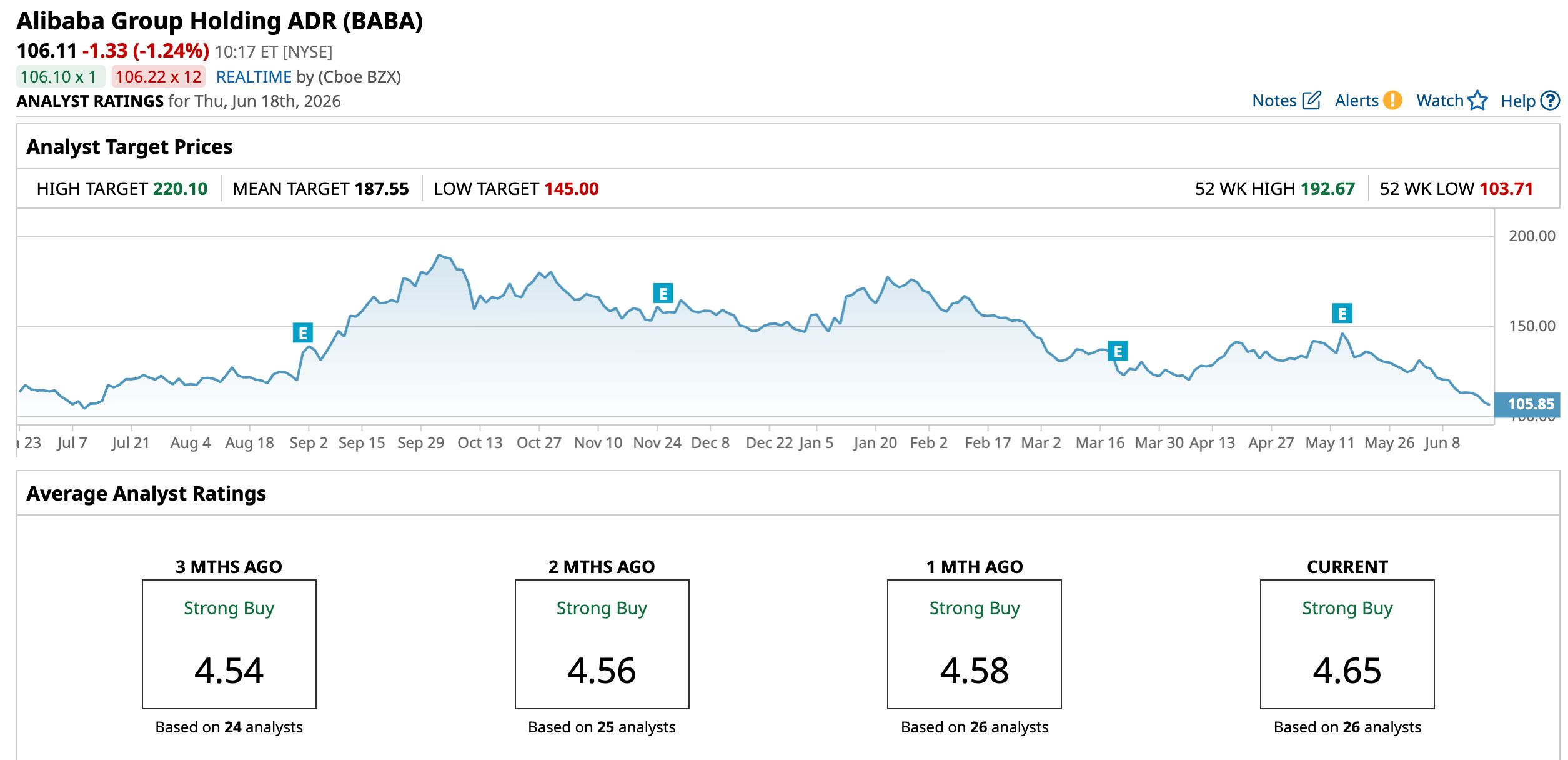
The average analyst price target for BABA is $187.55, indicating a potential upside of 76.75%. The Street-high target price of $220.10 suggests that the stock could rally as much as 107.43%.
 www.barchart.com
  www.barchart.com
 On the date of publication, Subhasree Kar did not have (either directly or indirectly) positions in any of the securities mentioned in this article. All information and data in this article is solely for informational purposes. For more information please view the Barchart Disclosure Policy here.
More news from Barchart
BABA Stock: The Physical AI Race Heats Up as Alibaba Releases New AI Models for Robots Intel Advances Next Generation 18A-P Chip to Risk Production. This Is a Big Deal for INTC Stock. Why This Mega-Cap Stock Might Be the Best Crash Warning We Have Oracle Stock Tumbles on Higher Capex and Equity Raise - Shorting ORCL Puts Works