

Companies in the AI megatrend need significant liquidity to cover cash burn. Valued at almost $1 trillion apiece, even top AI companies like OpenAI and Anthropic continue to report multi-billion-dollar losses annually.
Startups with great ideas but thin balance sheets often have to go through multiple rounds of funding to fuel growth and gain traction. Nvidia (NVDA) thinks it has found a way around that problem — and the plan could reshape who gets to build the next generation of AI products.
More Top Stocks Daily: Go behind Wall Street’s hottest headlines with Barchart’s Active Investor newsletter.
Last week, the chipmaker introduced a financing setup that lets smaller AI clouds access its hardware without paying the full bill upfront. Two names are already testing it out, and the early numbers are notable.
 www.barchart.com
 AI Compute Demand Needed a New Playbook
Companies used to spend most of their computing power on training AI models. Now, most of the compute is used for inference, or the moment an AI chatbot or AI agent gives you an answer or finishes a task. Inference needs to run all day on a massive scale, inside what Nvidia calls AI factories.
The problem is that building one of these factories takes serious money. Land, power, and construction all cost a fortune before a single chip gets plugged in. Emerging AI companies have often struggled to unlock financing for massive infrastructure projects, even with long-term customer commitments in hand, according to a company statement from Nvidia. Basically, smaller players and regional operators have been largely shut out.
Nvidia's answer is a business model built around revenue sharing and credit support. Instead of asking cloud partners to purchase everything outright, Nvidia lets them build capacity while sharing in the profits that come from running it.
How Nvidia's Revenue-Sharing Deal Works
Under the new setup, AI cloud companies buy Nvidia hardware and then sell Nvidia-powered cloud services to startups, model builders, and enterprises. Nvidia collects its usual hardware revenue from chip sales, and also takes a cut of the cloud revenue those chips generate over time. Sharon AI and Firmus are the first two partners using this approach.
Based in Australia, Sharon AI is deploying up to 40,000 Nvidia Grace Blackwell GB300 GPUs as part of the arrangement. Co-founder and CEO James Manning called the move a “pivotal moment” for the company's push into sovereign, large-scale AI compute infrastructure. Sharon AI has positioned itself as an Nvidia Cloud Partner, following Nvidia's reference architecture for building high-performance AI infrastructure, per a statement on its own website.
Meanwhile, Firmus is building a much bigger campus in Batam, Indonesia which is “expected to scale to 360 megawatts and up to 170,000 NVIDIA GPUs.” Co-founder and co-CEO Tim Rosenfield noted that AI-native firms “need access to scalable, energy- and cost-efficient compute infrastructure to compete globally” and that the campus will help more customers access the compute they need.
Finally, Nvidia also pointed to Baseten, Fireworks AI, and Together AI as the kind of AI-native customers this setup is meant to serve — companies that need fast access to compute for training, fine-tuning, and high-volume inference work.
What Critics Have to Say
As CNBC notes, Nvidia's new program lets cloud-based AI firms and model builders swap compute access for a slice of future cloud revenue, positioning the AI giant as a kind of go-between for startups chasing full-stack computing power. The outlet also noted that GPUs are increasingly being treated as a commodity, with compute reportedly tied to futures-style contracts as buyers deal with price swings and shortages.
Last month, Nvidia separately said that it wants to raise about $20 billion in debt, partly to refinance existing borrowing. Some analysts have flagged a related concern known as circular financing, in which Nvidia effectively funds the same companies that then buy its chips, making demand appear more organic than it really is.
What Do Analysts Think of NVDA Stock?
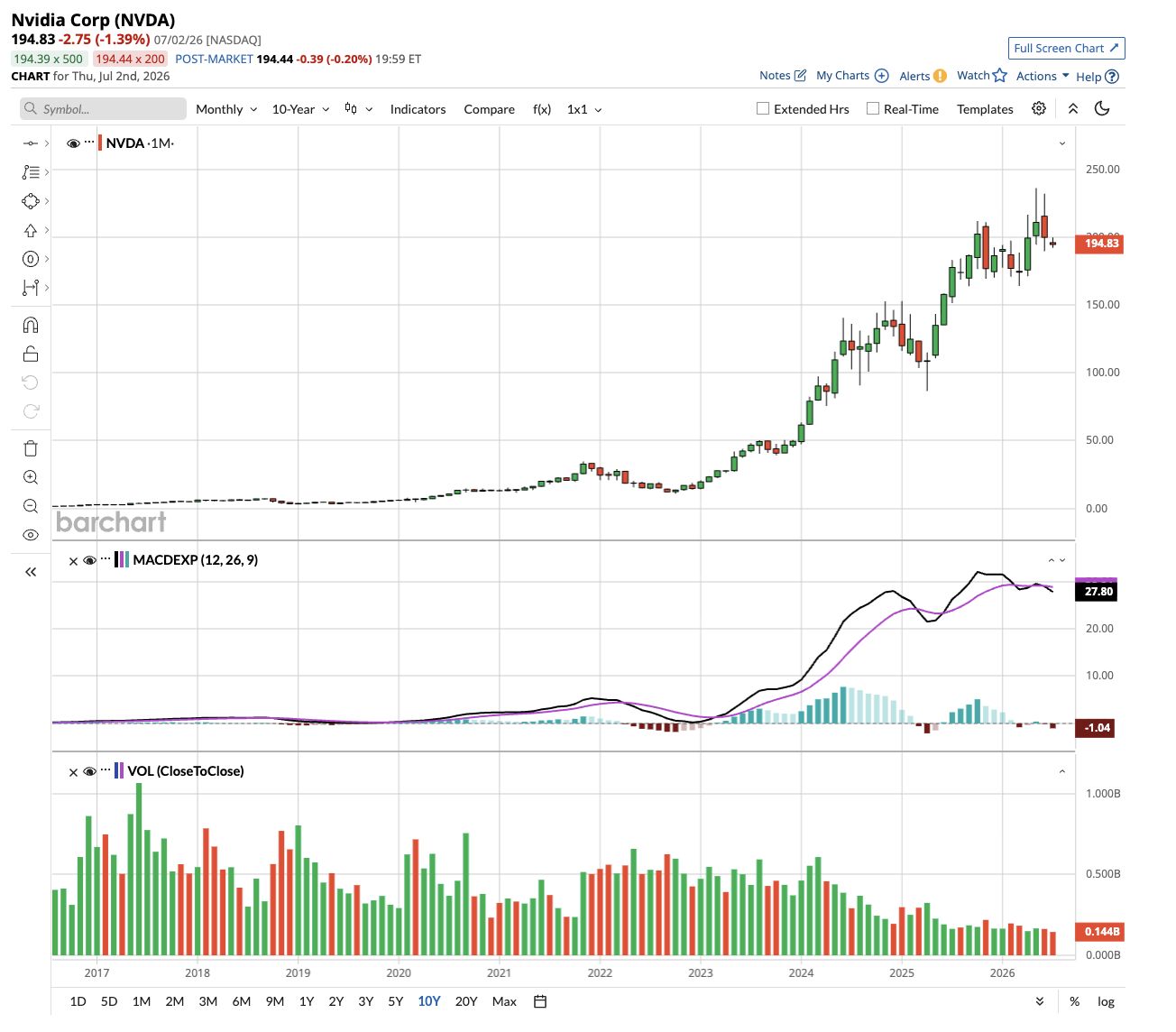
Nvidia is currently valued at a market capitalization of $4.7 trillion, while NVDA stock is down 23% from its 52-week high of $236.54 per share. Analysts tracking the tech stock forecast revenue to increase from $216 billion in fiscal 2026 to $867 billion in fiscal 2031. In this period, adjusted EPS is projected to expand from $4.77 to $18.82 per share. If NVDA stock is priced at 20 times forward earnings, it could roughly double within the next four years.
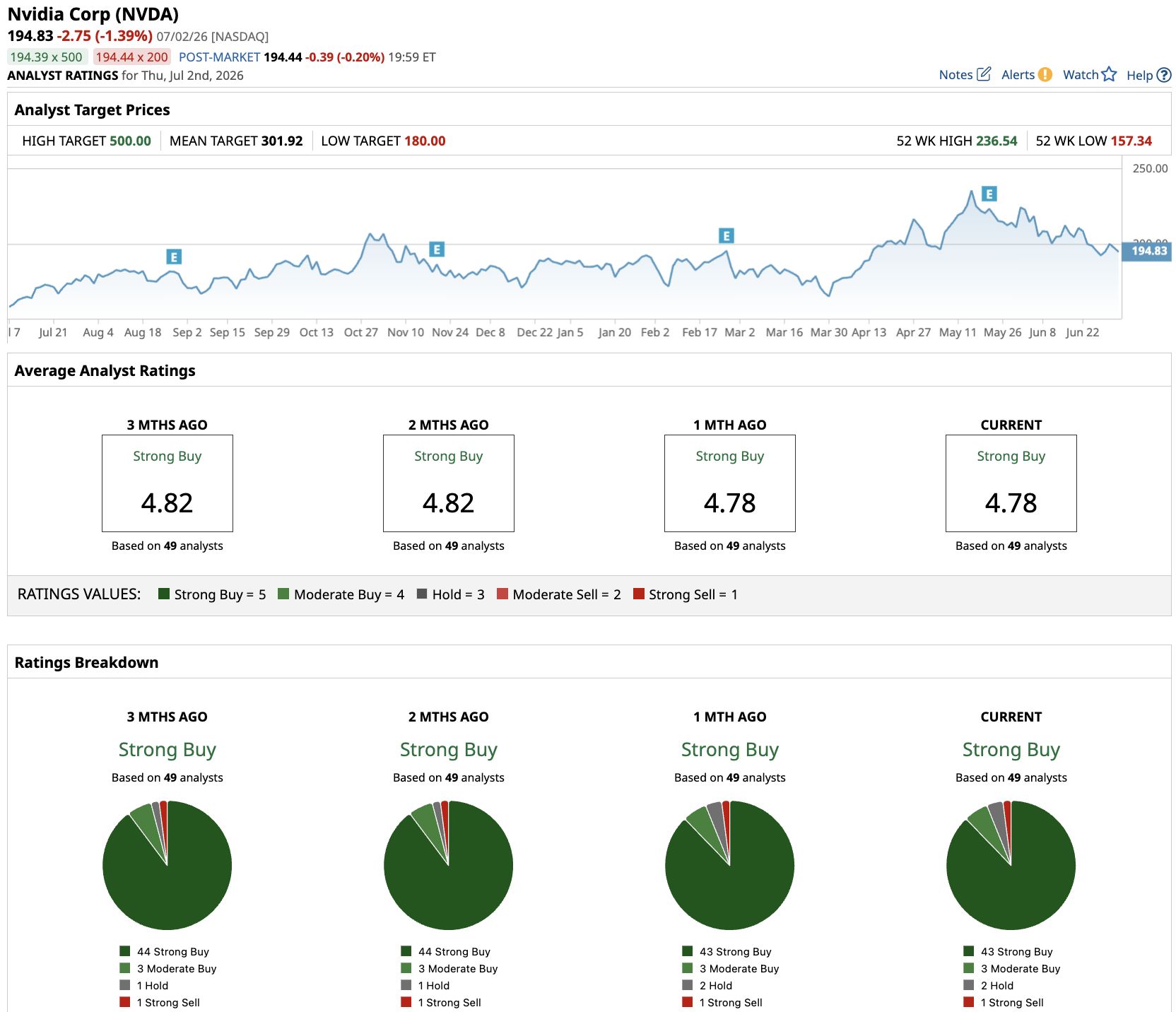
Out of the 49 analysts covering Nvidia stock, 43 recommend a “Strong Buy” rating, three recommend a “Moderate Buy,” two recommend a “Hold” rating, and one recommends a “Strong Sell.” The average price target of $301.92 represents potential upside of 53% from current levels.
 www.barchart.com
 On the date of publication, Aditya Raghunath did not have (either directly or indirectly) positions in any of the securities mentioned in this article. All information and data in this article is solely for informational purposes. For more information please view the Barchart Disclosure Policy here.
More news from Barchart
Nvidia Doubles Down on AI Startups With a Historic Revenue Sharing Model Everyone Thinks Meta’s Cloud Business Is Bad News for CRWV. Here’s What They’re Missing. Memory Prices Heat Finally Reaches Nvidia. Here’s How Jensen Huang Is Dealing With It. This Solar Stock Could Be the Biggest Winner From Trump’s Inverter Crackdown