

Alphabet (GOOG) (GOOGL) has emerged as one of the most aggressive spenders in the artificial intelligence (AI) race, pouring billions of dollars into data center equipment to support its expanding AI ambitions. These investments are strengthening the company’s competitive position while helping Google Cloud capture rising demand from businesses and AI developers. However, the scale of that spending is also beginning to place visible pressure on Alphabet’s financial performance.
That pressure became especially clear in the company’s latest earnings report, as heavy capital expenditures pushed Alphabet’s quarterly free cash flow into negative territory for the first time. For a company long known for generating enormous amounts of cash, that shift represents an important turning point. Investors are now being asked to look beyond rapid cloud growth and promising AI opportunities and consider how long Alphabet may need to spend at such an elevated pace before those investments produce sufficient returns.
More Top Stocks Daily: Go behind Wall Street’s hottest headlines with Barchart’s Active Investor newsletter.
So, how should investors approach GOOGL stock as Alphabet’s AI spending pushes its free cash flow into the red?
About Alphabet Stock
Alphabet is s a leading multinational technology company. It operates across three segments: Google Services, Google Cloud, and Other Bets. The Google Services segment, which accounts for the majority of the company’s total revenue, offers a broad range of products and platforms, including Search, Ads, Android, Chrome, YouTube, Gmail, Google Maps, Google Photos, and Google Play and serves billions of users globally. Its market cap currently stands at $3.87 trillion, making it the world’s third most valuable company.
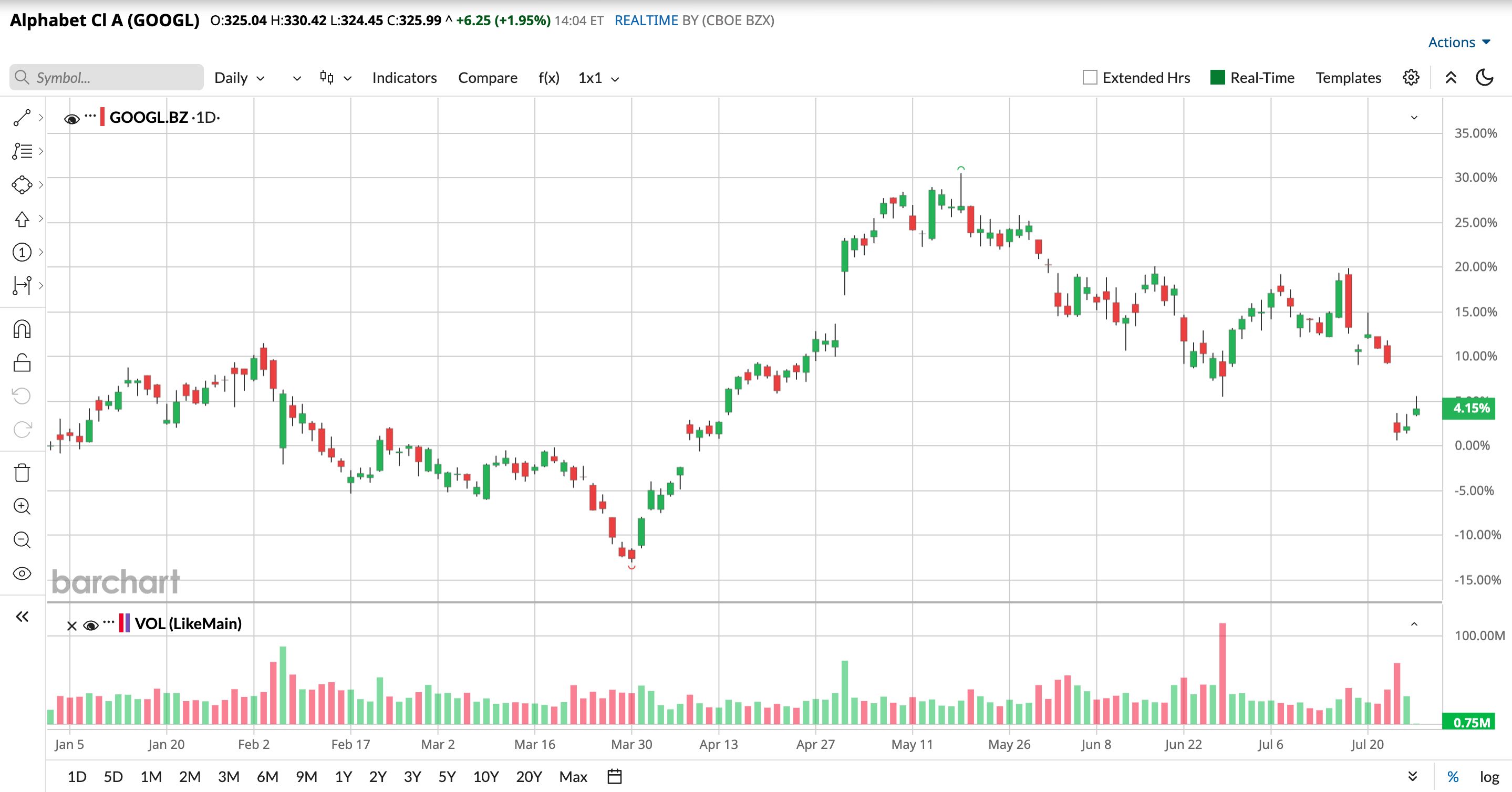
Shares of the Google parent have gained 4.39% year-to-date (YTD). GOOGL stock took a hit of 7.13% last week after the company raised its full-year capital expenditure guidance and reported negative free cash flow for the second quarter.
 www.barchart.com
 Alphabet’s $205 Billion Spending Plan and Negative Free Cash Flow Spook Investors
Alphabet stock sank 7.13% on July 23 after the Google parent raised its full-year capital spending guidance, overshadowing its stronger-than-expected Q2 results. Its higher-than-expected spending plans reignited concerns over the massive financial toll and long-term sustainability of the Silicon Valley AI race. The post-earnings drop wiped out more than $293 billion in the company’s market value, marking the largest one-day market-cap loss in its history.
As the AI buildout continues, the Google parent company raised its full-year capital expenditure guidance by $15 billion, bringing the new range to $195 billion to $205 billion. This increase came as the cost of components such as memory—the hardware required to power AI systems—continued to soar amid tight supply. Management sought to justify the higher guidance, saying it reflects the company’s efforts to accelerate the expansion of its AI computing capacity and generate more revenue from cloud-computing customers.
However, that failed to reassure investors, particularly as Alphabet’s AI spending exceeded its cash generation in the second quarter. The Google parent reported negative free cash flow of $5.9 billion for the quarter after sharply ramping up spending on data centers and AI hardware. That marked the company’s first negative reading since it went public in 2004. Chief Financial Officer Anat Ashkenazi said free cash flow would remain under pressure as the company ramps up its AI investments. As a result, Wall Street analysts now expect Alphabet to report Q3 free cash flow of just $452.7 million, down sharply from the $7.69 billion they had projected before last week’s earnings report.
Moreover, AI spending is not expected to slow anytime soon. Alphabet said it still expects capital expenditures to increase “significantly” in 2027. Morgan Stanley sees Alphabet’s capex rising to as much as $375 billion next year. That represents a staggering figure which exceeds Oracle’s (ORCL) entire market value. Against the backdrop of massive AI spending, Melius Research analyst Ben Reitzes now expects the company’s free cash flow to be negative in 2027.
As Alphabet’s AI buildout puts free cash flow under pressure, the company will continue to raise external capital. And debt sales are expected to be Alphabet’s primary source of additional funding after Ashkenazi confirmed that the company has no plans for further equity sales this year or next beyond those already disclosed. That will keep Wall Street’s biggest debate alive: whether new AI revenue can justify hundreds of billions of dollars in capital expenditures, just as those investments become increasingly debt-funded.
Google Cloud’s Growth Is Impressive, but AI Costs Keep Rising
At this point, let’s turn to the second part of the equation: the return on AI investments. In that respect, Google Cloud has become one of the clearest indicators of whether Alphabet’s AI spending can generate meaningful financial returns. Google Cloud is Alphabet’s cloud computing and AI platform that enables customers to rent computing infrastructure and services.
Google Cloud has emerged as one of Alphabet’s fastest-growing businesses, driven by demand from AI startups and enterprise customers for the infrastructure required to build and deploy AI applications. In the second quarter, the unit generated $24.77 billion in revenue, an increase of 82% from a year earlier and well above analysts’ expectations of $22.46 billion. Cloud demand was “powered by strong demand for AI infrastructure and AI solutions,” according to Chief Executive Officer Sundar Pichai. Google Cloud’s better-than-expected revenue provides a clear indication that the company’s investments are “converting into fast-growing, profitable revenue, with contracted deals coming online the moment capacity is built,” said Thomas Monteiro at Investing.com.
Moreover, Alphabet’s Google Cloud backlog - a measure of contracted business not yet recognized as revenue - rose to $514 billion in the second quarter from about $460 billion in the previous quarter. That underscores the strong pent-up demand for computing capacity. Google said most of its cloud backlog consists of standard contracts with “a broad mix of customers,” adding that it expects to recognize more than half of that backlog as revenue over the next 24 months. That means the unit will book over $257 billion in revenue over the next two years. However, investors are mindful that such strong growth comes at the cost of massive AI spending that is becoming increasingly difficult to justify.
Conclusion
Alphabet’s post-earnings sell-off clearly showed that investors are unlikely to celebrate strong cloud growth while AI spending continues to soar. Based on Alphabet’s latest capital spending forecast for this year and Morgan Stanley’s projection for 2027, the company could spend as much as $580 billion over the two years. And the free cash flow issue makes it even harder for investors to justify the heavy spending. With that, some caution may be warranted toward Alphabet and other major AI hyperscalers, at least in the near term.
On the date of publication, Oleksandr Pylypenko had a position in: GOOGL . All information and data in this article is solely for informational purposes. For more information please view the Barchart Disclosure Policy here.
More news from Barchart
Albertsons Stock Is Plunging After the Grocery Giant Slashed Its Outlook. Consumer Weakness Is to Blame. Qualcomm’s 36% Pullback Creates a Buying Opportunity Ahead of Q3 Earnings Alphabet’s AI Spending Crushes Its Free Cash Flow. How You Should Approach GOOGL Stock Here. QBTS Stock Pops as AT&T Expands Partnership With D-Wave Quantum