

Today, most of SpaceX’s (SPCX) business comes from rockets and Starlink. But a new projection from research firm SemiAnalysis says that the picture will flip completely within two years. SemiAnalysis estimates that SpaceX could reach a $305 billion annual revenue run rate (ARR) by the end of 2027, with $235 billion of that coming from AI compute alone.
While SpaceX’s AI business is growing rapidly, it still accounts for a small percentage of total revenue. This projection suggests it could make up more than three-quarters of the company’s revenue in less than two years. As I recently covered, SpaceX is turning into an AI company. This latest projection shows just how far that shift could go.
More Top Stocks Daily: Go behind Wall Street’s hottest headlines with Barchart’s Active Investor newsletter.
How SpaceX Gets There
SemiAnalysis' projection rests on how fast SpaceX builds, from around 1.4 gigawatts of compute today toward roughly 10 GW by the end of 2027, the figure SemiAnalysis uses in its model. SpaceX’s own ambitions run even higher, with CEO Elon Musk floating as much as 20 GW by the end of the same period.
SemiAnalysis points to the company’s track record to back its 10 GW estimate. SpaceX built its first large data-center cluster in 122 days, and scaled one power plant from under 500 MW to more than 1.2 GW in five months. Building its own gas power on site lets it skip the years-long wait that slows other data-center builders. The demand looks real, too. On the second-quarter earnings call, SpaceX noted that it had already booked more than $14 billion in cloud contracts, and named Alphabet's (GOOGL) Google and Anthropic as customers.
The $305 billion figure is not just a random estimate. Musk said that the company would hit $100 billion in annualized revenue by the end of 2026 even if it "basically did nothing,” and hit $1 trillion by 2030. So, SemiAnalysis’ estimate of $305 billion by the end of 2027 sits roughly in line with SpaceX’s own guidance.
However, there are reasons for investors to remain cautious. Reaching that scale would mean building around 10 GW of compute. As per SemiAnalysis, that could cost $300 billion to $500 billion in spending — an enormous amount for a company still posting losses. SemiAnalysis also admitted that the risk isn’t limited to building data centers. If the AI models get too powerful, the government could also intervene to limit them before the spending pays off.
About SpaceX Stock
SpaceX is a Texas-based space and technology company that operates through three main segments. The Space segment designs, manufactures, and launches reusable rockets to provide access to space, while the Connectivity segment operates a broadband data and communications network through various Starlink satellites. Finally, the AI segment operates vertically integrated AI spanning frontier large language model (LLM) Grok and social media platform X. SpaceX was founded in 2002.
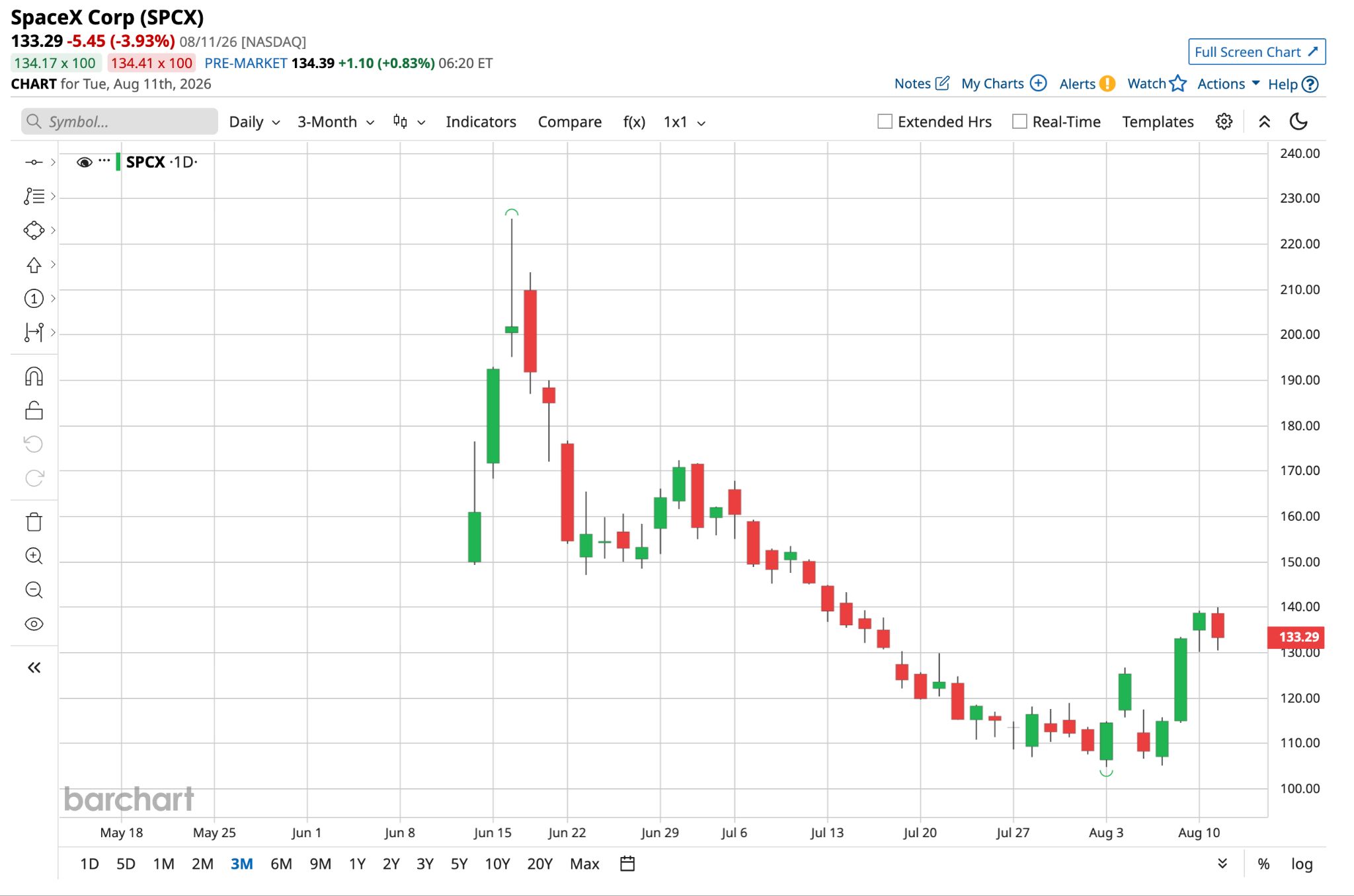
SPCX stock has climbed less than 1% over the past month, underperforming the iShares U.S. Aerospace & Defense ETF (ITA), which has gained 5% during the same period. The underperformance has largely been driven by post-IPO valuation compression following SpaceX’s June 2026 initial public offering at a market capitalization of approximately $1.7 trillion. As investors reassessed whether such a premium valuation was justified, SPCX stock faced selling pressure and heightened volatility.
 www.barchart.com
 Valuing SpaceX using the traditional measures is nearly impossible right now. The company only went public in June, so its ratios have no historical averages to compare against. The forward price-to-earnings (P/E) multiple is not meaningful. Like Tesla (TSLA) in its early years, SpaceX is spending everything on growth. This makes the near-term earnings too small to say anything useful about the price. Meanwhile, the forward price-to-sales (P/S) ratio of 97 times is undoubtedly steep. As often is the case with the market and Elon Musk, investors are paying up for a promising future amidst heavy spending.
The EPS outlook helps explain the high P/S multiple. Analysts expect earnings growth of close to 1,120% in fiscal 2027 as the AI compute business scales. The balance sheet further strengthens the case; SpaceX holds just over $100 billion in cash against less than $40 billion in debt. For a company planning to spend aggressively, that is a strong position to be in. Overall, though, the valuation only makes sense if the spending turns into the revenue that SemiAnalysis and SpaceX are both pointing toward.
SpaceX Targets More Than 2 GW of Compute by Year-End
SpaceX reported Q2 2026 earnings on Aug. 4. For the period, the company saw revenue of $7.8 billion, up 92% from $4.1 billion. Adjusted EBITDA came in at $3.5 billion, up 191% year-over-year (YOY) from $1.2 billion.
CEO Elon Musk said the company completed two successful flights of Starship V3 during the quarter, and Flight 14 will be SpaceX's first to fly Version 3 Starlink satellites to operational orbit. During Q2, the company added more than 1.7 million Starlink subscribers globally. Chief Operating Officer Gwynne Shotwell also noted that the company won more than $6 billion in U.S. contracts in Q2. SpaceX’s revenue growth strengthened across every segment, while the company “significantly strengthened the balance sheet through [its] IPO and inaugural investment-grade bond offering,” per CFO Bret Johnsen.
Looking forward, SpaceX expects to end 2026 with more than 2 GW of compute. Johnsen noted that the company has already contracted an additional $6.7 billion of cloud services revenue in the first few weeks of Q3. This puts the company on the right path to reach $100 billion of ARR by the end of this year.
Musk said the company aims to have as much as 20 GW of power and cooling infrastructure by the end of next year, significantly above the previously discussed 10 GW level. The CEO also added that SpaceX expects to receive a large share of Nvidia’s (NVDA) GPU shipments next year, which should support its AI expansion plans.
What Do Analysts Expect for SPCX Stock?
Citi analyst John Godyn recently reiterated a “Buy” rating on SpaceX stock with a price target of $200. The analyst cited strong growth and solid execution, noting that the Q2 results exceeded expectations across several key financial and operational metrics. As a result, Godyn raised his forecasts for 2026 and 2027, believing that the drivers behind the beat appear to be sustainable rather than a one-off.
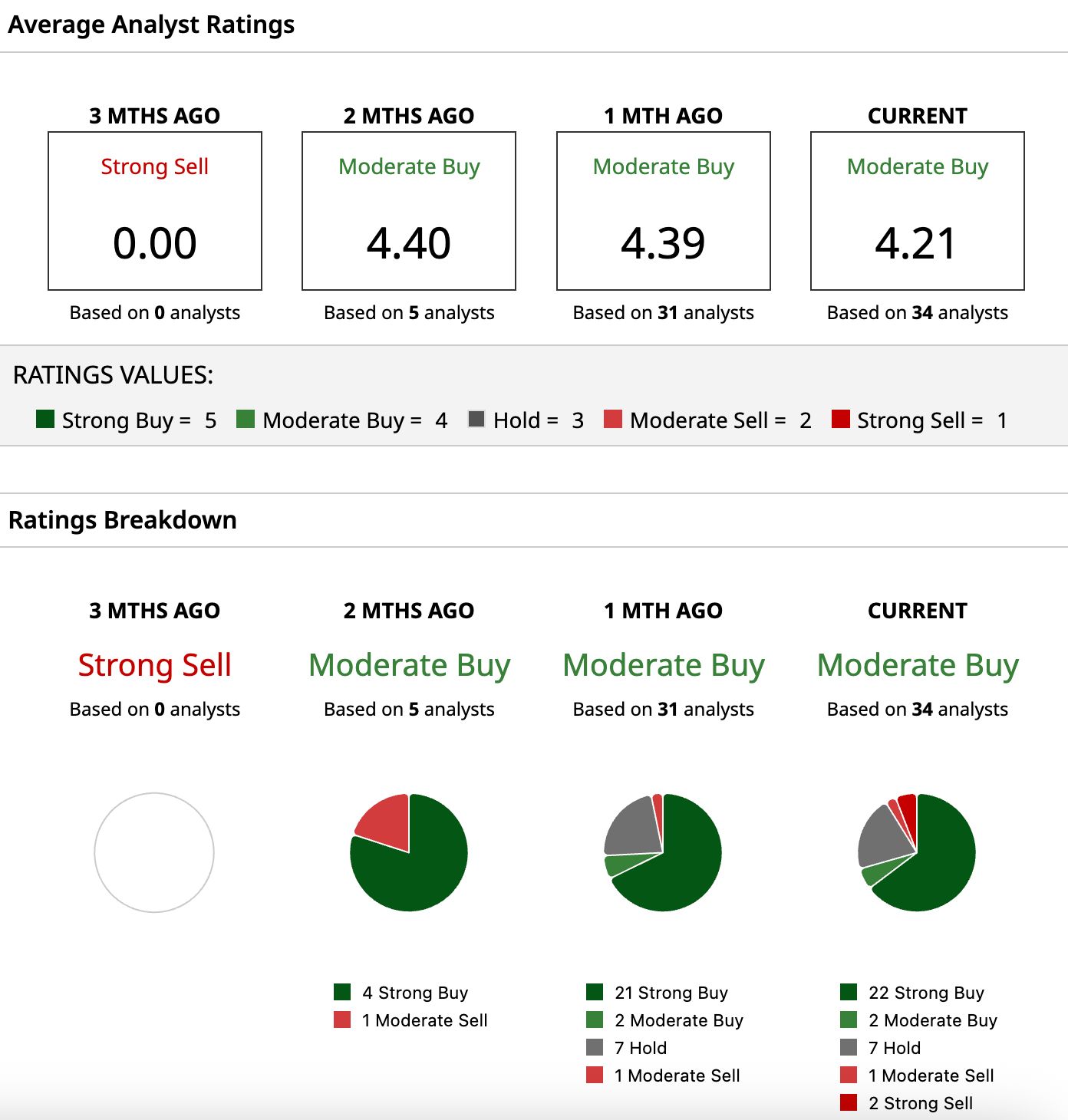
Based on 34 Wall Street analysts with coverage, SPCX stock holds a consensus “Moderate Buy” rating. Of those analysts, 22 have a “Strong Buy” rating, two have a “Moderate Buy” rating, seven have a “Hold,” one has a “Moderate Sell,” and two have a “Strong Sell” rating. The average price target of $220.62 reflects potential upside of 51% from current levels, while the high price target of $800 implies impressive potential upside of 448% from here. That optimism is about the long-term business, as SpaceX believes demand is rising faster than supply.
 www.barchart.com
 On the date of publication, Jabran Kundi did not have (either directly or indirectly) positions in any of the securities mentioned in this article. All information and data in this article is solely for informational purposes. For more information please view the Barchart Disclosure Policy here.
More news from Barchart
SoundHound AI's Acquisition Strategy Is Either Genius or Dangerous. How to Evaluate SOUN Stock. SpaceX Could Be Making $235 Billion From a Business It's Not Known For. SPCX Stock Investors Should Pay Attention. Dear Dell Stock Fans, Mark Your Calendars for September 3 Why Wall Street Isn't Buying Super Micro's $60 Billion Backlog Quite Yet