

If there’s one tech company that knows how to keep people curious, it is Apple (AAPL). Every time the tech giant pulls another product out of the hat, tech-savvy shoppers and gadget fans wonder what’s next, and investors immediately ask what it means for the stock.
This time, the spotlight is back on the tech giant as the company unveiled refreshed Mac mini and Mac Studio models, packing them with its latest M6, M5 Pro, M5 Max, and M5 Ultra chips. Apple is clearly tuning its desktop lineup for the artificial intelligence (AI) era, with faster processing, Neural Accelerators, higher memory bandwidth, and more muscle for AI-heavy and professional workloads.
More Top Stocks Daily: Go behind Wall Street’s hottest headlines with Barchart’s Active Investor newsletter.
The timing is interesting, especially after Apple previously acknowledged supply constraints for the Mac mini and Mac Studio as demand ran ahead of supply. The new machines, therefore, are not just another hardware refresh. They offer investors another glimpse into how Apple is positioning its ecosystem for the growing AI wave.
So, with new AI-ready Macs now entering the picture and the next iPhone cycle approaching, Apple has plenty of moving pieces for investors to watch. AAPL stock is already up in the mid-teens so far in 2026. So, is there still more room to run, and how should investors play AAPL stock from here?
About Apple Stock
For decades, Apple has turned everyday technology into products people rarely imagine living without. From the iPhone that transformed communication to the Mac and iPad that reshaped personal computing, the Cupertino-based giant has built one of the world’s most powerful consumer brands. But Apple’s story no longer ends with hardware.
Its Services business – spanning the App Store, iCloud, Apple Music, Apple Pay, and more – has become an increasingly important growth engine, bringing recurring revenue and keeping users deeply connected to its ecosystem. Today, that combination has helped Apple reach a staggering $4.5 trillion market capitalization.
Still, AAPL stock has been volatile in 2026. The year started on a softer note as concerns around interest rates, geopolitical uncertainty, and the broader AI trade weighed on big tech. Apple wasn’t immune, and shares struggled for months to find their footing.
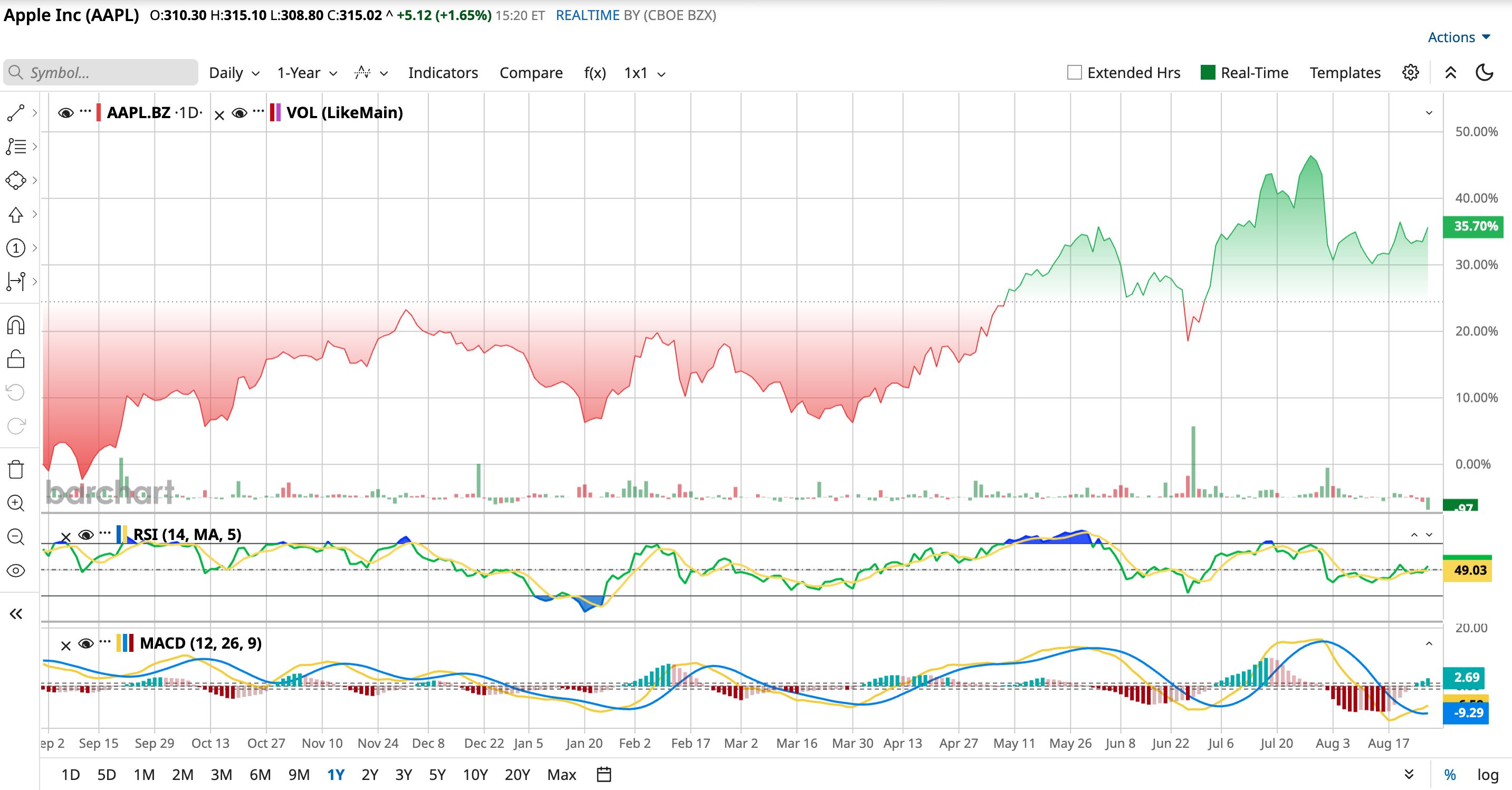
But the story changed as the year progressed. AAPL stock has recovered strongly and is now up 15.2% year-to-date (YTD), while gaining roughly 36.6% over the past 52 weeks. That recovery has been supported by continued strength in its Services business, resilient iPhone demand, and growing optimism around Apple’s AI strategy and its ability to monetize AI across its massive installed base.
Interestingly, Apple’s AI story has also benefited from what it has not been doing. Unlike several other large-cap tech companies pouring enormous amounts of capital into AI infrastructure, Apple has taken a relatively measured approach to AI-related capital spending. For investors, that restraint has reinforced the idea that Apple can participate in the AI opportunity without facing the same level of spending pressure as some of its peers.
The optimism pushed shares to an all-time high of $344.57 on July 29 before the stock pulled back 8.6% from that peak.
One emerging concern was Apple’s relatively bleak Q4 outlook, which weighed on shares after its latest earnings report. The company warned that the impact of rising memory costs was becoming more pronounced. That pressure is tied to the broader AI infrastructure build-out, which is driving up memory and storage costs across the industry. CEO Tim Cook said Apple has paid more for memory in each of the past three quarters and expects costs to rise again in the September quarter. The company has already raised prices on some Macs and iPads, although iPhones have so far avoided a price increase.
Technically, AAPL’s chart still looks reasonably healthy. The 14-day RSI is 51.20, suggesting the stock has cooled from its earlier overbought levels without becoming oversold. Meanwhile, the MACD remains bullish, with the MACD line above the signal line and a positive histogram, pointing to continued buying momentum.
 www.barchart.com
 Apple stock is not exactly shopping in the bargain aisle. Priced at around 35.43 times forward adjusted price-to-earnings and 10.88 times sales, AAPL trades above its historical averages and many mega-cap tech peers. Still, investors seem happy to pay up for Apple’s ecosystem, brand loyalty, and remarkably consistent cash machine.
And shareholders are not left waiting for their reward. Apple has raised its dividend for 13 consecutive years, while its 12.11% payout ratio leaves plenty of room for future increases. Add billions in share buybacks to the mix, and Apple’s capital-return strategy remains another reason investors may be willing to stomach that premium valuation.
New Macs Give AAPL Stock Another Catalyst
Apple’s latest Mac launch is more than just another hardware refresh. Looking a little closer, Apple is steadily turning its own silicon into an AI advantage.
The new Mac mini now comes with either the M6 or M5 Pro chip, starting at $899 and $1,699, respectively. The M6 model delivers up to four times faster AI performance, 40% faster CPU performance and twice the graphics and storage performance versus the previous M4 version. It also supports up to 32GB of memory and 170GB/s of memory bandwidth. The M5 Pro takes things further with up to an 18-core CPU, 20-core GPU, 64GB of unified memory and 307GB/s of bandwidth.
Then comes the Mac Studio, aimed squarely at professional and AI-heavy workloads. Its M5 Max supports up to 128GB of unified memory, while the M5 Ultra can reach an 80-core GPU and a massive 512GB of unified memory. Apple says the M5 Ultra delivers up to 4.3 times the AI performance of the M3 Ultra.
But why does this matter for investors? Apple is increasingly giving developers and businesses the ability to run demanding AI workloads locally rather than relying entirely on cloud infrastructure. Adding macOS 27 and the next generation of Apple Intelligence features into the mix, these Macs become another way for Apple to monetize the AI shift.
The timing is also interesting. Mac revenue already jumped impressively in Q3, despite supply constraints. With demand for the Mac mini and Mac Studio previously running ahead of supply, the new lineup could help Apple turn that momentum into another leg of growth.
A Snapshot of Apple’s Q3 Results
Before investors get too caught up in Apple’s latest Mac launches, it is worth taking a step back and looking at the numbers that set the stage. And Apple’s fiscal Q3 2026 results, released last month, gave investors plenty to chew on.
The company delivered a pretty strong June quarter, with revenue jumping 16.4% year-over-year (YOY) to $109.4 billion, topping Wall Street's expectations. Adjusted EPS amounted to $1.91, also ahead of estimates, while reported EPS climbed 28.7% annually to $2.02. Even more telling, Apple posted record June-quarter revenue from the iPhone, Mac and Services, while its installed base crossed 2.5 billion active devices – a new all-time high.
The iPhone was still doing the heavy lifting. Sales surged 22% YOY to $54.3 billion, with the iPhone 17 family driving record June-quarter results across every geographic segment. And with Apple preparing to unveil its next generation of iPhones in September, investors have another potential catalyst waiting around the corner.
Mac was no slouch either. Revenue jumped 28.7% to $10.4 billion, helped by the MacBook Neo and MacBook Pro, with Apple reporting record demand from both upgraders and first-time Mac buyers despite supply constraints. That makes the latest AI-focused Mac refresh particularly interesting – it is building on momentum that was already there.
Services added another layer of strength, with revenue rising 12% annually to a record $30.7 billion. Paid subscriptions crossed 1.5 billion, while cloud, payments, advertising, App Store, AppleCare, Music, and video all hit June-quarter records. However, iPad revenue slipped 6% to $6.2 billion, while Wearables, Home, and Accessories grew 6.5% to $7.9 billion.
And then there’s the balance sheet. Apple ended the quarter with $147 billion in cash and marketable securities, $84 billion in debt and a record $34.4 billion in operating cash flow. It returned $33 billion to shareholders, including $25.8 billion in buybacks and $4 billion in dividends and equivalents.
Looking ahead, Apple expects Q4 revenue growth of 9% to 11% YOY. iPhone revenue is expected to grow in the mid-teens, while Services growth should remain broadly similar to Q3 after adjusting for foreign exchange. Foreign exchange could shave about 2.5 percentage points off growth, while tighter supply and higher memory costs are expected to pressure margins, partly offset by existing inventory, lower costs for some components and a favorable product mix.
So, Apple is not exactly slowing down, and it is heading into Q4 with a strong iPhone pipeline, an increasingly AI-ready Mac lineup and a Services business that keeps quietly doing the heavy lifting. For investors looking for AI exposure without betting on massive AI infrastructure spending, that combination makes AAPL an interesting stock to watch.
Meanwhile, analysts monitoring the company remain optimistic, predicting Q4 revenue around $113.55 billion, while EPS is anticipated to rise by 7% YOY to $1.98. Looking further ahead to fiscal 2026, profit is expected to be around $8.76 per share, up 17.4% YOY, before surging another 8.7% annually to $9.52 per share in fiscal 2027.
What Do Analysts Expect for Apple Stock?
Wall Street’s view on Apple remains broadly positive, with analysts seeing more than just another product cycle ahead. For instance, Evercore’s Amit Daryanani sees Apple’s refreshed Mac mini lineup as a sign that the company is becoming more comfortable charging a premium for stronger AI performance. The new M6 and M5 Pro models start about $300 higher than the original M4/M4 Pro launch prices and $100 above the most recent pricing, partly reflecting higher memory costs. Daryanani believes better chips, memory bandwidth, connectivity, and AI capabilities help justify those prices. He has an “Outperform” rating for AAPL with a $365 price target.
Meanwhile, BofA Securities’ Wamsi Mohan is even more bullish, maintaining a “Buy” rating and $380 target. He credits Tim Cook with dramatically expanding Apple’s device base and turning that ecosystem into a powerful Services business while maintaining privacy. Mohan expects incoming CEO John Ternus to stick with that strategy and believes Apple can emerge as a “winner at AI at the edge.”
He sees AI-powered devices, new products, wearables, smart homes, personal assistants, and even robotics as potential growth drivers. In his view, Apple’s combination of in-house silicon, on-device processing, privacy, operating systems, personal context, and a massive installed base could keep its competitive edge intact in the AI era.
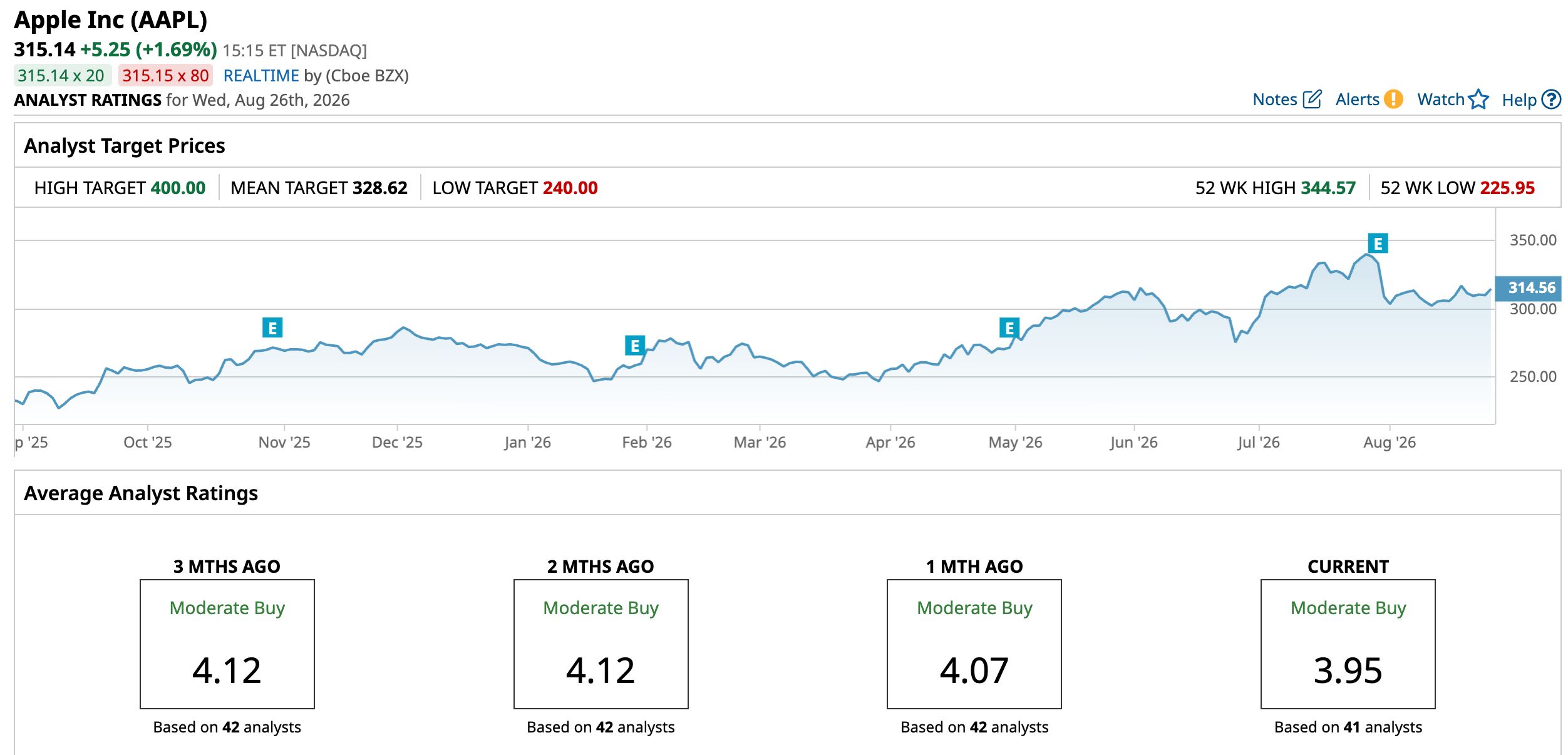
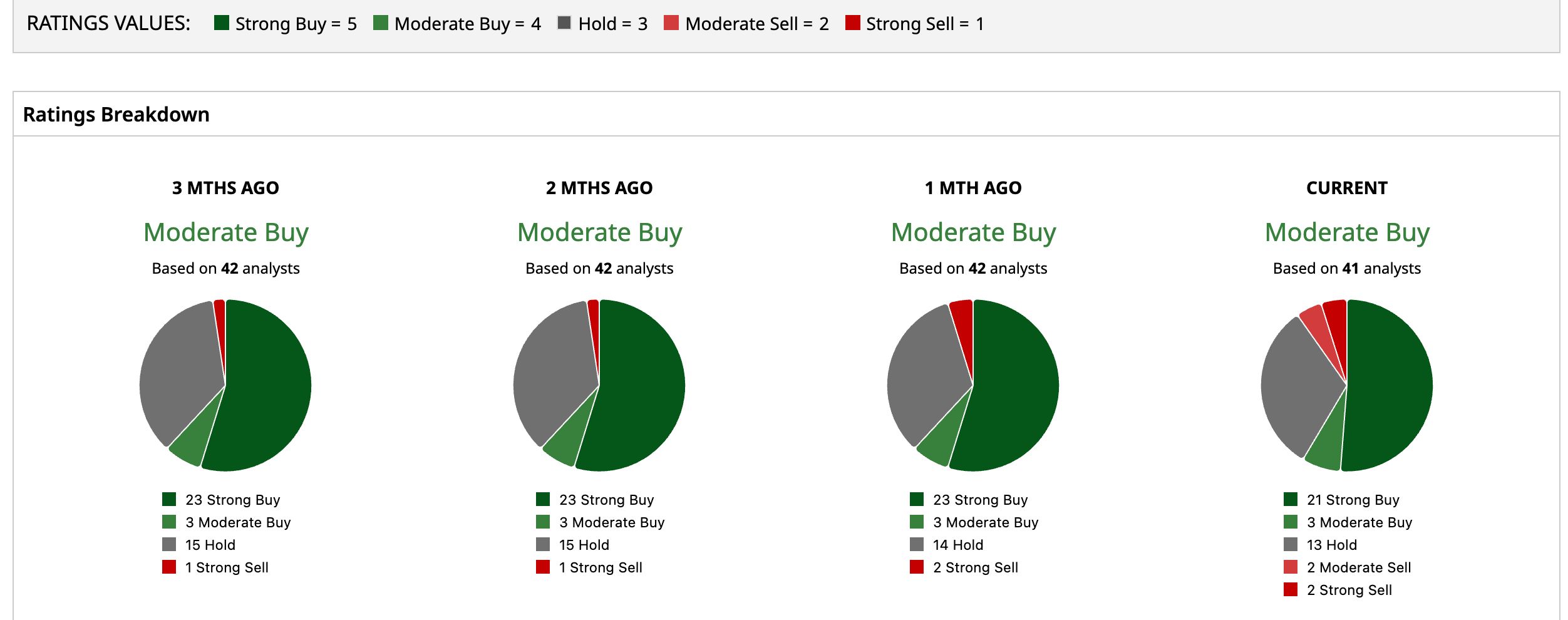
AAPL stock carries a consensus “Moderate Buy” rating, reflecting a mix of optimism and caution on Wall Street. Among the 41 analysts covering the stock, 21 have issued a “Strong Buy” recommendation, while three rate it a “Moderate Buy.” Meanwhile, 13 analysts have a more neutral “Hold” stance. On the bearish side, two analysts recommend a “Moderate Sell,” while the remaining two are outright skeptical, advising a “Strong Sell” rating.
The stock’s average analyst price target of $328.62 suggests 4.3% upside potential. The Street-high target price of $400 suggests that the stock could rally as much as 26.9%.
 www.barchart.com
  www.barchart.com
 On the date of publication, Sristi Suman Jayaswal did not have (either directly or indirectly) positions in any of the securities mentioned in this article. All information and data in this article is solely for informational purposes. For more information please view the Barchart Disclosure Policy here.
More news from Barchart
As Navitas Semiconductor Buys Claros, Here’s How to Play NVTS Stock SK hynix Stock Jumps as AI Memory Expansion Accelerates. How to Play SKHY Here. How to Play AAPL Stock as Apple Unveils New Macs A $60 Billion Reason to Buy Broadcom Stock