


Cathie Wood is making another bold move in the tech world. The Ark Invest CEO and chief investment officer, known for placing big bets on disruptive and innovative technology stocks, made two strikingly different trades this week. ARK bought 43,091 shares of Meta Platforms (META) worth about $27.9 million across the ARK Innovation ETF (ARKK) and ARK Next Generation Internet ETF (ARKW). At the same time, it sold 84,392 Alphabet (GOOG) (GOOGL) shares worth roughly $27.8 million through the same ETFs.
In other words, Wood is putting fresh money behind Meta while stepping back from Google parent Alphabet. And the timing is hard to ignore. Meta shares have climbed to their highest level in two months, riding a wave of excitement around the company’s latest artificial intelligence (AI) moves. Earlier this week, Meta officially launched Muse, an autonomous personal AI assistant powered by the Muse Spark 1.3 foundation model and developed by Meta Superintelligence Labs (MSL).
More Top Stocks Daily: Go behind Wall Street’s hottest headlines with Barchart’s Active Investor newsletter.
The company also acquired Swedish AI firm Stilla.ai, bringing its team and core technology into Meta to strengthen its Meta Business Agent initiative and expand automated commerce and transaction handling across WhatsApp, Instagram and Messenger. With Wood choosing to lean into Meta just as the company’s AI push is gaining momentum, her latest bet may be worth a closer look for investors.
About Meta Stock
If there is one tech giant that has become almost impossible to avoid in everyday digital life, it is Meta Platforms. Founded as Facebook in February 2004 by Mark Zuckerberg and headquartered in Menlo Park, California, Meta has transformed far beyond its social-networking beginnings. Today, its sprawling ecosystem includes Facebook, Instagram, WhatsApp, Messenger, and Threads, as well as Meta AI, Quest headsets, and AI-powered smart glasses. For billions of people, Meta’s apps are already deeply embedded in everyday life.
But Meta’s next big chapter is not really about social media. It is about AI. The company is pouring money and resources into AI with the goal of reshaping virtually every part of its ecosystem. And instead of making users learn yet another platform, Meta is putting AI directly into the apps they already use. Meta AI is available across WhatsApp, Instagram, Facebook, and Messenger, helping people answer questions, create content, search for information, get recommendations, and handle everyday tasks without ever leaving the app.
Now, Meta is taking that strategy a step further. Earlier this week, the company unveiled its AI personal agent app, a move that immediately caught Wall Street’s attention and sent Meta shares soaring nearly 6.6% on Sept. 9. Internally code-named Hatch, the app is powered by the Muse Spark family of foundation models, which Meta AI chief Alexandr Wang has been introducing at a breakneck pace since April.
Meta says the Muse app allows users to hand off digital chores to AI-powered assistants, from booking appointments and filling out electronic forms to monitoring home security camera feeds. The goal is to make AI feel useful without making it intimidating. Wang said Meta designed Muse so that it “feels very approachable and friendly and explainable, and it doesn’t feel too complicated.” The Muse personal agent will be offered through a free tier or monthly subscription plans of $20 or $100, depending on usage.
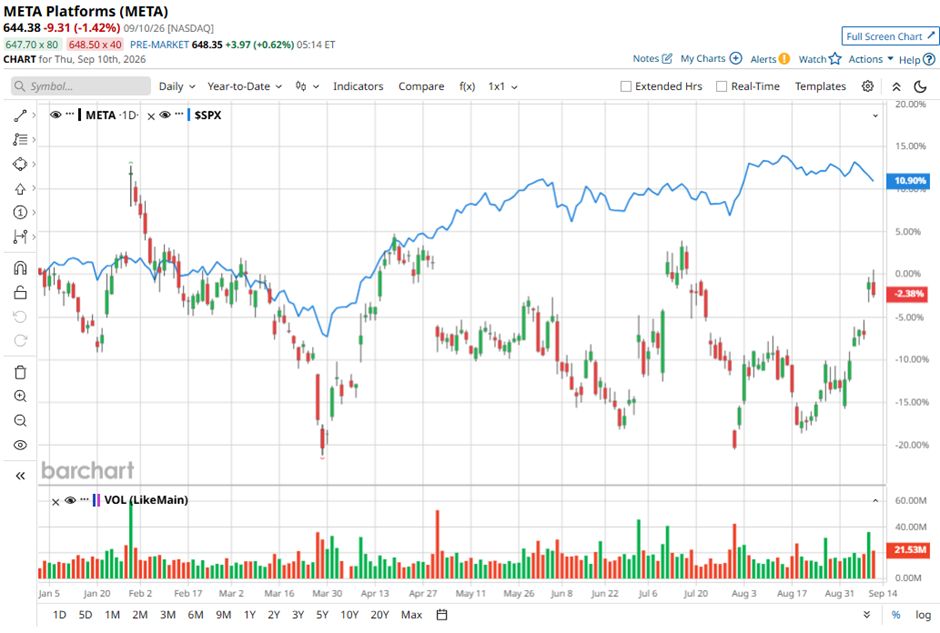
Investors are clearly paying attention. With a market capitalization of about $1.64 trillion, Meta’s stock has jumped nearly 8.7% in just the past five trading sessions and is up 12.9% over the past three months, outperforming the broader market during both periods. But the AI bet comes with a big expectation. Meta now needs to show that its massive AI spending can translate into real returns.
As the company looks to diversify its business and reduce its reliance on digital advertising, Wall Street will be watching closely. And despite its recent momentum, Meta shares remain down roughly 2.4% in 2026, lagging the broader S&P 500 Index ($SPX), which has gained about 11% year-to-date.
 www.barchart.com
 Meta’s Q2 Earnings Snapshot
Meta Platforms’ fiscal 2026 second-quarter results delivered a mixed bag for investors. The company reported earnings on July 29, and while revenue comfortably beat Wall Street expectations, soaring costs and massive AI-related investments weighed on profitability, sending the stock down 8% in the following trading session. In the second quarter, Meta generated $60.80 billion in revenue, up 28% year-over-year (YOY) and ahead of Wall Street’s $60.21 billion forecast.
The strong top-line performance was largely powered by continued demand for digital advertising across Meta’s Family of Apps. The company’s enormous user base also kept growing. Family daily active people (DAP) averaged 3.60 billion in June 2026, up 3% YOY. Meanwhile, ad impressions delivered across the Family of Apps jumped 14%, while the average price per ad rose 12% from a year earlier, underscoring the continued strength of Meta’s advertising engine.
But the picture changed sharply further down the income statement. Total costs and expenses surged 55% YOY to $42.03 billion, putting significant pressure on profitability. The increase was partly driven by $2.4 billion in legal proceeding charges and $1.18 billion in severance costs tied to workforce layoffs. As a result, Meta’s operating margin plunged to 31% from 43% in the year-ago quarter. EPS also came under pressure, landing at $6.18, down 13% from $7.14 in Q2 2025 and below analysts’ $7.10 consensus estimate.
Another major pressure point was Meta’s massive AI and infrastructure spending. Capital expenditures surged to $31.08 billion during the quarter as the company continued pouring money into AI infrastructure and servers. And while operating cash flow remained strong at $31.86 billion, the heavy investment spending left Meta with just $784 million in free cash flow, a dramatic drop from $8.55 billion in the year-ago quarter.
Despite the sharp decline in FCF, Meta ended June 30 with a substantial liquidity cushion. Cash, cash equivalents, and marketable securities totaled $90.26 billion. Looking ahead, Meta expects third-quarter 2026 revenue of $61 billion to $64 billion. The company also raised the lower end of its full-year expense outlook to account for the $2.4 billion in legal proceeding charges recognized during the second quarter.
Meta now expects full-year 2026 total expenses of $165 billion to $169 billion. At the same time, the company is preparing for an enormous AI infrastructure bill. Meta now expects 2026 capital expenditures, including principal payments on finance leases, to reach $130 billion to $145 billion, narrowing the range from its previous outlook of $125 billion to $145 billion.
What Do Analysts Think About Meta Stock?
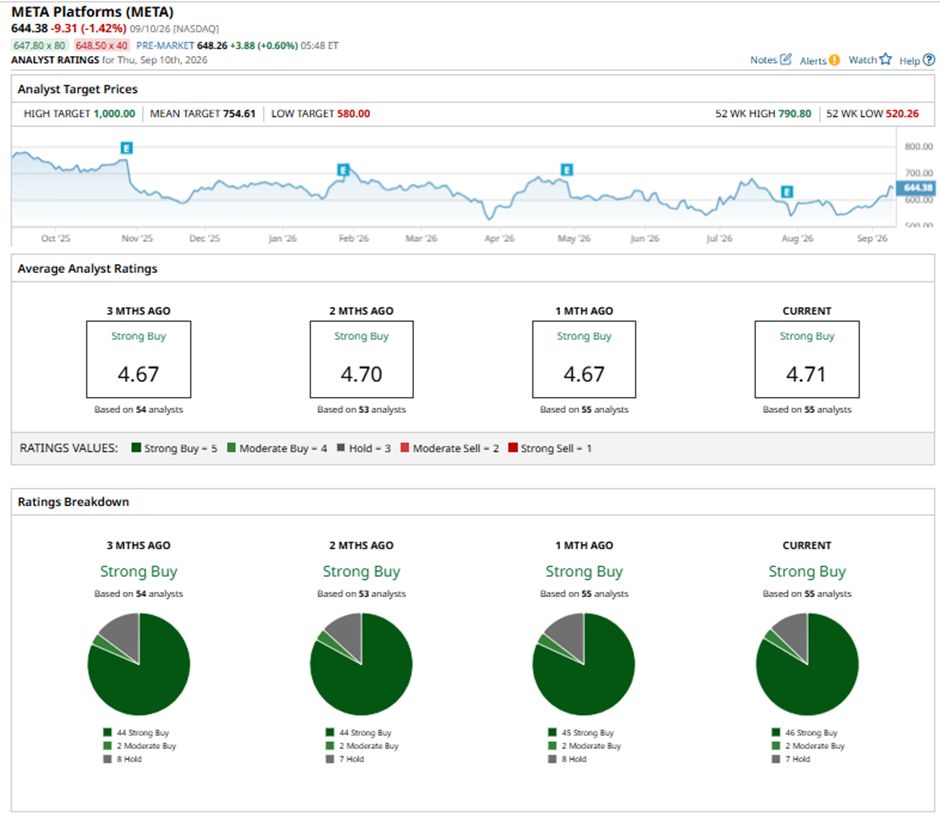
Wall Street is clearly bullish on Meta, with the stock carrying a consensus “Strong Buy” rating. Of the 55 analysts covering the stock, 46 recommend “Strong Buy,” two rate it “Moderate Buy,” and only seven say “Hold.” The average price target of $754.61 points to about 17.1% upside, while the Street-high target of $1,000 signals a potential 55.2% rally from current levels.
 www.barchart.com
 On the date of publication, Anushka Mukherji did not have (either directly or indirectly) positions in any of the securities mentioned in this article. All information and data in this article is solely for informational purposes. For more information please view the Barchart Disclosure Policy here.
More news from Barchart
Why Cathie Wood Is Selling Google and Buying More Meta Platforms Stock Why It’s Time to Buy the Dip in Affirm Stock Rigetti and D-Wave Just Got $100 Million Each. 1 Quantum Stock Has More Upside From Here. Palantir Stock Remains Attractive Even After a 50% Rally in August