


Fintech is entering a very different phase with artificial intelligence (AI). Both Intuit (INTU) and Block (XYZ) are expanding beyond their original products, pushing aggressively into AI, and have multiple ways to increase revenue from their existing user bases.
Only one of these names is built for the next decade, however. Let's take a closer look.
More Top Stocks Daily: Go behind Wall Street’s hottest headlines with Barchart’s Active Investor newsletter.
The Case for Intuit (INTU)
Intuit is a financial software and services platform for consumers and businesses. Basically, it helps people manage taxes and money while helping businesses manage their finances and grow.
 www.barchart.com
 In the fintech race, Intuit has the more mature and predictable financial profile. The company ended fiscal 2026 with revenue growth of 14% and adjusted earnings growth of 20%. Intuit is no longer relying on TurboTax or QuickBooks alone to drive the business. Its three key “Big Bets” — Assisted Tax, Money, and Mid-Market — delivered combined growth of 34% and generated 30% of the company’s fiscal 2026 revenue. Notably, Online Money revenue increased 31%, while Mid-Market revenue rose 39% in the fiscal year. Intuit ended the year with 8.9 million Online paying customers.
The company’s strategy of acquiring a business early, then selling it accounting, payments, payroll, financing, and other services as it grows, seems to be working well. Management stated that businesses already manage $2.7 trillion of invoices through QuickBooks every year, while total online payment volume, including Bill Pay, increased 30% to more than $225 billion for the full fiscal year. In other words, Intuit doesn’t necessarily need massive customer growth if it can just increase the amount of financial activity generated by its various products from each customer.
AI is making this model even stronger. Intuit says millions of customers are already using its “AI-native experiences.” The company helped customers file 39 million tax returns and facilitated more than $120 billion in tax refunds during fiscal 2026. According to management, its AI-powered platform currently accounts for one out of every nine credit card and personal loan originations in the United States.
Financial discipline further strengthens Intuit's case. The company ended the fourth quarter with $7.2 billion in cash and investments against $7.7 billion of debt. It repurchased $5.5 billion of shares for the full year and raised its quarterly dividend by 15% to $1.38 per share.
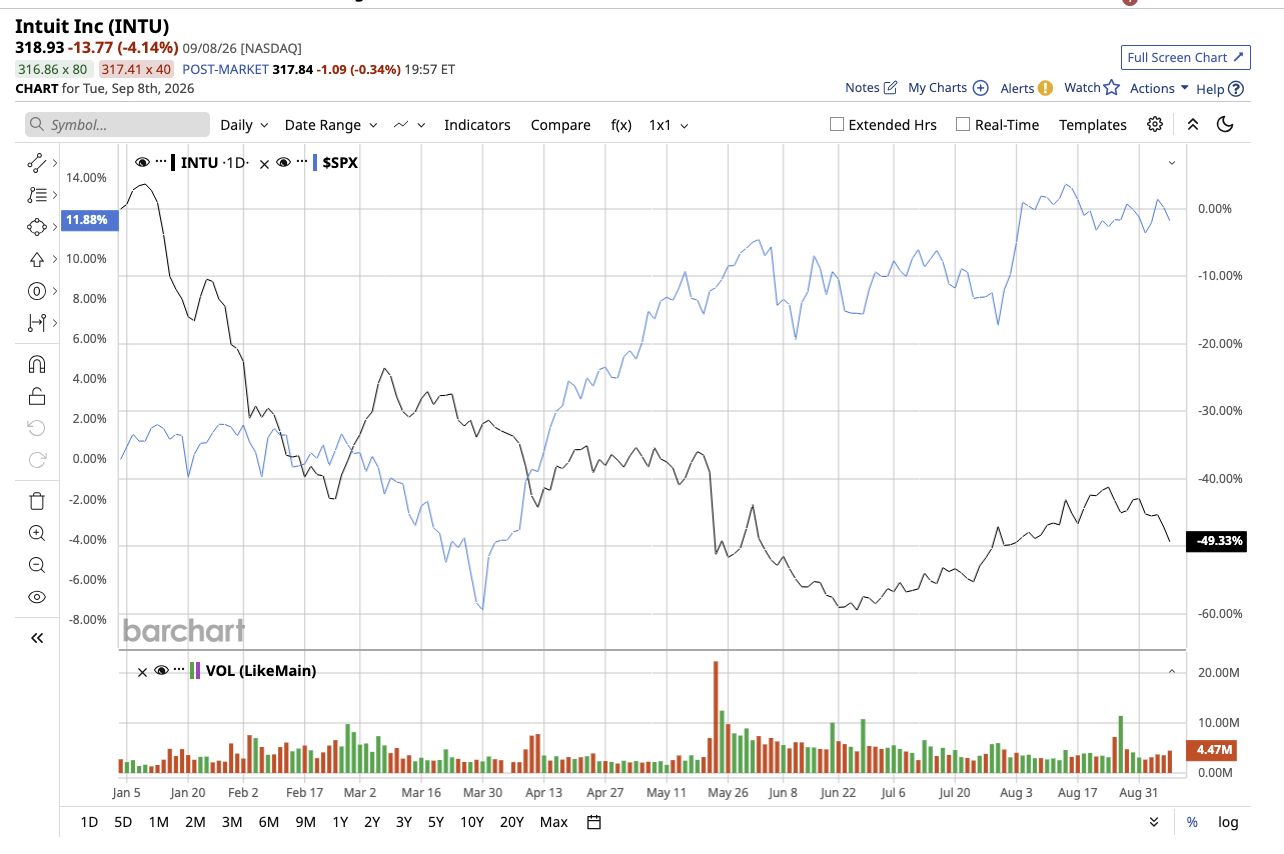
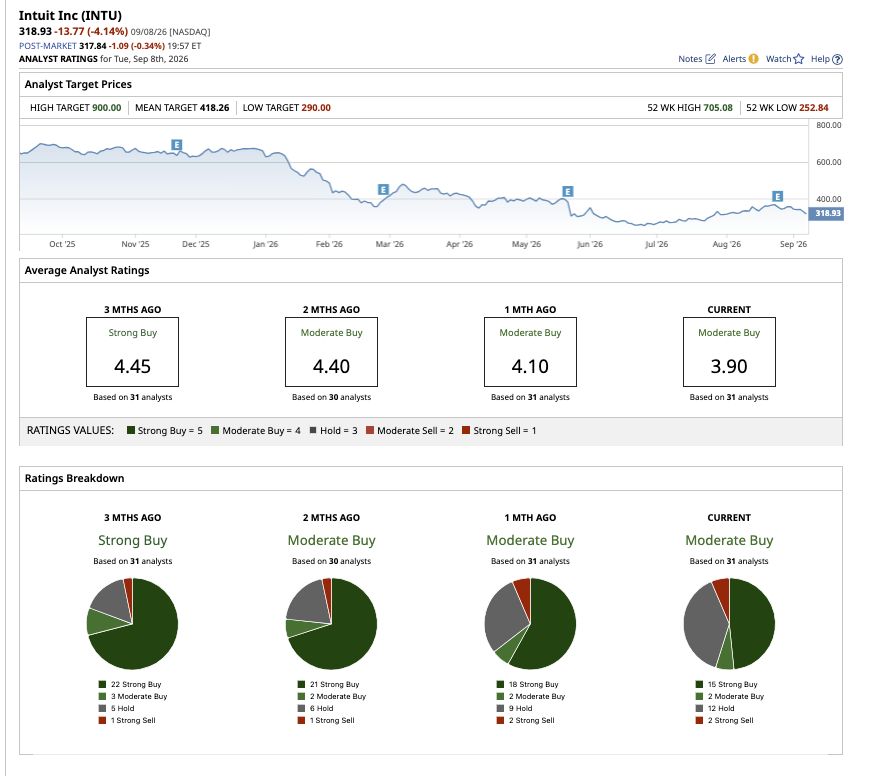
Overall, INTU stock has a consensus “Moderate Buy” rating on Wall Street. Out of the 31 analysts who cover Intuit, 15 have a “Strong Buy,” two have a “Moderate Buy” rating, 12 analysts have a “Hold,” and two have a “Strong Sell.” While the stock is down 51% year-to-date (YTD), analysts forecast potential upside of 29% based on the mean target price of $415.71. Plus, the most bullish estimate of $900 suggests that Intuit stock could rise as much as 180% over the next 12 months.
 www.barchart.com
 The Case for Block (XYZ)
Block helps businesses accept and manage payments and helps consumers move, spend, borrow, and manage money through its Square, Cash, and Afterpay businesses. In Q2 2026, Block’s adjusted earnings grew 65% year-over-year (YOY) to $1.02 per share. Square generated $1.16 billion of gross profit in the quarter, up 13% YOY, while gross payment volume (GPV) increased 13% to $72.8 billion.
Cash App is an even bigger reason to be bullish on XYZ stock. Cash App gross profit increased 31% YOY to $1.97 billion in Q2, far outpacing the growth of its 59 million monthly transacting actives. Furthermore, inflows per active increased 9% YOY to $1,469.
The interesting thing to note is Block is generating more profits from its existing customer base rather than relying solely on adding users. Cash App is gradually moving from being primarily a peer-to-peer payments app toward a broader financial ecosystem consisting of banking, lending, commerce, cards, and other financial products. Management estimates there are more than 100 million "modern earners" in the U.S., giving Cash App a large potential customer base to pursue.
What’s more, the company is also finding additional ways to monetize the ecosystems it has already built. The firm has introduced Neighborhoods, which is designed to connect Square sellers with Cash App consumers rather than treating the two ecosystems as separate businesses. Annualized seller GPV on Neighborhoods surpassed $1 billion in June, up 220% YOY. If Block can convert more of Cash App's consumer network into incremental demand for Square businesses, it will create a difficult-to-replicate cross-platform advantage.
Block is also utilizing AI to develop new banking and commerce products while keeping costs under control. The company expects adjusted EPS to increase by 70% YOY for the full year. The company's balance sheet is also strong. Block ended Q2 2026 with $7.9 billion in cash, cash equivalents, and marketable debt securities. It also had $4.6 billion remaining under its share-repurchase authorization after buying back 11.6 million shares YTD. This allows management the flexibility to continue returning cash while also investing in Square, Cash App, and other businesses.
Compared to Intuit, Block has a less mature story, but that is exactly what makes the long-term upside more compelling.
 www.barchart.com
 Which Is the Better Fintech Stock for the Next Decade?
Intuit has the better business today with a mature ecosystem and recurring software business. However, Block has more ways for growth initiatives to compound over the next decade with Square, Cash App, lending, banking, Neighborhoods, hardware, and AI. The next decade may ultimately favor both, but Block could have the better fintech advantage for investors willing to handle the short-term risk for long-term upside.
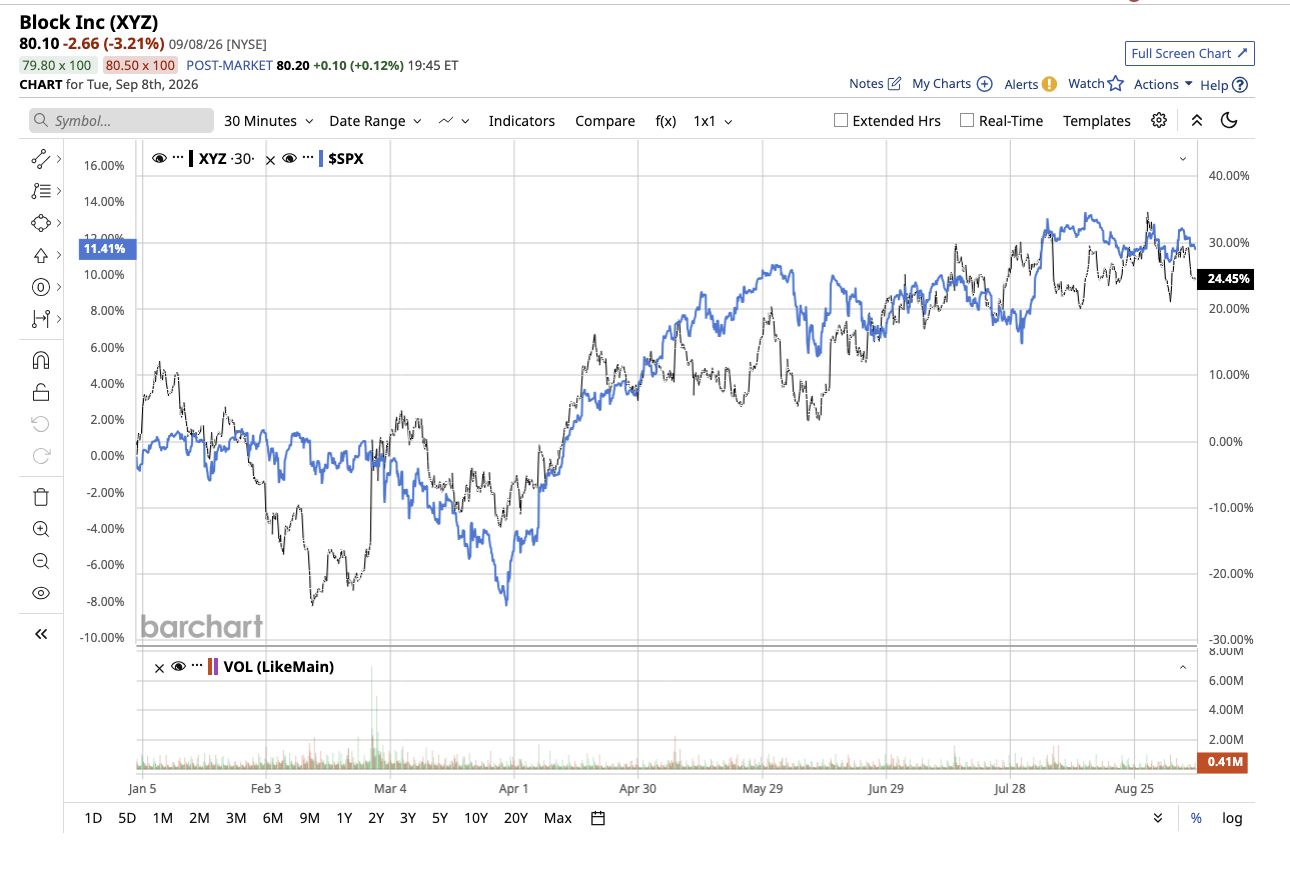
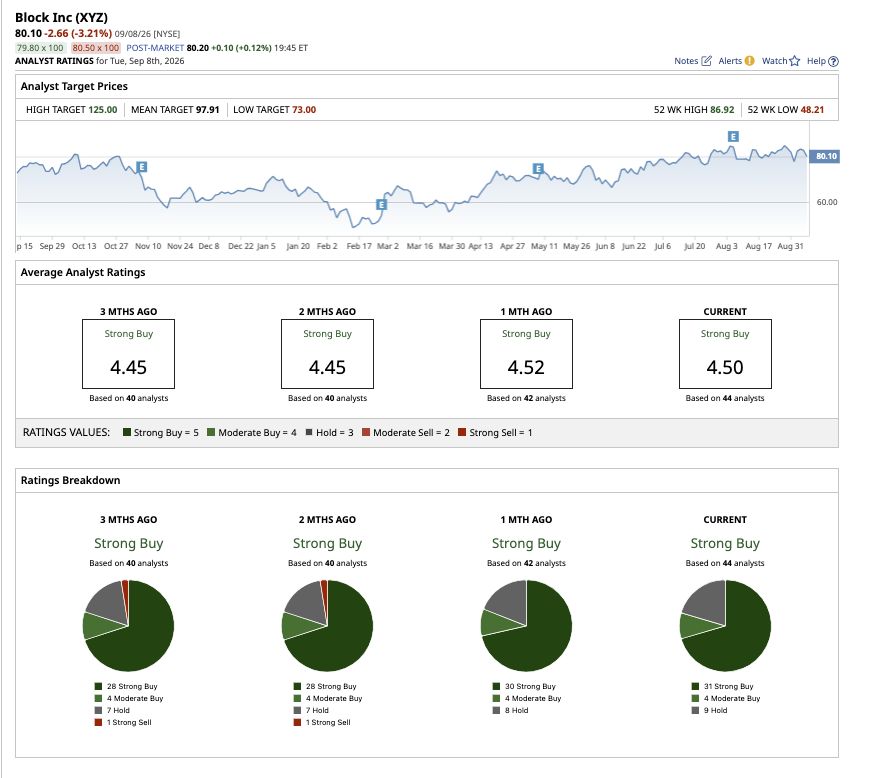
On Wall Street, XYZ stock has a consensus “Strong Buy” rating overall. Out of the 44 analysts covering Block stock, 32 have a “Strong Buy” rating, four have a “Moderate Buy,” and eight have a "Hold” rating. The average price target of $97.79 implies potential upside of 23% from current levels, while the Street-high price target of $125 suggests potential upside of 58% from here.
 www.barchart.com
 On the date of publication, Sushree Mohanty did not have (either directly or indirectly) positions in any of the securities mentioned in this article. All information and data in this article is solely for informational purposes. For more information please view the Barchart Disclosure Policy here.
More news from Barchart
Intuit vs. Block: 1 Fintech Stock Is Built for the Next Decade Goldman Sachs Is Bullish. Here Are 3 Reasons AFRM Stock Could Climb 69%. Dear Bloom Energy Stock Fans, Mark Your Calendars for September 21 Why Cathie Wood Is Selling Google and Buying More Meta Platforms Stock