

In the first quarter of 2026, the US economy grew at a 2.1% annualized rate. That number alone made it look like the economy is on a positive track.
On September 16, the Federal Reserve raised interest rates for the first time since 2023, a quarter-point hike to a range between 3.75% and 4%. The vote was unanimous, and officials penciled in one more hike before year's end. Chairman Kevin Warsh didn't mention AI spending once in his press conference and he didn't need to. Nearly every dollar hyperscalers have poured into data centers over the past three years was borrowed, invested, or justified against a backdrop of cheap money. The market environment is now completely different.
Join 200K+ Subscribers: Find out why the midday Barchart Brief newsletter is a must-read for thousands daily.
But when we peek under the hood, things… change. According to the third and final estimate from the Bureau of Economic Analysis (BEA), AI-related data center and software investment accounted for roughly three-quarters of that growth. Meanwhile, consumer spending - what most people call the real metric for economic health - contributed less than a fifth.
So if we strip out AI spending, that modest economic growth starts to look more like a stalled car on the side of the highway.
Now, to be clear, this isn’t going to be a discussion about whether AI stocks are expensive. I’ve already covered that in a previous article right here.
No, this is a story about accounting, growth, and whether massive spending by AI companies and hyperscalers on data center infrastructure will translate into real, sustainable growth.
Because if not, we may be looking at inflated headline numbers that belie a fractured economy on the brink of a crash.
And so, onto the pertinent question: are we in an AI spending bubble… and is it about to burst?
The Fed's decision this week didn't answer that question. But it did start the clock. And the clock starts exactly where the money already moves in a loop.
What Is Circular AI Financing? Nvidia, OpenAI, and Oracle Explained
Let's start with where the money actually moves, because that's what a rate hike really touches.
The core concern is the alleged circularity of all this AI spending, with ballpark estimates putting the value at around $1 trillion to $1.5 trillion of interlocking commitments.
I'm sure you've heard of this by now, but on the off chance that you haven't, here's a quick rundown.
Nvidia (NVDA) invests $30 billion in OpenAI. OpenAI uses some of that money to buy compute power from Oracle (ORCL). To meet that compute demand, Oracle uses that money to buy chips from - you guessed it - Nvidia.
The dollars leave Nvidia's balance sheet as "investment" and return to its income statement as "revenue," and by the time the loop completes, it's genuinely hard to say who actually paid for what.
Repeat that across several key AI players, and we have a web.
Here’s a visual breakdown of this web of deals among AI chip makers and hyperscalers.
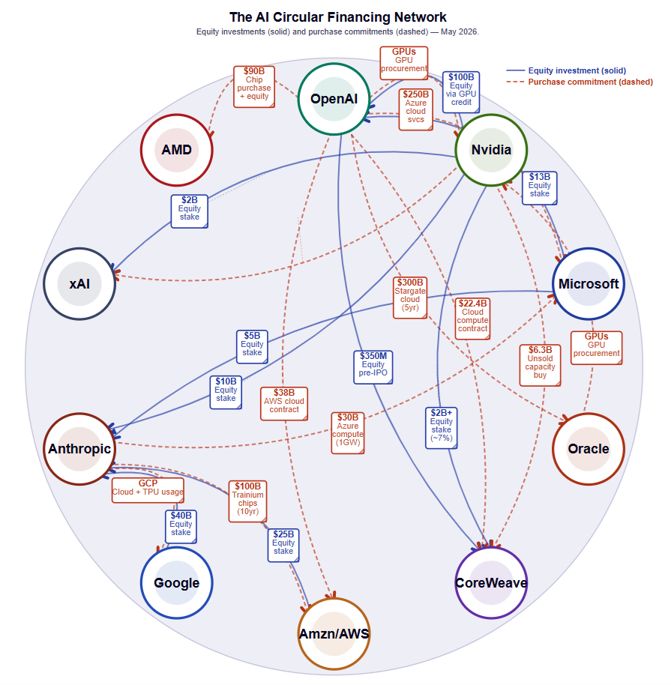 Screenshot courtesy of www.idc.com
 Now, to be clear, the companies in this alleged spending “circle” aren’t disputing that those kinds of deals exist. Otherwise, the SEC would be on their collective behinds like white on rice.
The main issue is that some experts claim the entire revenue streams of many companies in this circle are “self-referential” - meaning the money essentially flows from one AI company to the other, with no other demands existing outside the circle.
At least, that’s what famed “The Big Short” investor Michael Burry says in his critique of Nvidia’s Q2 FY’27 financials.
Of course, Burry is known for his bearish stance on, well, almost anything. But this time he’s not alone; the General Manager of the Bank for International Settlements (BIS) echoed that same sentiment in a speech earlier this month.
“At the same time,” Pablo Hernández de Cos said, “the capital expenditure of the largest firms is now outpacing their cash flows, prompting a growing reliance on debt and, increasingly, on private credit.”
He then went on to call that brand of financing “opaque and interconnected.”
“Under so-called circular financing,” he continued, “chip manufacturers and hyperscalers take equity stakes in AI firms, which in turn commit to purchasing their chips and compute, linking these players in ways that are difficult to observe and, at times, difficult to value.”
Interestingly, Nvidia somewhat addressed the claims in its Q2 FY’27 earnings call, in reference to its support of OpenAI’s infrastructure buildout.
CFO Colette Kress says, “We recognize the scale of this support, and we know some will call this circular financing. We see it differently. We're going through a major computing platform shift, the creation of one of the most important technologies in human history, and these are once-in-a-generation companies.”
Rather vague, really, but the gist of it is - Nvidia is reframing the transaction, not refuting it. The money moves in a loop, yes, but the loop is justified because the opportunity is JUST. THAT. BIG.
But is it really?
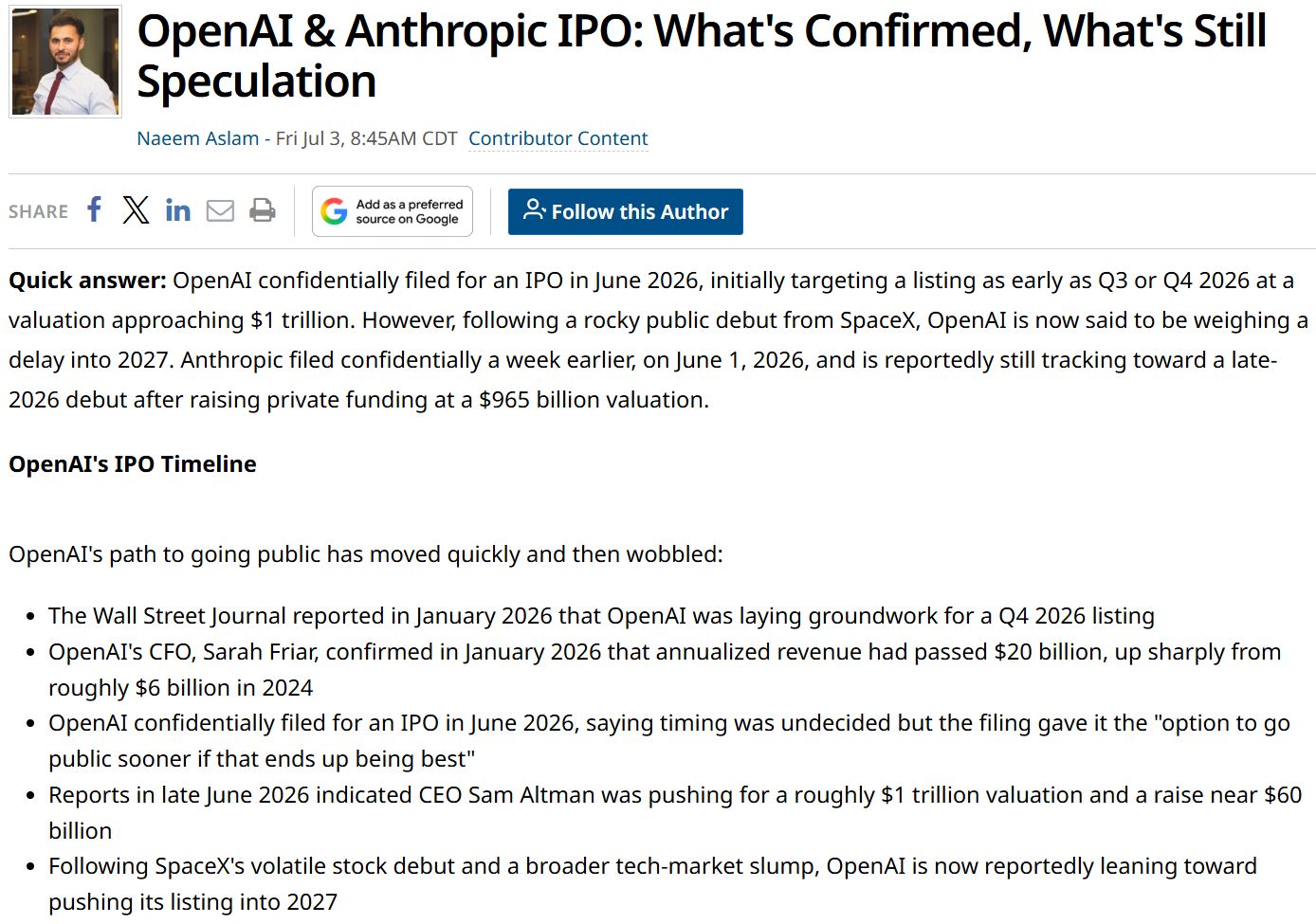
After the fiasco when SpaceX (SPCX) went public, OpenAI pushed back its expected IPO to 2027.
 Screenshot courtesy of www.barchart.com
 Since we don’t yet have fully transparent access to OpenAI's financials, we’ll have to rely on estimates and potential leaks.
Some sources claim that its Q2 2026 revenue is $6.7 billion, a decent 18% jump from Q1’s $5.7 billion.
That is objectively a strong number. If we extrapolate that 18% quarter-to-quarter growth, we get $29.6 billion in annual revenue.
But the same source puts OpenAI’s Q2 operating loss at $12.3 billion, up 32% from $9.3 billion last quarter. That’s a -184% operating margin right there - clear evidence that the trendline is moving in the wrong direction.
And all of this is from the pioneer - the company that’s supposed to be sitting at the beating heart of the AI loop.
That means every dollar of "circular" revenue that Nvidia, Oracle, and even Microsoft (MSFT) are booking from OpenAI is a dollar OpenAI is currently losing money to pay.
To be fair, expanding operational losses happen to infrastructure-heavy companies in their early years. But it does mean the whole financing cycle depends on OpenAI raising money faster than its losses grow, especially now that its IPO has been pushed back to 2027.
Even worse, OpenAI is not an outlier here.
Anthropic, xAI, and other well-funded startups with their own frontier models are running similarly steep cash burn rates - perhaps a bit smaller in absolute scale, but steep regardless. The entire foundation-model layer of this industry is mostly unprofitable, and that's before accounting for the hyperscalers' own AI-specific capex, which shows up on their books as investment rather than loss but still needs to eventually generate a return.
That's what should worry anyone holding a diversified portfolio, even one with zero direct AI exposure. Microsoft, Alphabet, Amazon, and Meta alone now make up roughly 17% of the S&P 500's ($SPX) total market capitalization.
Add Nvidia and Broadcom (AVGO), and you're looking at roughly 28% of the index concentrated in six companies making major, overlapping bets on the same underlying technology. And when retirement accounts and index-based ETFs are this concentrated in a single narrative, ordinary investors no longer have the diversification they think they're paying for.
Credit markets also carry their own version of this exposure. As mentioned, capex is increasingly funded through debt and private credit rather than free cash flow, and much of that debt sits inside special purpose vehicles (SPVs) that keep it off the parent company's balance sheet.
If AI revenue growth skids to a stop, the entities holding that debt will absorb the sudden shock, and many of them are institutions that many ordinary people depend on for their finances.
How Much Are AI Companies Really Spending on Data Centers in 2026?
Before we get into how big the spending circle actually is, it helps to see the raw scale of what everyone is spending. So, let’s take a look at the quarterly and projected annual capex of the top four AI companies in the world:
| Company | Latest Quarter Capex | 2026 Capex Guidance/Expectations |
| Amazon (AMZN) | $54.2B (+69% YoY) | ~$220B |
| Alphabet (GOOGL) | $44.9B (+100% YoY) | $195–205B |
| Microsoft (MSFT) | $41B (+69% YoY) | ~$175B |
| Meta (META) | $31.08B (+83% YoY) | $130–145B |
| Total | $171.18B | $720–745B |
To put this into perspective, Sweden's 2026 gross domestic product (GDP) is $760 billion.
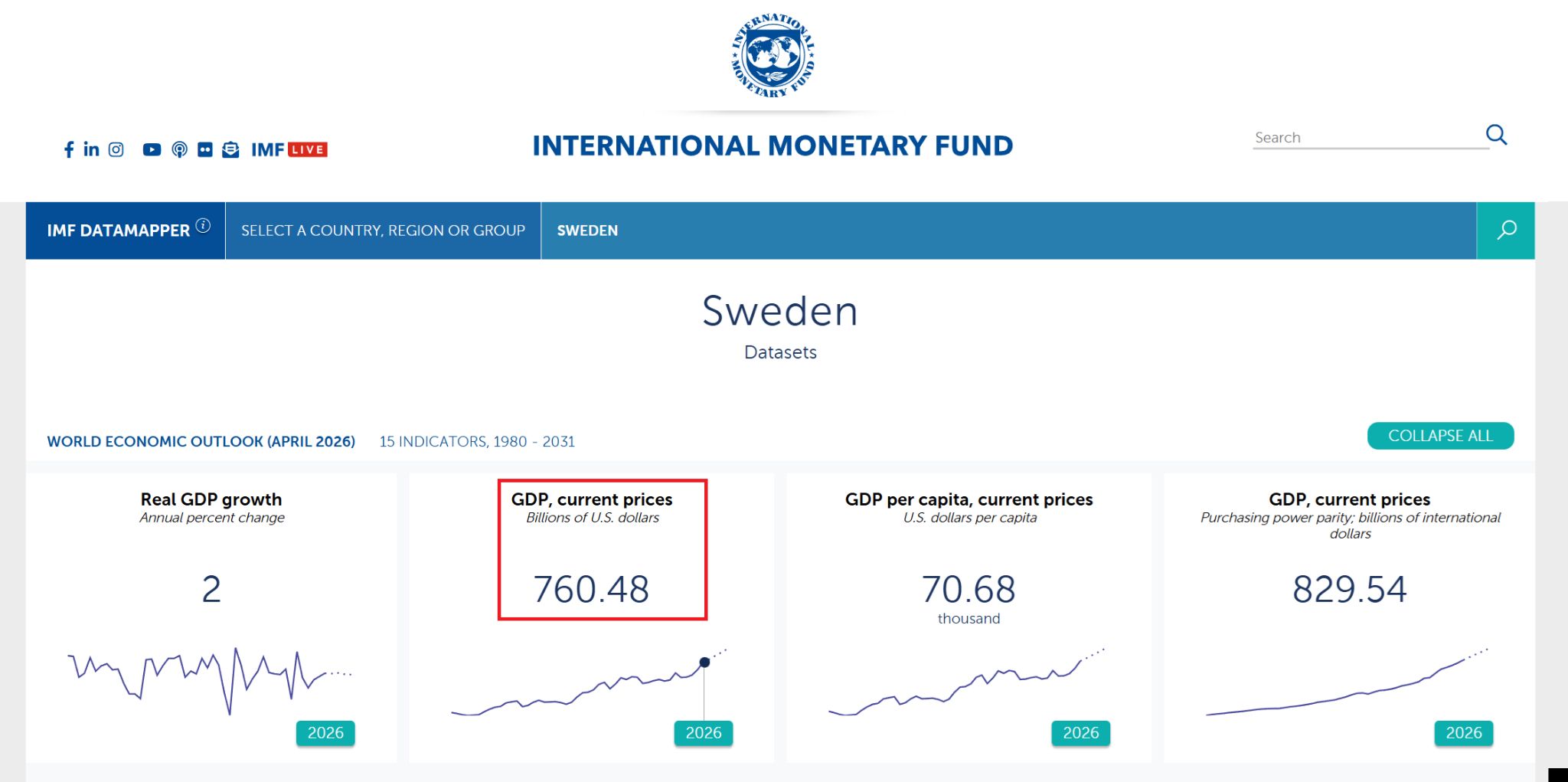 Screenshot courtesy of www.imf.com
 Meanwhile, Belgium's GDP is $777 billion.
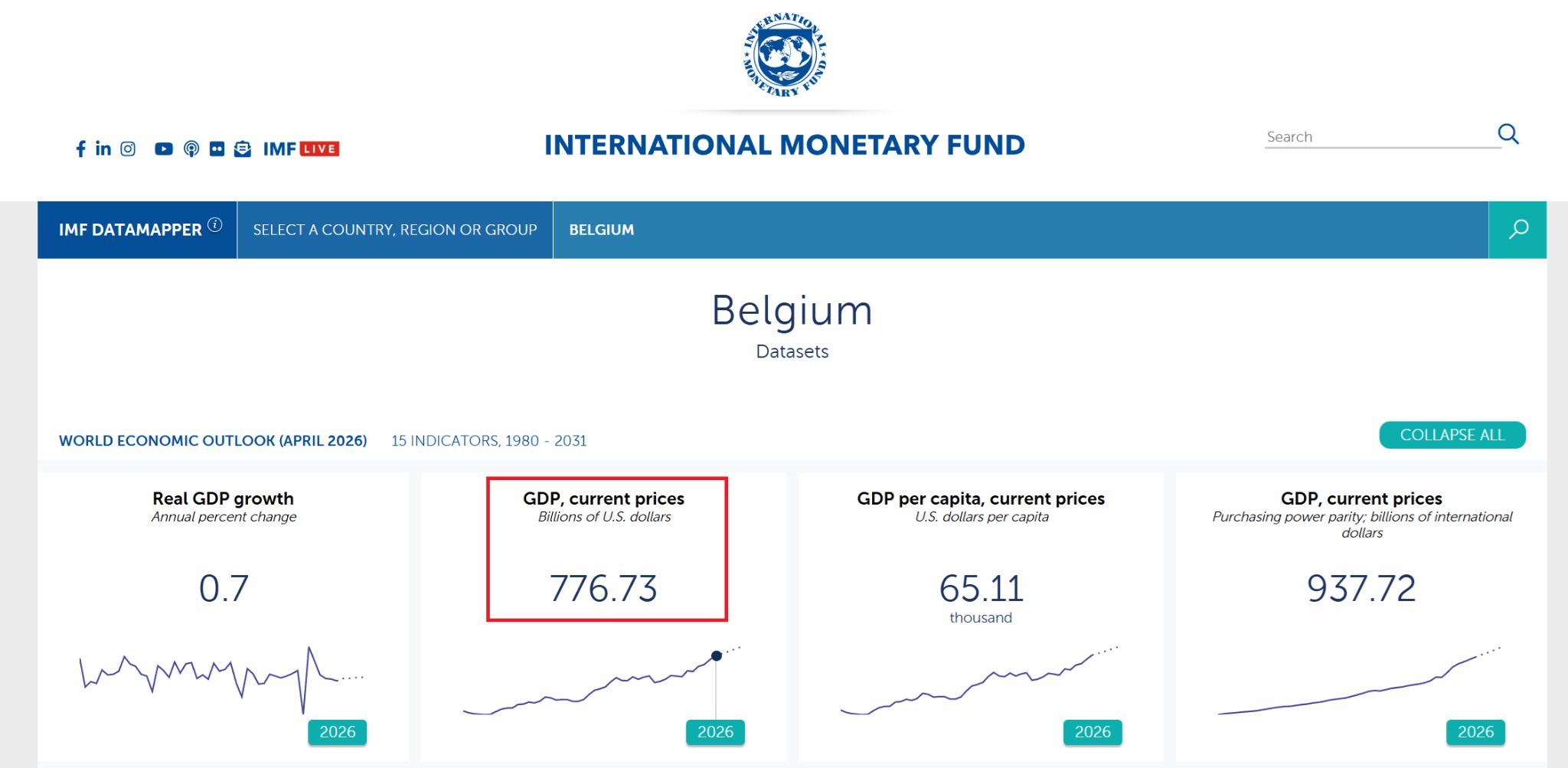 Screenshot courtesy of www.imf.com
 That means projected capex from just these four companies for 2026 is now only a handful of billions away from the entire annual economic output of some top world economies.
And you know what? By many estimates, AI spending will keep accelerating.
Some experts put spending at as much as $31.6 trillion by 2050.
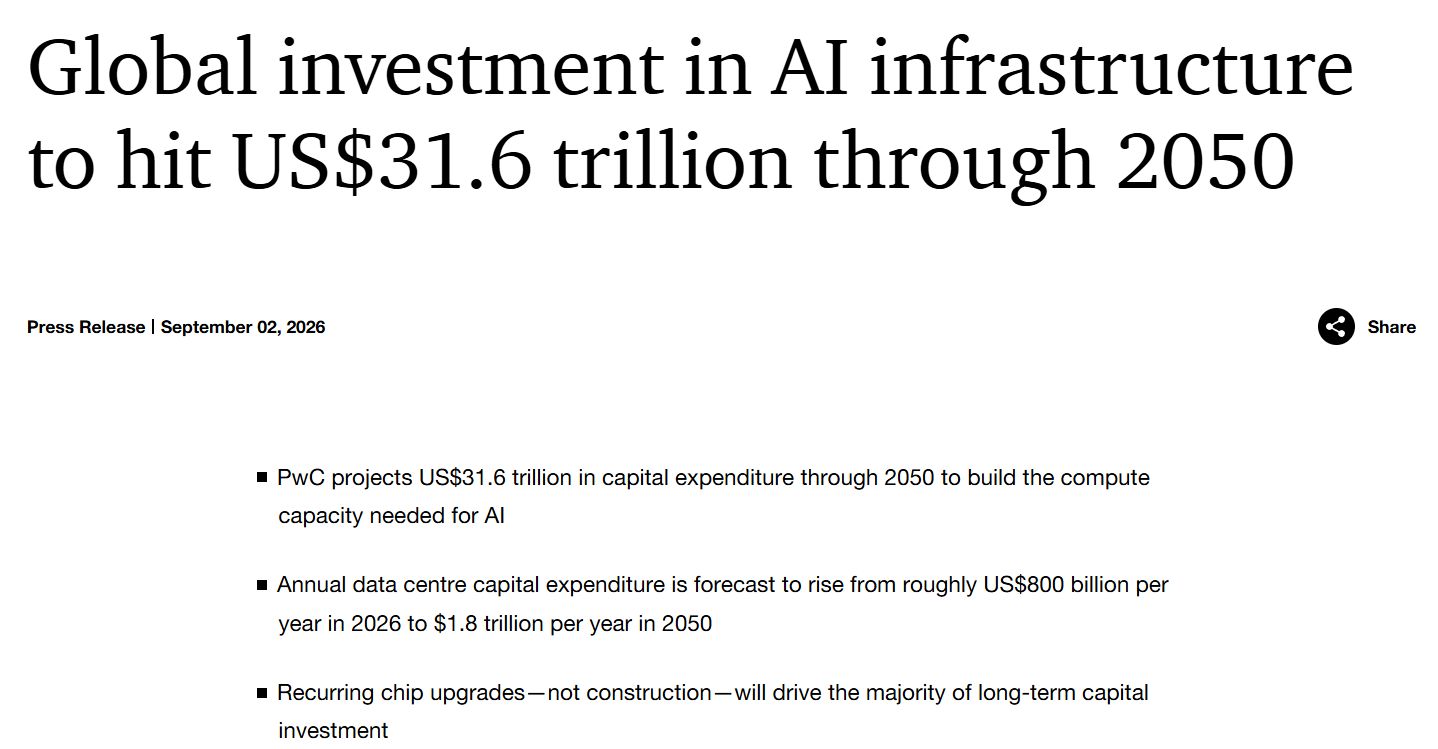 Screenshot courtesy of www.pwc.com
 That said, it doesn't mean companies will be building $31 trillion worth of data center facilities. Most of the spending is expected to happen during silicon upgrade cycles, which is essentially the AI industry equivalent of upgrading your PC parts every generation to keep up with the latest hardware.
But still, spending is spending, and with $31 trillion equating to roughly a full year of U.S. economic output, it’s not exactly a cheap bill to foot - even spread across two and a half decades.
Of course, the institutions that exist to worry about exactly this kind of risk are, understandably, worried. BIS - essentially the central bank of all central banks of the world - compared the AI investment boom to several high-profile technological and financial revolutions in history during that aforementioned speech.
“History offers some instructive parallels here,” said Hernández de Cos. “The canal mania of the 1830s, the British railway mania of the 1840s, the electrification boom of the 1920s and the dotcom surge of the late 1990s were all based on important technological breakthroughs.”
Now, if you’re a keen student of finance history, you’ll notice that all four examples didn’t exactly end with your typical “happily ever after.”
Instead, all four revolutions resulted in massive capital spending that, unfortunately, was never justified, and the resulting crashes and damage rippled across decades. We’re talking market drops that wipe out trillions in the space of a month, promising businesses erased from the face of the earth, and entire industries left crippled for years to come.
Is There Real Demand for AI, or Just Hyperscaler Spending?
But a more basic question sits underneath all of this, and the spending numbers alone can't answer it: who's actually buying? I mean, outside of the hyperscalers, of course, which I already broke down above.
Surveys often cite enterprise adoption of AI tools as the real source of demand, but they measure intent and pilot programs, not necessarily revenue-generating production deployments.
Some company running a proof-of-concept for using chatbots in the workplace is not the same as a firm completely overhauling their workflow around AI tools. In physics terms, one is stuck in potential energy, and the other is already kinetic.
There's also the issue of training and inference. Hyperscalers are justifying their massive spending plans to cover the costs of training larger and larger models. But once those models are trained… is there any proof they will actually get used?
Well, that’s the entire AI spending cycle bet right now - use current demand as hope for future projected usage.
But until actual usage catches up with capacity, the entire buildout is based on an assumption, not proven demand.
AI Data Center Power Demand and Rising Electricity Bills
Power is another problem for the spending circle. Data centers need enormous amounts of power, more than the "old" grid was ever meant to handle. And in some places, waiting lists for data center interconnections now stretch into years. New capacity can't be built fast enough to keep up with demand.
According to the Institute of Electrical and Electronics Engineers (IEEE), a single GB200 AI server rack can consume as much power as 100 U.S. homes. Scale that to a campus like Meta's planned 5-gigawatt Hyperion, and you're talking about a single site drawing what 4.2 million homes use.
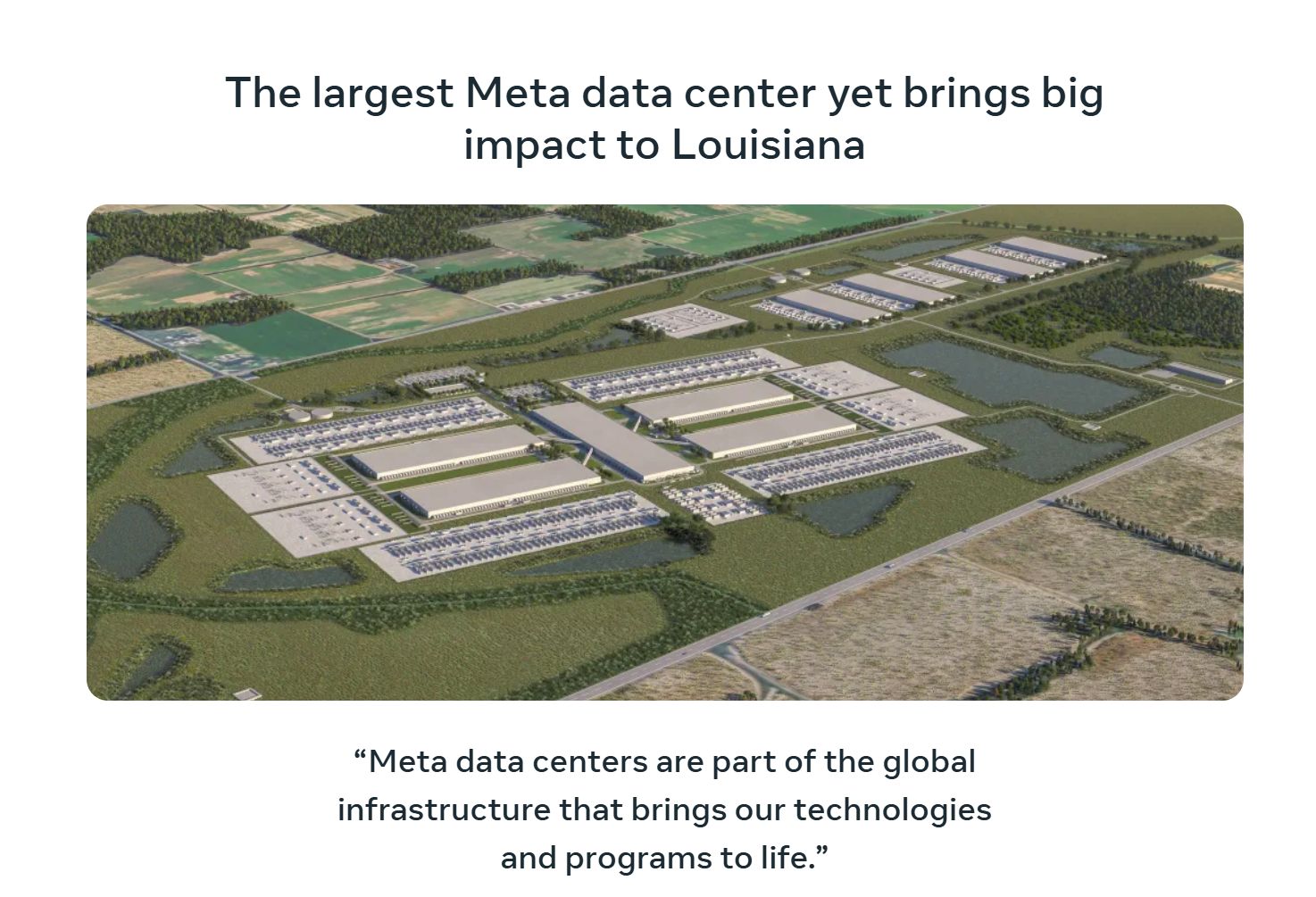 Screenshot courtesy of www.datacenters.atmeta.com
 Logically, utilities are beefing up infrastructure to meet that demand. That includes power plants, transmission lines, and substations. As long as the data center shows up, all that spending makes sense.
But what if the data center gets delayed or downsized? Heck, what if the facility gets canceled altogether?
The money is already spent. And residential demand can't absorb the slack. Household electricity use grows at roughly 1% a year, so no county is going to conjure a few hundred thousand new homes out of thin air to take up a stranded gigawatt of unused power.
And you know the worst part of all this is? No utility company in their right mind would stand still and take that damage alone.
Regulated utilities earn a return on their rate base, meaning approved capital spending gets recovered from customers over decades whether or not the anticipated load ever materializes.
So if the AI trade falls apart, shareholders take the hit on the GPUs. But the transmission lines are already built into electricity rates, amortized over 30 years.
And who shoulders that?
Ordinary ratepayers, of course.
How GPU Depreciation Inflates Profits
Another valid concern about AI spending is depreciation and how data center hardware is calculated.
Several major hyperscalers have extended the estimated useful lives assigned to servers and networking equipment in recent years, with many of those estimates now around five to six years.
Sounds like a routine adjustment, right?
Well, not when you consider the implications. With that arrangement, the cost of that hardware is spread thinner across each reporting period, and less of that expense hits the quarterly income statement.
Translation? Profits look healthier than under the old, shorter depreciation schedules, even though the actual hardware’s lifespan hasn’t really changed.
From a purely accounting perspective, that’s perfectly… well, let’s just say “legal.”
But think about it: when the GPU bites the dust, or gets outclassed by the next release, or becomes obsolete because of new computational requirements, do you think it consults an accountant first to find the most convenient time to exit the books?
Companies are still on the hook for hardware costs, even if the hardware becomes useless before the depreciation schedule says it should.
That gap between economic reality and accounting reality doesn't vanish. It just gets deferred, quarter after quarter, until something forces it into the open.
This is, perhaps, the more precise version of the circular financing argument Michael Burry made earlier against Nvidia. Media and internet coverage tend to oversimplify financial topics to serve click-worthy headlines. It might sound like he’s saying that the web of deals across AI players is a complete sham, but if this is his actual argument, then, frankly, it becomes much harder to ignore.
In essence, the accounting conventions used to depreciate hardware across this group of companies are too generous, and that generosity is doing a lot of the work in making earnings look as strong as they currently do.
The Case for the AI Boom
Now, to balance out the discussion, let’s cover the positives.
First, the BIS September 2026 speech wasn’t a complete doom-and-gloom piece.
Hernández highlighted the real, measured improvements in productivity and efficiency driven by AI adoption. That’s not hard economic data, sure, but it’s still “compelling” empirical evidence that AI is already delivering tangible benefits in the real economy. Macro numbers on productivity growth are also rising.
Meanwhile, the general fear that AI will replace workers has, largely, not yet materialized. However, the report explicitly said firms are in “wait-and-see mode,” meaning that they are still undecided about using AI to replace their active workforce.
But let’s get back to spending for a moment. As I mentioned earlier, AI spending can account for a majority of recent US GDP growth. Ergo, the data center buildout is still economically positive.
One of the clearest pieces of evidence outside the US is Taiwan, where the country’s Directorate General of Budget, Accounting and Statistics (DGBAS) has revised its 2026 economic growth forecast from 9.64% to 11.05%. This shift is largely due to chip demand and companies like Taiwan Semiconductor (TSM), a key player in the AI boom.
With that in mind, let’s revisit the four examples I used earlier and reframe them in a more positive, yet still accurate, light.
The canal craze in the 1830s accelerated migration and helped reshape population centers as we know them.
The British railway craze a decade later left behind tracks that the country would then use for the next century.
The electrification boom of the 1920s was the springboard for many technological advancements in the coming century.
Lastly, the dot-com bubble helped lay the foundations for the internet economy we know today, even though it wiped out many of the companies that fueled the frenzy. Call it natural selection before the World Wide Web really took over.
Will the AI Bubble Burst? 4 Signals to Watch
So where does that leave us?
Well, certainly not with a crystal-clear prediction. Anyone claiming to know exactly when or if this AI spending bubble pops is likely selling something.
But there are signals that you and I can watch out for that might spell a change in the status quo.
And as of this week, the first one has already flashed. On September 16, the Fed delivered its first rate hike since 2023, with another one already penciled in before year-end. As mentioned earlier, hyperscaler capex increasingly runs on debt and private credit rather than free cash flow. A tighter rate environment doesn't just make that debt more expensive; it does so at the exact moment free cash flow at the biggest spenders is projected to go negative. That's not a signal to watch for anymore. That's a signal that already went off.
Of course, depreciation schedules should be on your watchlist. If hyperscalers return GPU lifespans to their original periods, or write down older GPUs, then that's a good sign that the return on investment is starting to show up in the income statements. If not, then that just means they're still padding up their balance sheets.
I'd also want to watch for further developments in the OpenAI/Anthropic funding story. Right now, their IPOs are set for 2027 and October 2026, respectively. I'm particularly interested in whether the companies will need more funding than they've already said. Needing more money to burn just means the business still doesn't make sense.
Lastly, I'd track AI enterprise usage numbers. Again, the whole narrative, the entire basis for all this spending, stems from the belief that existing companies will be driving AI compute demand through the roof. If early numbers are showing slumps, then it might be time to pull back on the enthusiasm.
At the end of the day, we still need to wait for this massive AI spending bet to be validated. But the Fed just made that wait more expensive, and that's a warning sign worth watching closely.
On the date of publication, Rick Orford had a position in: MSFT , AMZN , META , GOOGL . All information and data in this article is solely for informational purposes. For more information please view the Barchart Disclosure Policy here.
More news from Barchart
Nvidia, OpenAI, and Oracle's $745B Financing Circle Just Hit Its First Stress Test: A Fed Rate Hike Why Now Could Be the Time to Buy Western Digital Stock Ciena Stock Could Double on the Next AI Spending Wave. Here’s How to Play CIEN. The Strange Reason for Arm’s Stock Drop: The Market May Be Punishing It Unfairly