

General Motors Company (GM), headquartered in Detroit, Michigan, traces its roots back to 1908 and remains one of the largest automakers on the planet. The company builds and sells a broad lineup of trucks, SUVs, crossovers, and passenger vehicles across its iconic brand portfolio, including Chevrolet, GMC, Cadillac, and Buick. Under CEO Mary Barra, GM has been executing a disciplined turnaround strategy built around three pillars: maximizing pricing power in full-size trucks and SUVs, growing high-margin software and OnStar Digital subscription revenue, and diversifying into new frontiers such as battery technology and defense contracting. GM Financial and a network of international joint ventures round out the company's diversified global footprint.
Pulling Back From Record Highs but Still Outperforming Its Sector
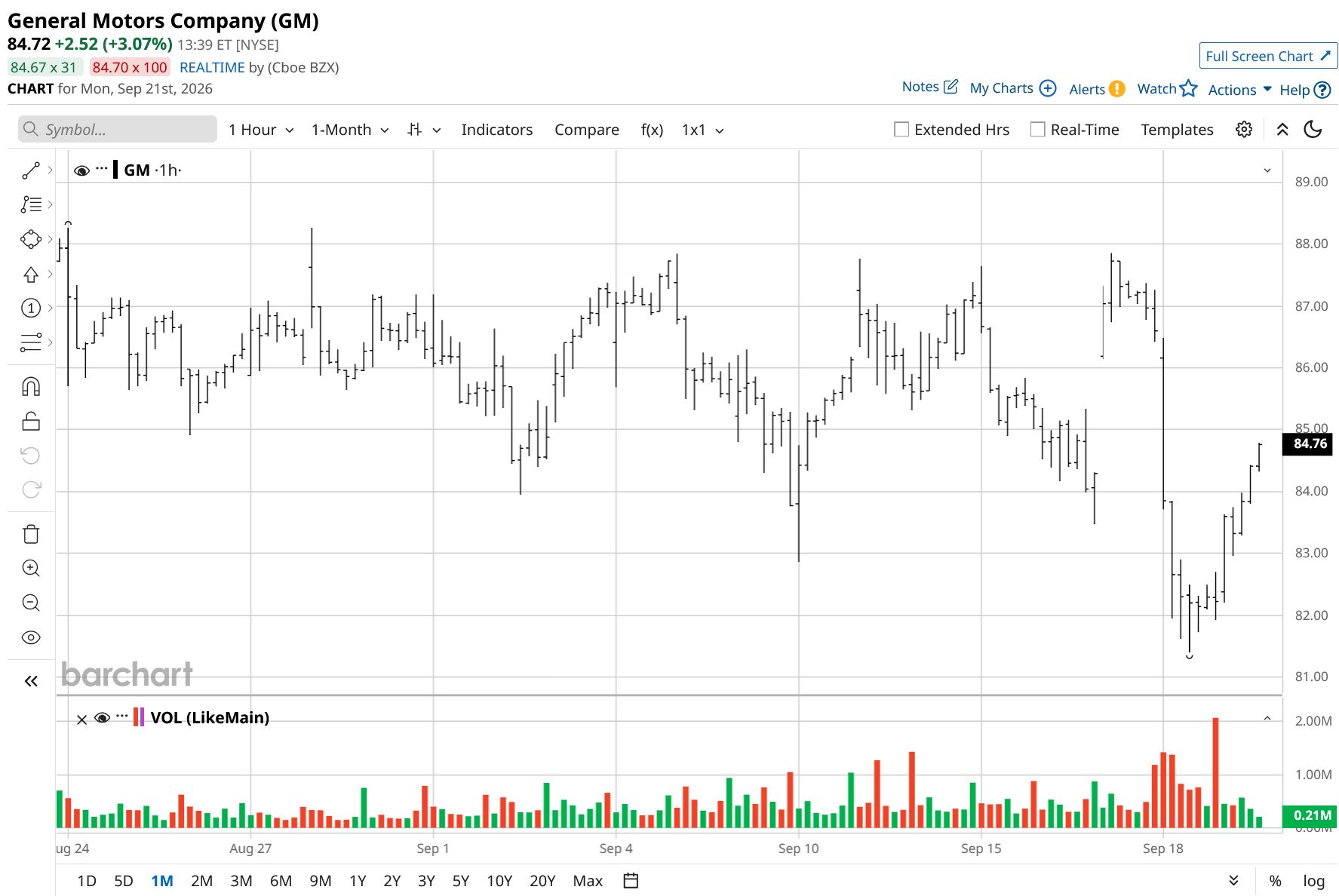
GM shares recently traded in the $85–$88 range, comfortably above their 52-week low of $54.33 but below the 52-week and all-time high of $91.85 reached in late July. The modest pullback followed management commentary warning of softer sales and flagging 2027 as a potential “flat spot” in GM's electric vehicle transition. Shares also popped 4% on news that GM is entering the missile manufacturing business, adding an unexpected new leg to its diversification strategy.
More Top Stocks Daily: Go behind Wall Street’s hottest headlines with Barchart’s Active Investor newsletter.
Context matters here: the S&P 500 Consumer Discretionary sector has been the weakest-performing sector in the broader market in 2026, down roughly 3% year-to-date (YTD) through mid-September. Against that sluggish backdrop, GM's stock has significantly outperformed its sector, suggesting investors are rewarding the company's pricing discipline, margin expansion, and push into new revenue streams even as consumer discretionary spending broadly struggles.
 www.barchart.com
 Another Earnings Beat but GAAP Profit Slides
General Motors posted second-quarter 2026 revenue of $48.0 billion, up 1.9% year-over-year (YoY) and ahead of the $47.01 billion analyst consensus. Adjusted diluted earnings per share came in at $3.57, beating Wall Street's $3.29 estimate by 8.5% and marking GM's fourth straight quarterly earnings beat. However, GAAP diluted EPS told a less flattering story, falling 26% YoY to $1.41, weighed down by one-time charges tied to the company's EV strategic realignment and ongoing restructuring efforts in China.
Net income attributable to shareholders declined 31.1% to $1.3 billion, even as adjusted EBIT surged 29.8% to $3.94 billion, pushing the adjusted EBIT margin up to 8.2% from 6.4% a year earlier. GM North America was the clear standout performer, posting a 42.7% jump in adjusted EBIT to $3.4 billion on the strength of robust full-size truck and SUV demand. Adjusted automotive free cash flow more than doubled to $5.0 billion, underscoring the underlying cash-generating power of the core business.
Looking ahead, management raised full-year 2026 adjusted EBIT guidance to a range of $14–$16 billion, alongside adjusted EPS guidance of $12 to $14. GM also lifted its adjusted automotive free cash flow outlook to $9.5–$11.5 billion. CFO Paul Jacobson has since cautioned that 2027 could represent a “flat spot” in GM's EV rollout, even as the company presses forward on new growth avenues, including battery development and its recently announced, headline-grabbing entry into missile manufacturing.
GM Enters the Missile Business
After securing a contract for a militarized version of its Chevy Colorado ZR2 to the U.S. Army, a contract that could potentially reward $1 billion, General Motors has now stepped further into defense manufacturing. GM delivered its first batch of missile-housing components for Lockheed Martin's (LMT) PAC-3 MSE Patriot interceptors in August, according to Lockheed. The move expands GM's growing defense unit as the Pentagon leans on automakers to help rebuild munitions stockpiles depleted by wars in Ukraine and the Middle East. Lockheed noted GM produced the components, typically a months-long process, in just three weeks, highlighting the automaker's manufacturing speed and efficiency.
CEO Mary Barra has previously projected GM's defense segment could generate roughly $700 million in revenue this year with double-digit margins. The Patriot program has faced steep supply shortages, with the Pentagon pushing Lockheed to more than triple annual output to over 2,000 missiles by 2030. The partnership underscores GM's broader push to diversify revenue beyond its core auto business.
Is GM Stock a Buy?
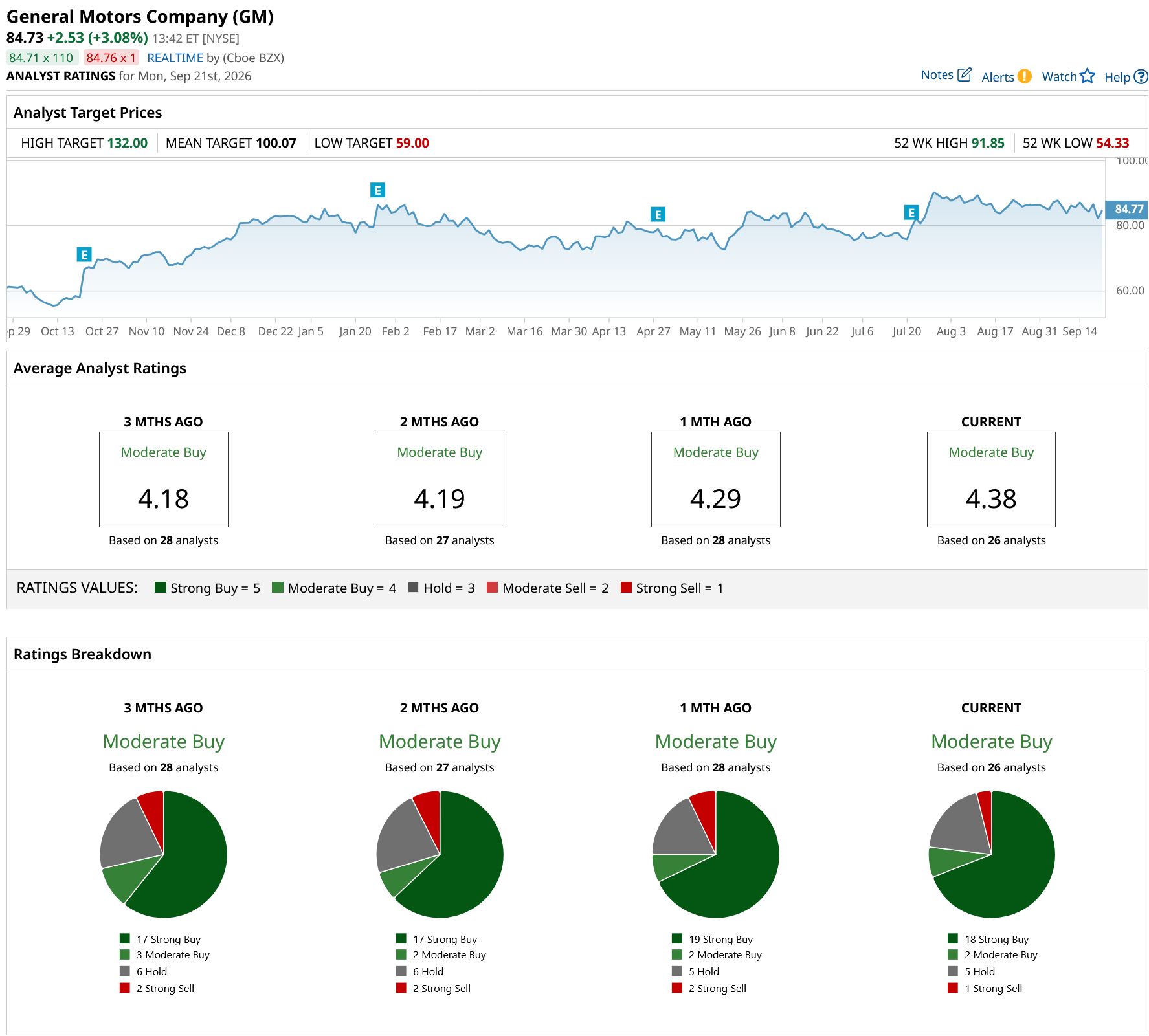
General Motors' unexpected leap into defense manufacturing, now supplying components for Lockheed Martin's Patriot missile interceptors, adds an intriguing new growth lever beyond its core auto business. Wall Street remains largely optimistic: GM holds a consensus “Moderate Buy” rating from 26 analysts, with 18 “Strong Buy” and two “Moderate Buy” calls far outnumbering five “Hold” ratings and just one “Strong Sell.” The average price target of $100.07 implies roughly 18% upside from current levels, suggesting analysts view GM's push into defense, digital services, and disciplined truck pricing as durable long-term growth drivers.
 www.barchart.com
 On the date of publication, Ruchi Gupta did not have (either directly or indirectly) positions in any of the securities mentioned in this article. All information and data in this article is solely for informational purposes. For more information please view the Barchart Disclosure Policy here.
More news from Barchart
Why General Motors Is Now in the Missile Manufacturing Business and What It Means for GM Stock USAR Stock Alert: USA Rare Earths Jumps on Trump's Greenland Deal Announcement Vicor Shares Moved Higher on a New AI Processing Deal. How Investors Should View the News. Critical Metals Surges 35% on Greenland Pact. The Tanbreez Opportunity Is Huge — But So Is the Risk.