

Microsoft (MSFT) has been spending heavily to build its artificial intelligence (AI) empire, and for a while, investors have asked when that spending will start showing up in the business. That question is becoming easier to answer as AI demand feeds into Microsoft’s cloud and productivity businesses. Now, the company is giving investors another reason to watch closely — a revamped Copilot designed to push AI deeper into everyday enterprise work.
Microsoft has spent the past six months overhauling Copilot, bringing its consumer and enterprise experiences together and adding tools that go beyond simply answering questions. The new Copilot centers on Home, Code, and Autopilot. For businesses, perhaps the most interesting piece is FinOps for AI. The new capabilities are designed to help organizations track AI spending, set usage policies, manage credits, and understand where AI is creating value. That could make it easier for companies to scale AI without letting costs run wild.
More Top Stocks Daily: Go behind Wall Street’s hottest headlines with Barchart’s Active Investor newsletter.
The timing matters, too. Microsoft is rolling out the new features through its Frontier program, while more Copilot developments are expected at its Ignite event in November.
Meanwhile, MSFT stock has staged a strong recovery, climbing 36.5% over the past three months. Much of its earlier decline has been reversed, but analysts tracking the stock still see further upside potential. To that end, let’s take a closer look at this tech giant.
About Microsoft Stock
Microsoft needs no introduction. A core member of the Magnificent Seven, it has come a long way from being the company behind the software on the office PC. It has grown into a technology titan, boasting a market capitalization of $3.8 trillion. Windows still commands more than 70% of the global PC operating system market, but that is just the starting point.
Today, Microsoft’s influence stretches across Azure cloud computing, Microsoft 365 productivity tools, developer platforms, enterprise solutions, and gaming. What truly defines the company is its evolution — from boxed software and subscription ecosystems to on-premises servers and AI-powered cloud platforms. Whether in corporate boardrooms, university classrooms, or everyday households, Microsoft has woven itself into the digital fabric of modern life — steady, scalable, and constantly reinventing itself.
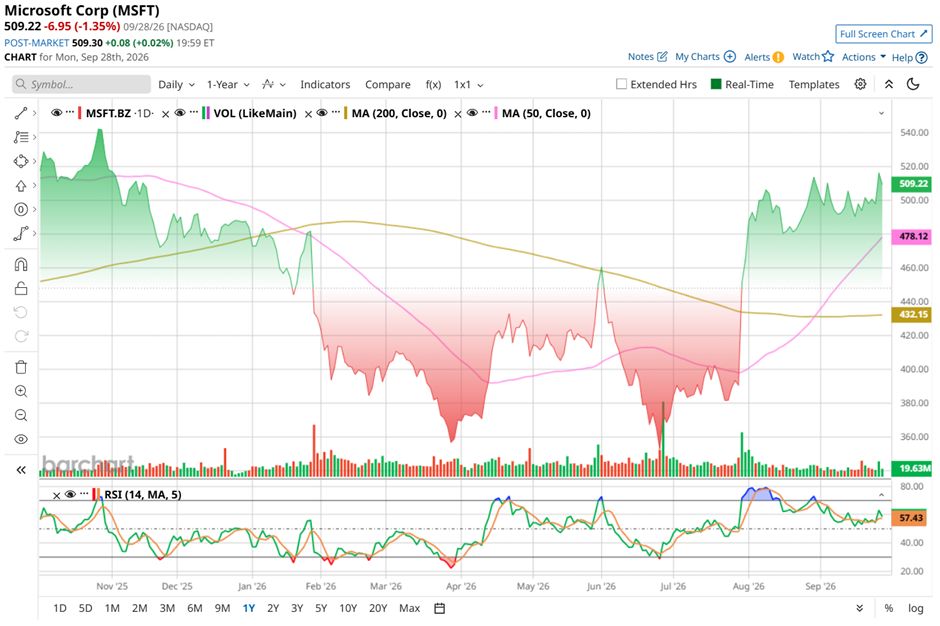
Microsoft’s long-term stock performance has been solid. Over the past decade, MSFT shares have climbed roughly 784.1%, riding the rise of cloud computing and, more recently, the AI boom. The shorter-term ride, however, has been much bumpier.
After spending much of the past year under pressure, the stock has managed to turn things around. MSFT is now up 42.7% over the past six months and about 36.5% over the last three months, recently reaching a YTD high of $519.40 on Sept. 25. Improving confidence in Microsoft’s AI monetization story, along with a string of bullish analyst calls, has helped fuel the rebound.
The chart also offers some encouraging technical signals. MSFT is trading comfortably above both its 50-day and 200-day moving averages. More importantly, the 50-day moving average has crossed above the 200-day line — a pattern commonly known as a “golden cross.” Traders often view this as a sign that the stock’s intermediate-term momentum is strengthening relative to its longer-term trend.
The 14-day RSI is around 57, after briefly reaching overbought territory, suggesting momentum remains positive without looking excessively stretched.
 www.barchart.com
 Microsoft may not look cheap at first glance. The stock is priced at roughly 26.1 times forward adjusted earnings and 9.8 times forward sales, both above the broader tech sector averages. Still, valuation looks more reasonable when compared with Microsoft’s own historical multiples, as the stock is trading somewhat below levels investors have typically been willing to pay. It reflects Microsoft’s position across cloud computing, enterprise software, and AI, while continued revenue growth and strong cash generation provide further support.
Microsoft also brings a growing dividend to the table. The company has increased its payout since initiating a dividend in 2003. It is scheduled to pay $0.98 per share on Dec. 10, taking its annualized dividend to $3.92 per share. That translates into a modest 0.76% forward yield, but with a payout ratio of just 21%, Microsoft has considerable room to keep raising its dividend. After more than two decades of consecutive increases, the company is getting closer to Dividend Aristocrat status.
Microsoft Gives Copilot a More Powerful AI Makeover
Microsoft is giving Copilot a pretty significant makeover, and this time, the focus is clearly on making AI more useful for businesses. After six months of engineering work, the company has brought its consumer and enterprise Copilot experiences together into one more capable product, with a bigger emphasis on AI agents that can handle tasks and help organizations scale their AI use.
The revamped Copilot brings several pieces under one roof. Home combines Chat and Cowork, while Code lets users build and run software using technology powered by GitHub Copilot. Then there’s Autopilot, formerly known as Scout, which works as a more proactive and persistent personal agent.
For enterprises, however, FinOps for AI could be the feature that gets the most attention. It is designed to help companies understand and control how much they are spending on AI tools. Administrators can set spending policies, manage credit requests, and control which AI models different groups can access. Individual users can still use the new Copilot, but Microsoft is putting greater emphasis on corporate customers.
If Microsoft can turn Copilot’s growing capabilities into broader enterprise adoption and recurring AI spending, that could give the company another avenue to monetize the AI boom — and potentially provide another growth catalyst for MSFT stock.
Microsoft Finishes Fiscal 2026 On a Strong Note
Microsoft reported fourth-quarter results on July 29, ending fiscal 2026 with a quarter that gave investors plenty to like. The numbers comfortably beat Wall Street's expectations, helped by strong commercial cloud demand and a surge in AI workloads. Revenue amounted to $90 billion, up 18% year over year (YOY), while adjusted EPS climbed 22.8% to $4.74. Operating income rose 18.3% to $40.6 billion.
As usual, the cloud business did much of the heavy lifting. Microsoft Cloud revenue jumped 27% YOY to $59.3 billion, while commercial remaining performance obligations (RPO) — essentially a window into contracted revenue still to come — surged 84% to $678 billion.
Within that portfolio, Intelligent Cloud was particularly strong, with revenue increasing 32% to $39.3 billion. Azure and other cloud services accelerated 43% annually, as businesses continued spending on computing capacity and custom AI deployments.
Microsoft’s Productivity and Business Processes segment revenue rose 14% to $37.8 billion, supported by several businesses. Microsoft 365 Consumer cloud revenue increased 24%, LinkedIn revenue grew 12%, and Dynamics 365 advanced 13%.
However, the soft spot was More Personal Computing, where revenue slipped 4% to $12.9 billion, and Windows OEM and Devices revenue fell 7% amid weaker hardware demand. Xbox content and services revenue also slipped 10%.
Meanwhile, Microsoft’s AI ambitions were impressive. During fiscal 2026, Azure revenue crossed $100 billion for the first time, while Microsoft 365 Copilot surpassed 30 million paid seats. This suggests customers are increasingly moving beyond AI experimentation and putting Microsoft’s tools to work.
Of course, that AI expansion comes with a hefty bill. Microsoft spent aggressively on infrastructure, with Q4 capital spending and finance lease additions reaching $41 billion, as the company continued building data centers and GPU capacity to support rising AI demand. Still, shareholders were not left out in the cold. The tech giant returned $10.2 billion through dividends and share repurchases during the quarter, resulting in over $43 billion of total cash returned to shareholders for fiscal 2026.
Looking ahead, management anticipates Q1 fiscal 2027 revenue between $89.85 billion and $90.95 billion, implying 16% to 17% annual growth. More strikingly, quarterly capex is expected to exceed $50 billion.
Meanwhile, analysts tracking Microsoft anticipate the company’s Q1 2027 revenue to be around $90.7 billion, with EPS expected to rise 13.6% YOY to $4.69. For fiscal 2027, EPS is expected to jump 13.5% annually to $19.62, and then rise another 18.4% YOY to $23.23 per share in fiscal 2028.
What Do Analysts Expect for Microsoft Stock?
The analyst mood around Microsoft has changed. After spending much of the first half of the year facing downgrades and target cuts, MSFT got a fresh vote of confidence following its strong fiscal Q4 results in July.
Stifel was among the latest to turn more positive. Last week, analyst Brad Reback upgraded the stock from “Hold” to “Buy” and lifted his price target to $575 from $530. The brokerage firm is becoming more comfortable with Microsoft sustaining mid-to-upper-teens revenue growth, helped by advances in open-weight models and the company’s model-agnostic AI strategy.
Stifel also sees room for operating margins to remain stable as Microsoft improves operating efficiency and keeps expenses under control. Strong cash flow should further reduce the need for outside financing. The brokerage has also become less concerned about earlier gross-margin pressures, pointing to better Azure efficiency, the end of payments to OpenAI following the April contract revision, disciplined capex, and controlled operating expenses.
And Stifel is not alone. Oppenheimer raised its target to $570 from $515, while Cantor Fitzgerald boosted its target to $608 from $522. Together, those moves suggest Wall Street’s view of Microsoft has become noticeably more upbeat.
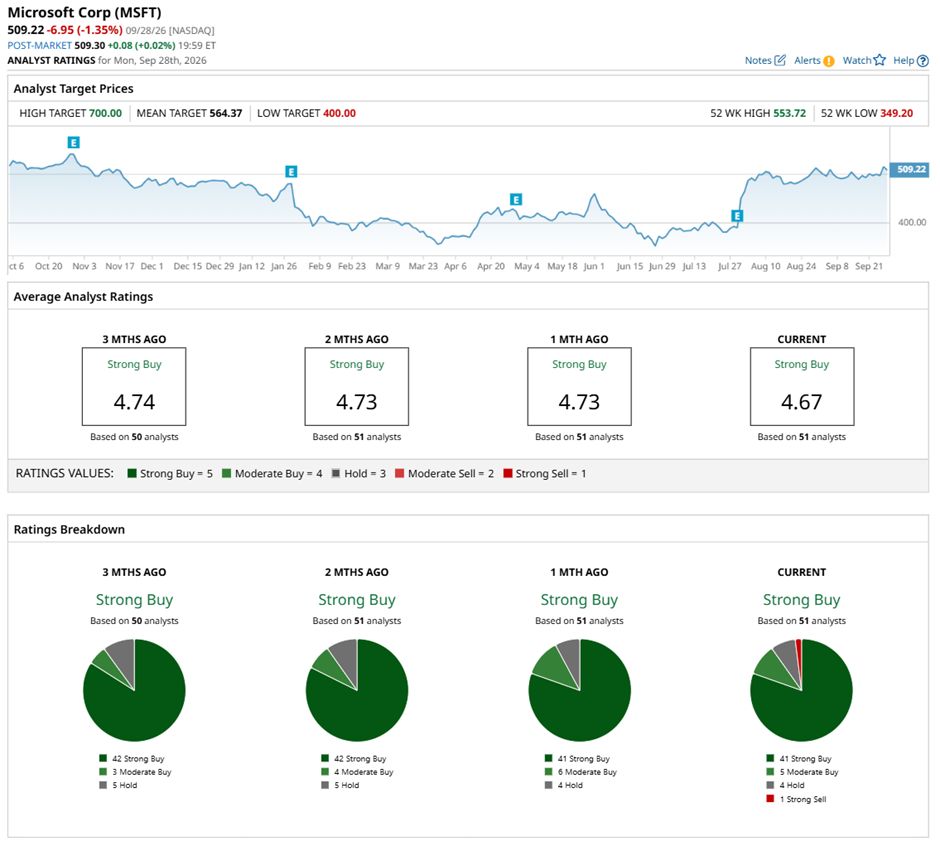
Analysts are upbeat on MSFT, with an overall “Strong Buy” consensus. Of the 51 analysts tracking the stock, 41 rate it a “Strong Buy,” five suggest a “Moderate Buy,” four are on the sidelines with a “Hold” rating, and the remaining one has a “Strong Sell.”
Microsoft’s rally may still have more fuel in the tank if we listen to Wall Street. MSFT’s average price target of $564.37 suggests about 10.8% upside potential from current levels. Some are even more optimistic. The Street-high target of $700 implies the tech stock could rise as much as 37.5%.
 www.barchart.com
 On the date of publication, Sristi Suman Jayaswal did not have (either directly or indirectly) positions in any of the securities mentioned in this article. All information and data in this article is solely for informational purposes. For more information please view the Barchart Disclosure Policy here.
More news from Barchart
SpaceX Could Double the Number of Nvidia Chips It Uses in Colossus 2. What This Would Mean for SPCX Stock. What a Revamped Copilot Means for Microsoft Stock A $60 Billion Amazon Opportunity Is Changing Qualcomm's Chip Story Elon Musk’s Potential Colossus 2 Expansion Sends Strong Signal on Nvidia Demand