

Selling put options before a company's earnings announcement can be a valid strategy for options traders seeking to capitalize on higher than normal volatility.
One of the primary reasons traders may consider selling a Delta Airlines (DAL) put option before their earnings announcement on Friday is the elevated implied volatility. Earnings reports can trigger significant price movements, and this volatility results in an increase in option premiums. By selling the put option before the announcement, traders aim to capitalize on the inflated premium, especially if they believe that the stock will remain above the strike price by the option's expiration date.
Can’t Get Enough Options?: Join the list for Barchart’s daily unusual options report, delivered free.
Before delving into the strategy, let's quickly recap what it means to sell a put option. A cash-secured put involves writing an at-the-money or out-of-the-money put option and simultaneously setting aside enough cash to buy the stock. The goal is to either have the put expire worthless and keep the premium or be assigned and acquire the stock below the current price.
Selling put options is an easy place for investors to start with options. They are like a covered call and are pretty easy to understand once you know the basics.
Traders selling puts should understand that they may be assigned 100 shares at the strike price.
Potential Benefits
Selling put options allows traders to collect premium income upfront. If the options expire worthless, the seller keeps the entire premium as profit.
The premium received can lower the breakeven point for the trade. If the stock price drops but remains above the breakeven point, the seller still profits.
Traders who are bullish or neutral on DAL can benefit from the increased volatility leading up to the earnings report.
After the earnings announcement, implied volatility tends to drop significantly, reducing option premiums. By selling options before the announcement, traders can take advantage of this implied volatility drop.
Potential Risks
If the stock price falls below the put option's strike price, the seller may be obligated to buy DAL shares at a higher price than the current market value.
While the profit potential is limited to the premium received, losses can theoretically be unlimited if the stock price drops significantly.
An earnings surprises could result in a sharp drop in the price of DAL stock.
Selling a DAL Put Option Before Earnings
A trader selling the October 9th $78-strike put on DAL would receive around $52 into their account, which would be theirs to keep. Due to the bid-ask spread, the actual amount could be slightly higher than this.
If DAL falls below $78 by October 9, they would be required to buy 100 shares at $78. The effective net cost of the position would be $77.48, thanks to the option premium received.
That is 6.74% below Monday’s closing price.
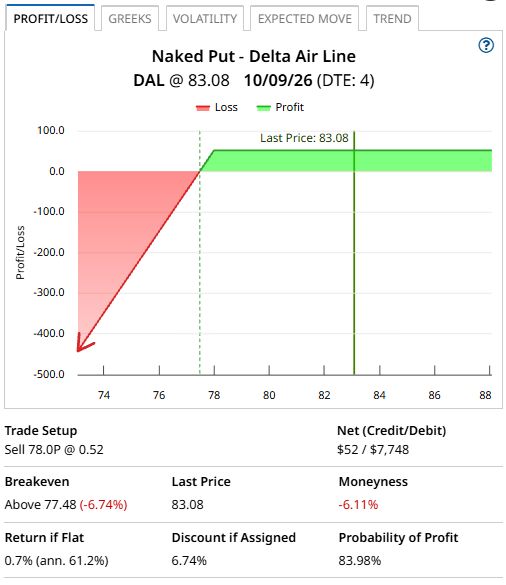
If the stock stays above $78 at expiry, the put expires worthless, leaving the trader with a 0.7% annualized return on capital at risk.
That works out to be 61.2% annualized.
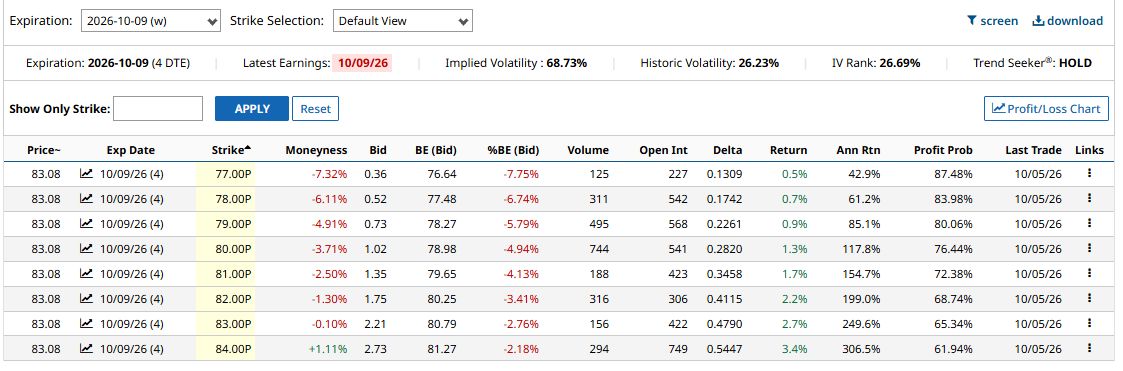
This table shows other potential put selling candidates on Delta Airlines for the October 9 expiration.
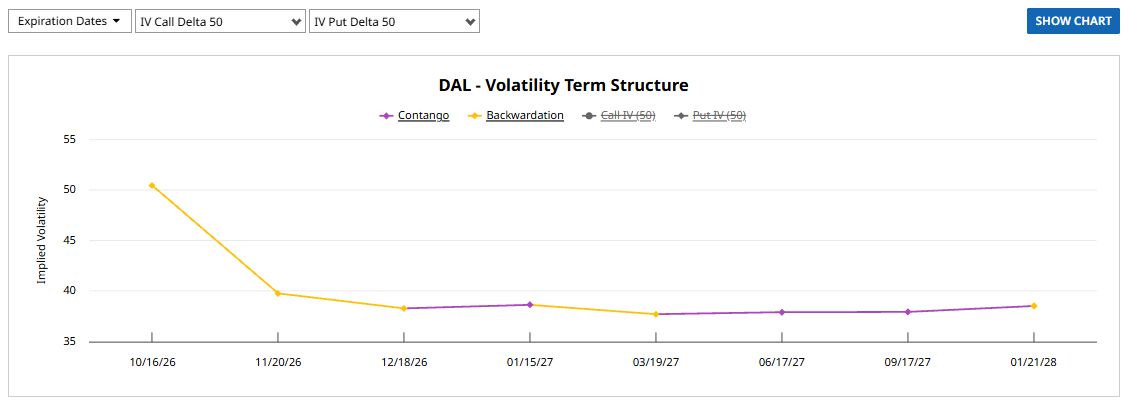
On the Delta Airlines volatility charts, we can see the term structure shows that implied volatility is very high for the expiration immediately after earnings.
This 50% volatility means high option premiums when compared to longer-term options which only have volatility of around 37%.
Company Details
The Barchart Technical Opinion rating is a 32% Buy with a Weakest short term outlook on maintaining the current direction.
Delta Air Lines is one of the four carriers that controls majority of the US aviation market (the carriers account for more than 60% of the domestic market share).
Bulk of this Atlanta-GA based carrier's revenues are recognized from its airline segment.
Balance is represented by the refinery segment, which operates for the benefit of the airline division by providing it with jet fuel from its own production and agreements with third parties.
Of the 24 analysts covering Delta Airlines, 21 have a Strong Buy, 2 have a Moderate Buy ratings and 1 has a Strong Sell rating.
Conclusion
Selling a Delta Airlines put option before their earnings announcement is a strategy that can potentially generate income while taking advantage of heightened volatility. However, it's essential to understand the risks involved, including the possibility of assignment and unlimited losses.
Conservative investors may consider buying a further out-of-the-money put to reduce the risk and capital requirements.
This essentially turns the trade into a bull put spread.
Please remember that options are risky, and investors can lose 100% of their investment.
This article is for education purposes only and not a trade recommendation. Remember to always do your own due diligence and consult your financial advisor before making any investment decisions.
On the date of publication, Gavin McMaster did not have (either directly or indirectly) positions in any of the securities mentioned in this article. All information and data in this article is solely for informational purposes. For more information please view the Barchart Disclosure Policy here.
More news from Barchart
Delta Airlines Earnings Trade: A High Probability Options Setup Why On Semiconductor Is Betting Big on AI Power and What Its $5.7 Billion Bet Means for ON Stock TSMC Is Set Up for a Big October 15. After Record Monthly Sales, 2nm and Margins Will Drive Future Price Action. Stock Index Futures Climb as Oil Prices and Bond Yields Fall; Fed Speak on Tap