

Analysts keep raising their price targets for Microsoft Corp. (MSFT) stock on higher revenue and free cash flow (FCF) forecasts. As a result, MSFT put credit spreads have worked well, as I discussed in a Sept. 11 Barchart article.
MSFT closed up 1.48% on Monday, Oct. 5, at $525.18. Three weeks ago, it was at $492.44, so it's risen +6.2%. But, as I will show below, the MSFT put credit spread play has returned +22.7% in the same period. It's time to run the play again. More on this below.
Can’t Get Enough Options?: Join the list for Barchart’s daily unusual options report, delivered free.
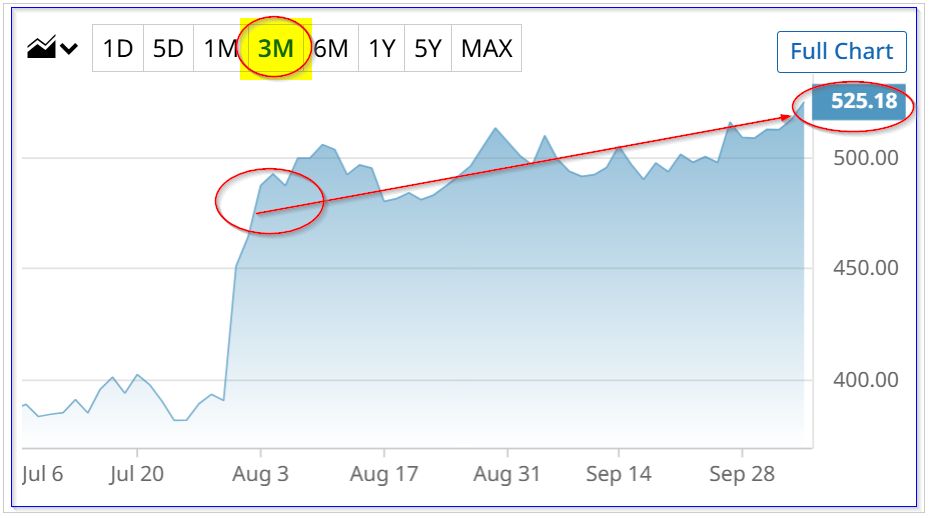 MSFT stock - last 3 months - Barchart - Oct. 5
 Why is MSFT Rising?
The chart above from Barchart shows that since Microsoft released its fiscal Q4 earnings on July 29, MSFT spiked up immediately and subsequently floated higher. I discussed Microsoft's earnings in an August 16 Barchart article, “Investors in Microsoft Love Shorting Out-of-the-Money MSFT Puts.”
I showed that, based on its strong free cash flow (FCF) and higher fiscal year 2027 revenue forecasts, MSFT could be worth $555 per share. That was 12% higher than its price at the time.
For example, analysts now project $467.31 billion in revenue for the year ending June 30, 2028. That's almost 20% higher than the $391.04 billion projected for June 2027.
Using a 61.6% operating cash flow (OCF) margin for FY 2028 and assuming capex rises 10% over $175 projected for FY 2027, FCF could hit $96 billion. So, using a 2.0% FCF yield metric, that projects a $4.8 trillion fair market value (FMV) in 1.75 years (June 30, 2028). That's 23% over its present $3.9 trillion market cap.
Discounting that by 5% for 1.75 years, the present value of this FMV is $4.406 trillion, or 13% higher. That leads to a PT of $593.45 PT.
Since then, analysts have been raising their price targets (PTs). I discussed this in a Sept. 11 Barchart article, “Microsoft Price Targets Are Rising - Short Put MSFT Plays Are Attractive Here.”
For example, analysts now project a $578.82 PT, implying at least 10% upside. This is even higher than the $572.92 in the Sept. 11 article.
The bottom line is that analysts' forecasts and PTs are leading to higher PTs for MSFT.
Put Credit Spread Play Worked Well
One way to play MSFT using an out-of-the-money (OTM) short-put strategy, but without having to post a large amount of collateral, is to do a put credit spread. I discussed this in my Sept. 11 Barchart article.
For example, I discussed shorting the $475 put strike price (i.e., 3.54% OTM) for $8.30, and simultaneously buying the $460 put for $4.75, both expiring on Oct. 16.
The net credit collected was $355 (i.e., $830 - $475), but the investor would only have to post $1,500 in collateral. That is much lower than posting $47,500 in doing a cash-secured put at $475.00 to collect $830.
(In fact, you could do 2 put credit spreads and collect $750, close to the $830, but the collateral requirement would be only $3,000.)
Today, that put credit spread has worked out well. The Oct. 16 expiry $475.00 put strike is $0.36 at the midpoint, and the $460 put is just $0.22. So, closing this position would only cost $36-$22, or $14.
Therefore, the net profit, after closing this play, is $355-$14, or $341, on $1,500 collateral. That works out to a 3-week return of 22.7% ($341/$1,500).
This return is much better than either holding MSFT (+6.2% in the same period), or a cash-secured put return ($833/$47,500, or 1.75%) before closing it out.
New Put Credit Spread Play
For example, the Nov. 6 expiry period shows that the $495.00 put strike price (5.75% OTM) has a $7.80 midpoint premium, and the $480 put is at $465.00.
So, the net put credit spread is $315, for a $1,500 collateral requirement (i.e., $780-$465). That works out to an expected return (ER) of 21% for the next month.
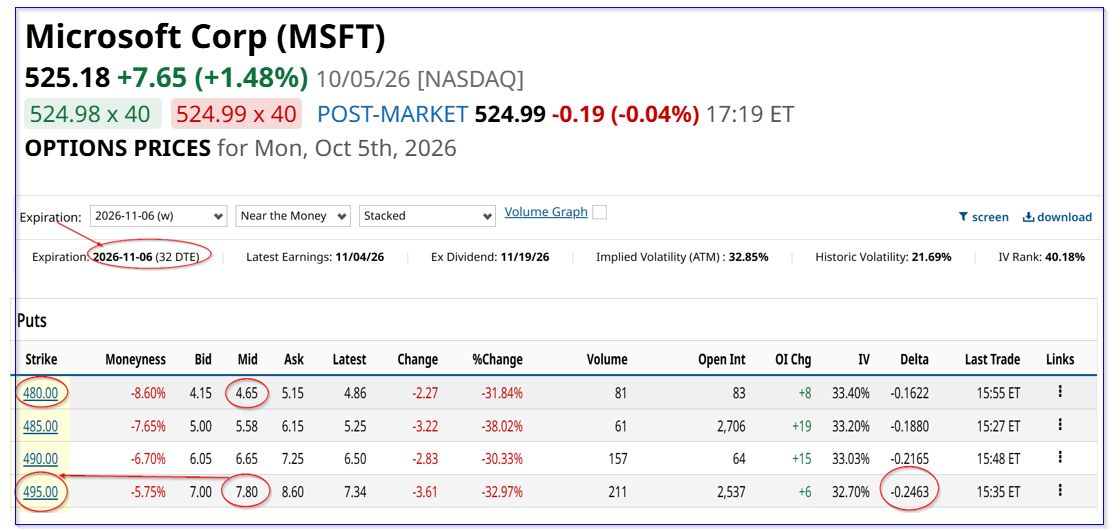 MSFT puts expiring Nov. 6 - Barchart - As of Oct. 5, 2026
 The advantage is the low collateral requirement and the high return. However, there is also a higher downside. The investor could lose a net $1,185 (i.e., $1,500 - $315), if MSFT falls to $480, or lower in the next month.
The bottom line is that this is an attractive way to play MSFT, even if it doesn't move higher. As long as it stays over $495.00, the investor collects the short-put income on a low collateral requirement.
On the date of publication, Mark R. Hake, CFA did not have (either directly or indirectly) positions in any of the securities mentioned in this article. All information and data in this article is solely for informational purposes. For more information please view the Barchart Disclosure Policy here.
More news from Barchart
Microsoft Put Credit Spread Plays Are Working Well as Analysts Hike their MSFT Price Targets Delta Airlines Earnings Trade: A High Probability Options Setup Huge Unusual Call Options Activity in Paramount Skydance Stock Ahead of Merger Close This Week Micron Generates Massive Free Cash Flow - MU Price Targets Rise