

Shares of Advanced Micro Devices (AMD), more popularly known as AMD, ended yesterday's trading session almost 3% higher after Wall Street major Citi raised its price target for it. The firm's price target for AMD stock is now $800, up more than 39% from its earlier target of $575. Citi cited a CPU market of $300 billion by 2030 as the broader driver for the stock.
Going deeper in a note to clients, analyst Atif Malik said, “We update our CPU model following the launch of several personal AI agents, including Muse, Dots, Instinct, GrokBot and GeminiSpark. Fundamentally, we view agentic AI as a potential orders-of-magnitude driver of compute demand relative to traditional chatbots. Unlike chatbots, which remain largely idle between user interactions, AI agents like Muse can operate continuously for hours or even run persistently in the background, autonomously executing multi-step tasks. Moreover, using cybersecurity as a prime example, where always-on agents could generate substantially higher token volumes, driving a significant increase in inference and compute consumption across both enterprise and consumer workloads.”
More Top Stocks Daily: Go behind Wall Street’s hottest headlines with Barchart’s Active Investor newsletter.
About AMD
AMD began as a small Silicon Valley second-source chipmaker in 1969 and has spent decades battling Intel (INTC) in CPUs, expanded into graphics through the 2006 ATI aquisition, and, under Lisa Su, has evolved into a broad high-performance computing company increasingly positioned as Nvidia’s (NVDA) principal challenger in AI accelerators. Specifically, under Su, the company has been going through its proverbial golden age. Since Su took charge of the company in October 2014 (when it was on the brink of bankruptcy), its market cap has risen more than 400 times.
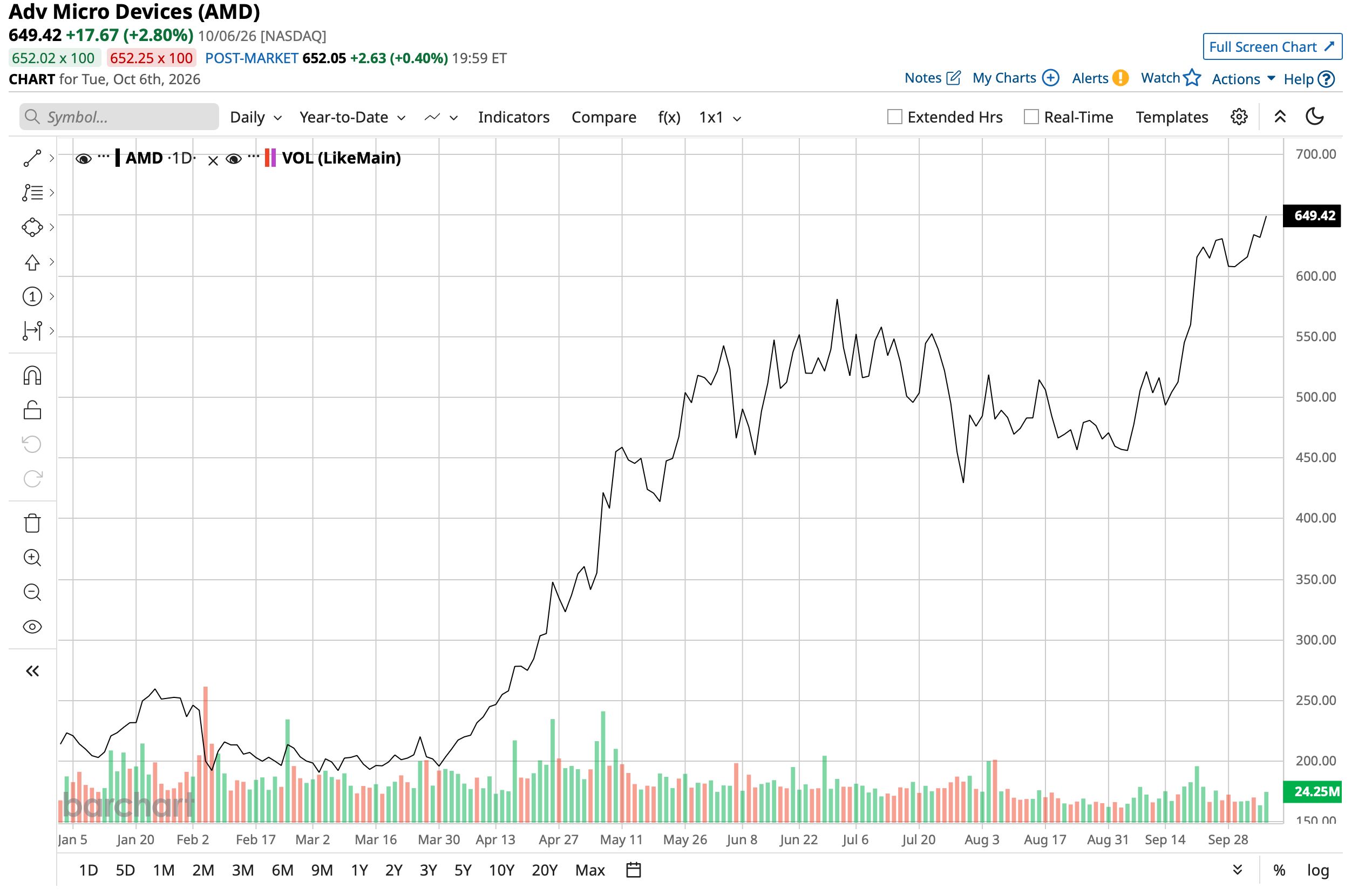
Now valued at a market cap of just over a trillion dollars, AMD stock is up a whopping 202% on a year-to-date (YTD) basis.
 www.barchart.com
 Would Rather Be EPYC
AMD's CPU strategy is “epic” in a sense, with EPYC server CPUs at the core of it. And driving this in the future will be Venice, a next-generation EPYC architecture/platform based on AMD's Zen 6 architecture. But why are CPUs becoming increasingly important in the next phase of AI? It is because of agentic AI.
While GPUs remain the primary engines for LLM inference, the rise of agentic AI is increasing the importance of CPUs, as autonomous agents require substantially more orchestration, tool execution, data processing, and compute around each inference cycle.
How does EPYC Venice fit in here? Well, to cater to agentic workloads, what it offers is quite substantial. For instance, the flagship EPYC 9996 has 256 cores and 512 threads, making it the highest-core-count publicly disclosed 1P CPU, according to AMD. That is particularly relevant to agentic AI because agents can simultaneously run code, call APIs, query databases, retrieve information, and perform other CPU-heavy tasks. More importantly, AMD says Venice became the first HPC product in the industry to enter production ramp on TSMC's (TSM) 2nm technology.
Venice supports 16 channels of DDR5 memory, including next-generation MRDIMMs at up to 12,800 MT/s. AMD's specifications show the EPYC 9996 reaching up to 1.6 TB/s of memory bandwidth with MRDIMM. And if that is not enough, Venice supports PCIe Gen 6, providing the high-speed I/O needed to connect GPUs, networking equipment, storage, and other accelerators.
However, a crucial thing to take into context is that Venice is yet to go live in the practical sense. On AMD’s August earnings call, Chief Executive Lisa Su said Venice was in production, while major equipment makers were preparing platforms and leading cloud providers planned deployments later in 2026. That is not the same as saying named customers already have broadly available Venice services. Microsoft (MSFT) has announced plans for Venice in Helios and two new Azure virtual machine families, one aimed at agentic AI and data pipelines. AMD also says Meta (META) is validating sixth-generation EPYC platforms in its labs and testing Helios racks. OpenAI and Anthropic are named Helios customers, but announced plans should not be mistaken for confirmation that their Venice deployments are already fully operational.
Thus, AMD's internal testing and benchmarking will not announce Venice as the “it” thing in CPUs. Performance in the real world will determine its true efficacy and how it stands up to Nvidia, whose Vera CPUs are already deployed with the likes of Oracle (ORCL), OpenAI, Anthropic, Amazon (AMZN), and SpaceXAI, to name a few.
Q2 Reinforces Robustness
AMD posted solid second-quarter 2026 results that largely aligned with elevated expectations. Although the share price declined after the announcement, the company again delivered a double beat on both the top and bottom lines.
Revenue increased 50% year-over-year (YoY) to $11.5 billion. The data center segment generated $6.7 billion, up 107% from the previous year. Gross margins improved substantially to 54% from 40% in the year-earlier period. Looking forward, management projected third-quarter net revenue in the range of $12.7 billion to $13.3 billion, comfortably above the consensus estimate of $12.5 billion.
Earnings per share rose sharply by 246% YoY to $1.66, beating the consensus forecast of $1.62. This extended AMD’s streak of consecutive earnings beats to seven quarters.
Cash flow remained healthy, as net cash from operating activities increased to $2.4 billion in the second quarter of 2026 from $1.5 billion in the year-ago period. Free cash flow grew 32% to $1.6 billion. The company closed the quarter with $13.1 billion in cash, well above its short-term debt of $875 million.
AMD also launched its next-generation Instinct MI400 Series graphics processing units, sixth-generation EPYC server central processing units, and Helios rack-scale systems during the quarter.
The strong rally in the shares has pushed AMD’s valuation to elevated levels. The forward P/E, P/S, and P/CF of 83.38, 20.25, and 102.31 are all above the sector medians of 23.81, 3.55, and 20.85, respectively.
Wall Street Opinion of AMD Stock
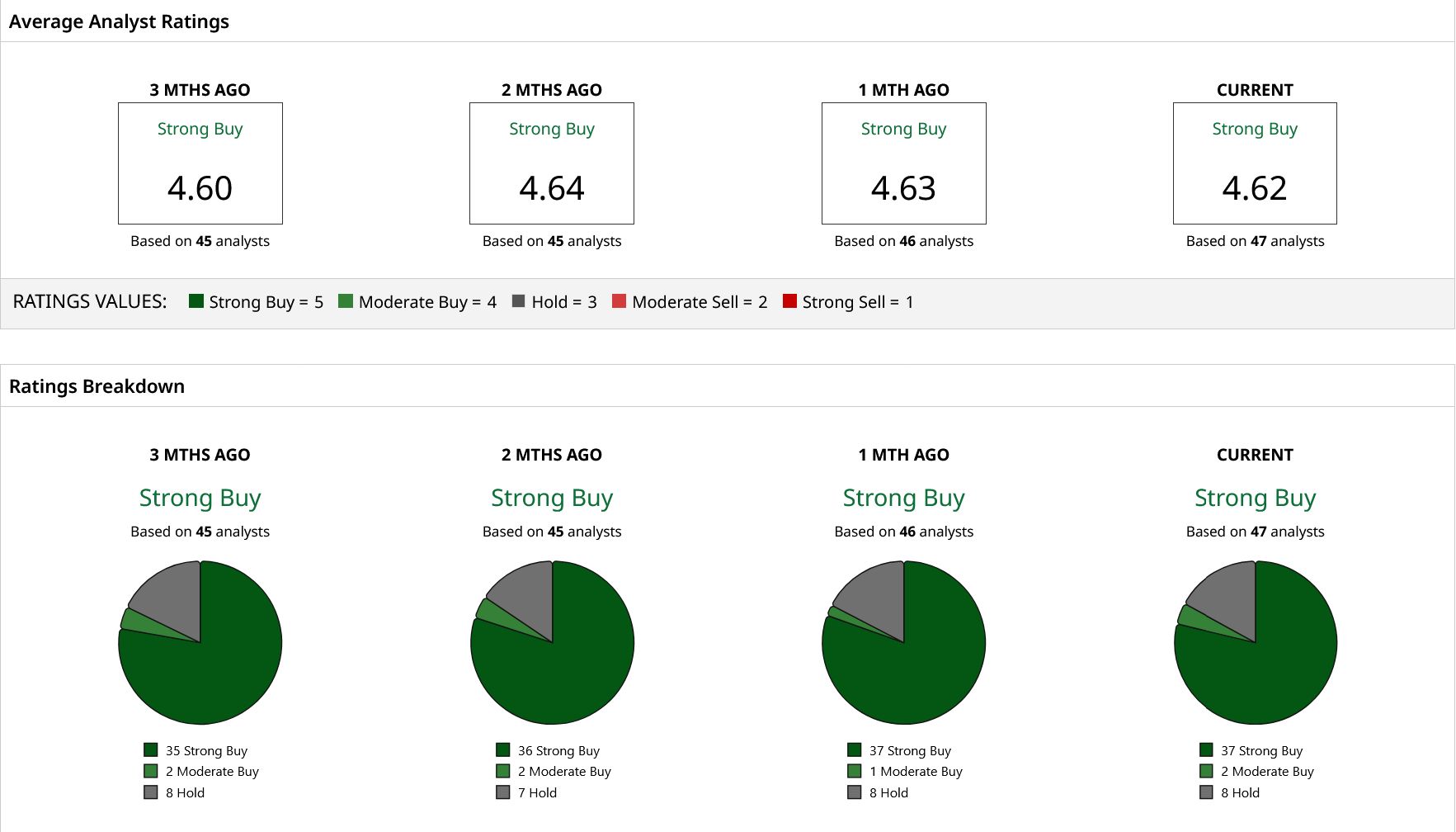
Like Citi, the overall Wall Street community is also gung-ho about AMD, assigning it a rating of “Strong Buy.” The stock is sitting just below its mean target price, and the high target price of $1,250 denotes a potential upside of 94% from current levels. Out of 47 analysts covering the stock, 37 have a “Strong Buy” rating, two have a “Moderate Buy” rating, and eight have a “Hold” rating.
 www.barchart.com
 On the date of publication, Pathikrit Bose did not have (either directly or indirectly) positions in any of the securities mentioned in this article. All information and data in this article is solely for informational purposes. For more information please view the Barchart Disclosure Policy here.