

Taiwan Semiconductor Manufacturing (TSM) could be emerging as a new player in Elon Musk’s ambitious Terafab project, creating a fresh overhang for Intel (INTC) investors. TSMC is reportedly exploring ways to help Terafab operate its planned semiconductor factories in Texas, and Musk confirmed this month that discussions are underway. However, he stressed that they are still preliminary.
The development is significant for Intel because it has been the only named chipmaker partner in Terafab since joining the project in April 2026. Musk had previously indicated that Terafab would use Intel’s next-generation 14A process technology, giving Intel a high-profile endorsement for its foundry ambitions.
More Top Stocks Daily: Go behind Wall Street’s hottest headlines with Barchart’s Active Investor newsletter.
Terafab is Elon Musk’s planned vertically integrated semiconductor manufacturing complex in Grimes County, Texas, being developed by SpaceX (SPCX) and Tesla (TSLA) to produce advanced logic and memory chips, including for AI applications. Terafab’s first phase carries an announced $16.8 billion investment, with the broader project potentially reaching $119 billion.
Meanwhile, the TSMC partnership does not necessarily mean Intel will be replaced, and TSMC involvement could be supplemental, with analysts suggesting Terafab could ultimately use both foundries.
Still, the possibility of TSMC taking a meaningful role raises questions about how much of Terafab’s future chip production Intel could capture and whether investors have already priced too much of the project’s potential into INTC shares.
About Intel Stock
Intel is a leading technology company specializing in the design, development, manufacture, and marketing of semiconductor products, including microprocessors, chipsets, graphics processing units (GPUs), memory, and related hardware for consumer, enterprise, and industrial markets. Headquartered in Santa Clara, California, Intel remains a key player in data center, PC, and emerging AI and networking segments. Intel’s market cap is around $594.7 billion, reflecting its valuation among the world’s largest semiconductor companies.
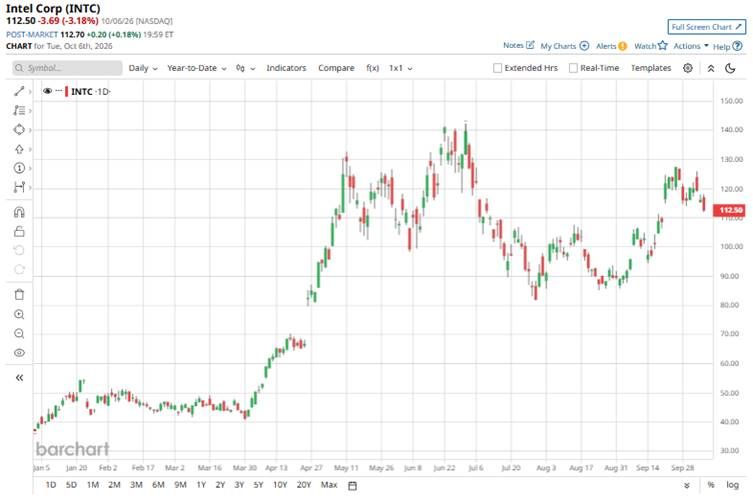
Intel has delivered an extraordinary rebound in 2026, with shares up 207.5% over the past year and 204.9% year-to-date (YTD), vastly outperforming the broader market. The stock also gained 17.4% over the past month, although the rally has recently shown signs of volatility.
Intel shares fell 2.6% on Oct. 5 and another 3.2% on Oct. 6, after Elon Musk confirmed that TSMC is in early discussions to participate in his Terafab semiconductor venture. The news raised concerns that TSMC could dilute Intel’s previously expected role as Terafab’s key manufacturing partner. However, there’s a possibility that both companies could benefit from the project.
Meanwhile, the sharp 2026 rally has been driven largely by renewed investor confidence in Intel’s turnaround and foundry strategy. Musk’s April announcement that Terafab planned to use Intel’s 14A process provided an important external validation of Intel Foundry and helped fuel a major rally. Intel has also benefited from growing expectations for advanced-chip demand, and a series of strategic AI and semiconductor partnerships.
The stock is currently trading at a premium to its sector median at 115.25 times forward earnings.
 www.barchart.com
 Q2 Results Exceeded Consensus Estimates
Intel released second-quarter 2026 results on July 23, reporting its strongest quarterly revenue growth in more than 15 years.
Its revenue rose 25% year-over-year (YOY) to $16.1 billion. The increase was primarily driven by Intel Products revenue, which climbed 28% YOY, including a 59% increase in Data Center and AI (DCAI) revenue and a 13% increase in Client Computing and Platform Group (CCPG) revenue. Intel said higher average selling prices, particularly from a richer mix of premium products, were a key contributor.
Profitability also improved substantially. Its non-GAAP gross margin rose to 41.8% from 29.7%, while non-GAAP operating margin increased to 17.2% from negative 3.9%. Intel generated $7.0 billion in operating cash flow during the quarter.
While GAAP results remained distorted by significant charges, on an adjusted basis, Intel swung to non-GAAP net income of $2.2 billion, or $0.42 per share, from a $0.4 billion loss, or $0.10 per share, a year earlier and exceeding guidance.
Yet Intel issued stronger-than-expected guidance for the September quarter. The company expects Q3 revenue of $15.8 billion to $16.8 billion and non-GAAP EPS of $0.38. Intel also increased its expected 2026 capital spending to about $20 billion, reflecting stronger demand and the need to expand manufacturing capacity. Management said it expects investment to increase meaningfully again in 2027.
In addition, analysts predict EPS to be around $1.04 for fiscal 2026, an improvement of 966.7% YOY, and to surge again by 38.5% to $1.44 in fiscal 2027.
What Do Analysts Expect for Intel Stock?
TD Cowen analyst Joshua Buchalter maintained a “Hold” rating on Intel on Sept. 23, while raising its price target to $115 from $75.
On the flip side, Melius Research analyst Ben Reitzes maintained a “Buy” rating on Intel last month, with a $165 price target, reflecting a highly bullish view of the company’s foundry opportunity and long-term earnings potential.
Also, Tigress Financial Partners maintained its “Buy” rating on Intel, while raising its price target to $145 from $118, reflecting growing confidence in Intel’s AI-driven turnaround.
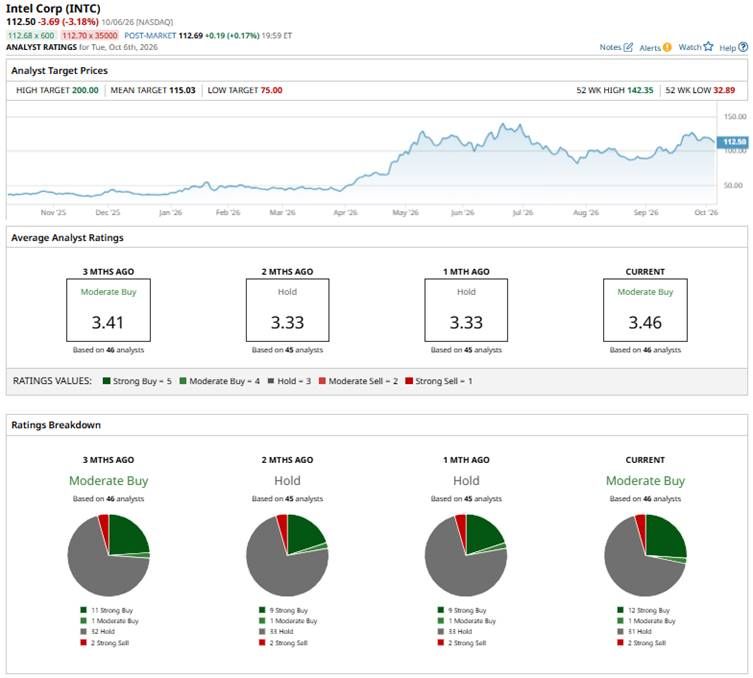
INTC has a consensus “Moderate Buy” rating overall. Of the 46 analysts covering the stock, 12 advise a “Strong Buy,” one recommends a “Moderate Buy,” 31 analysts are on the sidelines, giving it a “Hold” rating, and two suggest a “Strong Sell.”
INTC’s average analyst price target of $115.03 indicates a 2.2% upside, while the Street-high target price of $200 suggests that the stock could rally 77.8%.
 www.barchart.com
 On the date of publication, Subhasree Kar did not have (either directly or indirectly) positions in any of the securities mentioned in this article. All information and data in this article is solely for informational purposes. For more information please view the Barchart Disclosure Policy here.
More news from Barchart
TSMC Could Partner with Elon Musk’s Terafab. How Intel Stock Could Lose Big. How to Play United Microelectronics Stock as Revenue Surges U.S. Stock Futures Slump as Oil Prices and Bond Yields Surge These 3 Catalysts Make Microsoft Stock a Bargain Before Year-End