


The artificial intelligence (AI) boom may have first centered on GPUs, but CPUs are now in the spotlight. As AI infrastructure expands, Intel (INTC) has the chance to revive its core CPU business, while Advanced Micro Devices (AMD) is using the same demand wave to push deeper into data centers.
With the CPU comeback, both of these companies have something to prove. But one is already turning the opportunity into faster growth and stronger profits.
More Top Stocks Daily: Go behind Wall Street’s hottest headlines with Barchart’s Active Investor newsletter.
The Case for Intel: AI Is Bringing Intel Back to Its Roots
When GPUs took center stage at the start of the AI boom, Intel struggled to catch up to peers like Nvidia (NVDA), AMD, Broadcom (AVGO), and Taiwan Semiconductor (TSM) which capitalized on the demand surge. But under the leadership of CEO Lip-Bu Tan, Intel is working to regain its footing and rebuild its growth story.
Intel stock has gained 144% year-to-date (YTD), suggesting investors are buying into its turnaround story.
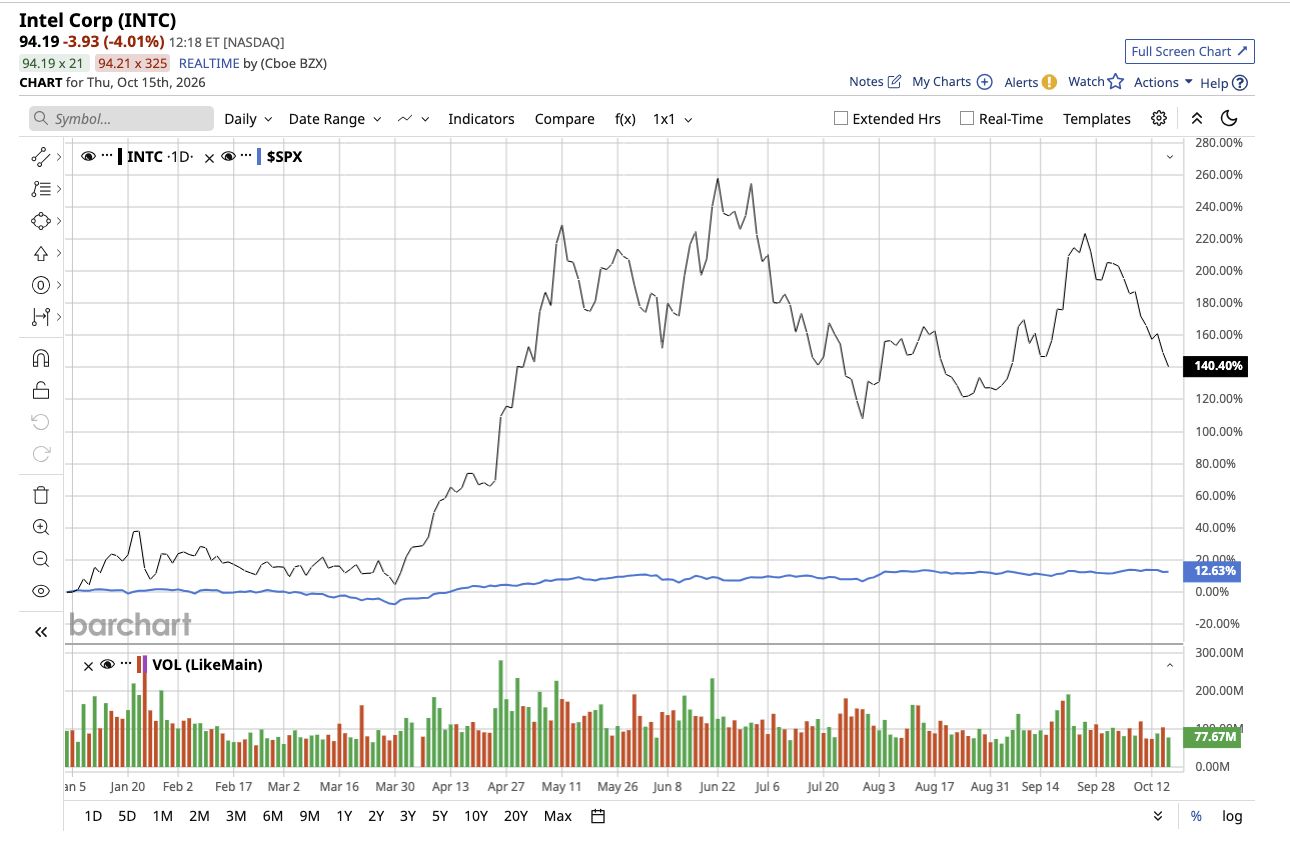 www.barchart.com
Intel is now focusing on the business that once made it a semiconductor leader. For more than 20 years, Intel dominated the CPU market, providing chips for personal computers and enterprise servers. As AI use grows from just training models to running them and supporting more independent AI agents, the need for processing power is likely to increase. Management says demand is rising among both cloud and enterprise customers, showing that more people see how important CPUs are to AI infrastructure.
In the second quarter, Intel’s Data Center and AI (DCAI) segment revenue surged 59% year-over-year (YOY) to $6.3 billion, while operating profit for the segment reached $2.5 billion. DCAI revenue also rose 24% sequentially, showing the server business is once again driving growth rather than simply serving as a legacy franchise.
Intel's manufacturing model sets it apart from AMD. It designs processors and runs its own fabrication facilities, giving it direct control over parts of production. While this is an advantage, Intel’s foundry business is still operating at a loss, which stood at $2.1 billion in Q2.
Intel is therefore as much a turnaround investment as a CPU investment. Analysts predict 2026 EPS of $1.04 and 2027 EPS of $1.44, representing huge growth. Intel stock currently trades at 62.3 times forward 2027 earnings, with EPS expected to increase by 38% YOY. While the projected earnings recovery is substantial, execution risks and increasing competition remain.
Basically, investors are paying a premium for a recovery that hasn't materialized yet.
Overall, Wall Street remains moderately bullish about INTC stock. Of the 46 analysts covering the stock, 11 have a "Strong Buy" rating, one recommends a "Moderate Buy," 32 have a "Hold" rating, and two analysts have a “Strong Sell.” The average price target of $115.58 suggests 29% potential upside from here, while the high estimate of $200 implies a 123% gain from current levels.
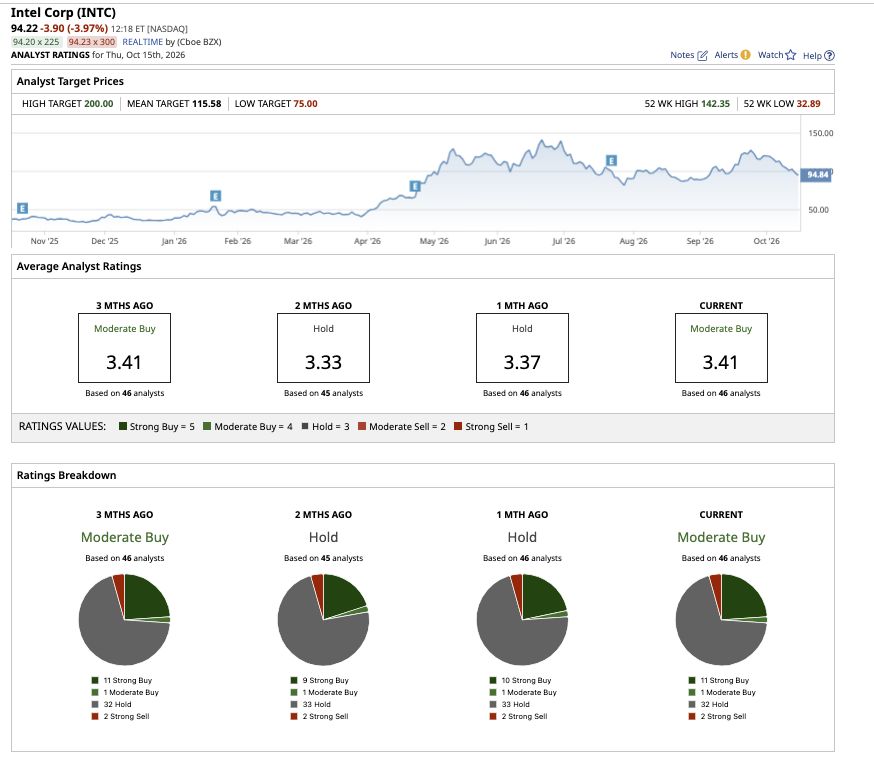 www.barchart.com
The Case for AMD: Already Winning More Server Business
In this CPU comeback, AMD’s opportunity looks different. Although it doesn’t have the legacy CPU business, it is not trying to rebuild its manufacturing operations while recovering its processor franchise. Instead, it is expanding its established EPYC server CPU business and using its broader data-center portfolio to capture more spending from cloud providers and enterprises.
AMD stock is up 147% YTD, outperforming both the broader market and the tech-heavy Nasdaq Composite ($NASX).
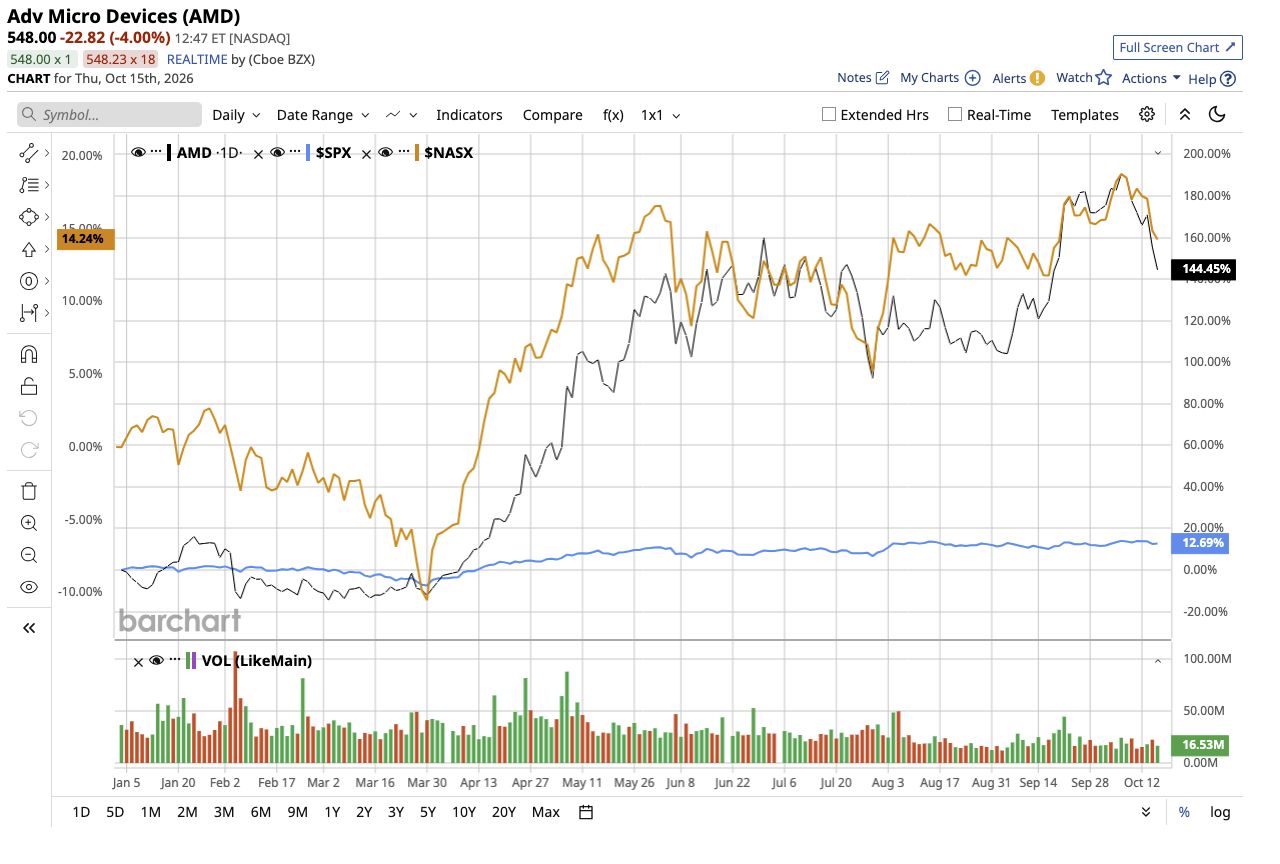 www.barchart.com
In Q2, AMD generated total revenue of $11.5 billion, up 50% YOY. Data Center revenue more than doubled to $6.7 billion, contributing roughly 58% of total revenue. The segment includes EPYC processors and Instinct AI accelerators, so its performance reflects growth across both CPU and accelerator markets. AMD has now achieved record server CPU revenue for five consecutive quarters, with cloud and enterprise sales each growing 70%-plus YOY. Management also reported gains in x86 server revenue share.
Furthermore, AMD can grow both server processors and AI accelerators. Its EPYC CPUs serve general-purpose computing needs, while its Instinct products target demanding AI workloads. The company benefits from both businesses when cloud companies expand their infrastructure.
AMD is also generating substantial profits, not just relying on revenue growth. Adjusted EPS increased 82% YOY to $1.66, while adjusted gross margin reached 56% in Q2. The company also generated $1.6 billion in free cash flow.
For fiscal 2026, analysts predict EPS of $6.49, representing 98% YOY growth. AMD stock trades at 37 times forward 2027 earnings, which are expected to rise 117% YOY. AMD is at a level of growth and profitability that Intel is still working to establish across its broader business.
Which Is the Better Buy?
Intel has a genuine comeback opportunity, but it still has a lot of things to prove. The company needs to expand output, sustain product competitiveness, and show that its manufacturing investments can generate better profits.
Meanwhile, AMD’s case is pretty straightforward. Its server CPU business is gaining share, its data-center segment is growing rapidly, and its profitability shows that the expansion is already generating meaningful results. The company is even making an $8.2 billion bet on what comes next in AI by agreeing to acquire World Labs. The acquisition could help AMD anticipate how emerging technologies such as spatial intelligence, robotics, and physical AI will shape future computing needs, allowing it to align its chips and systems with the next generation of AI workloads.
Overall, AMD is my preferred pick as the stronger business to back in this CPU comeback.
Wall Street remains strongly bullish when it comes to AMD stock. Of the 47 analysts covering AMD, 37 have a “Strong Buy” rating, two recommend a “Moderate Buy,” and eight recommend a “Hold.” The average price target of $653.74 suggests potential upside of 24% from here, while the high price target of $1,250 suggests a possible 136% increase from current levels.
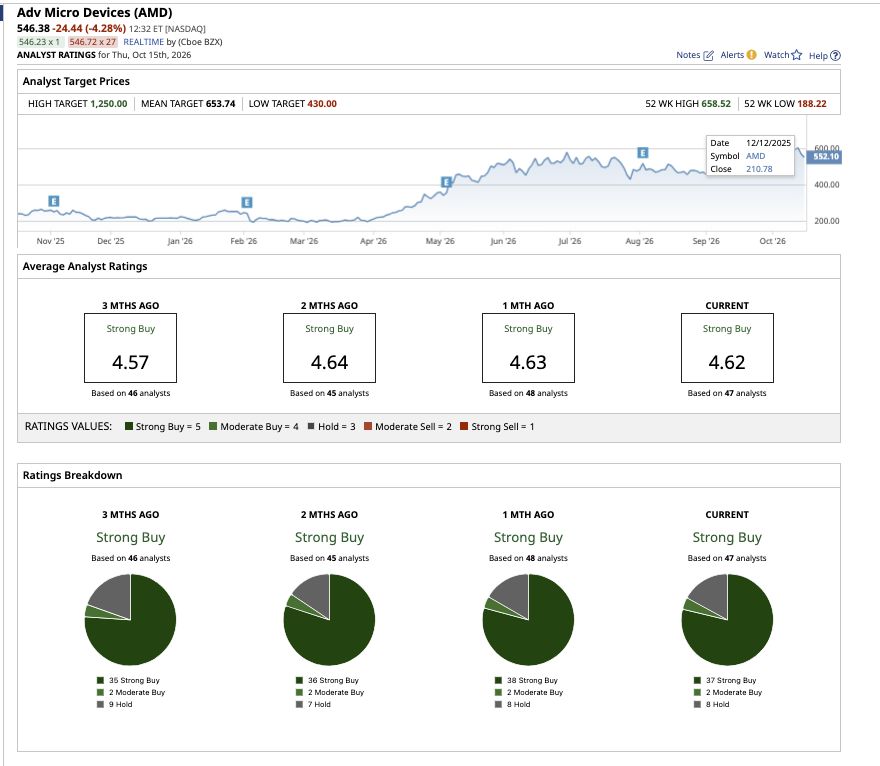 www.barchart.com
On the date of publication, Sushree Mohanty did not have (either directly or indirectly) positions in any of the securities mentioned in this article. All information and data in this article is solely for informational purposes. For more information please view the Barchart Disclosure Policy here.
More news from Barchart
Why 1 Analyst Is Cooling Their Stance on Red-Hot DELL Stock Intel vs. AMD: The CPU Comeback Has Become a 2-Stock Fight, But 1 Is the Better Buy Taiwan Semiconductor Could Partner With Elon Musk’s Terafab, but It Has 1 Condition Berkshire Hathaway Raised Its Stake in Bending Spoons to 4%. That’s a Big Vote of Confidence Retail Investors Should Follow.